
Radio Control: Helicopters
Paul Tradelius, 6704 Santiago, Ft. Worth, TX 76133
Unfortunately, work kept me from attending what has traditionally been considered the place to see many new and exciting products for our hobby: the Toledo show. Two products introduced there should greatly interest helicopter enthusiasts: the new JR XF622 computer radio, priced to fit many budgets, and the new Gas X-Cell Graphite, which combines the performance of a .60-size helicopter with the fuel efficiency and easy operation of a gas engine.
For the past several years, electronic equipment prices have decreased so that virtually everyone can afford devices like hand-held calculators and digital watches. Although this trend is true in many markets, the JR XF622 is the first computer radio that approaches the price of the most basic helicopter radios available. For this alone, JR should be commended; the high price of helicopters, radios, gyros, etc., keeps many new fliers from joining our hobby. I have not seen an advertised price for the XF622 as of this writing, but I expect it to be much less than $300, probably about $270.
JR XF622 computer radio
JR has incorporated much of the quality and many helicopter features from its higher-priced radios. Capable of being programmed for both airplanes and helicopters, the XF622 with a few flight packs can form a complete radio system to take the novice flier through both forms of flying with the ease and accuracy of computer programming at a reasonable price.
Key features include:
- Six-channel FM operation (XF622 = six channels), two model types (airplane and helicopter), and two-model memory.
- Helicopter-specific functions:
- Revolution mixing to automatically compensate the tail rotor for changes in main-rotor torque during climbs and descents.
- Throttle hold with offset for autorotation landings.
- Three pitch curves (each with three adjustable points).
- Two throttle curves (each with three adjustable points).
- Hover flight switch (acts like an idle-up switch) to change throttle and pitch curves, dual rates, and gyro sensitivity.
- Standard radio features:
- Servo reversing, travel adjustment, sub trim, assignable switch location.
- Low-transmitter-battery alarm.
- Trainer system.
The LCD is large and easy to read, and cycling through programs is simple, fast, and user friendly for making accurate adjustments. The transmitter is the same for both airplane and helicopter versions, with JR's "mini credit card" one-ounce receiver featuring ABC&W circuitry for advanced interference rejection. The helicopter version also includes a 1,000 mAh Sanyo battery, five NES-507 standard servos, a mini on/off switch, and an extensive, easy-to-read instruction manual.
Gas X-Cell Graphite
Gas helicopters have been around for several years but have often been large and heavy with limited performance. Miniature Aircraft's design efforts produced the Gas X-Cell Graphite, which claims performance similar to a standard .60-size X-Cell with only about 1.5 pounds of additional weight. By combining design and performance parameters of their world-winning X-Cell with a Zenoah High Performance 23cc engine, a new breed of helicopter was born.
Continuing X-Cell features:
- Sealed ball bearings throughout.
- Tuf-Strut flexible landing gear.
- Carbon-fiber-filled composite head block and blade grips.
- Delta III high-tilt flybar system.
Notable changes and additions for the Gas X-Cell Graphite:
- Zenoah 23cc gas engine for aerobatic power, ease of operation, and good fuel economy.
- Graphite CNC-machined components and carbon-fiber framework for a modular design, simplifying construction and maintenance while combining high strength with low weight and precision.
Other features:
- Self-aligning clutch.
- Epoxy-glass canopy with Lexan window.
- CG-weighted Pro-I paddles and XL-Pro wood 690mm rotor blades.
- Tubular TVR drive with speed-up.
- All standard X-Cell features retained.
I hope to have the Gas X-Cell and JR XF622 assembled and operating together for a flying report in the next column.
There were many other manufacturers at Toledo with excellent, exciting products to make helicopter flying more enjoyable. Since I wasn't there, I didn't get information on all of them, but I will report on helicopter improvements I hear about in future columns.
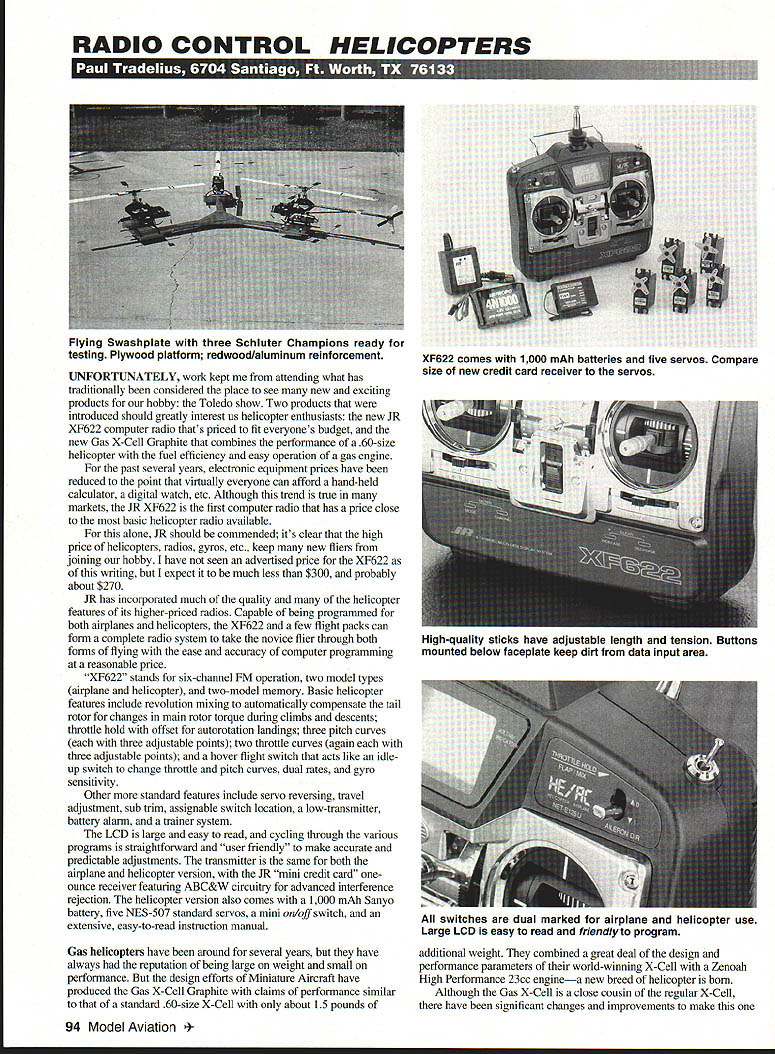
Flying Swashplate (UAV project)
Professor Chris Atkeson of Georgia Tech and I are working on the Flying Swashplate. Professor Atkeson is interested in developing an unmanned aerial vehicle (UAV) that can be flown by a computer. After experimenting with several designs, we are now focusing on getting a three-rotor system into the air, then progressing to a four-rotor vehicle.
I built the structure from wood because it is relatively inexpensive and easy to work with. Three Schluter Champions are mounted at the corners of a triangle, with collective pitch used for both collective and cyclic functions. This proved relatively easy to implement using the CCPM mixing function of my Futaba radio, but flight stability remains a problem that must be solved to achieve precision and controlled maneuvering.
All Champions point to the center of the triangle, which makes yaw control possible using the aileron function of each helicopter. However, until control is better defined, one Champion still has a tail rotor for added control.
One challenge is that all three Champions must perform as identically as possible. Several companies have provided equipment for the project:
- Yellow Aircraft: Rotormax carbon-fiber-reinforced rotor blades (regular wood blades were used for initial testing).
- Hitec RCD, Inc.: Supreme Series receivers and HS-605 BB servos.
- SR Batteries: 1,000 mAh batteries.
Although this equipment contributed to initial testing and demonstrated flight-control theory, I do not yet have three identical engines. Two Champions have Enya .80 engines and the other has a Webra .60, resulting in mismatched power and throttle response. I hope to install three identical engines and add stabilizing gyros for aileron and elevator; with those improvements, I see no reason the Flying Swashplate should not be able to hover and maneuver in forward flight.
I appreciate any help or advice for this project, especially from anyone who has experimented with a similar design. There will surely be more problems to overcome, so if you can help me avoid reinventing the wheel, I would appreciate it.
Transcribed from original scans by AI. Minor OCR errors may remain.

