
RADIO CONTROL: HELICOPTERS
Paul Tradelius 6704 Santiago, Ft. Worth, TX 76133
The Nats!
THE NATS! Just saying it brings a certain chill. It's not just the great helicopter flying I enjoy, but the many other flying activities as well. It has been more years than I care to remember since I've flown Free Flight, Control Line Stunt and Combat, or Pylon Racing, and it always brings a certain warmness and fond memories to see those models in the air again.
It also makes me remember what a terrific influence modeling has had on my life and professional career, and I wonder if there aren't more effective ways to get more young people involved with helicopters. (But I will leave that subject for next month's column.)
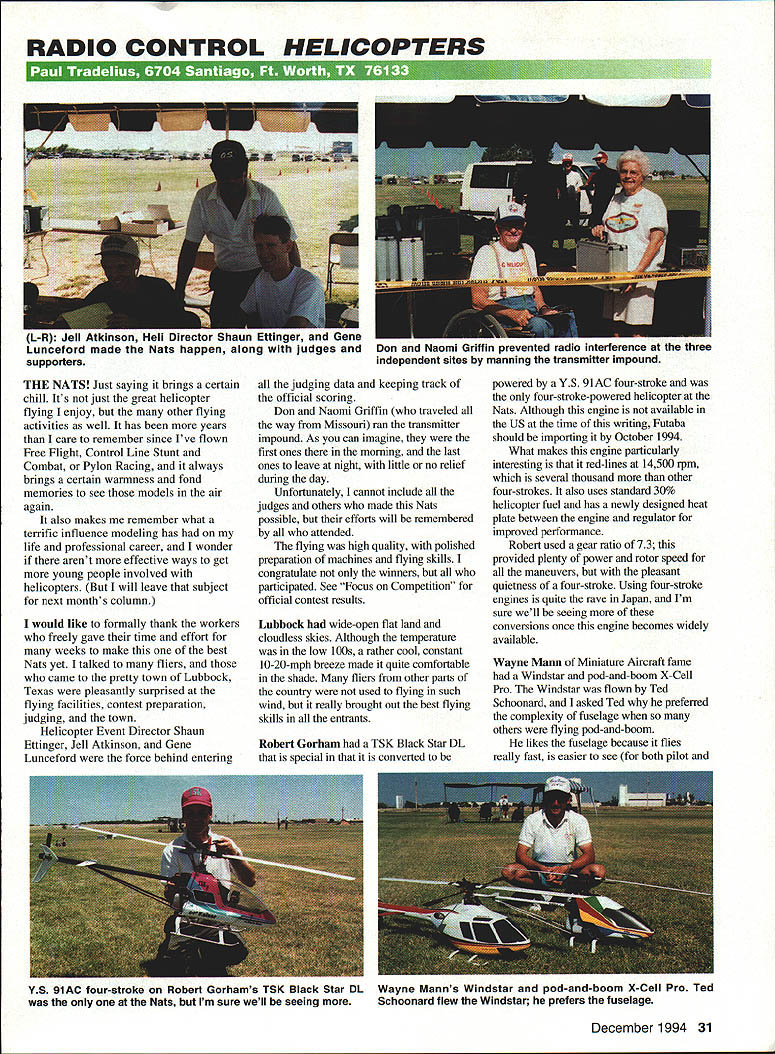
I would like to formally thank the workers who freely gave their time and effort for many weeks to make this one of the best Nats yet. I talked to many fliers, and those who came to the pretty town of Lubbock, Texas were pleasantly surprised at the flying facilities, contest preparation, judging, and the town.
- Helicopter Event Director: Shaun Ettinger
- Scoring/data: Jell Atkinson and Gene Lunceford
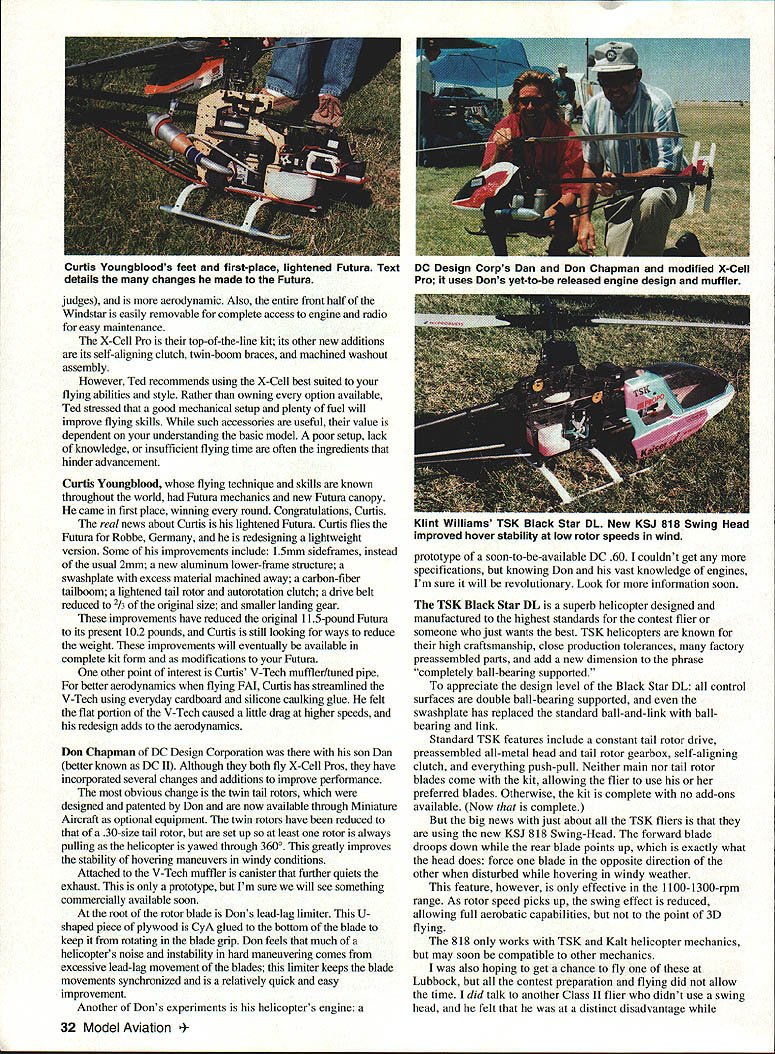
- Transmitter impound: Don and Naomi Griffin (traveled from Missouri)
As you can imagine, Don and Naomi were the first ones there in the morning and the last ones to leave at night, with little or no relief during the day. Unfortunately, I cannot include all the judges and others who made this Nats possible, but their efforts will be remembered by all who attended.
The flying was high quality, with polished preparation of machines and flying skills. I congratulate not only the winners, but all who participated. See "Focus on Competition" for official contest results.
Lubbock had wide-open flat land and cloudless skies. Although the temperature was in the low 100s, a rather cool, constant 10–20 mph breeze made it quite comfortable in the shade. Many fliers from other parts of the country were not used to flying in such wind, but it really brought out the best flying skills in all the entrants.
Notable Helicopters and Equipment
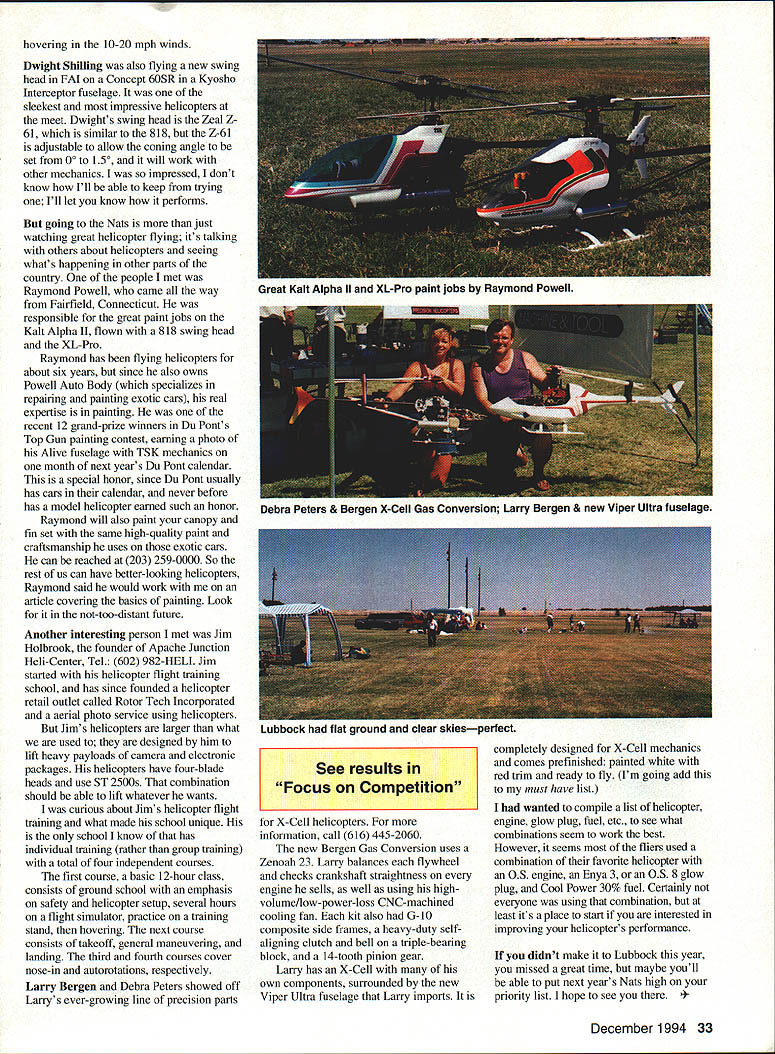
- Robert Gorham — TSK Black Star DL converted to a Y.S. 91AC four-stroke
- Engine red-lines at 14,500 rpm (several thousand more than other four-strokes)
- Uses standard 30% helicopter fuel
- New heat plate between engine and regulator for improved performance
- Gear ratio of 7.3 provided plenty of power and pleasant four-stroke quietness
- Engine not yet available in the U.S. at time of writing; Futaba expected to import it by October 1994
- Wayne Mann / Miniature Aircraft — Windstar and pod-and-boom X-Cell Pro
- Windstar flown by Ted Schoonard
- Ted prefers a fuselage: faster, easier to see (pilot and judge), front half removable for engine/radio access
- X-Cell Pro is top-of-the-line with features like self-aligning clutch, twin-boom braces, machined washout assembly
- Ted recommends choosing equipment suited to your ability and stresses good mechanical setup, knowledge, and plenty of flying time over simply owning every accessory
- Curtis Youngblood — Futura (first place)
- New Futura canopy; overall lightened Futura being redesigned by Robbe (Germany)
- Improvements include: 1.5 mm sideframes (vs. 2 mm), aluminum lower-frame structure, material machined away from swashplate, carbon-fiber tailboom, lightened tail rotor, autorotation clutch, drive belt reduced to 2/3 original size, smaller landing gear
- Weight reduced from 11.5 lb to 10.2 lb; Curtis continues to seek further reductions
- V‑Tech muffler/tuned pipe streamlined with cardboard and silicone caulking to reduce drag at higher speeds
- Don Chapman (DC Design Corporation) and Dan Chapman (DC II) — X-Cell Pro modifications
- Twin tail rotors (designed and patented by Don) now available through Miniature Aircraft as an option; reduce to about .30-size tail rotor but set so at least one rotor is always pulling during 360° yaw for better hover stability in wind
- Prototype canister attached to V‑Tech muffler to further quiet the exhaust
- Lead-lag limiter: U-shaped plywood CA-glued to blade roots to keep blades from rotating in the blade grip, reducing noise and instability in hard maneuvers
- Prototype DC 60 engine in development
- TSK Black Star DL — high-standard contest helicopter
- Double ball-bearing support on all control surfaces; swashplate uses ball-bearing and link rather than standard ball-and-link
- Standard features: constant tail-rotor drive, preassembled all-metal head and tail-rotor gearbox, self-aligning clutch, full push-pull setup
- Main and tail rotor blades not included so fliers can choose preferred blades
- KSJ 818 Swing-Head (used by many TSK fliers)
- Forward blade drops down while rear blade points up; forces one blade opposite the other when disturbed in hover
- Effective in the 1100–1300 rpm range; swing effect reduced as rotor speed increases, allowing aerobatic capability (not full 3D)
- Currently works with TSK and Kalt mechanics; may become compatible with other mechanics soon
- Dwight Shilling — Zeal Z-61 swing head on a Concept 60SR in Kyosho Interceptor fuselage
- Z-61 similar to the 818 but adjustable for coning angle from 0° to 1.5° and compatible with other mechanics
People, Painting, and Services
- Raymond Powell (Fairfield, Connecticut) — excellent paint jobs (Kalt Alpha II, 818 swing head, XL-Pro)
- Has been flying RC helicopters about six years; owns Powell Auto Body (exotic car repair and painting)
- One of 12 grand-prize winners in Du Pont's Top Gun painting contest — his Alice fuselage with TSK mechanics will appear in a month of next year's Du Pont calendar (first model helicopter ever honored this way)
- Raymond will paint canopies and fin sets; contact: (203) 259-0000
- He will work with me on a basics-of-painting article — look for it in a future column
- Jim Holbrook — founder of Apache Junction Heli-Center (Tel: (602) 982-HELI)
- Also founded Rotor Tech Incorporated (retail outlet) and operates an aerial photo service using helicopters
- Designs larger helicopters to lift heavy camera and electronic payloads; four-blade heads and ST 250 engines used for heavy lift
- Unique helicopter flight school offering individual (not group) training, four independent courses:
- Basic 12-hour class: ground school (safety and setup), flight simulator, training-stand practice, hovering
- Takeoff, general maneuvering, landing
- Nose-in maneuvers
- Autorotations
- Larry Bergen and Debra Peters — precision parts for X-Cell helicopters
- Contact: (616) 445-2060
- Bergen Gas Conversion uses Zenoah 23; Larry balances each flywheel, checks crankshaft straightness, uses CNC-machined cooling fan (high-volume/low-power-loss)
- Kits include G-10 composite side frames, heavy-duty self-aligning clutch, one-piece bearing block, 14-tooth pinion gear
- Larry imports the Viper Ultra fuselage: prefinished white with red trim, designed for X-Cell mechanics and ready to fly
Trends and Common Setups
I had hoped to compile a list of helicopter, engine, glow plug, fuel, etc., combinations to see what worked best. Most fliers used a favorite helicopter paired with an O.S. engine or an Enya .3, an O.S. #8 glow plug, and Cool Power 30% fuel. Not everyone used that combination, but it's a reasonable place to start if you want to improve performance.
Final Thoughts
If you didn't make it to Lubbock this year, you missed a great time, but maybe you'll put next year's Nats high on your priority list. I hope to see you there.
Transcribed from original scans by AI. Minor OCR errors may remain.

