

Radio Control Helicopters
Paul Tradelius 6704 Santiago, Ft. Worth, TX 76133
More on Blade Balancing
Several columns ago I discussed blade balancing and the need to match blades to any two of the following: blade spanwise center of gravity (CG); their total weight; or their overall balance, to obtain a useful pair of statically balanced blades. Note that if you match any two of the blade characteristics, you automatically have matched the third.
I also discussed the Koll Rotor Pro balancer, designed by Laurel Koll and manufactured and sold by Miniature Aircraft (3743 Silver Star Rd., Orlando, FL 32808), as the first commercially available product to accurately balance and match the apparent CGs of our rotor blades. This means we can get a set of balanced blades just by using the Rotor Pro balancer. However, another way to solve the balance problem is to substitute the benefits of an accurate gram scale for overall balance.
Although triple-beam balance scales have been on the market for several years, they have not been widely used because of their cost, delicate nature, and the time required to get accurate results. They were not really needed to obtain "workshop accuracy."
I like to use, and write about, the normal tools most of us have in the workshop. Combined with useful techniques, these tools will give us adequate results to keep our helicopters well balanced and in the air. This article deviates from that theory of operation to describe the use and advantages of the Acculab digital gram scale, available from Champion Model Products (880 Carmen Court, La Verne, CA 91750).
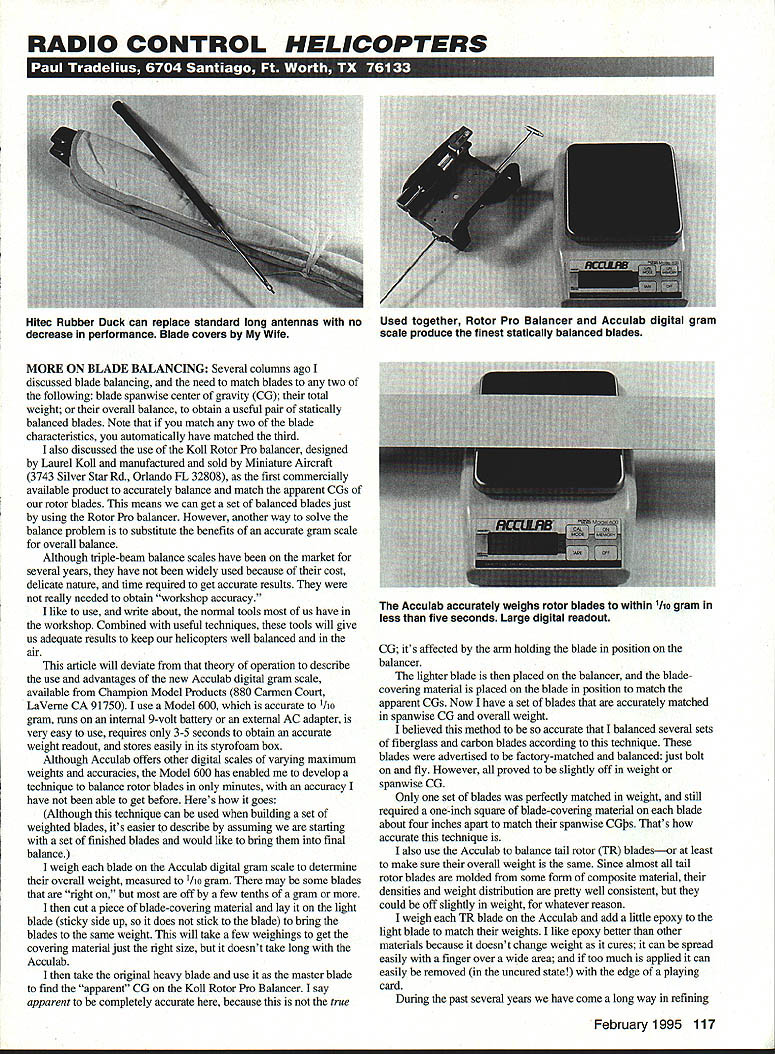
I use a Model 600, which is accurate to 0.1 gram, runs on an internal 9-volt battery or an external AC adapter, is very easy to use, requires only 3–5 seconds to obtain an accurate weight readout, and stores easily in its styrofoam box. Although Acculab offers other digital scales of varying capacities and accuracies, the Model 600 has enabled me to develop a technique to balance rotor blades in only minutes, with an accuracy I have not been able to get before.
Although this technique is best used when building a set of weighted blades, it's easier to describe by assuming we are starting with a set of finished blades and would like to bring them into final balance.
I weigh each blade on the Acculab to determine overall weight, measured to 0.1 gram. There may be some blades that are "right on," but most are off by a few tenths of a gram or more.
I then cut a piece of blade-covering material and lay it on the light blade (sticky side up, so it does not stick to the blade) to bring the blades to the same weight. This will take a few weighings to get the covering material just the right size, but it doesn't take long with the Acculab.
I then take the original heavy blade and use it as the master blade to find the "apparent" CG on the Koll Rotor Pro balancer. I say apparent to be completely accurate here, because this is not the true CG; it's affected by the arm holding the blade in position on the balancer.
The lighter blade is then placed on the balancer, and the blade-covering material is positioned on the blade to match the apparent CGs. Now I have a set of blades that are accurately matched in spanwise CG and overall weight.
I believed this method to be so accurate that I balanced several sets of fiberglass and carbon blades according to this technique. These blades were advertised to be factory-matched and balanced; just bolt on and fly. However, all proved to be slightly off in weight or spanwise CG. Only one set of blades was perfectly matched in weight, and it still required a one-inch square of blade-covering material on each blade about four inches apart to match their spanwise CGs. That's how accurate this technique is.
I also use the Acculab to balance tail rotor (TR) blades—or at least to make sure their overall weight is the same. Since almost all tail rotor blades are molded from some form of composite material, their densities and weight distribution are generally consistent, but they can be slightly off in weight for various reasons.
I weigh each TR blade on the Acculab and add a little epoxy to the light blade to match their weights. I prefer epoxy because it doesn't change weight as it cures; it can be spread easily over a wide area with a finger; and if too much is applied it can be removed (while uncured) with the edge of a playing card.
What we really need is a dynamic balancer—like those used to balance automobile wheels. One could build an external device to mount the blades and the overall head, and others are working on a balancer adjuster that would mount on the main- and tail-rotor shafts. The device would sense an out-of-balance condition of the rotors and automatically distribute the weight needed to bring the system into dynamic balance. I expect such a device to be available in the not-too-distant future, and I hope it will indicate which blade needs additional weight rather than being a permanent, heavy part of the rotor system.
New Heli Items
#### Hitec Rubber Duck Antenna Hitec RCD Inc. (10729 Wheatlands Ave., Suite C, Santee, CA 92071) is selling a Rubber Duck antenna for our transmitters. What makes this antenna unique is that it feels like a coiled piece of wire wrapped in a black rubber housing and can be bent in a complete circle without damage. Although you will have to check with Hitec to see if it fits your particular transmitter, it easily replaces the stock antenna in my Airtronics Infinity 660 transmitter, leaving less than 10 inches of antenna exposed with no noticeable change in effective range. No more bent or broken antennas, and it adds to the overall balance of the transmitter.
#### Performance Specialties Engine Work Performance Specialties (Box 3146, Gardnerville, NV 89410) modifies existing engines to increase power and overall performance while reducing vibration. I sent them a crash-damaged O.S. .61 FNSH; they went through it completely and brought it back to better-than-new life.
It's hard for me to compare the power and performance of their modified engines to others I am using, since I don't have the necessary measuring equipment or the required knowledge of how to make the measurements, but it is as good an engine as I have. I'd like to have a complete article on engines and on what companies such as Performance Specialties accomplish to improve engine performance, so we can all be more knowledgeable about the care and feeding of a very important and expensive part of our helicopters.
#### Blade Covers by "My Wife" Blade Covers by "My Wife" (555 Garden Heights Dr., Winter Garden, FL 34787; Tel.: (407) 656-0083) manufactures quilted blade covers to protect your main rotor blades from "hangar rash" during transportation or storage. My covers, for .60-size rotor blades, are made of white quilted cotton with yellow trim and have a tie string around the middle to keep the pair of blades together and well protected. Other colors and sizes are available, and Jean Hiatt will be happy to hear if you have a special request.
Transcribed from original scans by AI. Minor OCR errors may remain.

