
RADIO CONTROL HELICOPTERS
Paul Tradelius
6704 Santiago, Ft. Worth, TX 76133
FOR YEARS, CURTIS YOUNGBLOOD has been renowned as the best overall model helicopter pilot in the world, excelling in both freestyle aerobatics and precision FAI maneuvers. However, it wasn't until I had the opportunity to see Curtis compete at the Nats that I knew the secret to his success in FAI.
It may be obvious to say that Curtis flies differently than others, since he continues to win almost every contest he enters, but the truth of the matter is that he really does fly differently than other competitors. As he began his hovering maneuvers, I could see that what he is really doing is flying formation with the ground.
I spent many years flying fighters in the Air Force; some of that time was spent teaching formation flying. The idea behind flying formation is for the wingman to maintain a specific position relative to lead. But maintaining position is rather hard to do when first learning, so in effect the wingman is flying in a large bubble and trying to refine his control movements to reduce the size of this bubble. To do this he has to understand and master several formation-flying techniques; the first is to know when he is out of position.
It may seem rather obvious that a pilot should know when he is out of position, but the objective here is to concentrate on lead so that you know immediately when you are out of position, rather than only realizing it when you are ten feet out of position.
The next step is to make an immediate and aggressive control input to 1) keep from getting further out of position and 2) start moving back into the correct position.
To further complicate matters, flying formation must be perfected in all three axes to maintain a specific position. As all of us have seen great displays of formation flying by the Air Force Thunderbirds, what most people don't realize is the wingmen are never in perfect position, but are always striving to get there. To put it in numbers, a new formation pilot may be striving to maintain a 30-foot bubble, while a good formation pilot can maintain a 5-foot bubble, and a Thunderbird pilot can maintain a 2-foot bubble.
This may be well and good if you want to fly formation, but how does this relate to Curtis and his flying? It turns out that he uses these exact same techniques, by flying formation with the ground.
Remember, the first step is to know immediately when you are out of position. This takes a great deal of concentration, and really looking—not just seeing—your helicopter. When hovering he is constantly looking for the slightest change in altitude, or for any change in attitude which will produce a change in hover position. Notice here that I say a change in attitude will produce a change in hover position. Let's look at this more closely:
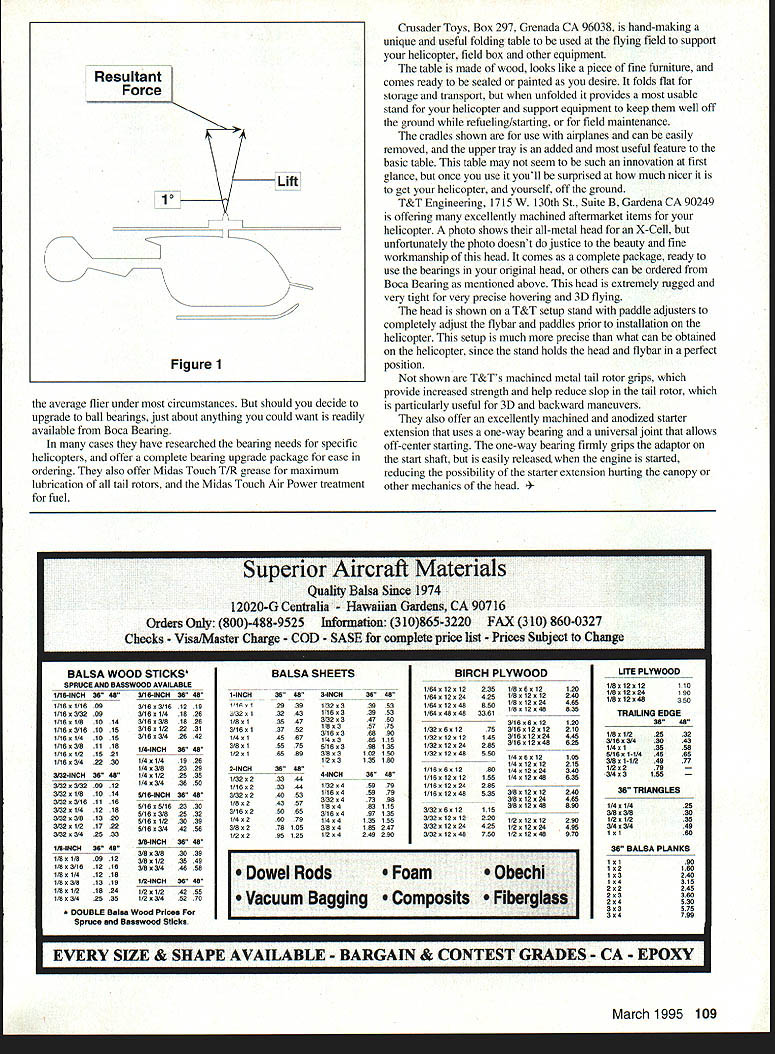
Assume that the helicopter is in a good hover position, and for whatever reason the nose dips down by 1°. This situation is shown in Figure 1, with the resultant force moving the helicopter forward equal to the sine of 1° times the lift of the rotor system. If we have a 10-pound helicopter, the lift of the rotor system must also be 10 pounds to maintain altitude, so this calculates as 0.175 lb. of force.
Even this small force will move the helicopter if left to act over a finite period of time. But if the pilot can immediately see this 1° change in pitch attitude, and make an immediate correction, the helicopter will remain in the desired hover position. This is what I mean by a change in helicopter attitude producing a corresponding change in helicopter hover position.
And what Curtis does so well is really look at his helicopter, to know when it is even slightly out of the desired hover position. Then he makes an immediate and aggressive control correction to return the helicopter to its desired attitude, before even the smallest of resulting forces has a chance to take effect on the helicopter.
How do I know he does this? By watching his helicopter. His control inputs are very quick and aggressive, almost disregarding smoothness.
Pilots competing against Curtis seem to let their helicopters get farther out of the desired hover position before making a control input; even then, they are more concerned with smoothness of control rather than an aggressive correction, so the helicopter is farther out of position for a longer period of time. This is why I say Curtis almost disregards smoothness—he is more interested in making an immediate and aggressive control correction, resulting in his helicopter correcting those one or two degrees very quickly.
One of the first things you will notice if you try to apply these principles to hover your helicopter (or fly formation in a fighter) is that you will be mentally drained in a very short period of time. It takes a lot of concentration to really look at your helicopter to see a 1° movement, make an immediate and aggressive control input, and then start the process all over again. And you are always striving to see the helicopter better so you can make control inputs more quickly.
Most of us don't care to put in this tremendous amount of effort to improve our hovering, so in effect we accept a larger bubble. And the same bubble applies to every maneuver we fly: are we really in the position we want, or just close enough? Ask yourself how large your bubble is, and if you really want to put forth the effort to make it smaller. You can do it if your desire is strong enough.
New Products
- Boca Bearing, 7040 W. Palmetto Park Rd., Suite 2304, Boca Raton, FL 33433
- Excellent source for virtually all engine and helicopter bearing needs.
- Many helicopter manufacturers keep costs down by using bushings; bushings are fine for the average flier, but if you decide to upgrade to ball bearings, Boca Bearing stocks almost everything you could want.
- They have researched bearing needs for specific helicopters and offer complete bearing upgrade packages for ease of ordering.
- They also offer Midas Touch T/R grease for tail-rotor lubrication and Midas Touch Air Power fuel treatment.
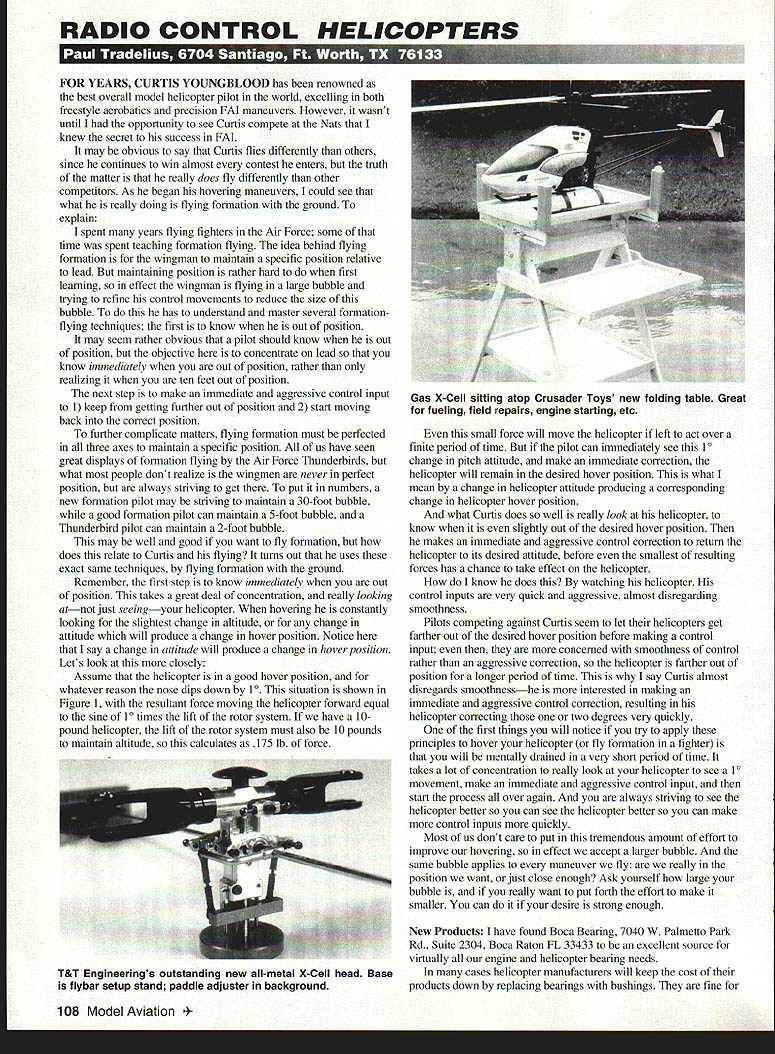
- Crusader Toys, Box 297, Grenada, CA 96038
- Hand-making a unique folding table for use at the flying field to support your helicopter, field box, and other equipment.
- The table is made of wood, looks like a piece of fine furniture, and comes ready to be sealed or painted as desired.
- It folds flat for storage and transport, but when unfolded provides a usable stand to keep helicopter and support equipment off the ground while refueling/starting or for field maintenance.
- Cradles shown are for airplanes and can be easily removed; the upper tray is an added, useful feature.
- T&T Engineering, 1715 W. 130th St., Suite B, Gardena, CA 90249
- Offering many excellently machined aftermarket items for your helicopter.
- All-metal head for an X-Cell shown in photos; the workmanship is rugged and precise. It comes as a complete package, ready to use the bearings from your original head or bearings ordered from Boca Bearing.
- The head is ideal for precise hovering and 3D flying.
- Shown on a T&T setup stand with paddle adjusters to completely adjust the flybar and paddles prior to installation on the helicopter—more precise than adjustments made on the helicopter itself.
- Also offer machined metal tail rotor grips to increase strength and reduce slop in the tail rotor, particularly useful for 3D and backward maneuvers.
- Offer a machined and anodized starter extension that uses a one-way bearing and a universal joint allowing off-center starting. The one-way bearing firmly grips the adaptor on the start shaft but releases when the engine starts, reducing the possibility of the starter extension damaging the canopy or head mechanics.
Transcribed from original scans by AI. Minor OCR errors may remain.

