
RADIO CONTROL HELICOPTERS
Paul Tradelius 6704 Santiago, Fort Worth, TX 76133
When I sit at my computer to start another column, I try to think of a subject that will be of most interest to all the readers. This task is made a lot easier when I receive a letter requesting information of general interest: Luke Christian of Rohnert Park, CA wrote with questions concerning the proper setup of a gyro; techniques for setup for hovering and aerobatics; and some technical reasons why gyros behave as they do if not set up correctly.
Since I have not devoted a column to gyros as yet, this certainly seems like the perfect time. So let's start with some theory as a basis for understanding this very valuable part of our helicopters.
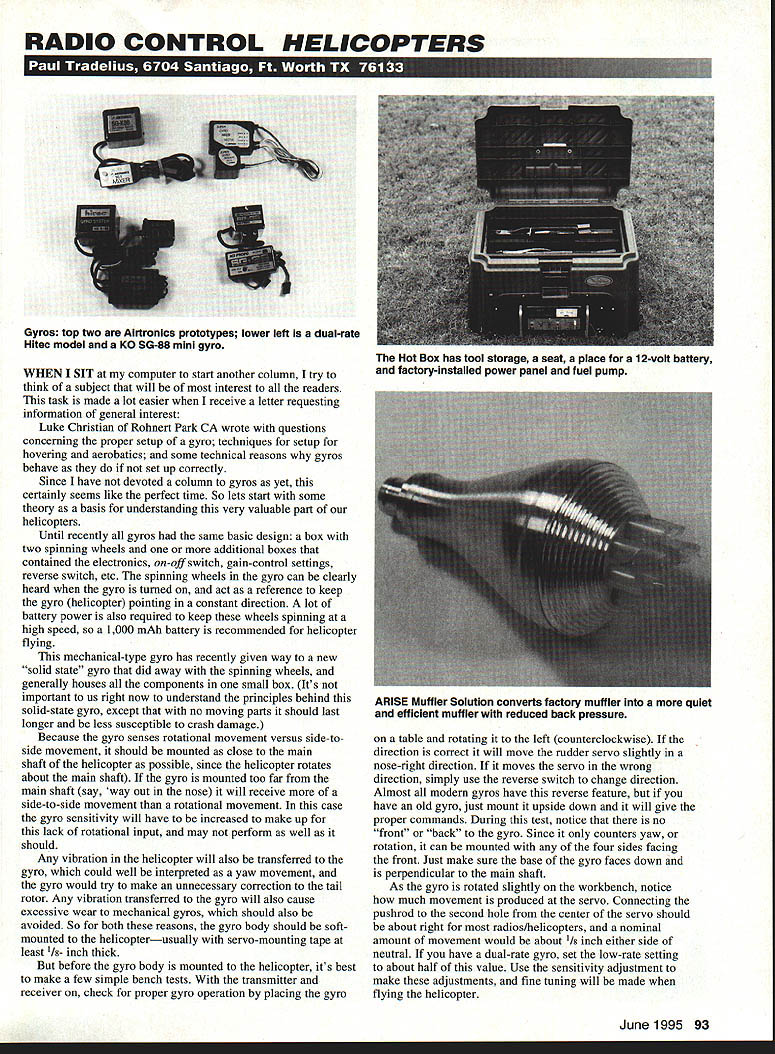
Until recently all gyros had the same basic design: a box with two spinning wheels and one or more additional boxes that contained the electronics, on-off switch, gain-control settings, reverse switch, etc. The spinning wheels in the gyro can be clearly heard when the gyro is turned on, and act as a reference to keep the gyro (helicopter) pointing in a constant direction. A lot of battery power is also required to keep these wheels spinning at a high speed, so a 1,000 mAh battery is recommended for helicopter flying.
This mechanical-type gyro has recently given way to a new "solid state" gyro that does away with the spinning wheels, and generally houses all the components in one small box. (It's not important to us right now to understand the principles behind this solid-state gyro, except that with no moving parts it should last longer and be less susceptible to crash damage.)
Because the gyro senses rotational movement versus side-to-side movement, it should be mounted as close to the main shaft of the helicopter as possible, since the helicopter rotates about the main shaft. If the gyro is mounted too far from the main shaft (say, way out in the nose) it will receive more of a side-to-side movement than a rotational movement. In this case the gyro sensitivity will have to be increased to make up for this lack of rotational input, and may not perform as well as it should.
Any vibration in the helicopter will also be transferred to the gyro, which could well be interpreted as a yaw movement, and the gyro would try to make an unnecessary correction to the tail rotor. Any vibration transferred to the gyro will also cause excessive wear to mechanical gyros, which should be avoided. For these reasons, the gyro body should be soft-mounted to the helicopter—usually with servo-mounting tape at least 1/8-inch thick.
Bench tests and mounting
Before the gyro body is mounted to the helicopter, it's best to make a few simple bench tests. With the transmitter and receiver on, check for proper gyro operation by placing the gyro on a table and rotating it to the left (counterclockwise). If the direction is correct it will move the rudder servo slightly in a nose-right direction. If it moves the servo in the wrong direction, simply use the reverse switch to change direction. Almost all modern gyros have this reverse feature, but if you have an old gyro, mount it upside down and it will give the proper commands.
During this test, notice that there is no "front" or "back" to the gyro. Since it only counters yaw, or rotation, it can be mounted with any of the four sides facing the front. Just make sure the base of the gyro faces down and is perpendicular to the main shaft.
As the gyro is rotated slightly on the workbench, notice how much movement is produced at the servo. Connecting the pushrod to the second hole from the center of the servo should be about right for most radios/helicopters, and a nominal amount of movement would be about 1/8 inch each side of neutral. If you have a dual-rate gyro, set the low-rate setting to about half of this value. Use the sensitivity adjustment to make these settings, and fine tuning will be done when flying the helicopter.
Tail rotor and other influences
There are several other aspects of the helicopter that affect the gyro's overall operation. One is the size and airfoil of the tail rotor blades—larger, more effective blades require less gyro input. Also, increasing the tail rotor rpm (either with a speed-up kit or by increasing engine/main rotor rpm) will make the tail rotor more effective. For the purposes of this article, however, let's assume a stock helicopter setup is being used.
During flight tests I am first concerned with the overall performance of the tail rotor before being too concerned with the sensitivity settings of the gyro. It may be that the second hole out on the servo will not give me the performance I need for 540 stall turns, etc., so I first want to make sure that the tail rotor system, the linkages, and end-points are where I want them.
Once this is done, I would like to have a very stable helicopter in a hover, so in the case of the gyro this means holding the nose very steady or canceling out any yaw movements. If the gyro sensitivity is set too low the nose will wander slightly, and if the sensitivity is set too high the tail will wiggle back and forth rapidly.
The reason for this wiggle is mechanical overshoot of the gyro. It initially senses a slight yaw movement, but gives too much correction so the nose overshoots its intended position. Realizing this, the gyro then sends another command opposite to the first, but again it overshoots, and on and on. Simply turning the sensitivity down slightly will stop this unwanted movement. For the most stable hover, set the gyro just below the "wiggle" point.
Once the gyro sensitivity is set for a hover, you will probably notice the fast wiggling again when you go into fast forward flight; this is where it's nice to have a dual-rate gyro. The tail rotor now wiggles because it is more efficient due to the increase in air mass flow rate. This increase in efficiency can also be seen in the main rotor system in forward flight, which is why it takes no more power for fast forward flight than it does to hover.
So if you have a single-rate gyro, a compromise setting must be made for all flight regimes. A dual-rate gyro can be set on a high setting for hover and a lower setting so the tail does not wiggle in fast forward flight.
Setting gyro sensitivity for aerobatics and 3D flying
Setting the gyro sensitivity for various aerobatic maneuvers or 3D flying becomes a matter of obtaining the strongest possible tail rotor response without wiggling. Increase the gyro gain until a wiggle is produced in the particular maneuver, then back off the sensitivity slightly. This is particularly easy and accurate if the gyro gain is adjustable through the transmitter on more advanced computer radios.
New Products
- Hot Box (MAR West Mfg. & Dist.)
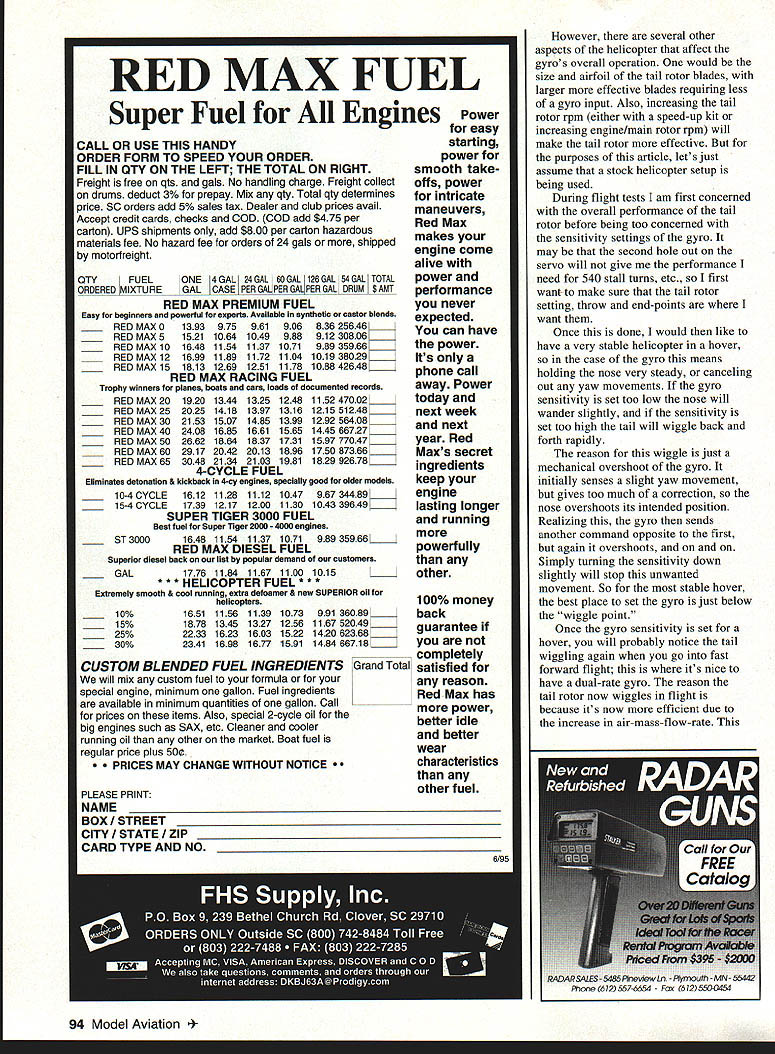
MAR West Mfg. & Dist., 3339 Fitzgerald Rd #1, Rancho Cordova, CA 95742 produces the Hot Box, which combines many necessary field-box operations into one compact and durable unit. Made of almost indestructible plastic, it makes a nice seat with the top closed, or a large storage bin with the top open. Also included is a power panel that automatically adjusts glow power output to compensate for a flooded engine, an electric fuel pump, and a master on-off switch. I particularly like being able to sit on the box as I refuel and start my helicopter—it keeps my knees from getting wet and dirty.
- Extended length gimbal sticks (Guidair R/C International)
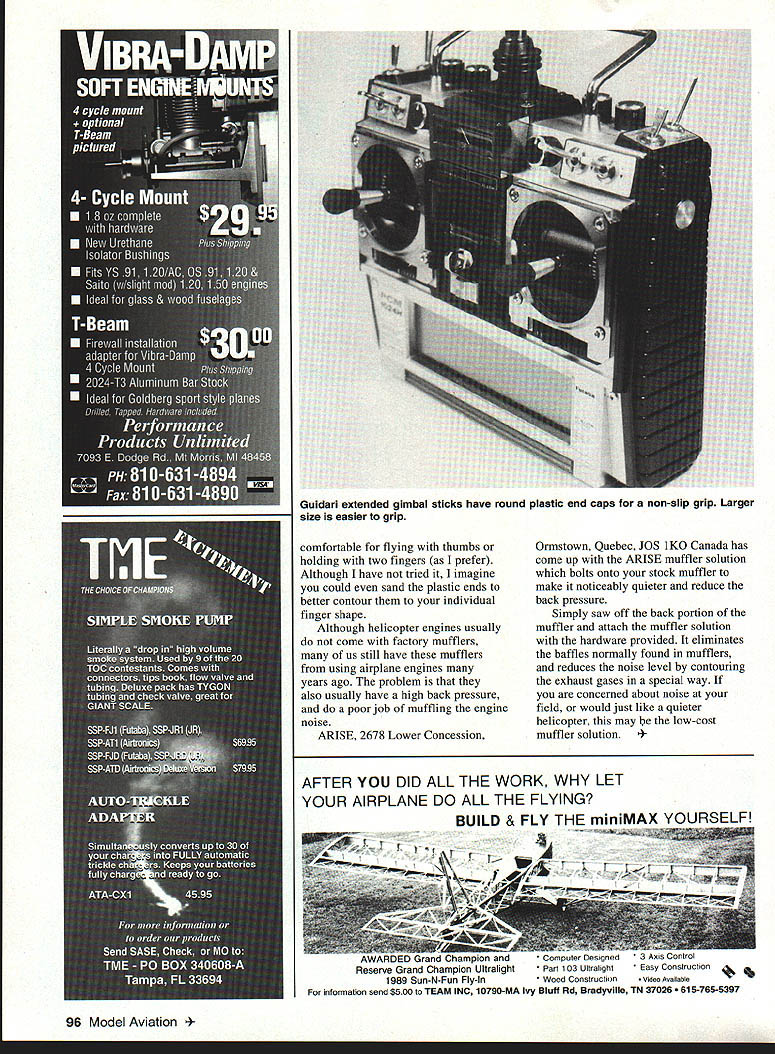
Guidair R/C International, 170 University Ave., Suite 12-103, Waterloo, Ont., N2L 3G9, Canada, offers extended length gimbal sticks with large or small end pieces. Unscrew your factory sticks and these extended, more massive sticks screw on in their place. They are adjustable in length and provide a longer stick for more precise control. Their rounded plastic ends also feel more comfortable for flying with thumbs or holding with two fingers. You could even sand the plastic ends to better contour them to your individual finger shape.
- ARISE muffler solution (JOS IKO Canada)
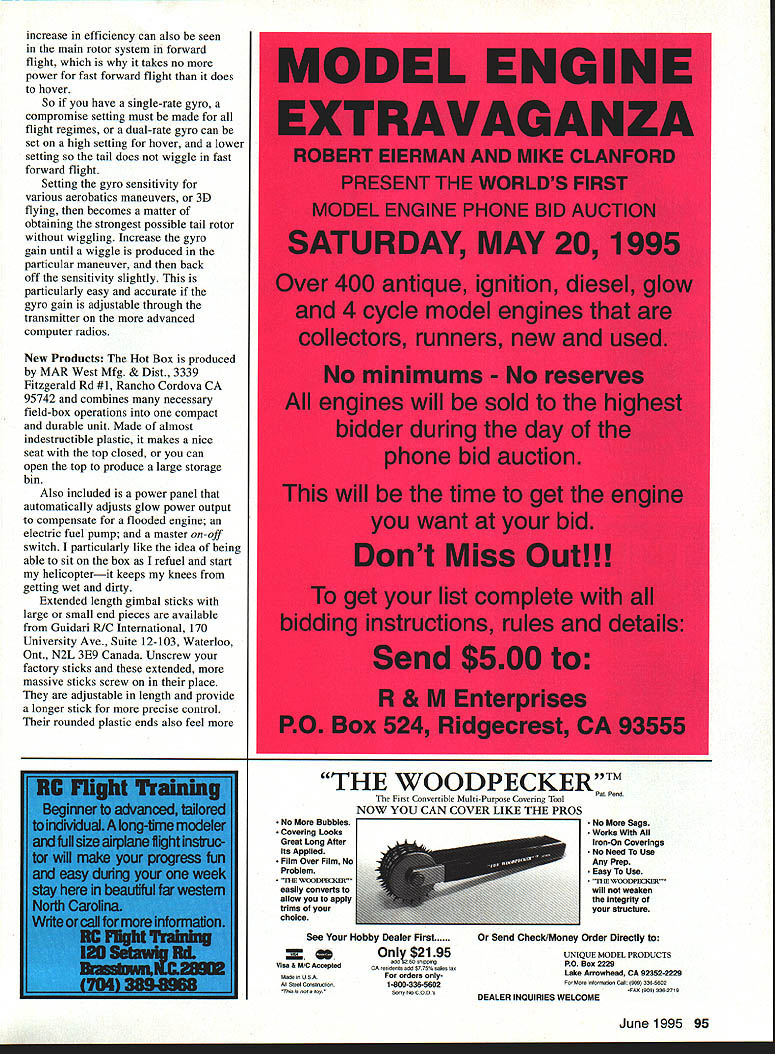
Although helicopter engines usually do not come with factory mufflers, many of us still have mufflers from airplane engines. The problem is they often have high back pressure and do a poor job of muffling engine noise. JOS IKO Canada, 2678 Lower Concession, Ormstown, Quebec, has come up with the ARISE muffler solution which bolts onto your stock muffler to make it noticeably quieter and reduce back pressure. Simply saw off the back portion of the muffler and attach the ARISE unit with the hardware provided. It eliminates the baffles normally found in mufflers and reduces noise by contouring the exhaust gases in a special way. If you are concerned about noise at your field, or would just like a quieter helicopter, this may be a low-cost muffler solution.
Transcribed from original scans by AI. Minor OCR errors may remain.

