
RADIO CONTROL HELICOPTERS
Paul Tradelius, 6704 Santiago, Ft. Worth, TX 76133
HELI RADIO FEATURES
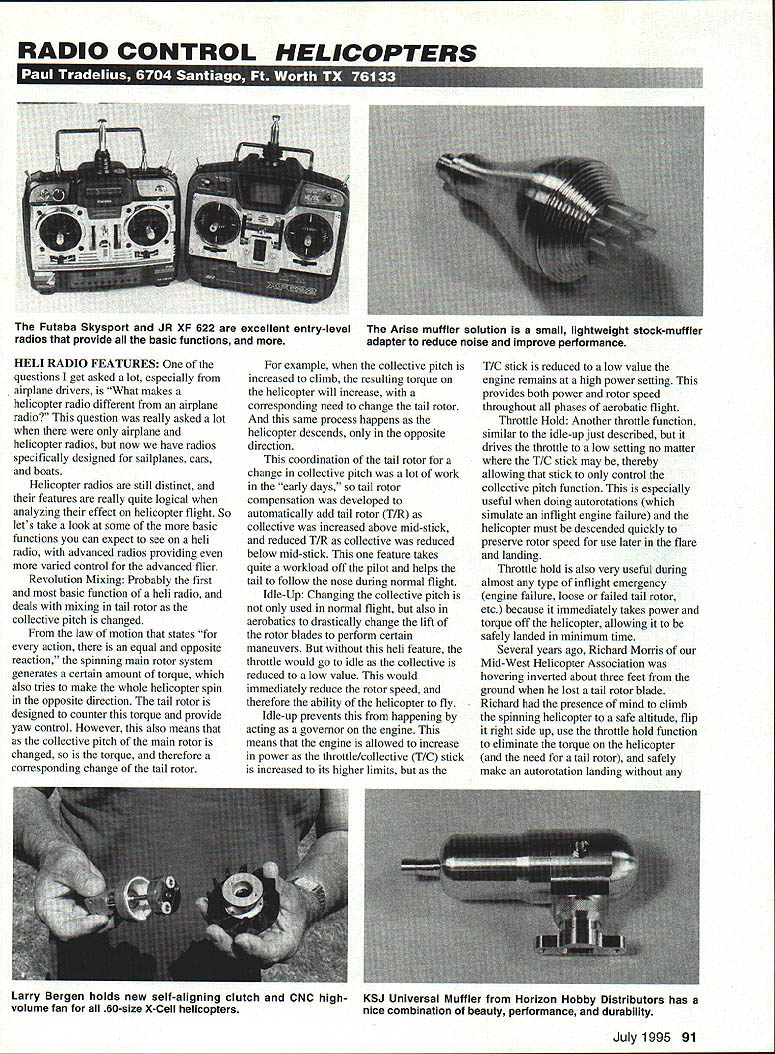
One of the questions I get asked a lot, especially from airplane drivers, is "What makes a helicopter radio different from an airplane radio?" This question was asked frequently when there were only airplane and helicopter radios, but now we have radios specifically designed for sailplanes, cars, and boats.
Helicopter radios are still distinct, and their features are quite logical when analyzing their effect on helicopter flight. Below are some of the basic functions you can expect to see on a heli radio, with advanced radios providing even more varied control for the experienced flier.
Revolution Mixing
Probably the first and most basic function of a heli radio, revolution mixing deals with adding tail rotor (T/R) as the collective pitch is changed.
From the law of motion that states "for every action, there is an equal and opposite reaction," the spinning main rotor system generates torque that tries to make the whole helicopter spin in the opposite direction. The tail rotor is designed to counter this torque and provide yaw control. However, this also means that as the collective pitch of the main rotor is changed, so is the torque, and therefore a corresponding change of the tail rotor is required.
For example, when the collective pitch is increased to climb, the resulting torque on the helicopter will increase, with a corresponding need to increase tail rotor thrust. The same process happens in reverse as the helicopter descends.
In the early days this coordination of the tail rotor with collective changes was a lot of work, so tail rotor compensation was developed to automatically add T/R as collective is increased above mid-stick, and reduce T/R as collective is lowered below mid-stick. This feature reduces pilot workload and helps the tail follow the nose during normal flight.
Idle-Up
Changing the collective pitch is used in normal flight and in aerobatics to drastically change the lift of the rotor blades for certain maneuvers. Without idle-up, the throttle would go to idle as the collective is reduced to a low value. This would immediately reduce rotor speed and therefore the ability of the helicopter to fly.
Idle-up prevents this by acting as a governor on the engine. The engine is allowed to increase power as the throttle/collective (T/C) stick is increased to its higher limits, but as the T/C stick is reduced to a low value the engine remains at a higher power setting. This provides consistent power and rotor speed throughout all phases of aerobatic flight.
Throttle Hold
Another throttle function, throttle hold is similar to idle-up but forces the throttle to a low setting no matter where the T/C stick is, allowing the stick to control only collective pitch. This is especially useful when doing autorotations (which simulate an in-flight engine failure) so the helicopter can descend quickly while preserving rotor speed for the flare and landing.
Throttle hold is also very useful during any in-flight emergency (engine failure, loose or failed tail rotor, etc.) because it immediately removes power and torque from the helicopter, allowing a safer, quicker landing.
Several years ago, Richard Morris of the Mid-West Helicopter Association was hovering inverted about three feet off the ground when he lost a tail rotor blade. He climbed the spinning helicopter to a safe altitude, flipped it right side up, used the throttle hold function to eliminate torque (and the need for a tail rotor), and safely made an autorotation landing without any damage.
Pitch Curves
For performing individual maneuvers, it's helpful to be able to limit or adjust the amount of collective pitch available. For normal aerobatics, a maximum (100%) pitch is about what the engine can handle; a minimum (30%) is about right for a middle roll. Having the ability to set pitch range makes flying easier.
Optimal settings for autorotations might be those for touchdown—around 14°—and less pitch for descents, say about 5°. Different pitch curves allow you to have both. Basic heli radios offer pitch curves; advanced radios allow varying high/low limits and include intermediate points for finer control.
Trainer System
When a helicopter is close to the ground learning to hover and there is no time for the instructor to take over, a trainer system should be used. Likewise, when a student is ready to try some forward flight, it's nice to have an instructor ready to take over if needed. The best way to do this is with a trainer system built into your transmitter: a "buddy-box."
A transmitter with a trainer switch enables you to connect a second transmitter (using a long electrical cord, available from the manufacturer) that can be used as a buddy-box.
Computer radios make the buddy-box especially easy to use, since all functions are presented in a digital readout and can be accurately copied to the second transmitter so each will have identical control. The instructor can engage the spring-loaded trainer switch on the "master" transmitter to give control to the student and can quickly regain control by releasing the switch.
If you would like to benefit from such a trainer system, find a suitable instructor who has a radio with a trainer feature, then get a similar make and model radio so the radios will be compatible.
NEW PRODUCTS
- Arise Inc., 2678 Lower Concession, Ormstown, Quebec J0S 1K0, Canada, has developed a "muffler solution" to convert your stock muffler into one that is quieter and more free-flowing. Simply remove (or cut off) the latter half of your stock muffler and use the mounting hardware to install the Arise—it's that simple. Although originally developed for fixed-wing models, the Arise works well on helicopters using a 90° exhaust adapter on the original muffler to get it parallel with the ground.
- Bergen Machine & Tool, 1101 Follett Drive, Cassopolis, MI 49031, offers a new heavy-duty, gold-anodized, ball-bearing, self-aligning clutch for .60-size X-Cells. Now you don't need to use a dial indicator to true the starter shaft to eliminate vibration; just bolt it on and you're ready to go. Their new fan is CNC machined for trueness and uses angled fins for optimum airflow over the engine. Adequate cooling is increasingly important as we demand more power from our engines for aerobatic and 3D flying in summer.
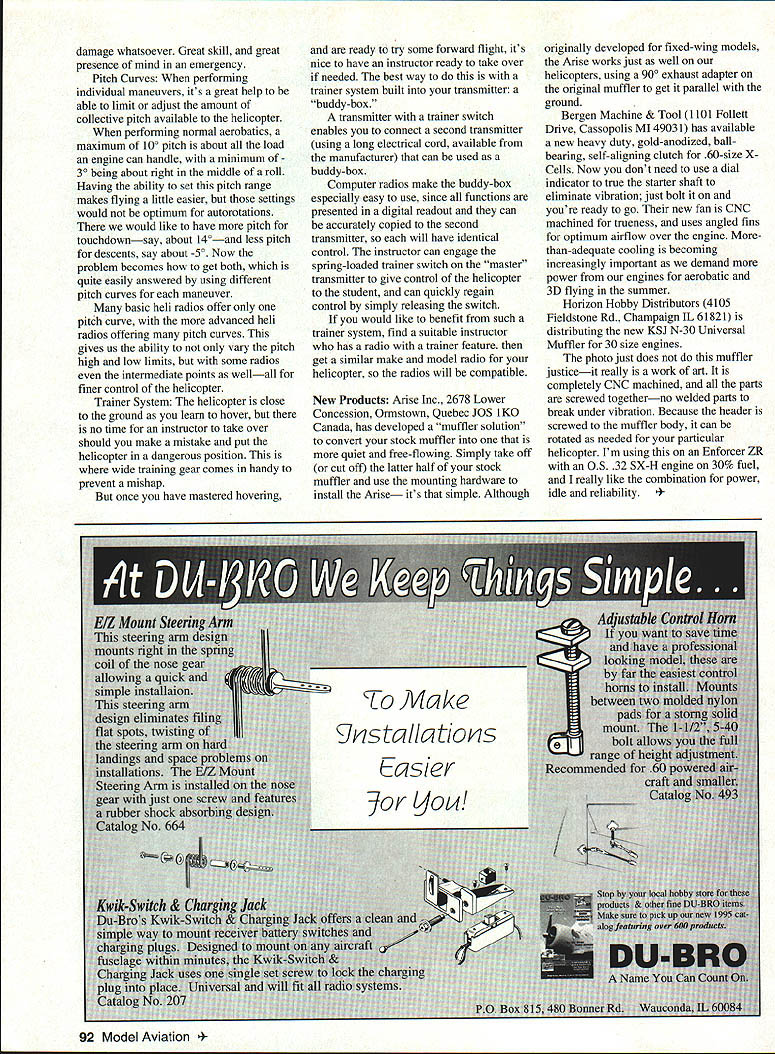
- Horizon Hobby Distributors, 4105 Fieldstone Rd., Champaign, IL 61821, is distributing the new KSJ N-30 Universal Muffler for 30-size engines. The photo does not do this muffler justice—it is a work of art. It is completely CNC machined, and all parts are screwed together (no welded parts to break under vibration). Because the header is screwed to the muffler body, it can be rotated as needed for your particular helicopter. I'm using this on an Enforcer ZR with an O.S. .32 SX-H engine on 30% fuel, and I like the combination for power, idle, and reliability.
Transcribed from original scans by AI. Minor OCR errors may remain.

