
RADIO CONTROL HELICOPTERS
Paul Tradelius 6704 Santiago, Fort Worth, TX 76133
Once in a while a new product comes along that really improves on an older idea, and we sit back and say, "Isn't that a neat idea? Why didn't I think of that?" Well, it's happened again — not with just an accessory, but with a whole new helicopter design: the Lite Machines Corporation LMH-100.
Paul Arlton, the company's co-owner, chief designer (and bottle washer), set out to design a new helicopter targeted at the beginner. The LMH-100 is simple to build, easy to fly, and almost unbreakable in normal use. It is powered by the Cox Tee Dee .051 engine.
Design goals and overview
When I first heard about the LMH-100 I assumed it would be a scaled-down version of an earlier model. On examination, it was clear Paul started with a clean sheet of paper and had specific ideas about improving helicopter performance compared with standard designs.
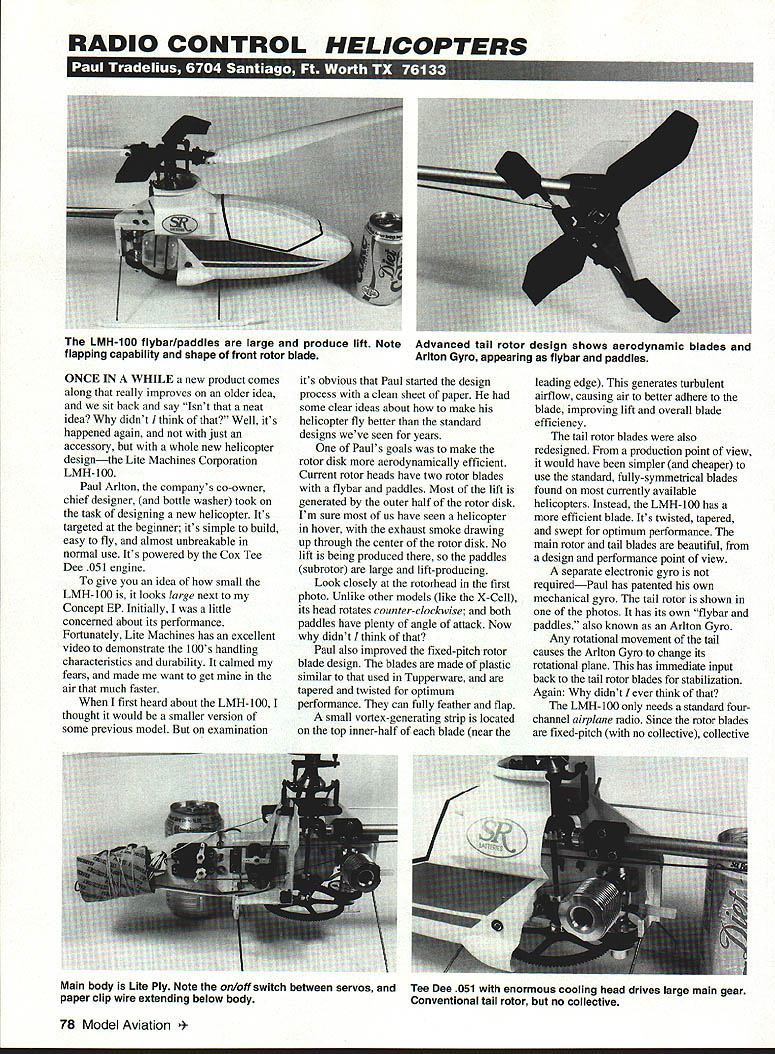
One of his goals was to make the rotor disk more aerodynamically efficient. Traditional rotor heads use two rotor blades with a flybar and paddles; most lift is generated by the outer half of the disk. The LMH-100's rotor head rotates counter-clockwise and both paddles have plenty of angle of attack, resulting in improved lift distribution across the disk.
Rotor and blade design
Paul also improved the fixed-pitch rotor blades. The blades are made of a plastic similar to that used in food containers, and are tapered and twisted for optimum performance. They can fully feather and flap. A small vortex-generating strip is located on the top inner half of each blade near the leading edge; this generates turbulent airflow that helps the air better adhere to the blade, improving lift and overall efficiency.
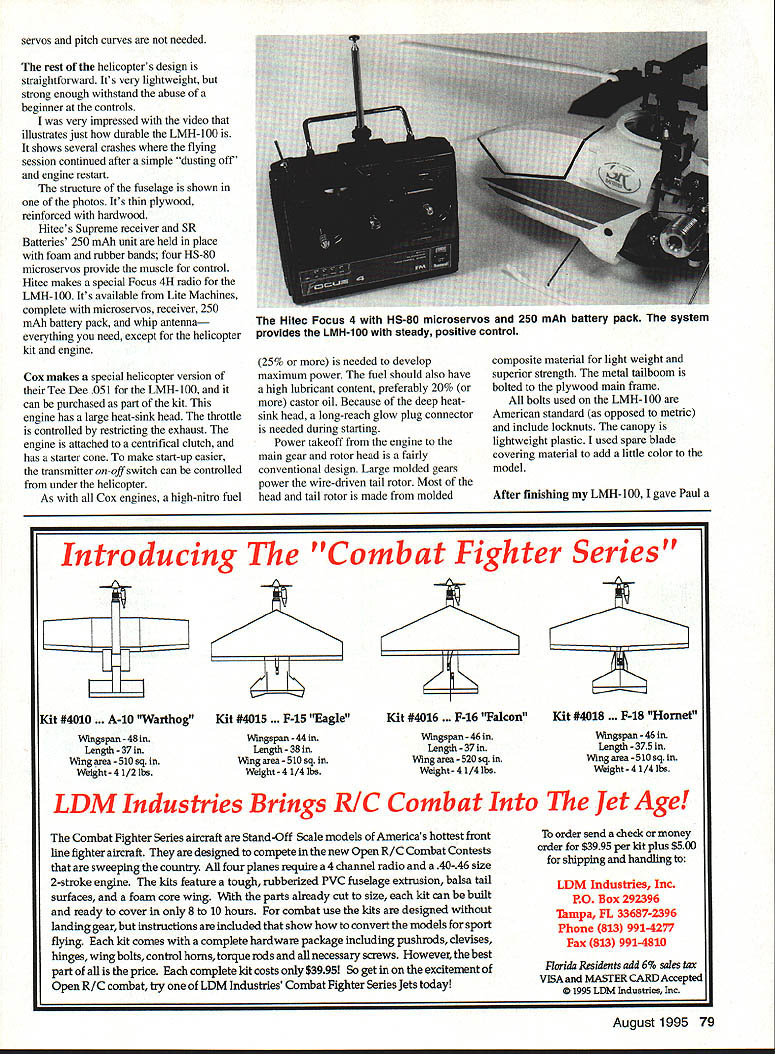
The tail rotor blades were redesigned as well. Rather than using standard fully symmetrical blades, the LMH-100 uses twisted, tapered, and swept blades for better efficiency. Both the main rotor and tail blades are attractive from a design and performance standpoint.
Tail rotor and Arlton mechanical gyro
A separate electronic gyro is not required. Paul has patented his own mechanical gyro — the Arlton Gyro. The tail rotor has its own flybar and paddles; any rotational movement of the tail causes the Arlton Gyro to change its rotational plane and immediately inputs corrective movement back to the tail rotor blades for stabilization.
Radio, servos, and receiver
The LMH-100 only needs a standard four-channel airplane radio because the rotor blades are fixed-pitch (no collective), so collective servos and pitch curves are not required. The sample installation uses four HS-80 microservos. The receiver used is Hitec's Supreme SR. Hitec also makes a special Focus 4H radio for the LMH-100, available from Lite Machines as an option.
Batteries are a 250 mAh unit held in place with foam rubber bands. Lite Machines offers a package that includes microservos, receiver, 250 mAh battery pack, whip antenna, and everything needed except the helicopter kit and engine.
Powerplant and drivetrain
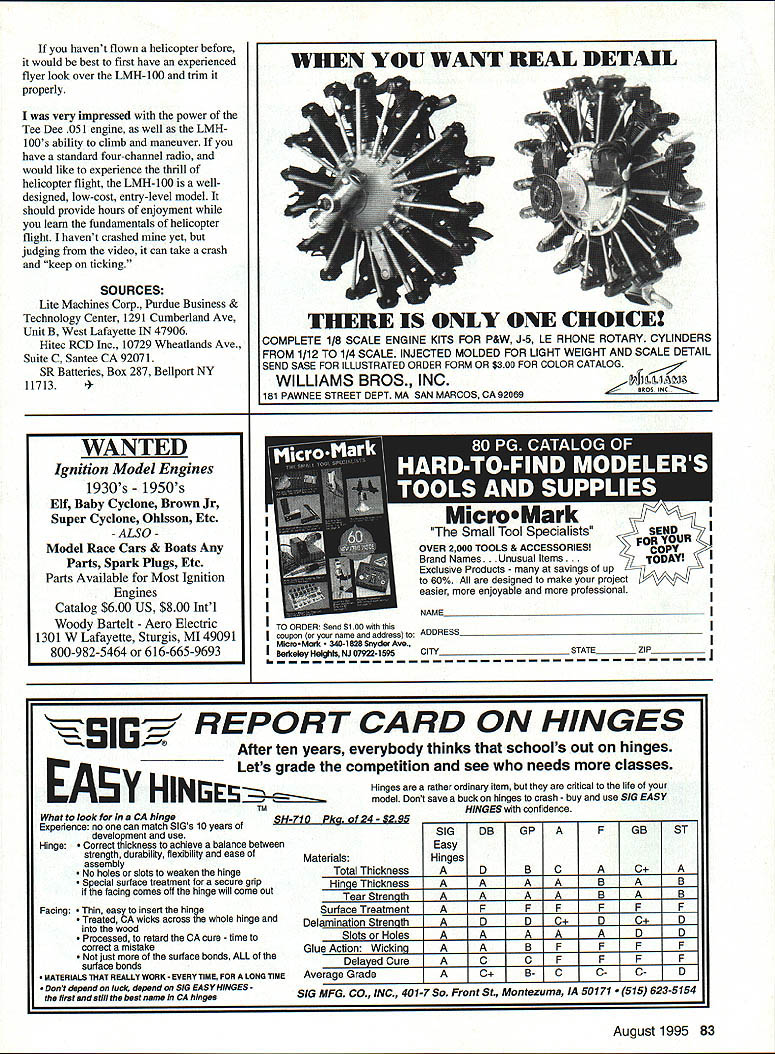
Cox makes a helicopter version of the Tee Dee .051 for this model. The engine has a large heat-sink head and a throttle that controls the exhaust. It is attached to a centrifugal clutch and has a starter cone to ease starting. Power takeoff from the engine to the main gear and rotor head is conventional. Large molded gears drive the wire-driven tail rotor. Most of the head and tail rotor components are molded composite material for light weight and superior strength. The metal tailboom is bolted to the plywood main frame.
Because Cox engines develop maximum power on high-nitro fuel, a 25% nitro fuel is recommended, with high lubricant content (preferably 20% castor oil). The deep heat-sink head requires a long-reach glow plug connector during starting.
Construction and hardware
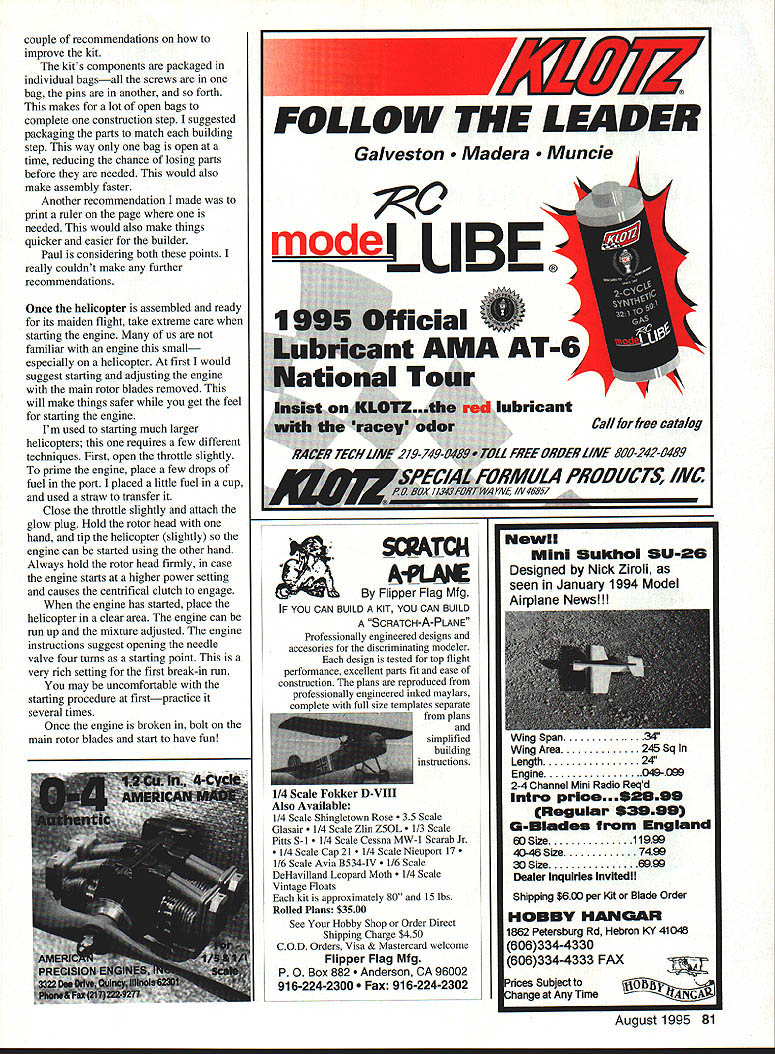
The LMH-100 is very lightweight yet strong enough to withstand beginner abuse. The structure uses thin plywood reinforced with hardwood where needed. All bolts on the LMH-100 are American standard (not metric) and include locknuts. The canopy is lightweight plastic. I used spare blade covering material to add a bit of color to my model.
Kit packaging and recommended improvements
The kit's components are packaged in individual bags — all screws in one bag, pins in another, and so forth. This leads to many open bags during a build step. I suggested packaging parts to match each building step so only one bag is open at a time, which would reduce the chance of losing parts and speed assembly. I also recommended printing a ruler on the page where one is needed. Paul is considering both suggestions.
Assembly tips and starting procedure
Once assembled, take extreme care when starting the engine. Many are not familiar with an engine this small, especially on a helicopter. For safety, start and adjust the engine with the main rotor blades removed until you get the feel for it.
Recommended starting procedure:
- Open the throttle slightly.
- Prime the engine by placing a few drops of fuel in the port (I used a cup and a straw).
- Close the throttle slightly and attach the glow plug.
- Hold the rotor head firmly with one hand and tip the helicopter slightly so the engine can be started with the other hand. This prevents the helicopter from taking off if the centrifugal clutch engages at a higher power setting.
- When the engine starts, move to a clear area, run up the engine, and adjust the mixture. The engine instructions suggest opening the needle valve four turns as a starting point for a rich setting during break-in.
Practice the starting procedure several times until comfortable. After the engine is broken in, bolt on the main rotor blades and prepare for the maiden flight. If you haven't flown a helicopter before, have an experienced flyer check and trim the LMH-100.
Flight impressions
I was impressed with the power of the Tee Dee .051 and the LMH-100's ability to climb and maneuver. The model appears very durable: the Lite Machines video shows several crashes after which flying continued after a simple dusting off and engine restart. If you have a standard four-channel radio and want to experience helicopter flight, the LMH-100 is a well-designed, low-cost entry-level model that should provide hours of enjoyment while you learn the fundamentals of helicopter flying.
SOURCES
- Lite Machines Corp., Purdue Business & Technology Center, 1291 Cumberland Ave., Unit B, West Lafayette, IN 47906
- Hitec RCD Inc., 10729 Wheatlands Ave., Suite C, Santee, CA 92071
- SR Batteries, Box 287, Bellport, NY 11713
Transcribed from original scans by AI. Minor OCR errors may remain.

