
RADIO CONTROL HELICOPTERS
Paul Tradelius, 6704 Santiago, Ft. Worth TX 76133
GAS X-CELL UPDATE:
Several issues ago I wrote about the Gas X-Cell, and how much I enjoyed flying this gas-powered version of a proven, winning design. Since that time I've sent the stock Zenoah engine to Royce Brademan (3903 Quisenberry Dr., Alexandria VA 22309). Royce worked his magic on the engine so it would perform to its design specifications. I'm certainly no engine guy, so I don't understand everything he did, but the Zenoah is performing better (and smoother) than ever before.
Royce says the Zenoah is very well designed, but the manufacturing process is rather "loose" to keep production costs down. Royce "blueprints" each engine to the original specifications for increased power and smoothness.
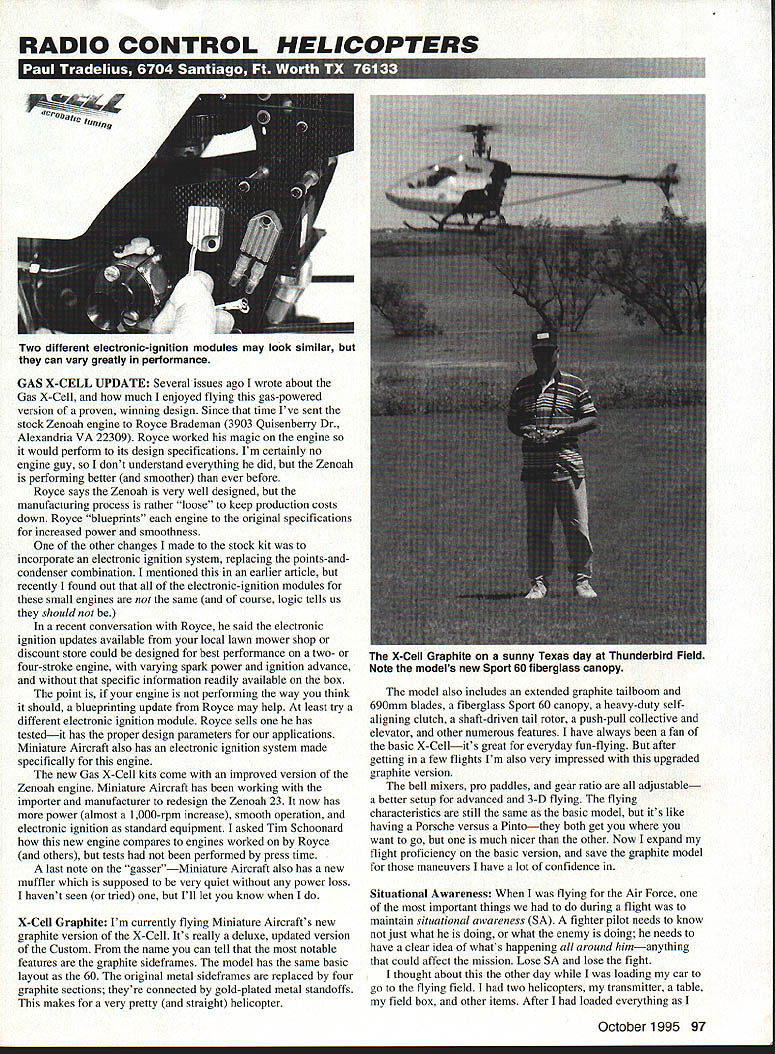
One of the other changes I made to the stock kit was to incorporate an electronic ignition system, replacing the points-and-condenser combination. I mentioned this in an earlier article, but recently I found out that all of the electronic-ignition modules for these small engines are not the same (and of course, logic tells us they should not be).
In a recent conversation with Royce, he said the electronic ignition updates available from your local lawn mower shop or discount store could be designed for best performance on a two- or four-stroke engine, with varying spark power and ignition advance, and without that specific information readily available on the box. The point is, if your engine is not performing the way you think it should, a blueprinting update from Royce may help. At least try a different electronic ignition module. Royce sells one he has tested — it has the proper design parameters for our applications. Miniature Aircraft also has an electronic ignition system made specifically for this engine.
The new Gas X-Cell kits come with an improved version of the Zenoah engine. Miniature Aircraft has been working with the importer and manufacturer to redesign the Zenoah 23. It now has more power (almost a 1,000-rpm increase), smooth operation, and electronic ignition as standard equipment. I asked Tim Schoonard how this new engine compares to engines worked on by Royce (and others), but tests had not been performed by press time.
A last note on the "gasser" — Miniature Aircraft also has a new muffler which is supposed to be very quiet with no power loss. I haven't seen (or tried) one, but I'll let you know when I do.
X-Cell Graphite:
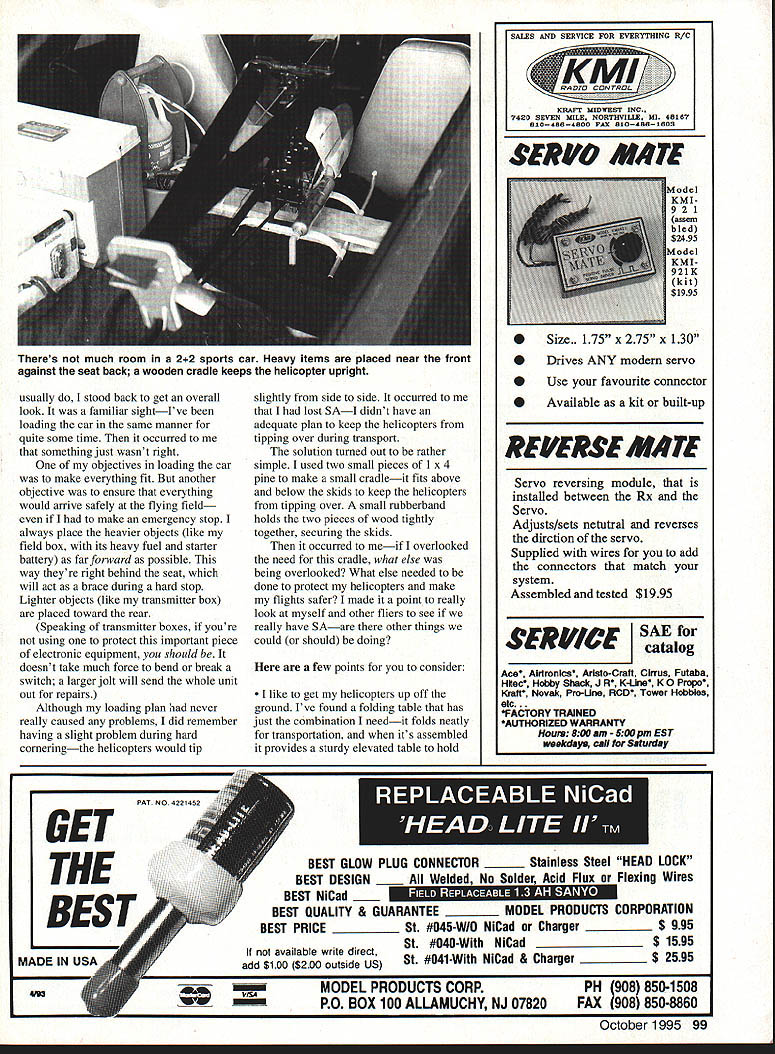
I'm currently flying Miniature Aircraft's new graphite version of the X-Cell. It's really a deluxe, updated version of the Custom. From the name you can tell that the most notable features are the graphite sideframes. The model has the same basic layout as the .60. The original metal sideframes are replaced by four graphite sections; they're connected by gold-plated metal standoffs. This makes for a very pretty (and straight) helicopter.
The model also includes an extended graphite tailboom and 690mm blades, a fiberglass Sport .60 canopy, a heavy-duty self-aligning clutch, a shaft-driven tail rotor, a push-pull collective elevator, and numerous other features. I have always been a fan of the basic X-Cell—it's great for everyday fun flying. But after getting in a few flights I'm also very impressed with this upgraded graphite version.
The bell mixers, pro paddles, and gear ratio are all adjustable — a better setup for advanced and 3-D flying. The flying characteristics are still the same as the basic model, but it's like having a Porsche versus a Pinto — they both get you where you want to go, but one is much nicer than the other. I now expand my flight proficiency on the basic version, and save the graphite model for those maneuvers I have a lot of confidence in.
SITUATIONAL AWARENESS:
When I was flying for the Air Force, one of the most important things we had to do during a flight was to maintain situational awareness (SA). A fighter pilot needs to know not just what he is doing, or what the enemy is doing; he needs to have a clear idea of what's happening all around him — anything that could affect the mission. Lose SA and lose the fight.
I thought about this the other day while I was loading my car to go to the flying field. I had two helicopters, my transmitter, a table, my field box, and other items. After I had loaded everything as I usually do, I stood back to get an overall look. It was a familiar sight—I've been loading the car in the same manner for quite some time. Then it occurred to me that something just wasn't right.
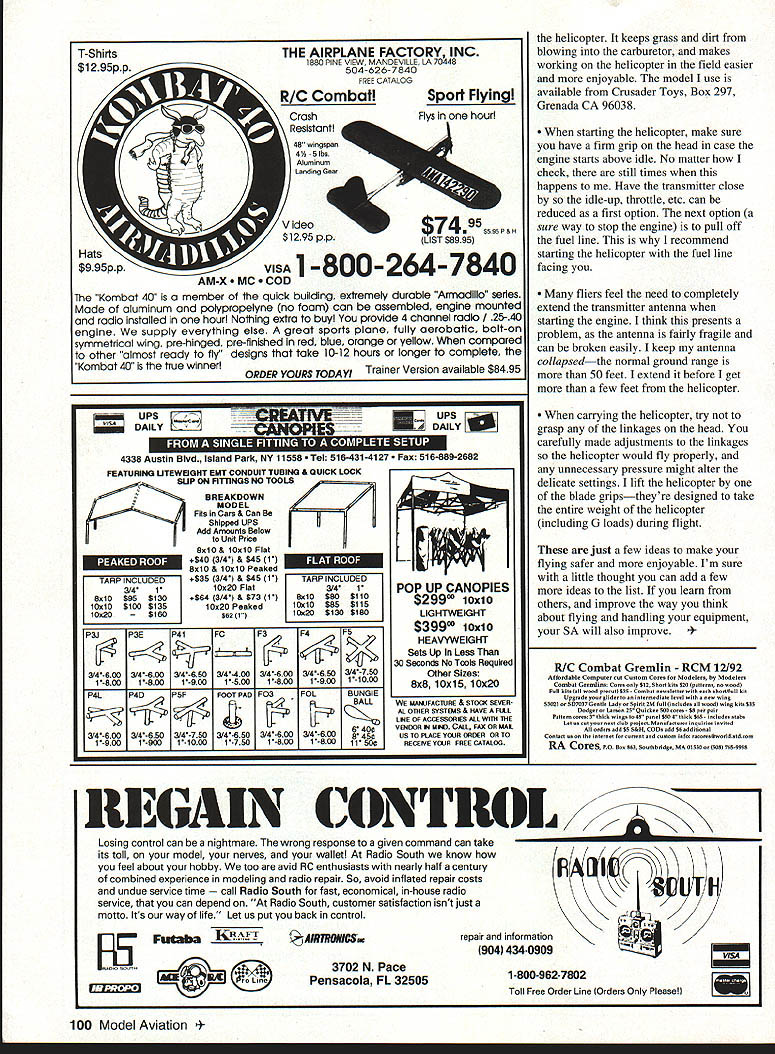
One of my objectives in loading the car was to make everything fit. But another objective was to ensure that everything would arrive safely at the flying field—even if I had to make an emergency stop. I always place the heavier objects (like my field box, with its heavy fuel and starter battery) as far forward as possible. This way they're right behind the seat, which will act as a brace during a hard stop. Lighter objects (like my transmitter box) are placed toward the rear.
(Speaking of transmitter boxes, if you're not using one to protect this important piece of electronic equipment, you should be. It doesn't take much force to bend or break a switch; a larger jolt will send the whole unit out for repairs.)
Although my loading plan had never really caused any problems, I did remember having a slight problem during hard cornering—the helicopters would tip slightly from side to side. It occurred to me that I had lost SA—I didn't have an adequate plan to keep the helicopters from tipping over during transport.
The solution turned out to be rather simple. I used two small pieces of 1x4 pine to make a small cradle—it fits above and below the skids to keep the helicopters from tipping over. A small rubber band holds the two pieces of wood tightly together, securing the skids.
Then it occurred to me—if I overlooked the need for this cradle, what else was I overlooking? What else needed to be done to protect my helicopters and make my flights safer? I made it a point to really look at myself and other fliers to see if we really have SA — are there other things we could (or should) be doing?
Here are a few points for you to consider:
- I like to get my helicopters up off the ground. I've found a folding table that has just the combination I need—it folds neatly for transportation, and when it's assembled it provides a sturdy elevated table to hold the helicopter. It keeps grass and dirt from blowing into the carburetor, and makes working on the helicopter in the field easier and more enjoyable. The model I use is available from Crusader Toys, Box 297, Grenada CA 96038.
- When starting the helicopter, make sure you have a firm grip on the head in case the engine starts above idle. No matter how I check, there are still times when this happens to me. Have the transmitter close by so the idle-up, throttle, etc., can be reduced as a first option. The next option (a sure way to stop the engine) is to pull off the fuel line. This is why I recommend starting the helicopter with the fuel line facing you.
- Many fliers feel the need to completely extend the transmitter antenna when starting the engine. I think this presents a problem, as the antenna is fairly fragile and can be broken easily. I keep my antenna collapsed—the normal ground range is more than 50 feet. I extend it before I get more than a few feet from the helicopter.
- When carrying the helicopter, try not to grasp any of the linkages on the head. You carefully make adjustments to the linkages so the helicopter will fly properly, and any unnecessary pressure might alter the delicate settings. I lift the helicopter by one of the blade grips—they're designed to take the entire weight of the helicopter (including G loads) during flight.
These are just a few ideas to make your flying safer and more enjoyable. If you have a little thought you can add a few more ideas to the list. If you learn from others, and improve the way you think about flying and handling your equipment, your SA will also improve.
Transcribed from original scans by AI. Minor OCR errors may remain.

