
RADIO CONTROL HELICOPTERS
Paul Tradelius, 6704 Santiago, Ft. Worth TX 76133
FREQUENCY BOARDS
Over the years we have seen improvements to every aspect of our hobby and its equipment, but being "shot down" by another flier remains a problem, and continues to eat helicopters.
(For those new to radio control, "shot down" refers to having more than one transmitter on at the same time and on the same frequency. Both transmitters try to control both helicopters, and both receivers "listen" to both transmitters, causing the receivers to fail to properly process the needed information—resulting in a crash of both helicopters.)
Multiple transmissions on the same frequency have been a problem from day one of radio control, and there is no foolproof solution. There are many good attempts to keep it from happening, but unfortunately it continues.
Common solutions include placing a flag on the transmitter antenna showing the frequency being transmitted or placing a frequency pin on a board prior to turning on a transmitter. These sound good, but somehow they just don't work all the time. I guess there really isn't a perfect solution, but there has to be a better way.
One of the best solutions to frequency control is the frequency board; anyone who belongs to a radio control club should be familiar with its operation. Some clubs have a frequency pin allocated to each frequency, and you must have the club-approved pin prior to turning on your transmitter. This seems like a good idea, but the inherent problem is that someone will unintentionally go home with the frequency pin, making that frequency unprotected until the pin is returned.
A frequency control system I have seen that appears to work as well as any is one where each flier has his own pin. It's this simple:
The frequency board is a piece of angle iron about eight feet in length. The top six feet is painted white, and places for each usable frequency are marked off. It is then driven into the ground near the flightline, providing an inexpensive and very durable frequency board.
Each person who wants to fly at that field has their name and frequency number on their own wooden clothespin. When the transmitter is off, the pin is placed on the transmitter antenna so it's easy to see before turning on the radio. Before turning on the radio, the pin must be placed on the frequency board. Now everyone knows who is flying—by name and frequency.
This system has several advantages over others I have seen:
- The frequency board is very durable.
- No more lost frequency pins belonging to the club.
- Spare clothespins can be kept for those who misplaced theirs, or for visitors.
- Emblems can be glued to members' pins showing they are club members and belong to the AMA.
Although this system is not perfect (because there is yet to be a perfect frequency control system) it works as well as any I have seen. You may want to try this system at your club field, or if you have a better one, please let me know so we can all share it.
PRODUCTS AND NEW EQUIPMENT
The next issue will be devoted to the Nats; this will be the last regular column before Christmas. Since we all like to receive presents, especially for helicopters, here are some interesting and useful products:
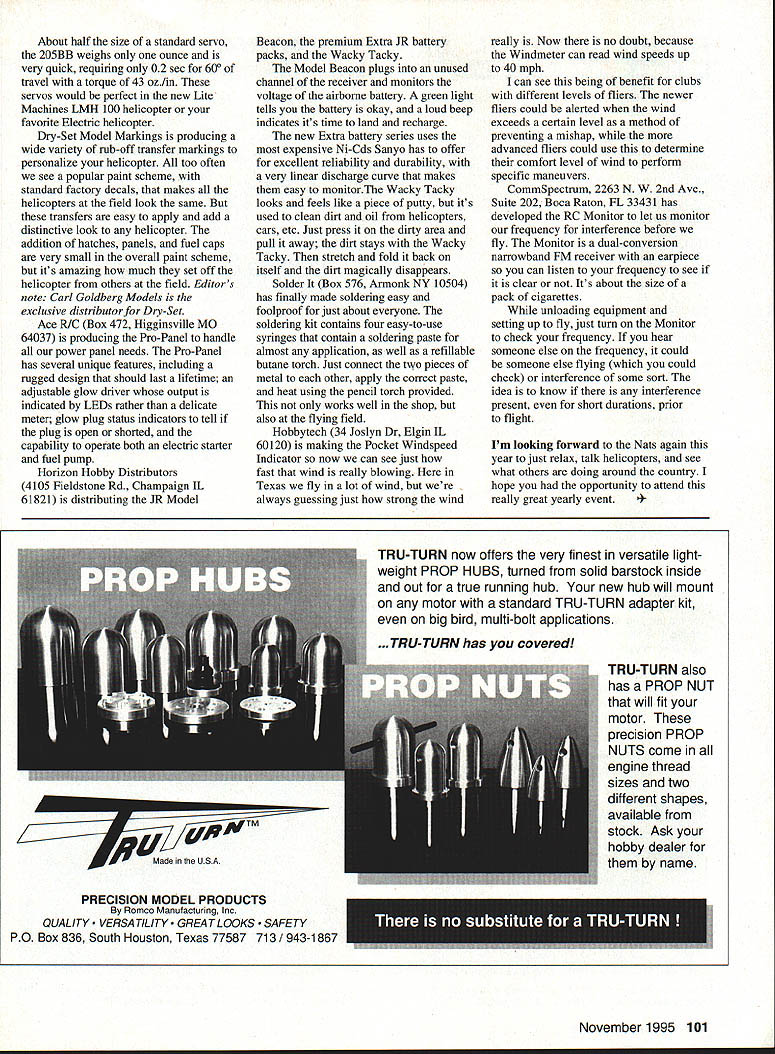
- Hitec RCD, Inc. (10729 Wheatlands Ave., Suite C, Santee CA 92071) — HS-205BB
- The HS-205BB is a ball-bearing microservo for use in small helicopters. It weighs only one ounce, requires only 0.2 sec for 60° of travel, and provides 43 oz./in. of torque. These servos are ideal for the new Lite Machines LMH 100 helicopter or for electric helicopters.
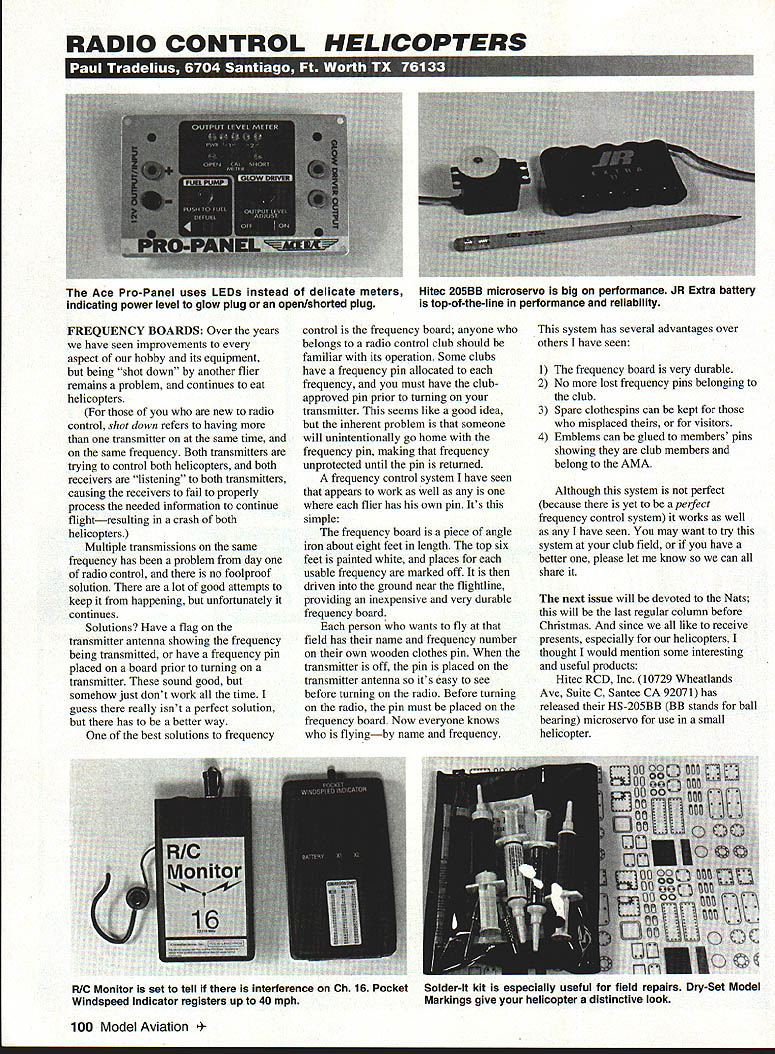
- Ace R/C (Box 472, Higginsville, MO 64037) — Pro-Panel
- The Ace R/C Pro-Panel uses LEDs instead of delicate meters to indicate power level to the glow plug and to show glow plug status (open or shorted). Features include a rugged design expected to last a lifetime, an adjustable glow driver with LED indication, and the capability to operate both an electric starter and a fuel pump.
- Horizon Hobby Distributors (4105 Fieldstone Rd., Champaign, IL 61821)
- Distributing JR Model Beacon, JR premium Extra battery packs, and the Wacky Tacky. The JR premium Extra battery series uses high-quality Sanyo Ni-Cd cells for reliability, durability, and a very linear discharge curve for easy monitoring.
- Model Beacon: plugs into an unused receiver channel and monitors airborne battery voltage. A green light signals the battery is OK; a loud beep indicates it's time to land and recharge.
- Wacky Tacky: looks and feels like putty and is used to clean dirt and oil from helicopters, cars, etc. Press it on the dirty area and pull away; the dirt sticks to it. Then stretch and fold it to renew.
- Dry-Set Model Markings
- Produces a wide variety of rub-off transfer markings to personalize your helicopter. These transfers are about half the size of a standard servo decal set and add hatches, panels, and fuel caps that help distinguish your helicopter from others. (Editor's note: Carl Goldberg Models is the exclusive distributor for Dry-Set.)
- ComSpectrum (2263 N.W. 2nd Ave., Suite 202, Boca Raton, FL 33431) — RC Monitor
- The RC Monitor lets you check your frequency for interference before flight. It's a dual-conversion narrowband FM receiver with an earpiece so you can listen to your frequency to see if it is clear or not. It's about the size of a pack of cigarettes. While unloading equipment and setting up to fly, just turn on the Monitor to check your frequency. If you hear someone else on the frequency, it could be another flier or some interference. The idea is to know if there is any interference present, even for short durations, prior to flight.
- Hobbytech (34 Joslyn Dr., Elgin, IL 60120) — Pocket Windspeed Indicator
- The Pocket Windspeed Indicator (Windmeter) registers up to 40 mph. This is useful for clubs with different levels of fliers: beginners can be alerted when wind exceeds a safe level, while advanced fliers can determine their comfort level for specific maneuvers.
- Solder It / Pocket Solder-It kit (Solder It, Box 576, Armonk, NY 10504)
- The soldering kit contains four easy-to-use syringes of soldering paste for many applications and a refillable butane torch. Connect the two pieces of metal, apply the correct paste, and heat with the pencil torch provided. This works well in the shop and at the flying field.
- Pocket Solder-It kit and other field repair tools
- Especially useful for field repairs; keep one in your flight box.
I'm looking forward to the Nats again this year to relax, talk helicopters, and see what others are doing around the country. I hope you had the opportunity to attend this really great yearly event.
Transcribed from original scans by AI. Minor OCR errors may remain.

