
Radio Control: Helicopters
Paul Tradelius, 6704 Santiago, Ft. Worth TX 76133
Event summary
The 1995 IRCHA-AMA Helicopter Nationals was held at AMA's National Flying Site in Muncie, Indiana, July 8–11, and everyone I saw was having a great time. I know many of you were unable to attend for a variety of reasons, but you really missed a lot of great helicopter flying and the chance to learn from the very best fliers in the country.
IRCHA (International Radio Control Helicopter Association) president Shaun Ettinger and his many helpers did an outstanding job of preparation and handling the minute-by-minute tasks needed to keep three flight lines going at once. I don't know how they pulled it off so smoothly—almost made it look easy—and we all know it wasn't.
I'm not sure how the IRCHA gang did it, but they even made the weather perfect. I left 100°F Texas for 82°F Indiana, with light winds and partial cloud cover during the day, making flying and visiting just about perfect.
The only unfortunate part of this year's Nats was that it took place in three separate locations, which AMA hopes to remedy next year. Part of the enjoyment of going to the Nats is seeing all types of flying—fixed-wing as well as helicopter. It's been a long time since I raced pylon or flew control line, but I still enjoy seeing everything that's going on. With all the space available at the National Flying Site, I hope it can all be brought together next year.
I only had the opportunity to see the first two days of flying, and since the overall standings are being reported elsewhere in this issue, I'll bring you what I consider to be the more interesting points of the Heli Nats.
Impound and frequency control
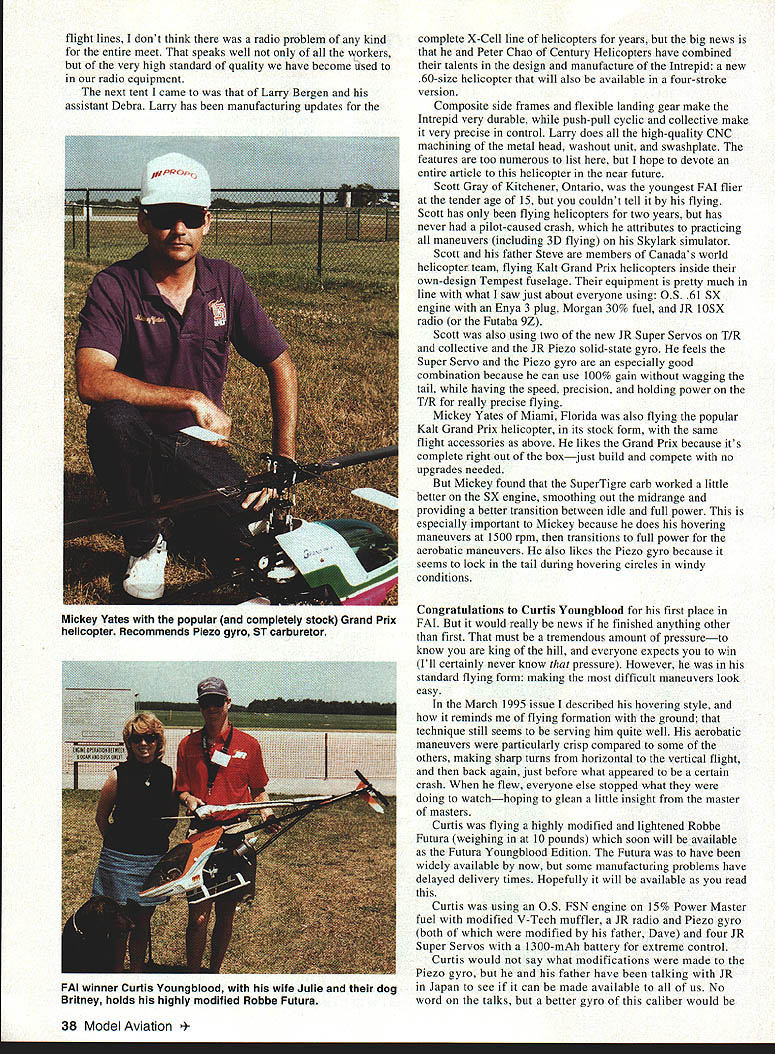
The first tent I came to was the transmitter impound area for FAI, manned by Naomi and Don Griffin and several others to keep track of the flying statistics. The Griffins have been in charge of the Nats impound area since 1984 and deserve special thanks for providing many long hours of work each day of the contest to make sure there are no frequency mishaps. I don't think there was a radio problem of any kind for the entire meet. That speaks well not only of all the workers, but of the very high standard of quality we have come to expect in our radio equipment.
New helicopters and products
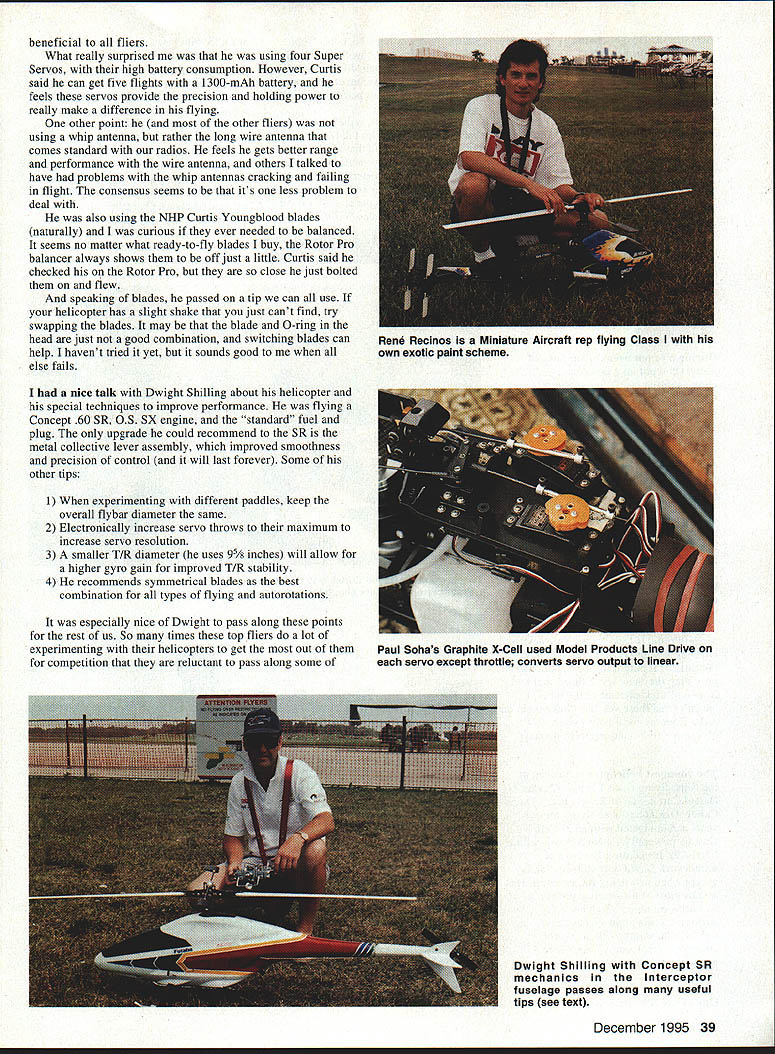
The next tent I came to was that of Larry Bergen and his assistant Debra. Larry has been manufacturing updates for the complete X-Cell line of helicopters for years, but the big news is that he and Peter Chao of Century Helicopters have combined their talents in the design and manufacture of the Intrepid: a new .60-size helicopter that will also be available in a four-stroke version.
Composite side frames and flexible landing gear make the Intrepid very durable, while push-pull cyclic and collective make it very precise in control. Larry does all the high-quality CNC machining of the metal head, washout unit, and swashplate. The features are too numerous to list here, but I hope to devote an entire article to this helicopter in the near future.
Ted Schoonard was flying X-Cell Pro mechanics in his Windstar fuselage, with Miniature Aircraft's new XL-Pro all-metal head. This is the first time I have had a chance to see this head, and it looks completely different from others in that it has a rectangular shape, with all parts counterbored for a precision fit. Although this CNC-machined head is assembled at the factory, it's so precise that none of the setup settings will change if it's disassembled for service.
Other features include a split axle for improved hover stability; everything is ball-bearing supported; and the yoke now clamps to the main shaft with a hardened pin replacing the "Jesus bolt." Ted said his first production run of this head has been so successful that he does not have any left in stock.
Notable competitors and equipment
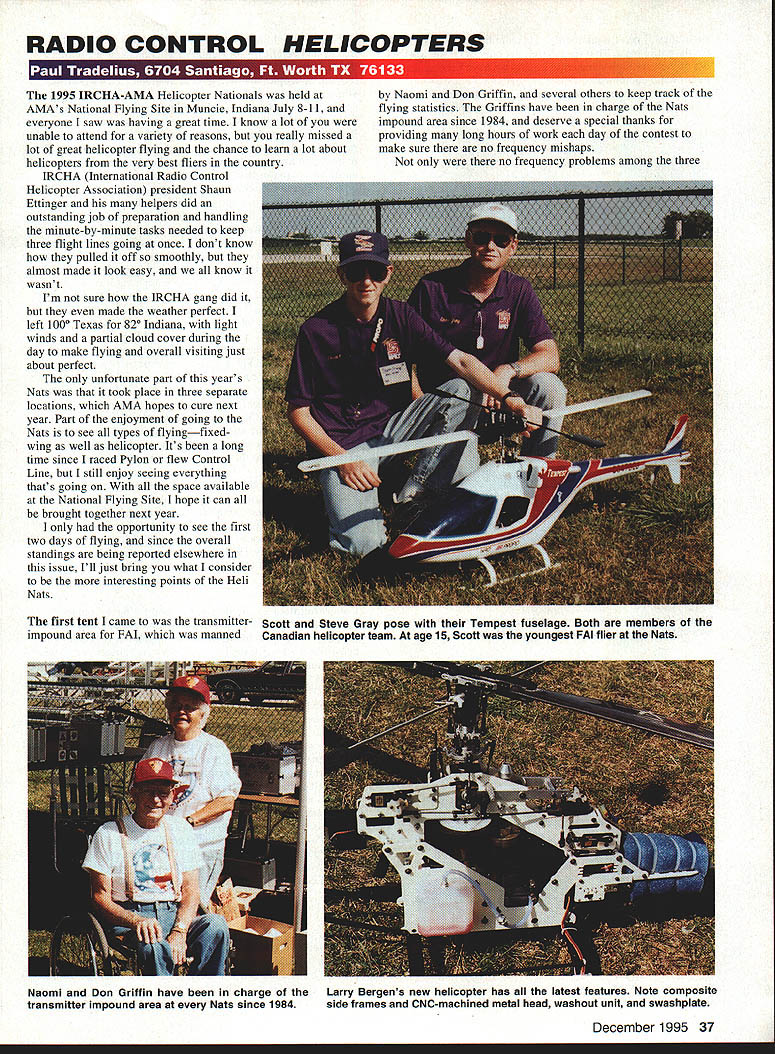
Scott Gray of Kitchener, Ontario, was the youngest FAI flier at the tender age of 15, but you couldn't tell it by his flying. Scott has only been flying helicopters for two years, but has never had a pilot-caused crash, which he attributes to practicing all maneuvers (including 3D flying) on his Skylark simulator.
Scott and his father Steve are members of Canada's world helicopter team, flying Kalt Grand Prix helicopters inside their own-design Tempest fuselage. Their equipment was pretty much in line with what I saw most competitors using: O.S. .61 SX engine with an Enya 3 plug, Morgan 30% fuel, and JR 10SX radio (or the Futaba 9Z).
Scott was also using two of the new JR Super Servos on tail rotor and collective and the JR Piezo solid-state gyro. He feels the Super Servo and the Piezo gyro are an especially good combination because he can use 100% gain without wagging the tail, while having the speed, precision, and holding power on the tail rotor for really precise flying.
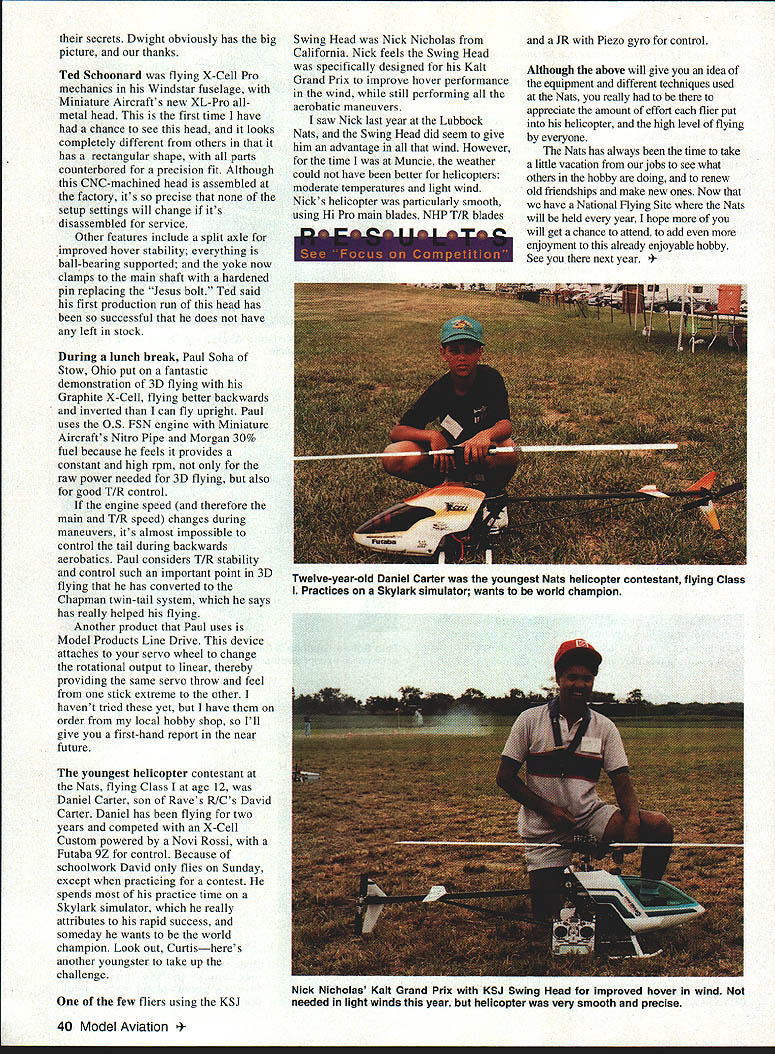
Mickey Yates of Miami, Florida, was also flying the popular Kalt Grand Prix helicopter in stock form, with the same flight accessories as above. He likes the Grand Prix because it's complete right out of the box—just build and compete with no upgrades needed. But Mickey found that the SuperTigre carb worked a little better on the SX engine, smoothing out the midrange and providing a better transition between idle and full power. This is especially important to Mickey because he does his hovering maneuvers at 1,500 rpm, then transitions to full power for the aerobatic maneuvers. He also likes the Piezo gyro because it seems to lock in the tail during hovering circles in windy conditions.
Congratulations to Curtis Youngblood for his first place in FAI. But it would really be news if he finished anything other than first. That must be a tremendous amount of pressure—to know you are king of the hill and everyone expects you to win. However, he was in his standard flying form: making the most difficult maneuvers look easy.
Curtis was flying a highly modified and lightened Robbe Futura (weighing in at 10 pounds) which soon will be available as the Futura Youngblood Edition. The Futura was to have been widely available by now, but some manufacturing problems have delayed delivery times. Hopefully it will be available as you read this.
Curtis was using an O.S. FSN engine on 15% Power Master fuel with a modified V-Tech muffler, a JR radio and Piezo gyro (both modified by his father, Dave), and four JR Super Servos with a 1300-mAh battery for extra power.
Curtis would not say what modifications were made to the Piezo gyro, but he and his father have been talking with JR in Japan to see if it can be made available to all of us. No word on the talks, but a better gyro of this caliber would be beneficial to all fliers.
What really surprised me was that he was using four Super Servos, with their high battery consumption. However, Curtis said he can get five flights with a 1300-mAh battery, and he feels these servos provide the precision and holding power to really make a difference in his flying.
One other point: he (and most of the other fliers) was not using a whip antenna, but rather the long wire antenna that comes standard with our radios. He feels he gets better range and performance with the wire antenna, and others I talked to have had problems with whip antennas cracking and failing in flight. The consensus seems to be that it's one less problem to deal with.
He was also using the NHP Curtis Youngblood blades (naturally). I was curious if they ever needed to be balanced. It seems no matter what ready-to-fly blades I buy, the Rotor Pro balancer always shows them to be off just a little. Curtis said he checked his on the Rotor Pro, but they were so close he just bolted them on and flew.
And speaking of blades, he passed on a tip we can all use. If your helicopter has a slight shake that you just can't find, try swapping the blades. It may be that the blade and O-ring in the head are just not a good combination, and switching blades can help.
I had a nice talk with Dwight Shilling about his helicopter and his special techniques to improve performance. He was flying a Concept .60 SR with an O.S. SX engine and the "standard" fuel and plug. The only upgrade he could recommend to the SR is the metal collective lever assembly, which improved smoothness and precision of control (and it will last forever). Some of his other tips:
- When experimenting with different paddles, keep the overall flybar diameter the same.
- Electronically increase servo throws to their maximum to increase servo resolution.
- A smaller tail-rotor diameter (he uses 9 5/8 inches) will allow for a higher gyro gain for improved tail stability.
- He recommends symmetrical blades as the best combination for all types of flying and autorotations.
It was especially nice of Dwight to pass along these points for the rest of us. So many times these top fliers do a lot of experimenting with their helicopters to get the most out of them for competition and are reluctant to pass along some of their secrets. Dwight obviously has the big picture, and our thanks.
During a lunch break, Paul Soha of Stow, Ohio put on a fantastic demonstration of 3D flying with his Graphite X-Cell, flying better backwards and inverted than I can fly upright. Paul uses the O.S. FSN engine with Miniature Aircraft's Nitro Pipe and Morgan 30% fuel because he feels it provides a constant and high rpm—not only for the raw power needed for 3D flying, but also for good tail-rotor control.
If the engine speed (and therefore the main and tail-rotor speed) changes during maneuvers, it's almost impossible to control the tail during backwards aerobatics. Paul considers tail-rotor stability and control such an important point in 3D flying that he has converted to the Chapman twin-tail system, which he says has really helped his flying.
Another product that Paul uses is Model Products Line Drive. This device attaches to your servo wheel to change the rotational output to linear, thereby providing the same servo throw and feel from one stick extreme to the other. I haven't tried these yet, but I have them on order from my local hobby shop, so I'll give you a first-hand report in the near future.
The youngest helicopter contestant at the Nats, flying Class I at age 12, was Daniel Carter, son of Rave's R/C's David Carter. Daniel has been flying for two years and competed with an X-Cell Custom powered by a Novi Rossi, with a Futaba 9Z for control. Because of schoolwork David only flies on Sunday, except when practicing for a contest. He spends most of his practice time on a Skylark simulator, which he really attributes to his rapid success, and someday he wants to be the world champion. Look out, Curtis—here's another youngster to take up the challenge.
One of the few fliers using the KSJ Swing Head was Nick Nicholas from California. Nick feels the Swing Head was specifically designed for his Kalt Grand Prix to improve hover performance in the wind while still performing all the aerobatic maneuvers.
I saw Nick last year at the Lubbock Nats, and the Swing Head did seem to give him an advantage in heavy wind. However, for the time I was at Muncie, the weather could not have been better for helicopters: moderate temperatures and light winds. Nick's helicopter was particularly smooth, using Hi Pro main blades, NHP tail-rotor blades, and a JR radio with Piezo gyro for control.
Closing thoughts
Although the above will give you an idea of the equipment and different techniques used at the Nats, you really had to be there to appreciate the amount of effort each flier put into his helicopter, and the high level of flying by everyone.
The Nats has always been the time to take a little vacation from our jobs to see what others in the hobby are doing, and to renew old friendships and make new ones. Now that we have a National Flying Site where the Nats will be held every year, I hope more of you will get a chance to attend, to add even more enjoyment to this already enjoyable hobby. See you there next year.
Transcribed from original scans by AI. Minor OCR errors may remain.

