
RADIO CONTROL HELICOPTERS
Paul Tradelius, 6704 Santiago, Ft. Worth TX 76133
Midwinter Maintenance
Most fliers probably haven't flown their helicopters in the past couple of months, and aren't making plans for the next flying season, still several months away. This is an easy trap to fall into—no one wants to admit that the flying season is over.
We all hope for that one additional nice day in late fall when we can get to the field one more time before winter settles in for good. Often that means our helicopters are in the same condition as when we last flew them—lacking the TLC they will need to overcome the inactivity of the winter.
A little preventive maintenance now will keep your helicopter (and its associated equipment) in top form for when you are ready to fly again. On a cold evening when there's not much to do outside and there's nothing good on TV, put your helicopter on the workbench and take a look at the following items.
Engine
Make sure your engine and fuel system are drained of fuel. There are several after-run oils on the market which can be liberally added to the engine. These will help keep it loose and rust-free over the winter.
- Pour some after-run oil down the carburetor.
- Remove the glow plug and add some oil to the top of the cylinder.
- Put some oil through the exhaust port.
That glow plug has served you well over the last flying season—now may be a good time to replace it with a new one. If the old one still seems to be good, keep it for emergency use.
Batteries
It's generally accepted that batteries should be fully charged every month or so over the winter to keep them in top condition. If you have a cycler, use it—especially if the pack is more than a year old. Cycling will not only exercise the pack, it will also let you know if there is a weak cell.
A dendrite check is another important battery-related test. I didn't know much about these "dreaded dendrites" until I spoke with Larry Sribnick of SR Batteries. Dendrites are tiny, whisker-like needles that grow inside a Ni-Cd cell. These cause internal shorting of the cell, which you may never notice.
You can test for dendrites:
- Fully charge and cycle the pack to check its capacity.
- Note the freshly charged capacity; a good pack will self-discharge at about 1–2% per day.
- Let the pack sit for five days.
- Measure its capacity again by cycling. It should have lost no more than about 10% (2% per day × five days).
If the pack has lost considerably more than 10%, you most likely have dendrites. One option is to open the pack, find the defective cell, and replace it. The option I prefer is to retire it to use as a doorstop and install a fresh pack.
Storage Location
Where you store your helicopter may have a dramatic effect on how well it survives the winter. If your workshop is not heated (a storage shed or basement, for example), dampness will seep into every bearing that has not been adequately protected. There are several oils with Teflon (or other additives) that claim to protect metal from rusting. These are readily available at discount or hardware stores.
Now that the boys have grown out of the house, my primary workshop is the spare bedroom. However, storing helicopters inside the house has caused problems. I hang helicopters from the ceiling to keep them out of the way. I never took into consideration how hot and dry it is near the ceiling in wintertime. One helicopter I flew last season had an unusual mishap: it had been stored close to the ceiling during winter. During its first flight in spring a wooden blade pulled through the blade bolt. Since the helicopter had flown for months the year before, I concluded something happened during winter storage which weakened the blade.
Although I'll never be certain, I assume the notably warm, dry air near the ceiling dried out the wooden blade, leading to its failure on its first flight of the season. If you store helicopters in a warm, dry place and use wooden blades, take precautions to seal them to prevent blade failure next year. Sealing both ends with cyanoacrylate (CyA) or paint should do the trick, whichever method you choose.
Helicopter Simulators
Although this isn't maintenance related, getting some stick time on a simulator during the winter months will keep flying skills well-oiled for next year. It's easy to have a personal computer (PC) simulator; you don't have to own one. If other pilots in the area have one, it might be nice to have the local helicopter club hold its monthly meeting at the home of a member who has a simulator. Several people could get some practice before or after the meeting.
You might be able to talk to a local helicopter hobby shop about buying a simulator for customers to use. Most hobby shops probably use some type of PC to conduct business; it wouldn't be much expense to add a flight simulator course. There may be reasons why it would be impractical, but attracting customers (especially in the slow winter months) with a simulator would seem like a good public-relations idea. Club meetings could be held at the shop, providing a nice place to meet while generating a few sales for the store.
- Suggestion: Arrange club meetings at a member's home with a simulator or at a hobby shop that offers one.
- Benefit: Keeps pilots current, draws customers to shops, and fosters community.
Helicopter Seminars
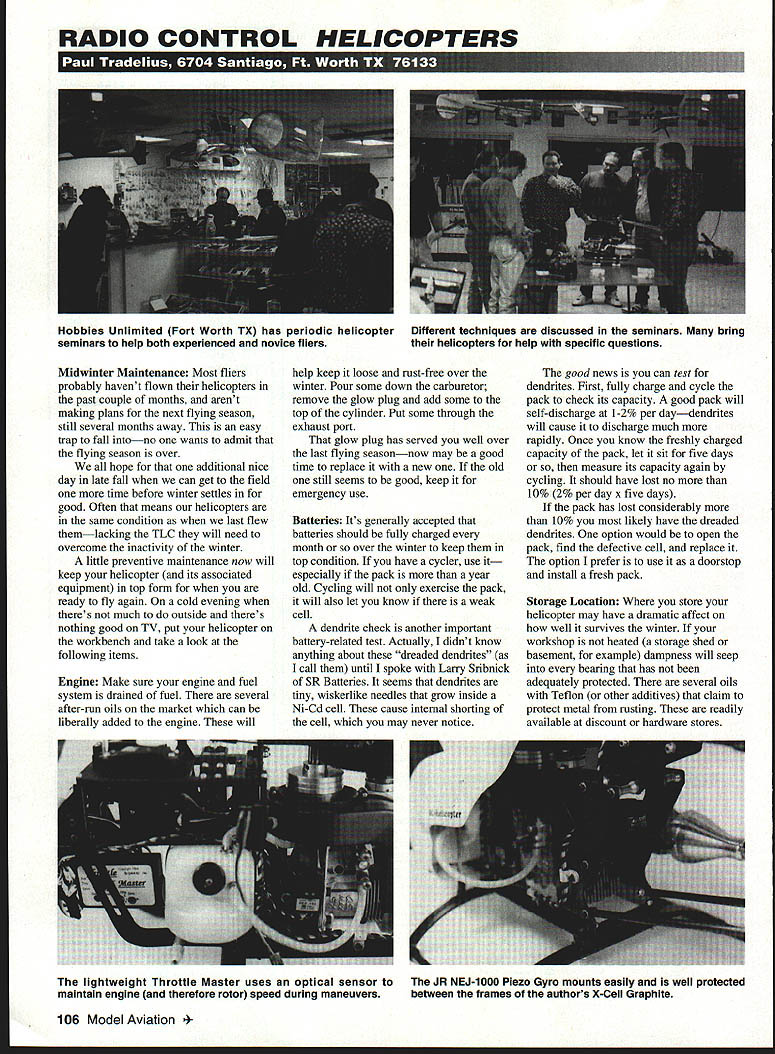
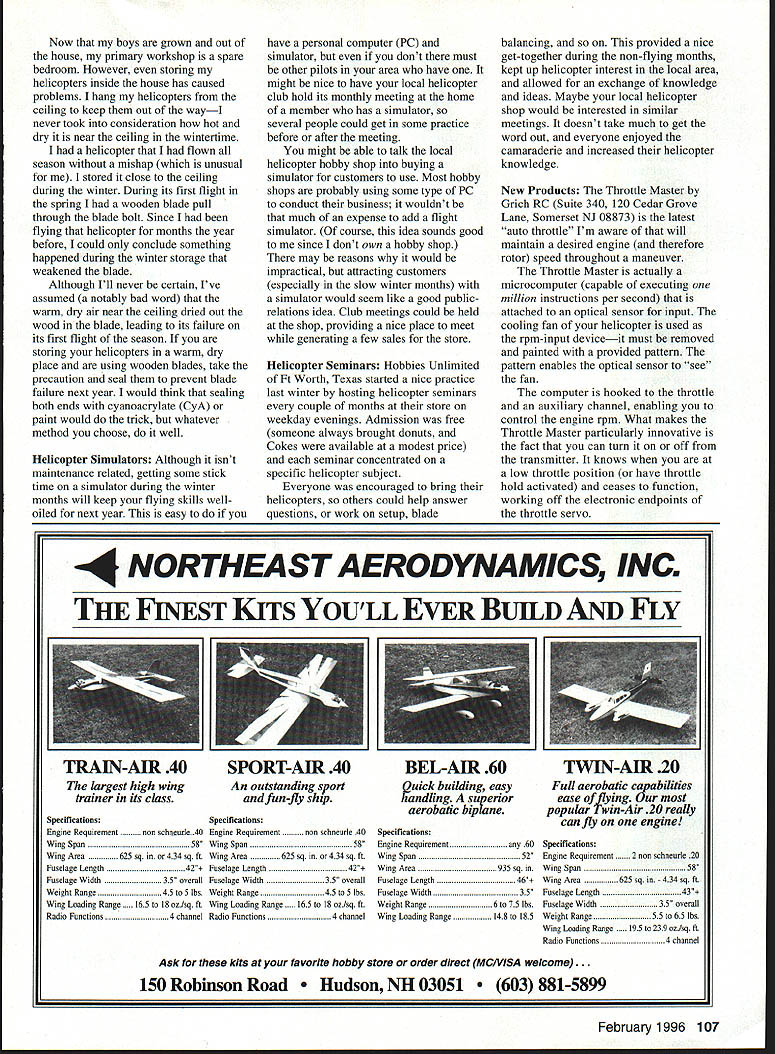
Hobbies Unlimited of Ft. Worth, Texas started a nice practice last winter by hosting helicopter seminars every couple of months at their store on weekday evenings. Admission was free (someone always brought donuts, and Cokes were available at a modest price) and each seminar concentrated on a specific helicopter subject.
Everyone was encouraged to bring their helicopters so others could help answer questions or work on setup, blade balancing, and so on. This provided a nice get-together during the non-flying months, kept up helicopter interest in the local area, and allowed for an exchange of knowledge and ideas. Maybe your local helicopter shop would be interested in similar meetings. It doesn't take much to get the word out, and everyone enjoyed the camaraderie and increased their helicopter knowledge.
New Products
Throttle Master (Grich RC)
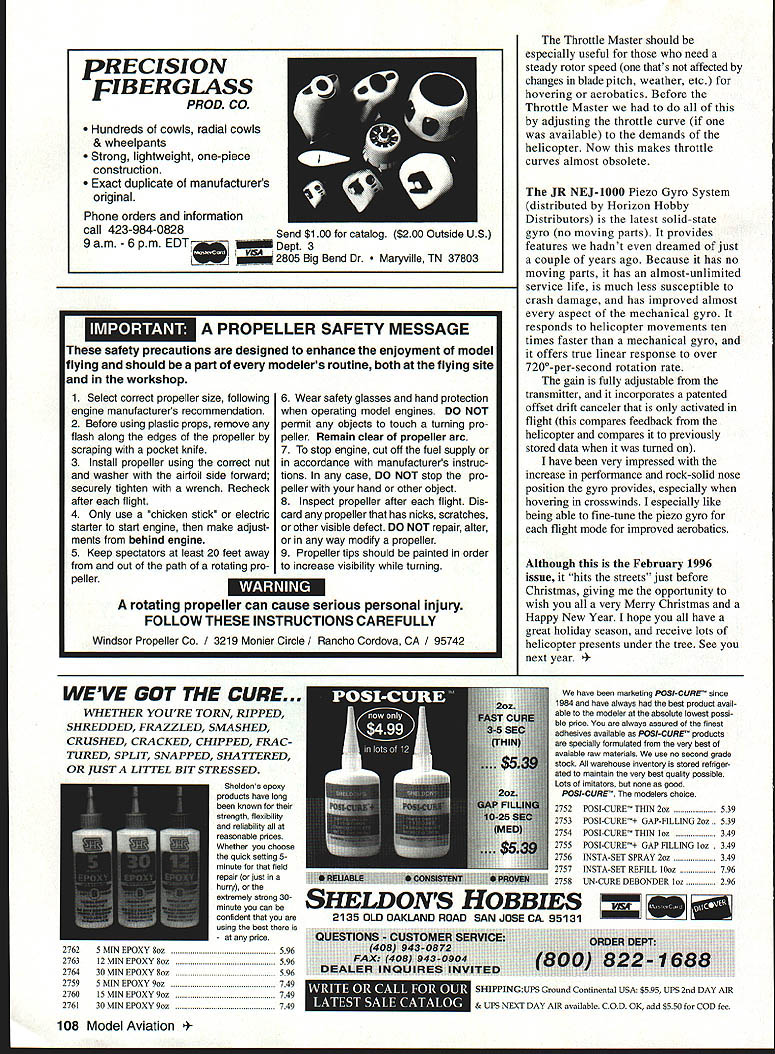
The Throttle Master by Grich RC (Suite 340, 120 Cedar Grove Lane, Somerset NJ 08873) is the latest "auto throttle" I'm aware of that will maintain a desired engine (and therefore rotor) speed throughout a maneuver.
The Throttle Master is actually a microcomputer (capable of executing one million instructions per second) that is attached to an optical sensor for input. The cooling fan of your helicopter is used as the RPM-input device—it must be removed and painted with a provided pattern. The pattern enables the optical sensor to "see" the fan.
The computer is hooked to the throttle and an auxiliary channel, enabling automatic control of engine RPM. What makes the Throttle Master particularly innovative is the fact that you can turn it on or off from the transmitter. It knows when you are at a low throttle position (or have the throttle hold activated) and ceases to function, working from the electronic endpoints of the throttle servo.
The Throttle Master should be especially useful for those who need a steady rotor speed (one that's not affected by changes in blade pitch, weather, etc.) for hovering or aerobatics. Before the Throttle Master, we had to do all of this by adjusting the throttle curve (if one was available) to the demands of the helicopter. Now this makes throttle curves almost obsolete.
JR NEJ-1000 Piezo Gyro System (Horizon Hobby Distributors)
The JR NEJ-1000 Piezo Gyro System is the latest solid-state gyro (no moving parts). It provides features we hadn't even dreamed of just a couple of years ago. Because it has no moving parts, it has an almost-unlimited service life, is much less susceptible to crash damage, and has improved almost every aspect of the mechanical gyro.
It responds to helicopter movements ten times faster than a mechanical gyro and offers true linear response to rotation rates of over 720° per second. The gain is fully adjustable from the transmitter, and it incorporates a patented offset drift canceler that is only activated in flight (this compares feedback from the helicopter and compares it to previously stored data when it was turned on).
I have been very impressed with the increase in performance and the rock-solid non-drift position the gyro provides, especially when hovering in crosswinds. I especially like being able to fine-tune the piezo gyro for each flight mode for improved aerobatics.
Although this is the February 1996 issue, it "hits the streets" just before Christmas, giving me the opportunity to wish you all a very Merry Christmas and a Happy New Year. I hope you all have a great holiday season, and receive lots of helicopter presents under the tree. See you next year.
Transcribed from original scans by AI. Minor OCR errors may remain.

