

RADIO CONTROL HELICOPTERS
Paul Tradelius, 6704 Santiago, Ft. Worth TX 76133
Canopies
Last month I talked about repairing and painting damaged canopies, but there will always be that canopy you've been looking at long enough, or just don't want to fix for whatever reason. When that happens you may want to give Just Canopies a call: (800) 747-7033. As their name implies, they only do canopies, for almost any helicopter flying.
I called and requested a canopy for my X-Cell, painted in three specific colors in a particular pattern, with a tinted windshield. I received the canopy assembled and painted, ready to mount to the helicopter, for $50. When you consider the cost of the canopy itself, and then the time and expense to trim, glue it together, and paint, this price is very reasonable.
World Heli-Hams
World Heli-Hams is a nonprofit organization for people interested in helicopters and amateur short-wave radio, and provides another means to communicate ideas and techniques pertaining to our hobby. I am not a ham radio operator, so I have not been able to join in with any discussions, but I'm sure that many of you have ham equipment and will find this means of getting together very interesting. Contact Marden Pride, 34 Fountain St., Haverhill MA 01830.
Tornado (Precision Helicopters Inc.)
Tornado is the name of a new helicopter on the market from Precision Helicopters Inc., 115A North Main St., Enterprise, AL 36330. Those of you who have been around this hobby for a while will remember the Legend helicopter manufactured by Gorham Model Products several years ago; although the Legend was an excellent helicopter, GMP was not able to stay in business. Kam Wyatt has taken the basic design of the Legend, made some upgrades and other changes, and is manufacturing this new helicopter under the name Tornado. It's an all-metal 60-size helicopter with a stated full 60-inch main rotor diameter and an overall weight of only 9.5 pounds ready to fly.
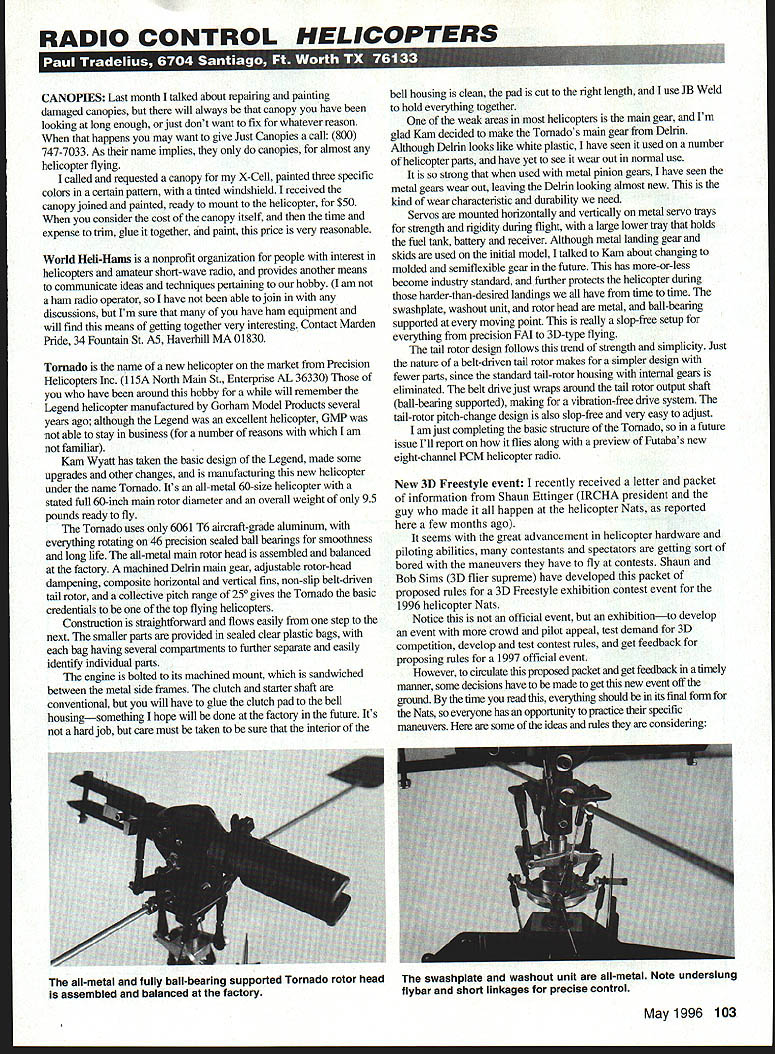
The Tornado uses only 6061-T6 aircraft-grade aluminum, with everything rotating on 46 precision sealed ball bearings for smoothness and long life. The all-metal main rotor head is assembled and balanced at the factory. A machined Delrin main gear, adjustable rotor-head dampening, composite horizontal and vertical fins, non-slip belt-driven tail rotor, and a collective pitch range of 25° give the Tornado the basic credentials to be one of the top flying helicopters.
Construction is straightforward and flows easily from one step to the next. The smaller parts are provided in sealed clear plastic bags, with each bag having several compartments to further separate and easily identify individual parts.
The engine is bolted to its machined mount, which is sandwiched between the metal side frames. The clutch and starter shaft are conventional, but you will have to glue the clutch pad to the bell housing—something I hope will be done at the factory in the future. It's not a hard job, but care must be taken to be sure that the interior of the bell housing is clean, the pad is cut to the right length, and I use JB Weld to hold everything together.
One of the weak areas in most helicopters is the main gear, and I'm glad Kam decided to make the Tornado's main gear from Delrin. Although Delrin looks like white plastic, I have seen it used on a number of helicopter parts, and have yet to see it wear out under normal use. It is so strong that when used with metal pinion gears, I have seen the metal gears wear out, leaving the Delrin looking almost new. This is the kind of wear characteristic and durability we need.
Servos are mounted horizontally and vertically on metal servo trays for strength and rigidity during flight, with a large lower tray that holds the fuel tank, battery and receiver. Although metal landing gear and skids are used on the initial model, I talked to Kam about changing to molded and semiflexible gear in the future. This has more-or-less become industry standard, and further protects the helicopter during those harder-than-desired landings we all have from time to time. The swashplate, washout unit, and rotor head are metal, and ball-bearing supported at every moving point. This is a slop-free setup for everything from precision FAI to 3D-type flying.
The tail rotor design follows this trend of strength and simplicity. Just the nature of a belt-driven tail rotor makes for a simpler design with fewer parts, since the standard tail-rotor housing with internal gears is eliminated. The belt drive just wraps around the tail rotor output shaft (ball-bearing supported), making for a vibration-free drive system. The tail-rotor pitch-change design is also slop-free and very easy to adjust.
I am just completing the basic structure of the Tornado, so in a future issue I'll report on how it flies along with a preview of Futaba's new eight-channel PCM helicopter radio.
New 3D Freestyle event
I recently received a letter and packet of information from Shaun Ettinger (IRCHA president) and the guy who made it all happen at the helicopter Nats, as reported here a few months ago.
With the great advancement in helicopter hardware and piloting abilities, many contestants and spectators are getting sort of bored with the maneuvers they have to fly at contests. Shaun and Bob Sims (3D flier supreme) have developed a packet of proposed rules for a 3D Freestyle exhibition contest event for the 1996 helicopter Nats.
Notice this is not an official event, but an exhibition—to develop an event with more crowd and pilot appeal, test demand for 3D competition, develop and test contest rules, and get feedback for proposing rules for a 1997 official event.
However, to circulate this proposed packet and get feedback in a timely manner, some decisions have to be made to get this new event off the ground. By the time you read this, everything should be in final form for the Nats, so everyone has an opportunity to practice their specific maneuvers. Here are some of the ideas and rules they are considering:
- Freestyle flying should be a continuous program of maneuvers and combinations created by the pilot that will allow him or her to best express their style of flying. This will encompass an overall theme or feeling to the flight, which will be flown to background music.
- There will be no required maneuvers that would inhibit the pilot's expression of helicopter and flight.
- Initial judging will use closed scoring and a videotape review. The closed scoring will allow for more accurate scores since later flights can be compared with earlier ones, and scores can be adjusted accordingly.
- A video review will also be available if the judges need help to refresh their memories as to who did what, and to what level of proficiency. Certainly this form of scoring will need a certain learning curve, but it offers the maximum flexibility for a fledgling event.
Now that the groundwork has been laid, there's a tremendous need for patience and support from the rest of us. It's certainly easy to criticize any new event, but what is really needed is to hold 3D events at your next planned contest or fun-fly and see what it's like to be a contestant or judge.
Accept uncertainty and tolerate the little problems that are bound to occur, and make notes on how the event can be improved in the future. You can voice your comments to Shaun at (810) 488-0588; he will be able to keep you advised of the latest developments.
Although everyone I have talked to has been very pleased with the Nats over the last several years, the addition of this Freestyle event should add a lot of excitement. I'll be there, and I hope you plan to make it also.
Transcribed from original scans by AI. Minor OCR errors may remain.

