
RADIO CONTROL HELICOPTERS
Eric Hawkinson
319 Yellowstone Ave., Billings, MT 59101 E-mail: tech@heliproz.com
Editor's note: This column was written for the December 2000 issue, but did not run because of the Nationals coverage.
New models and market notes
It's another perfect month to enjoy the most challenging of radio control (RC) aircraft—and some serious shopping. This issue arrives at the start of the holiday frenzy. Some hot, anxiously awaited releases have finally arrived and will no doubt be on some of your shopping lists. Here are a few highlights.
.60-size models
- Eagle Freya (Hirobo)
- New low-cost .60 in the Hirobo line.
- Molded frame set, belt-driven tail, new pitch slider, and constant drive.
- Street price approximately $700.
- Thunder Tiger Raptor (.60)
- Shown at IRCHA minus a few parts; Ace Hobby hoped it would arrive in time for the holidays (no price announced).
- Tube-drive tail, molded frame, open bottom similar to the .30-size Raptor.
- Standard mix (non-CCPM).
- Miniature Aircraft X-Cell Pro "Pro 2K"
- Deluxe, contest-ready helicopter (after a relatively involved build).
- Comes with components that are upgrades on other machines; priced accordingly.
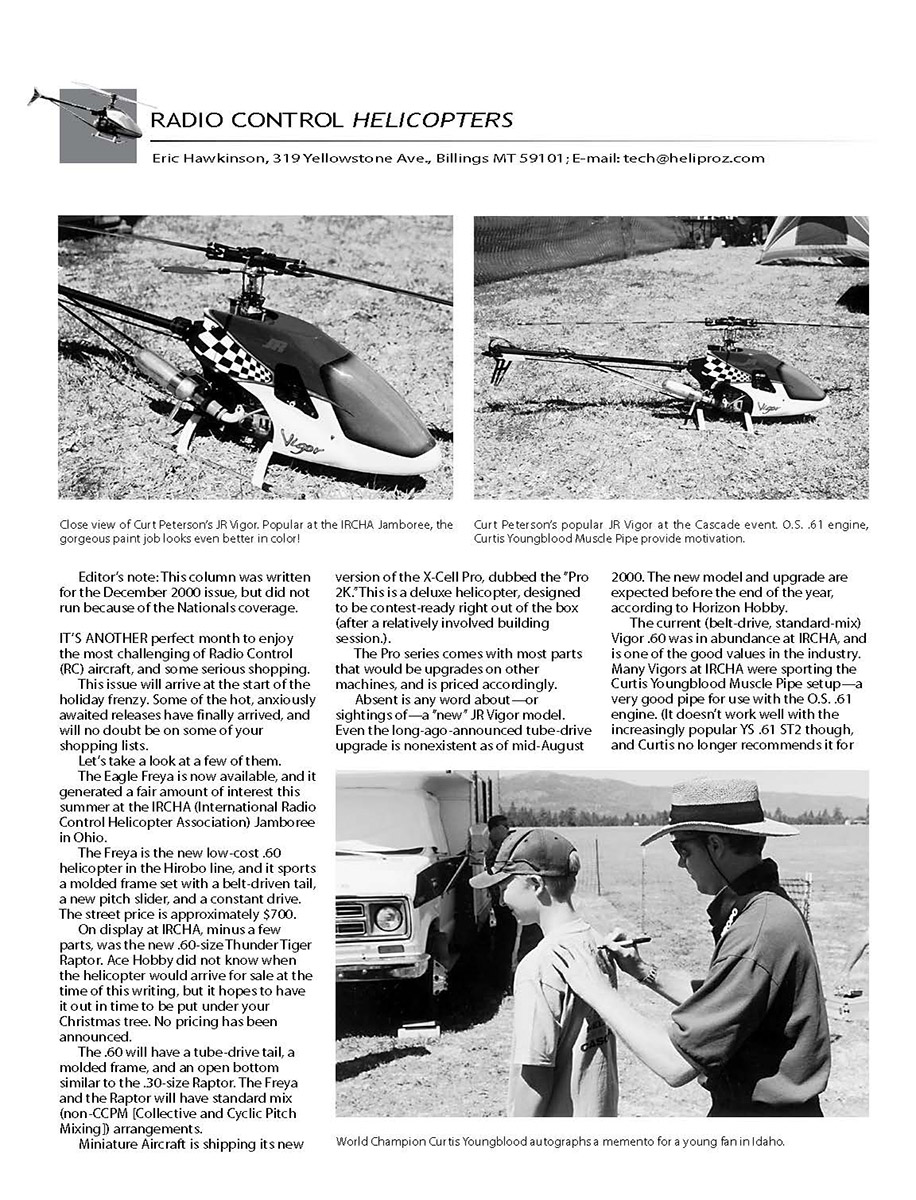
- JR Vigor .60
- No sightings yet of a new Vigor model or the long-announced tube-drive upgrade (as of mid-August 2000).
- New model and upgrade expected before year-end per Horizon Hobby.
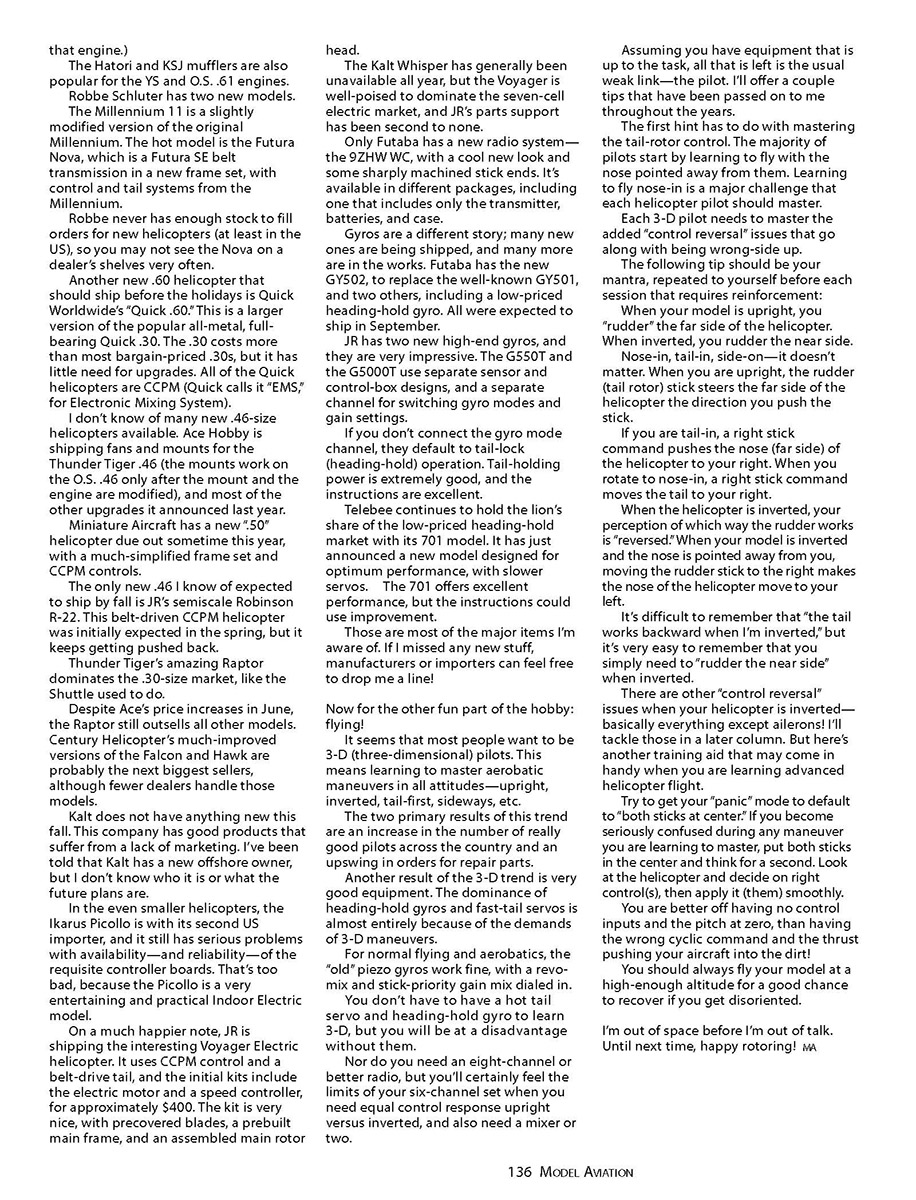
- Current belt-drive, standard-mix Vigor .60 remains a good value; many at IRCHA used the Curtis Youngblood Muscle Pipe with the O.S. .61 (not recommended for the YS .61 ST2).
- Hatori and KSJ mufflers are also popular for YS and O.S. .61 engines.
- Quick Worldwide "Quick .60"
- Larger version of the all-metal, full-bearing Quick .30.
- Quick helicopters are CCPM (Quick calls it "EMS," Electronic Mixing System).
Robbe Schluter
- Millennium 11: slightly modified version of the original Millennium.
- Futura Nova: the hot model—Futura SE belt transmission in a new frame set with control and tail systems from the Millennium.
- Note: Robbe often has limited stock in the U.S., so dealers may not have these models on the shelf.
.46 / .50-size and semiscale
- Few new .46-size helicopters this season.
- Ace Hobby shipping fans and mounts for the Thunder Tiger .46 (mounts work on the O.S. .46 only after mount and engine modification) and other upgrades it announced.
- Miniature Aircraft: a new ".50" due later this year with a simplified frame set and CCPM controls.
- JR Robinson R-22 (semiscale .46)
- Belt-driven CCPM helicopter initially expected in spring but repeatedly pushed back; only new .46 expected by fall.
.30-size market
- Thunder Tiger Raptor continues to dominate the .30-size market and outsells other models despite price increases.
- Century Helicopter’s improved Falcon and Hawk are likely the next biggest sellers, though they’re handled by fewer dealers.
Smaller electrics and other manufacturers
- Ikarus Piccolo: now with a second U.S. importer but still has availability and controller-board reliability problems; it’s an entertaining indoor electric when supported properly.
- JR Voyager Electric
- Uses CCPM control and a belt-drive tail.
- Initial kits include motor and speed controller for about $400.
- Kit includes precovered blades, prebuilt main frame, and an assembled main rotor head.
- Well poised to dominate the seven-cell electric market; JR parts support is excellent.
- Kalt Whisper: generally unavailable all year. Kalt makes good products but lacks marketing; ownership reportedly changed offshore, details unknown.
Radios and gyros
Radio systems
- Futaba 9ZHW WC
- New radio system with a fresh look and nicely machined stick ends.
- Available in different packages, including a transmitter-only option.
Gyros
- Many new gyros are shipping and more are in development.
- Futaba
- GY502 to replace the well-known GY501.
- Two other models expected, including a low-priced heading-hold gyro (shipments expected in September).
- JR
- Two new high-end gyros: G550T and G5000T.
- Use separate sensor and control-box designs, plus a separate channel for switching gyro modes and gain settings.
- If the gyro-mode channel is not connected, they default to tail-lock (heading-hold) operation; tail-holding power is excellent and the instructions are very good.
- Telebee
- Continues to hold a large share of the low-priced heading-hold market with the 701 model.
- Just announced a new model optimized for performance with slower servos.
- The 701 offers excellent performance though the instructions could be improved.
If I missed any new items, manufacturers or importers can feel free to drop me a line.
Flying and the 3-D trend
Most pilots seem to want to become 3-D (three-dimensional) pilots, mastering aerobatic maneuvers in all attitudes—upright, inverted, tail-first, sideways, etc. The 3-D trend has led to:
- An increase in really good pilots across the country.
- An upswing in orders for repair parts.
- Very good equipment: the dominance of electronic heading-hold gyros and fast-tail servos is largely driven by 3-D demands.
For normal flying and basic aerobatics, the older piezo gyros still work fine if you have a revo-mix and a stick-priority gain mix dialed in. You don't have to have the hottest tail servo and heading-hold gyro to learn 3-D, but you will be at a disadvantage without them. Likewise, you don't need an eight-channel radio, but you will feel the limits of a six-channel set when you need equal control response upright versus inverted and when you need mixers.
Assuming your equipment is adequate, the remaining limiting factor is the pilot. A couple of training tips passed on to me over the years:
Tail-rotor control and orientation
- Learn nose-in flight. Most pilots start by flying with the nose pointed away (tail-in); nose-in is a major challenge but essential to master.
- Master the control-reversal issues that come with being wrong-side up.
Mantra to repeat before sessions that require reinforcement:
- "When your model is upright, the rudder (tail-rotor) stick steers the far side of the helicopter. When inverted, your rudder steers the near side."
Explanation and examples:
- Upright: the rudder stick moves the far side of the helicopter in the direction you push the stick. If the model is tail-in, a right-stick command pushes the nose (far side) to your right.
- Nose-in: a right-stick command moves the tail to your right.
- Inverted: perception of rudder direction is reversed. If the model is inverted and the nose is pointed away from you, moving the rudder stick to the right makes the nose move to your left.
- Instead of thinking "the tail works backward when I'm inverted," remember simply to "rudder the near side" when inverted.
There are additional control-reversal issues when the helicopter is inverted—basically everything except ailerons. I’ll tackle those in a later column.
Panic strategy and safety
- Train a default "panic" response: both sticks at center.
- If you become seriously confused during a maneuver, center both sticks and think for a second.
- Look at the helicopter, decide the right control(s), then apply them smoothly.
- It’s better to have no inputs and the pitch at zero than to give the wrong cyclic command and have thrust push the aircraft into the ground.
- Always fly at a high enough altitude to give yourself a reasonable chance to recover if you get disoriented.
I'm out of space before I'm out of talk. Until next time, happy rotoring!
MA
Transcribed from original scans by AI. Minor OCR errors may remain.

