
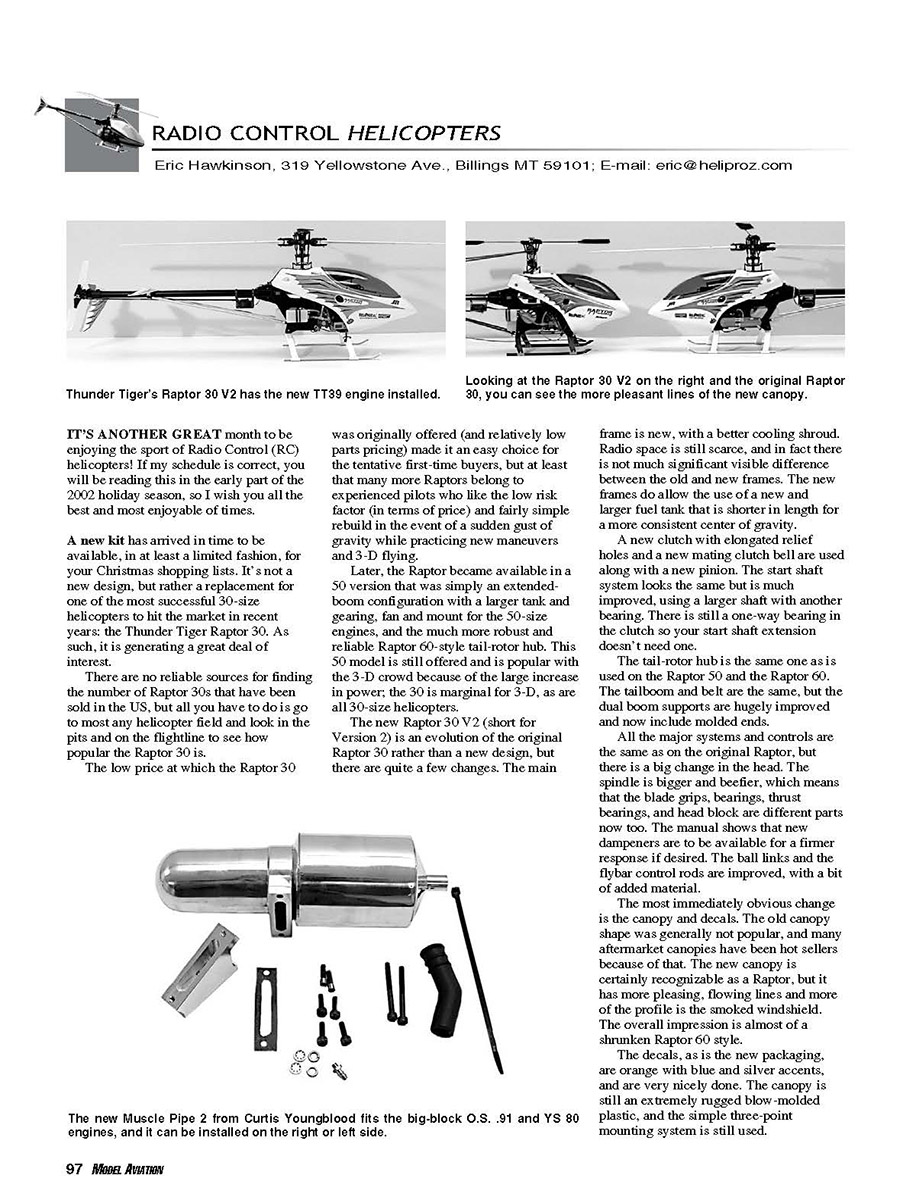
RADIO CONTROL HELICOPTERS
Eric Hawkinson, 319 Yellowstone Ave., Billings MT 59101; E-mail: eric@heliproz.com
Introduction
It's another great month to be enjoying the sport of radio-control (RC) helicopters! If my schedule is correct, you will be reading this in the early part of the 2002 holiday season, so I wish you all the best and most enjoyable of times. A new kit has arrived in time to be available, at least in a limited fashion, for your Christmas shopping lists. It's not a new design, but rather a replacement for one of the most successful 30-size helicopters to hit the market in recent years: the Thunder Tiger Raptor 30. As such, it is generating a great deal of interest.
Raptor 30 background
There are no reliable sources for finding the number of Raptor 30s that have been sold in the U.S., but all you have to do is go to most any helicopter field and look in the pits and on the flight line to see how popular the Raptor 30 is. The low price at which the Raptor 30 was originally offered (and relatively low parts pricing) made it an easy choice for tentative first-time buyers, but many Raptors also belong to experienced pilots who like the low risk factor (in terms of price) and the fairly simple rebuild in the event of a sudden gust of gravity while practicing new maneuvers and 3-D flying.
Later, the Raptor became available in a 50 version that was simply an extended-boom configuration with a larger tank and gearing, a fan and mount for 50-size engines, and the much more robust and reliable Raptor 60–style tail-rotor hub. This 50 model is still offered and is popular with the 3-D crowd because of the large increase in power; the 30 is marginal for 3-D, as are all 30-size helicopters.
Raptor 30 V2 — what’s changed
The new Raptor 30 V2 (short for Version 2) is an evolution of the original Raptor 30 rather than a new design, but there are quite a few changes:
- The main frame is new, with a better cooling shroud. Radio space is still scarce, and in fact there is not much significant visible difference between the old and new frames.
- The new frames allow the use of a larger fuel tank that is shorter in length for a more consistent center of gravity.
- A new clutch with elongated relief holes and a new mating clutch bell are used, along with a new pinion.
- The start-shaft system looks the same but is much improved, using a larger shaft with another bearing. There is still a one-way bearing in the clutch so your start-shaft extension doesn't need one.
- The tail-rotor hub is the same one used on the Raptor 50 and the Raptor 60. The tailboom and belt are the same, but the dual boom supports are hugely improved and now include molded ends.
- All major systems and controls are the same as on the original Raptor, but there is a big change in the head. The spindle is bigger and beefier, which means the blade grips, bearings, thrust bearings, and head block are different parts now too. The manual shows that new dampeners will be available for a firmer response if desired.
- The ball links and flybar control rods are improved, with a bit of added material.
Canopy, decals, and manual
The most immediately obvious change is the canopy and decals. The old canopy shape was generally not popular, and many aftermarket canopies sold well because of that. The new canopy is certainly recognizable as a Raptor, but it has more pleasing, flowing lines and more of the profile is the smoked windshield. The overall impression is almost of a shrunken Raptor 60 style. The decals, as is the new packaging, are orange with blue and silver accents and are very nicely done. The canopy is still an extremely rugged blow-molded plastic, and the simple three-point mounting system is still used.
The manual is basically the same as for prior versions, except that it includes the new parts. The manual is not outstanding, but the line drawings are excellent; if you are patient enough, you will be able to build the Raptor V2 just fine.
Engine options and performance
What may turn out to be the best selling point for the V2 is the new engine that Thunder Tiger offers in packages with the kit or the Almost Ready-to-Fly (ARF) version. The Raptor has always had a good control system, and expectations are that the new Thunder Tiger Pro 39H engine will have enough power to make 3-D pilots happy and be a good choice for beginners.
The original Raptor 30 was available with the old TT36 engine, but that turned out to be a poor-selling version because of the engine's inconsistent performance. However, recent TT engines are a completely different story; the TT50 and TT70 helicopter engines have gained reputations as decent engines with power and consistency close to their O.S. counterparts, at slightly lower prices.
Like those engines, the new TT39 is a ringed design with a new carburetor. Early reports have been mostly favorable. I expect to have much more experience with this engine to report in the next issue.
Versions, packaging, and accessories
Overall, the V2 looks like a solid upgrade to the popular Raptor 30. Street prices for the kits will be in the same range as those for the new ARFs such as the JR Venture CP and the Kyosho Caliber 30, and much higher than the newest Hirobo Shuttle (the Shuttle Plus), which was one of the helicopters the original Raptor 30 undercut in the market with a much lower price. It will be interesting to see how the new V2 sells, but there is little doubt it will be a popular choice.
Your favorite helicopter shop should have the V2 in stock by the time you read this. Which versions it may have is harder to say because there are many choices. The V2 is packaged in a Sport version and a Pro version; the difference is whether it has 29 (Sport) or a full 49 ball bearings.
Both versions are available with or without the TT39 engine. Packages with the engine also include a cast muffler, which is larger and looks a bit more rugged than the original cast .36 muffler. The welded "upgrade" muffler fits the .39 and should run well on it.
I intend to fly the stock muffler briefly, then install the Mavrik muffler. Of course, those intentions may be affected by the weather. Here in Montana, fall is sometimes hard to tell from summer, but more often it can include some winterish weather! I will do my most serious flight time on the new Raptor and engine, and I will report what I find as soon as possible.
Muscle Pipe 2 tuned-pipe system
Another new product that has just hit dealers' shelves addresses the helicopters on the other end of the size spectrum. Current World Champion, National Champion, and generally PDG (pretty darn good) pilot Curtis Youngblood has released his newest version of the Muscle Pipe tuned-pipe system. The Muscle Pipe 2 is designed and tuned for the new large engines including the YS 80 and the O.S. .91.
Curtis has done quite a bit of work designing the pipe and has given it a broad range, which makes it very non-peaky. It is also pretty quiet—another big plus. The tuning is so broad that several people report it runs great on the slightly higher-revving O.S. .70.
Mounting is ingenious. The pipe set includes a mounting flange and hardware that not only allows mounting on the very different YS and O.S. crankcases, but also allows use on mechanics with the exhaust on either the right or the left side.
After assembling the pipe body, the angled extension, and the stub header, the pipe functions as a one-piece style of pipe. The "potato masher" shape of the pipe is different but agreeable, and it allows mounting on most mechanics with minimum trimming of the canopy.
I think Horizon will eventually distribute the Muscle Pipe 2 along with the other products from Curtis Youngblood Enterprises, which would mean almost any hobby shop should be able to get you one. Pricing should be roughly $110 for the complete package.
Final notes
Until next time, fly safely and happy motoring! /EA
Transcribed from original scans by AI. Minor OCR errors may remain.

