
RADIO CONTROL HELICOPTERS
Dan Williams, 27 Treeline Dr., Liverpool NY 13090; E-mail: dlw@dreamscape.com
We got roughly a month of decent weather with more sun than rain, but it still managed to rain at least one day of the weekend almost every week. Those of us who live in the Northeast learn to get what we can out of the nice weather. Then there are those who are really lucky and get to go south for the winter for flying all the time. Ah, retirement. Someday.
So far I’ve gotten some really good, positive feedback about my column and one scathing e-mail. It seems that I shouldn’t write any more about the basics of learning to fly. The writer claims that learning to hover nose-in has been reiterated “ad nauseam” and that I should point readers to the Internet for the required information.
Maybe I should point the readers to the Internet for everything in this column and close it out from Model Aviation completely. Yes, the Internet is certainly timelier for breaking news, but it is not as convenient as a magazine.
How many of you take your laptops to the “reading room” to surf the Internet? Not me. And I certainly cannot afford to hook up to the Internet while I do my traveling. I take magazines, such as Model Aviation, with me on my trips wherever I go. They’re great for those long airplane flights. You can take them to the model field if you like. Did you ever try to find something you’re looking for on the Internet among the endless volumes of drool out there?
Thank you, but I’ll continue to read the magazine. There are those who desperately need the information I provide here, and I will continue to do so. I pity the poor soul who goes to this gentleman for help at the field. “Hey ‘new guy,’ don’t bother me. Go find whatever it is you’re looking for on the Web and leave me to my flying.”
Newcomers to this hobby outnumber those who stick around for the long haul. Many leave because of the lack of help in sport-flying helicopters. I struggled for a long time to learn to fly helicopters because there wasn’t a local club with that pool of knowledge for me to tap into to overcome my learning difficulties.
To ignore those individuals who are coming into this hobby in favor of those who already know it all would do a great disservice to the Academy of Model Aeronautics and everything for which it stands. I will continue to do whatever it takes to make the task of learning to fly helicopters less painful. There will be more people involved with the specialty as a result. That’s how a hobby evolves.
IRCHA Jamboree and Heli-Internationals
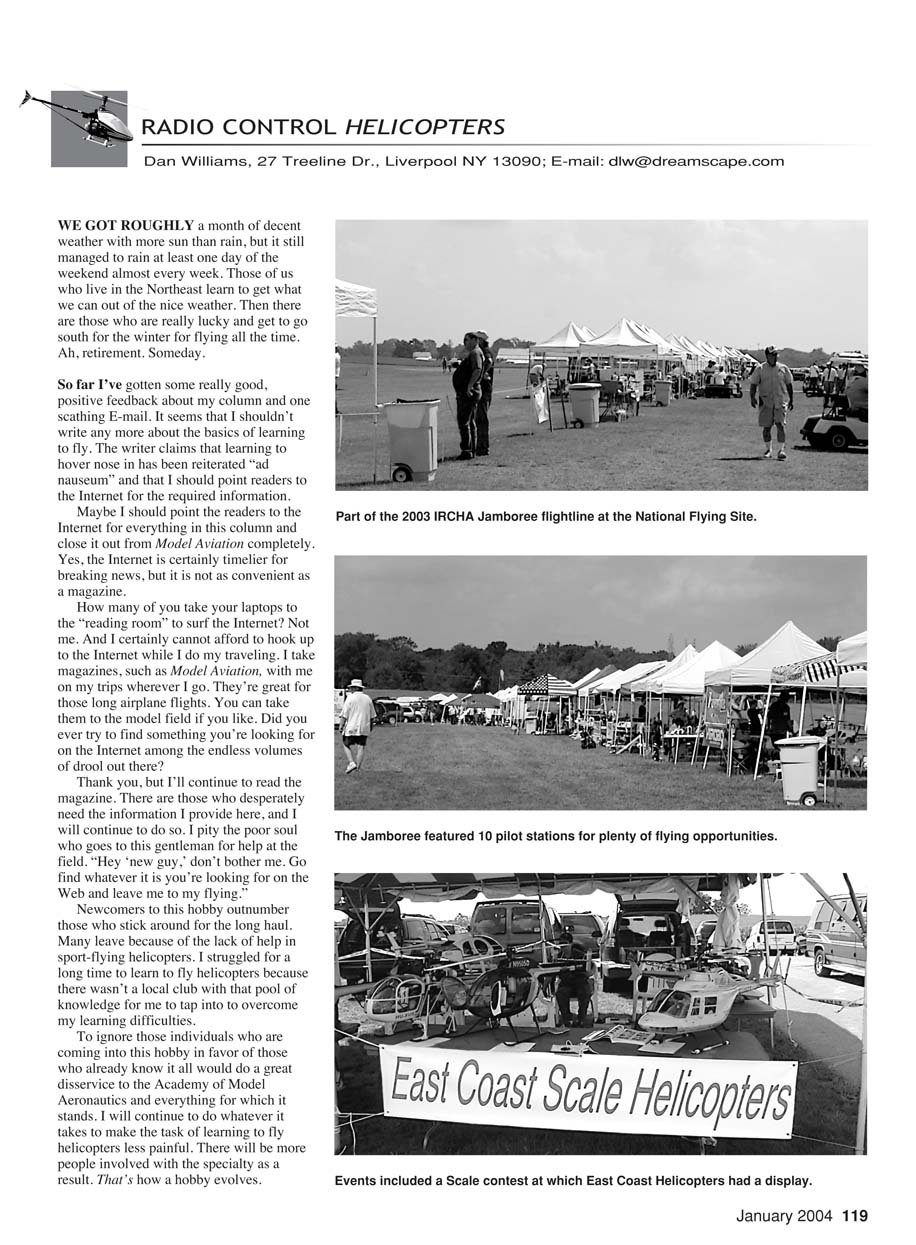
The month of August brings thoughts of the largest gathering of helicopters, pilots, and manufacturers. This year the International Radio Control Helicopter Association (IRCHA) put on the annual IRCHA Jamboree and the 10th-annual Heli-Internationals in Muncie, Indiana, at the Academy of Model Aeronautics’ National Flying Site.
If you’ve never been to the AMA site, you’re missing something. It is by far the most awesome place to fly. Except for the occasional tree, there’s really nothing to interrupt the view all the way to the horizon. Basically there’s nothing except terra firma to hit with a model.
I visited the site in 2001 for the F3C World Championships, which was followed immediately by the eighth-annual Heli-Internationals. I didn't make it this year, but I got a report and some photographs from my good friend Chuck Wright of Syracuse, New York. Chuck flies with the Syracuse Helicopter Group. He made the trek to Muncie with his family and got to see some of the most incredible helicopter flying anywhere.
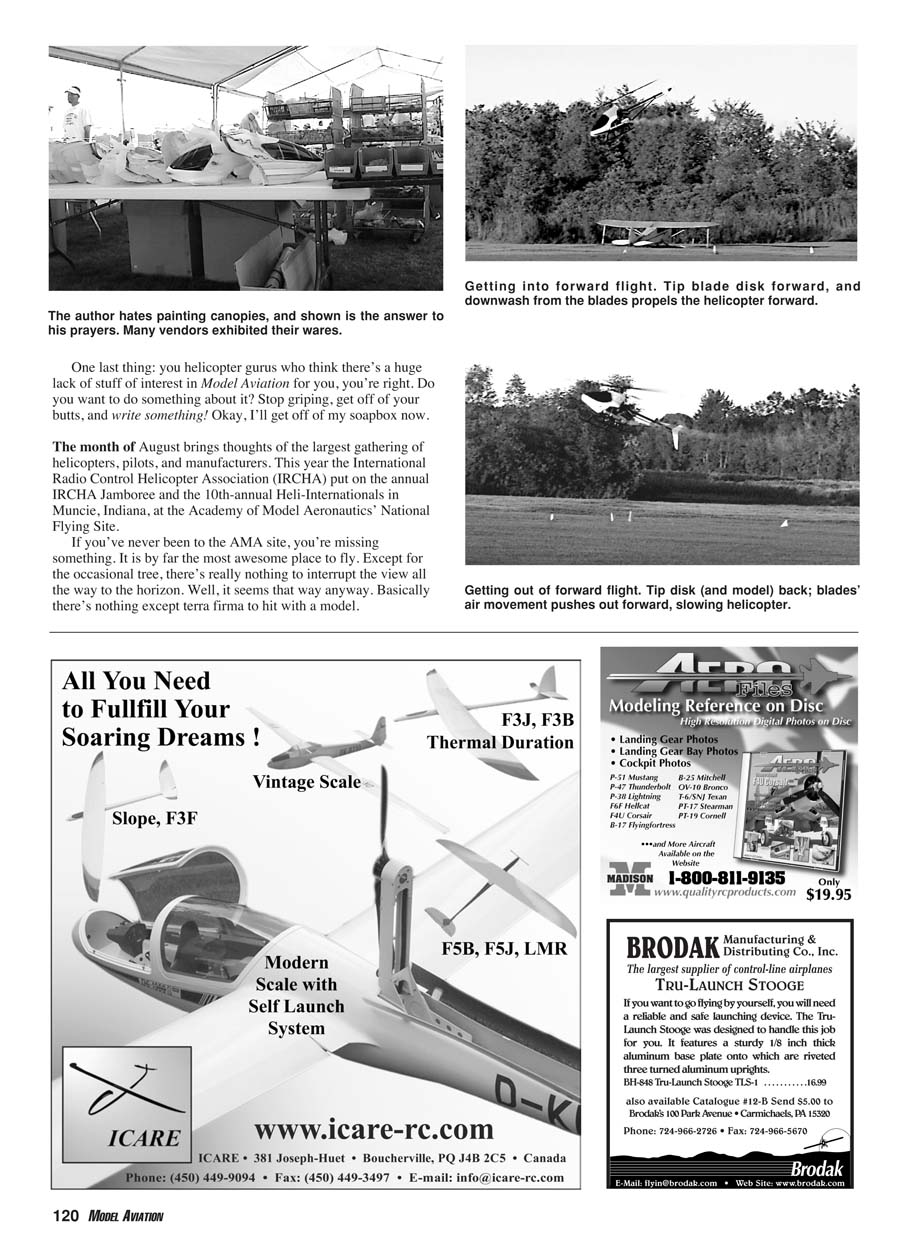
Everybody who's anybody shows up for this event. There isn't a better place to get help, see the latest stuff, see some great flying, and fly often after gallon. With 10 flight stations marked out along the runway, there's no excuse not to fly.
This year the Heli-Internationals was held August 14–17. The event brought in 378 registered pilots and more vendors than ever. Every day at noon the flightlines were shut down and demonstrations commenced. All of the major helicopter manufacturers demonstrated their stuff with the best 3-D flying you'll ever see.
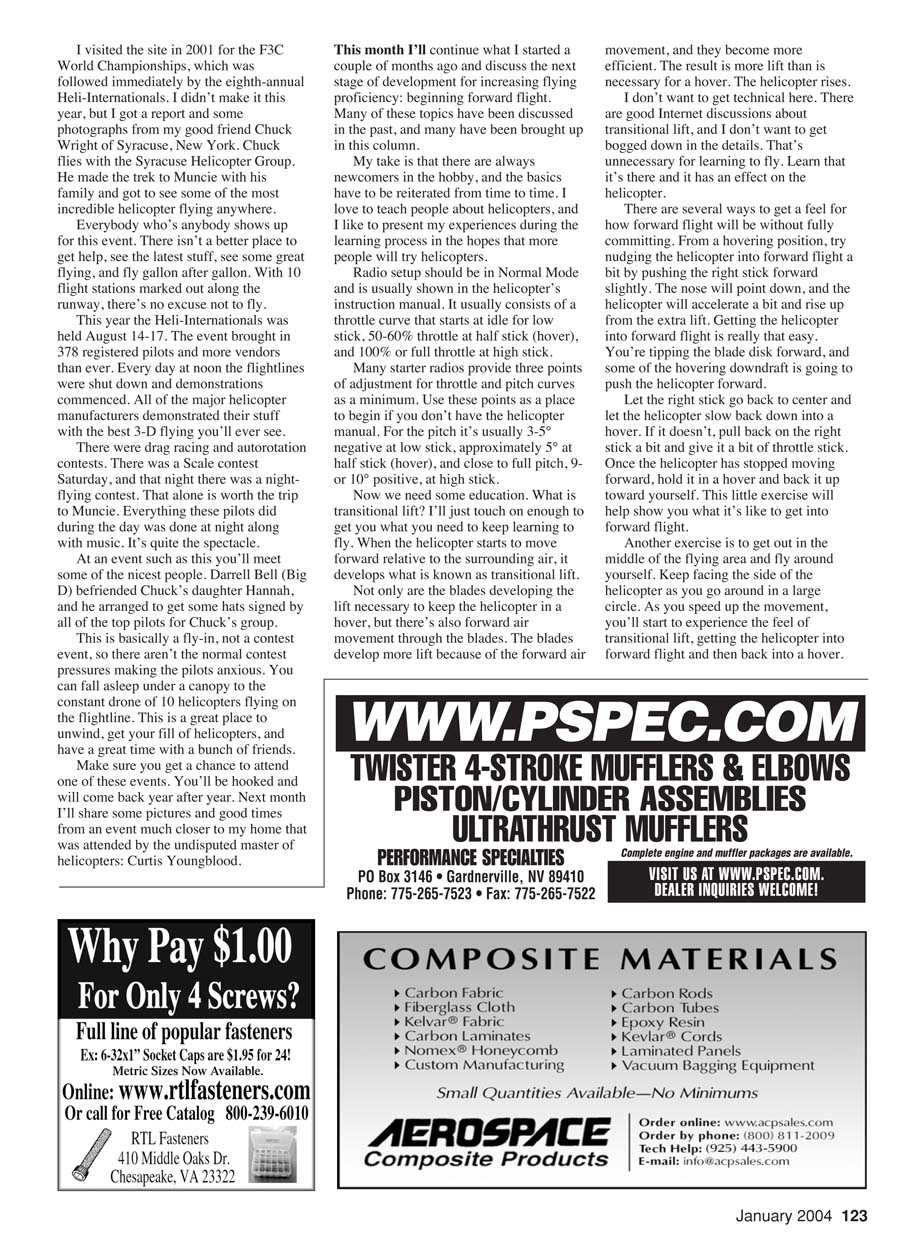
There were drag racing and autorotation contests. There was a Scale contest on Saturday, and that night there was a night-flying contest. That alone is worth the trip to Muncie. Everything these pilots did during the day was done at night along with music. It's quite the spectacle.
At an event such as this you'll meet some of the nicest people. Darrell Bell (Big D) befriended Chuck's daughter Hannah, and he arranged to get some hats signed by all of the top pilots for Chuck's group.
This is basically a fly-in, not a contest event, so there aren't the normal contest pressures making the pilots anxious. You can fall asleep under a canopy to the constant drone of 10 helicopters flying on the flightline. This is a great place to unwind, get your fill of helicopters, and have a great time with a bunch of friends.
Make sure you get a chance to attend one of these events. You'll be hooked and will come back year after year. Next month I'll share some pictures and good times from an event much closer to my home that was attended by the undisputed master of helicopters: Curtis Youngblood.
Beginning forward flight
This month I'll continue what I started a couple of months ago and discuss the next stage of development for increasing flying proficiency: beginning forward flight. Many of these topics have been discussed in the past, and many have been brought up in this column.
My take is that there are always newcomers in the hobby, and the basics have to be reiterated from time to time. I love to teach people about helicopters, and I like to present my experiences during the learning process in the hopes that more people will try helicopters.
Radio setup and curves
Radio setup should be in Normal Mode and is usually shown in the helicopter's instruction manual. It usually consists of a throttle curve that starts at idle for low stick, 50–60% throttle at half stick (hover), and 100% or full throttle at high stick.
Many starter radios provide three points of adjustment for throttle and pitch curves as a minimum. Use these points as a place to begin if you don't have the helicopter manual. For pitch it's usually 3–5° negative at low stick, approximately 5° at half stick (hover), and close to full pitch, 9–10° positive, at high stick.
What is translational lift?
When the helicopter starts to move forward relative to the surrounding air, it develops what is known as translational lift. Not only are the blades developing the lift necessary to keep the helicopter in a hover, but there's also forward air movement through the blades. The blades develop more lift because of the forward air movement, and they become more efficient. The result is more lift than is necessary for a hover. The helicopter rises.
I don't want to get technical here. There are good Internet discussions about translational lift, and I don't want to get bogged down in the details. That's unnecessary for learning to fly. Learn that it's there and it has an effect on the helicopter.
Exercises to feel forward flight
There are several ways to get a feel for how forward flight will be without fully committing:
- From a hovering position, bring the helicopter into forward flight a bit by pushing the right stick forward slightly. The nose will point down, the helicopter will accelerate a bit, and it may rise up from the extra lift. Getting the helicopter into forward flight is really that easy — you're tipping the blade disk forward, and some of the hovering downdraft is going to push the helicopter forward.
Let the right stick go back to center and let the helicopter slow back down into a hover. If it doesn't, pull back on the right stick a bit and give it a bit of throttle. Once the helicopter has stopped moving forward, hold it in a hover and back it up toward yourself. This little exercise will help show you what it's like to get into forward flight.
- Get out in the middle of the flying area and fly around yourself. Keep the side of the helicopter facing you as you go around in a large circle. As you speed up the movement, you'll start to experience the feel of translational lift, getting the helicopter into forward flight and then back into a hover. Practice circling in both directions.
- Do some figure eights out in front of you, turning the helicopter into the direction of flight as you go. Ease into it slowly. As you start the slow figure eights, you'll find that you need to use rudder to get the helicopter to turn; otherwise, it will bank but it won't turn. This is the big difference from flying a fixed‑wing model. You'll learn the value of rudder rather quickly.
Don't forget to practice the eights going both ways. As you bank, use a little back cyclic by pulling back a bit on the right stick. This will compensate for the lack of lift as the helicopter banks around the turn. Straighten everything out at the end of the turn by banking back to straight and letting go of the back cyclic.
Getting out of forward flight
Getting a helicopter out of forward flight can be a bit trickier, especially if you've really picked up momentum and altitude. Pull back slowly on the right stick, and ease down on the throttle stick a bit as the helicopter tries to rise up from the back cyclic. This will take away the forward force and start slowing the helicopter.
As the disk tips back, some of the downdraft keeping the helicopter aloft is going to be pushed forward, further slowing the model. I usually start this as the helicopter approaches me so I end up getting back into a full hover somewhere out past my position.
As you start slowing the helicopter, it will start to sink. If you're too high, that's a good thing. If you're already too low, you need to add more throttle stick to gain some altitude. It is a balancing act between cyclic, which is slowing the model, and throttle/collective, which is going to add power.
Once the helicopter stops moving forward, give whatever collective is necessary to hold it in a hover and use the right stick to keep a level attitude. I've included a couple of pictures to illustrate what the helicopter looks like when it's getting into and out of forward flight.
Additional tip: fixed‑wing stick time
If you know of a fixed‑wing model club or belong to one, see if you can get some stick time on someone's trainer airplane. That's one of the best ways to learn what to do in forward flight because a helicopter acts much like an airplane does. Doing the approach to landing is almost like getting the helicopter slowed and back into a hover. At nearly the time that the airplane is rotating to land, the helicopter should be leveled, have power added, and be brought up into a hover.
That's it for this month. Keep e-mailing me and I'll include what information I can. If you have pictures from an event, pass them along and give me some information; I'd be glad to include it. Keep practicing! Success is found at the bottom of each gallon of fuel burned. You've got to burn it to learn it!
MA
Transcribed from original scans by AI. Minor OCR errors may remain.

