
RADIO CONTROL HELICOPTERS
Dan Williams, 27 Treeline Dr., Liverpool NY 13090; E-mail: dlw@dreamscape.com
Summer events and the Northeast Model Helicopter Jamboree
Hi all! This being the July issue, the summer events are in full swing by now. There's something to do every weekend, and most weekends you have to choose which event to attend.
In the February issue I wrote about a local helicopter fly-in in Rochester, New York. We've decided to do it again, and it will be bigger this year. The Northeast Model Helicopter Jamboree will be August 27–29, and it will be sponsored by the Rochester Aero Modeling Society (RAMS) and Performance Hobbies. The RAMS will host again this year, and Curtis Youngblood will be back! Go to www.rcplane.com for more information.
Helping pilots get ready for the season
I can tell when it gets close to flying season. The telephone calls and e-mail messages start, and helicopter pilots begin looking for help getting their machines set up for hovering.
I've done many of these setups through the years. No matter how I try to speed up the process, it takes roughly four hours to go completely through a new helicopter: fix things that were assembled incorrectly, set up the radio, make necessary adjustments to the machine, and finally put fuel into it and fire it up. Then there are the adjustments to the engine, helicopter mechanics, the radio again, etc.
I enjoy it immensely when I can find the time to devote to it. If you haven't been through this aspect of the hobby, consider it. I feel like it's a way of giving something back.
There are a few things that bother me, though. Some pilots expect everything to be done for them. There are those who won't listen about an issue with the machine, ignore it completely, and then expect someone else to deal with the consequences. I have my ways of dealing with it; you should solve it the way you feel is best. Fortunately it doesn't happen very often.
I also feel bad for the new person who has just spent a ton of money and didn't buy the right stuff. Someone told him or her to get the wrong model, engine, or radio, and then I have to tell that person the bad news. Get with your local hobby shop and help educate the staff about the right helicopters and correct accessories, and let them know you're available for help. Give them your name, telephone number, and e-mail address. I usually meet the person at the shop, go out back, and start the process.
Try to remember exactly what it was like when you decided to start flying helicopters. Do you remember the excitement during the buildup and how frustrating it was when you couldn't get help? Many of us are fortunate not to have had to go through that. It could be that you've just dumped a great deal of money, you want to get on with the flying, and you can't connect with help, the weather doesn't cooperate, or something is wrong with a part and you have to wait for orders to come in.
Flight training and club programs
My fixed-wing club runs a flight school one evening every week, and the field and personnel are devoted only to helping the new people. We don't fly our own stuff until all the teaching is done. The newbies know they can go there and get expert help from the modelers who do it all the time. It's a lot of work, but it's good for the hobby and it helps build the future.
Through the years we've developed a regular flight-training program that all the instructors follow. We have a preseason session at the hobby shop during which we go over the models and help educate the new fliers. They have tons of questions; it's no wonder we have a tough time getting new blood into the hobby.
If your club is looking for something new to do, think about a flight-training program; you'll be surprised by the results. Your club will grow, you'll have new help for field chores and events, and best of all, you'll make a bunch of new friends.
WRAM Show and getting ready for the season
As I'm writing this, the Westchester Radio Aero Modelers (WRAM) Show in White Plains, New York (held February 20–22) just ended. WRAM Show time is a reminder for me to start working on the helicopters, cycling the battery packs, doing engine maintenance, and generally getting my act together for the flying season.
The WRAM Show is also a big help in eliminating my cabin fever from the long winter months. Seeing all the new models that will be coming out for the year makes me want to sell what I have and get new stuff.
Battery care
Cycling battery packs is cheap insurance against losing a machine because of battery failure. It won't catch every type of malfunction, but if there's a soft cell in the pack, you'll find it. If a pack of mine is more than three seasons old, I ditch it and get a new one. New batteries are cheap compared to buying a new machine.
With all the fast chargers out there, I've gotten out of the habit of charging my packs overnight and leaving them on trickle for the next flying session. I find myself fast-charging the packs on the way to the flying field. Battery cycling takes on even more importance in my mind because of this. Plus I'm generally paranoid about failures.
I still use Ni-Cd packs, but this year I picked up a few NiMH packs to see how they would fare. Don't forget the transmitter packs; I had to replace one during the winter because of exceptionally low capacity.
Industry contacts and the WRAM Show experience
Now that I'm approaching a year of doing this column, attending the WRAM Show was a bit different. I feel as if I know many more people in the industry. Going around to the various helicopter manufacturers and accessory booths, I enjoy talking to the people as part of the media instead of just a regular modeler. They really do try to give me the latest scoop on their new stuff.
Not all the manufacturers attend the WRAM Show anymore. In the past few years the model-helicopter industry has been shying away from this event and focusing more on the Toledo, Ohio, show. There are so many shows now and costs are escalating, so I guess they pick the biggest bang for the buck.
Robbe/Schluter Millennium III Pro
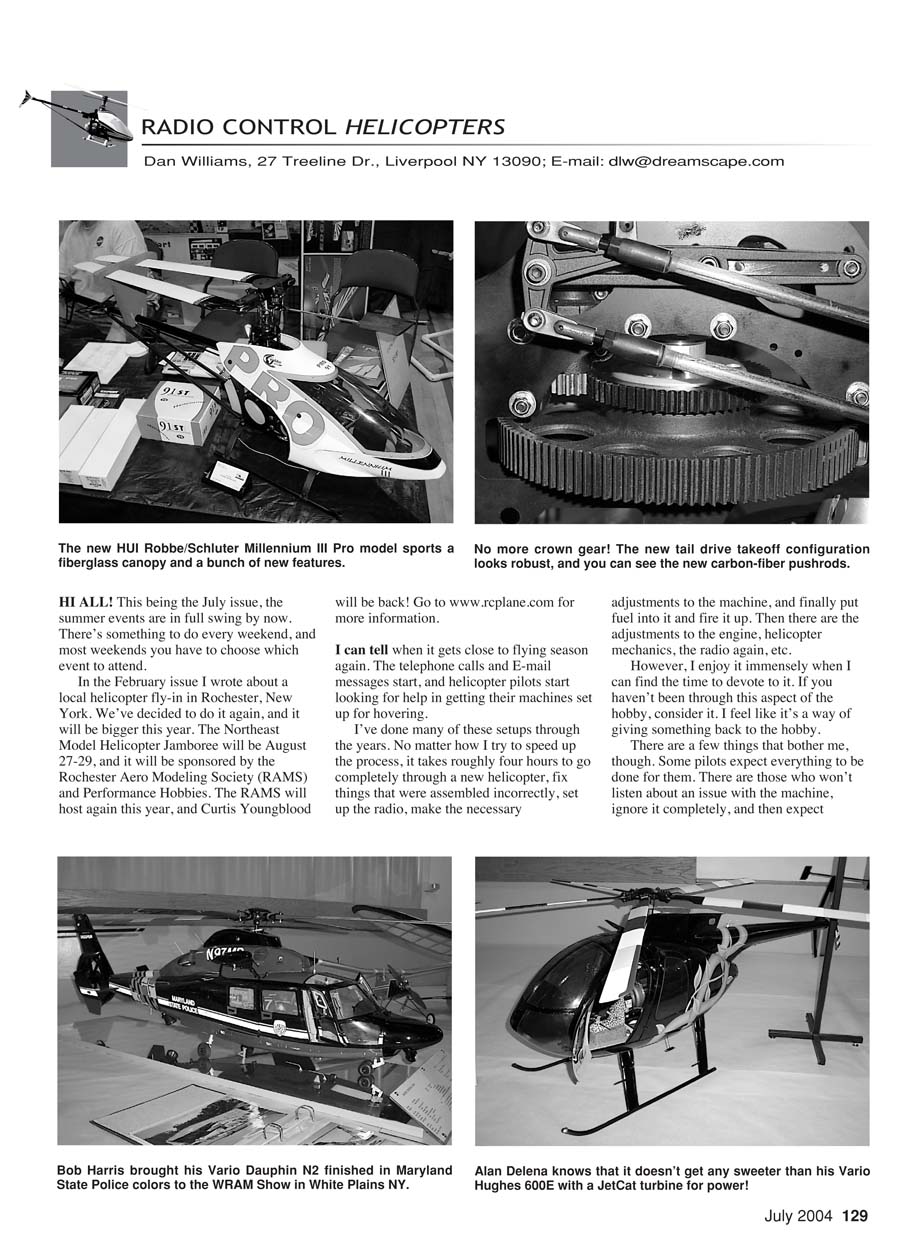
HUI (Helicopters Unlimited Inc.) / Robbe/Schluter introduced the latest in the Millennium series: the Millennium III Pro. I have a Millennium II (Millie 2), so the changes incorporated into the new machine made it easy for me to identify with and relate to. The representatives and sponsored pilots had their machines on hand, so the helicopters coming across the pond now are for the masses.
Robbe/Schluter introduced the model worldwide all at once, which was a departure from past introductions where Europe benefited from being first. In today's world economy, things such as this have to be done to keep from getting ripped apart on various Internet sites; everybody seems to know the news immediately.
Key features and changes:
- Fiberglass canopy (new design) with windshield screwed into the canopy; larger cheek on the muffler side to accommodate various mufflers without carving the canopy.
- New-style radio tray slotted for attaching radio gear.
- Servos mounted on their sides for CCPM (Cyclic Collective Pitch Mixing) swashplate control.
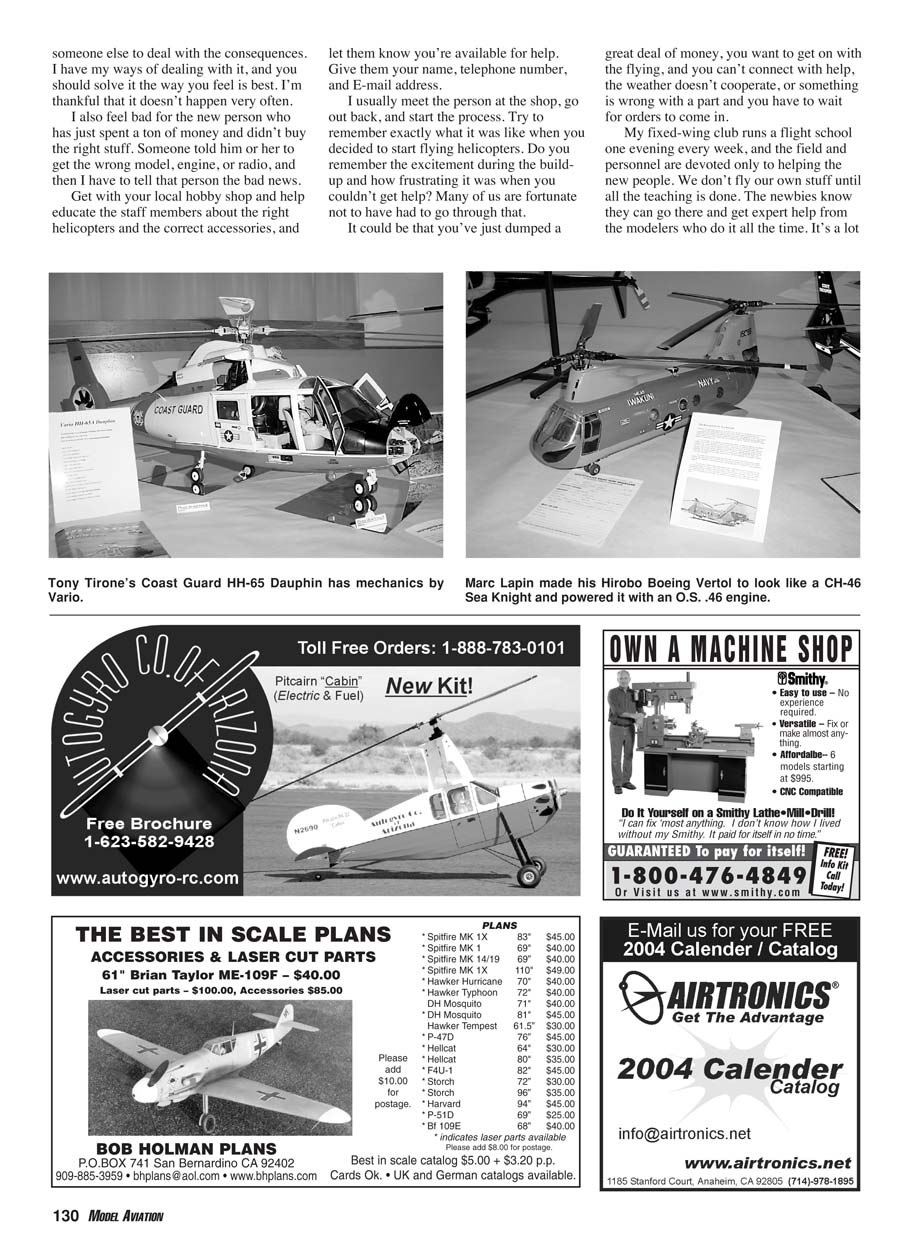
- Carbon-fiber pushrods, precut to size; ends assembled with J.B. Weld and adjustable.
- One-piece engine mount instead of the old two-piece design that used the engine as a structural member.
- Larger fan to accommodate 90-size engine cooling needs; resized shroud and larger fuel tank.
- Starter assembly with two ball bearings; two pinions included (7.5:1 and 8.5:1) to accommodate 60- and 90-size engines.
- Main shaft with three support bearings; new washout mixer.
- New flybar and rectangular flybar control-arm support with adjustable ratios.
- Three O-rings in the head and a rosette bearing for spindle support.
- Redesigned tail drive: no more crown gear to strip out. Tail drive takeoff is a second gear on top of the main gear, with a second pinion and bevel gears to rotate the drive to horizontal for the torque tube.
- Stainless-steel torque tube supported with two bearings in the boom; boom is longer to accommodate all blade lengths.
- Tail rotor mounted on the right side with scissor tail pitch control; tail pitch control rod is carbon fiber.
There are probably more features, but I could only write so fast while two guys were pointing them all out. Can you tell I'm excited? I've had my Millennium II for a couple of years, and I'm looking forward to getting one of these. All the new stuff is available as upgrades for the older Millennium; it's something to think about as parts get busted and replaced. Go to www.robbeusa.com for updates.
Scale helicopters
Something that fascinates me—and someday I hope to have the time to do it justice—is Scale. Scale models take special people and special talents. I guess I like to fly more than I like to build, so right now I'll stick to flying, but there's nothing cooler than a good scale helicopter.
Helicopters are tough to model because of all the exposed mechanics and, many times, fully exposed cockpits. With exposed cockpits and cabin areas, there isn't much room for servos and other necessities. Unless you want to get really adventurous, you're usually stuck with normal head mechanics and flybars.
A few companies have done scale head mechanics and have done a good job locating electromechanical necessities; these include Vario and Hirobo. Both have done a nice job with their scale helicopter offerings, and they make it much less intimidating to step into the Scale area.
For Hirobo kits, see www.modelrectifier.com. For Vario kits, see www.vario-usa.net.
Scale entries at the WRAM Show
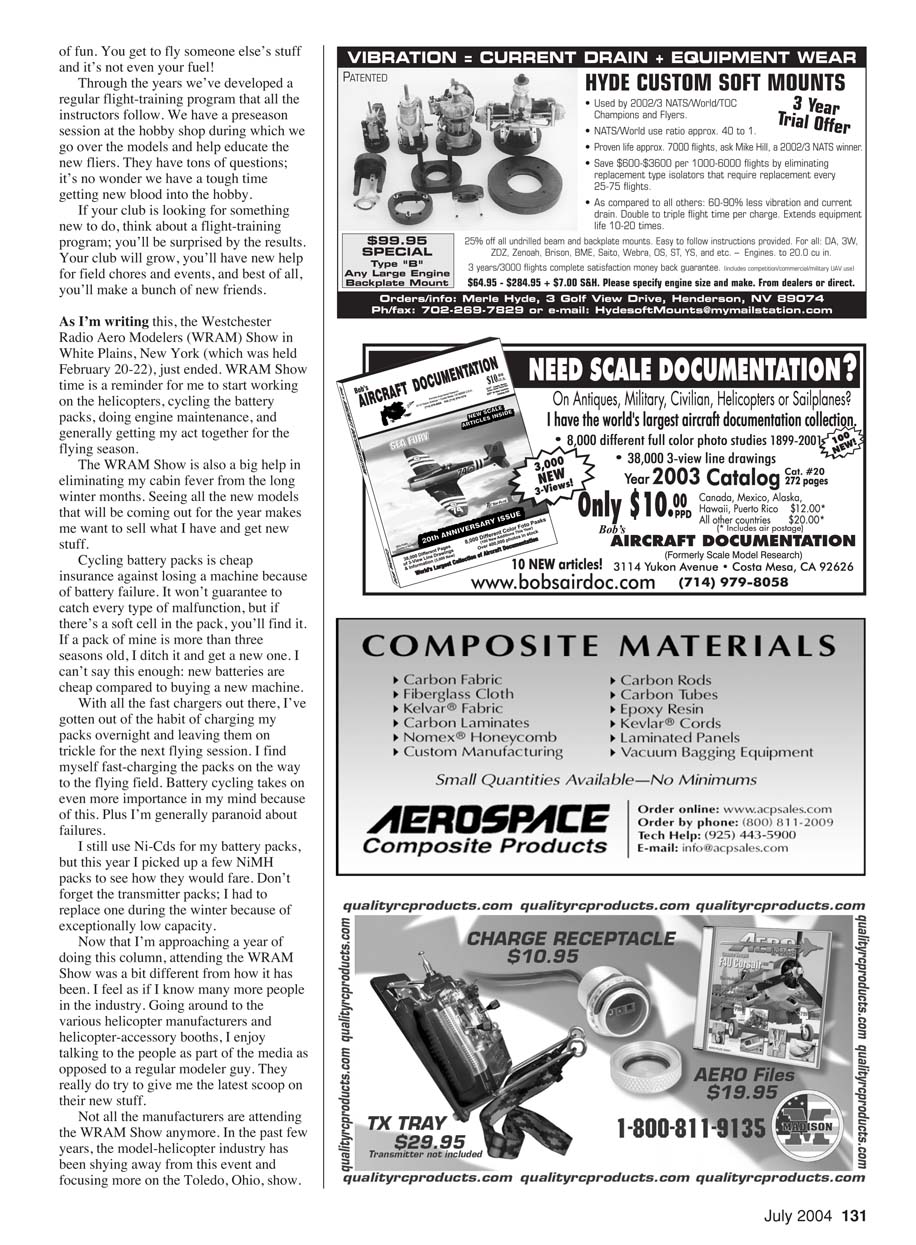
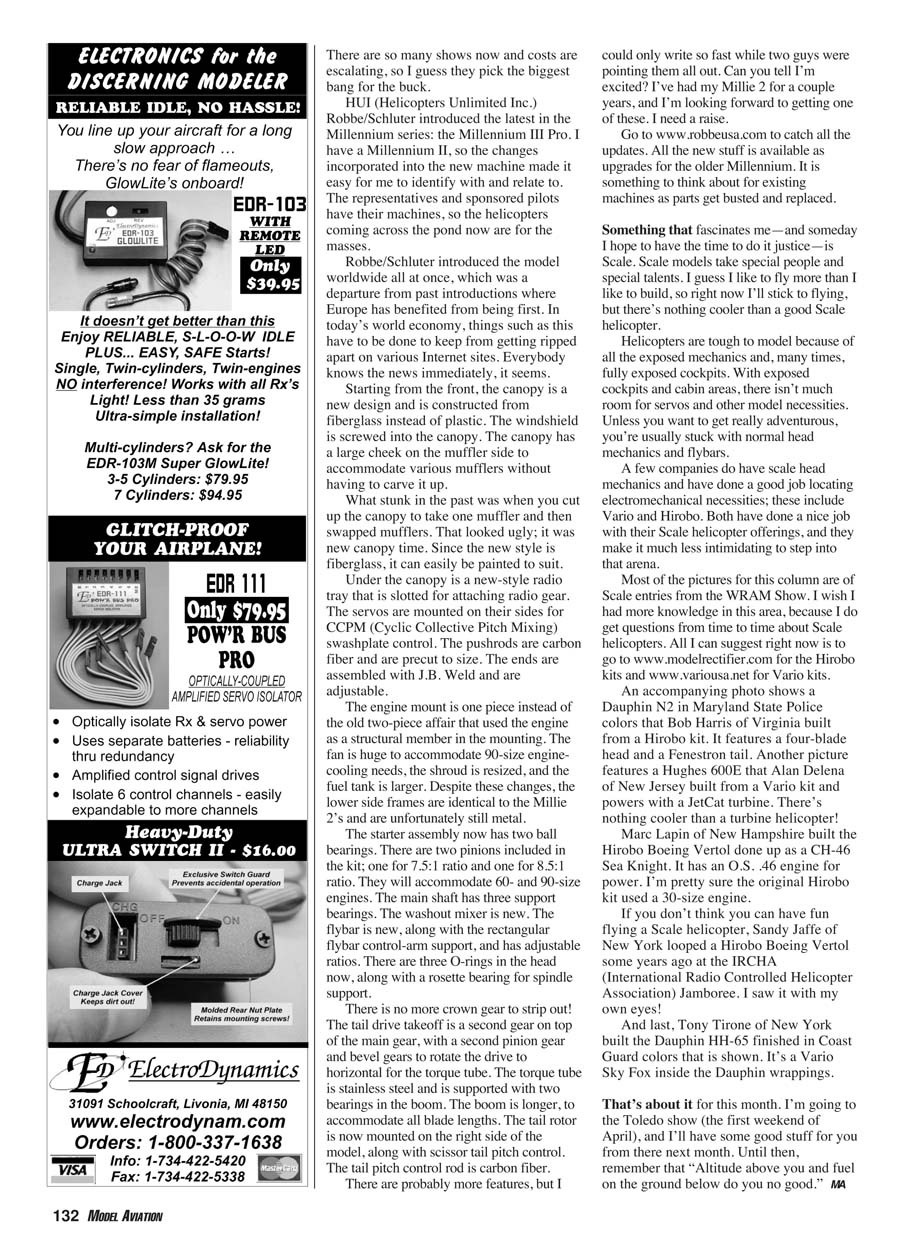
Most of the pictures for this column are of Scale entries from the WRAM Show.
Notable builds mentioned:
- Dauphin N2 in Maryland State Police colors — built by Bob Harris (Virginia) from a Hirobo kit; features a four-blade head and a Fenestron tail.
- Hughes 600E — built by Alan Delena (New Jersey) from a Vario kit and powered with a JetCat turbine.
- Hirobo Boeing Vertol done up as a CH-46 Sea Knight — built by Marc Lapin (New Hampshire); it has an O.S. .46 engine for power (original Hirobo kit likely used a .30-size engine).
- Hirobo Boeing Vertol looped at IRCHA — Sandy Jaffe (New York) looped a Hirobo Boeing Vertol some years ago at the IRCHA Jamboree.
- Dauphin HH-65 in Coast Guard colors — built by Tony Tirone (New York); it’s a Vario Sky Fox inside the Dauphin wrappings.
If you don't think you can have fun flying a scale helicopter, these examples show otherwise—there's nothing cooler than a turbine helicopter!
Closing
That's about it for this month. I'm going to the Toledo show (the first weekend of April), and I'll have some good stuff for you from there next month. Until then, remember: "Altitude above you and fuel on the ground below do you no good."
Transcribed from original scans by AI. Minor OCR errors may remain.

