
RADIO CONTROL HELICOPTERS
Paul Tradelis, 6704 Santiago, Ft. Worth TX 76133
Introduction
This month's Model Aviation revolves around newcomers to the hobby: how we can help them get started, expand their knowledge, and share the enjoyment of flying with them. In the past we have thought of these newcomers as youngsters, but now we're expanding the definition to include everyone who would like to enter the hobby—even those of the "older" generation. However, we should still make every effort to get young people involved in a worthwhile pastime so in years to come they can expand what we have started.
Whenever I think of helping someone enjoy our hobby, I can't help but think of my childhood in New York City and how modeling had such an important influence on my life. The story goes something like this: I was born and raised in the heart of NYC, and saw my first model airplane at the age of five in one of the city's few public parks. I was immediately fascinated by thoughts of being up in the air and traveling to distant places, and it wasn't long before I was drawing and designing airplanes.
This interest in aviation led to my enjoyment of math and the sciences in school, a degree in Aeronautical Engineering, and a 23-year flying career in the Air Force. I retired from that exciting career several years ago, and now I'm a commercial pilot for USAir. For as long as I can remember I have wanted to fly, and I have often wondered where life would have taken me if I had not been introduced to modeling at an early age.
Unfortunately, there are children in every city of the country who have no idea what they want to do with their lives, and only live from day to day. Without desires and goals they have no reason to go to school and study. Often their only alternative is to join a gang. With just a little effort we can help bring modeling into these children's lives.
Getting young people involved
Check with your local school to see if your club could make a special aviation presentation during the next Career Day or during a similar activity. This would be a perfect opportunity for you and your club to bring a few model helicopters, and possibly a video of helicopters flying, for the children to see. Those who show interest could attend your next club meeting or fun-fly; get names and phone numbers so you can follow up and provide transportation if needed.
Wouldn't it be nice to find a youngster looking for your friendship, who could help you with building or repairing in exchange for a little stick time or some other help getting started?
Other outreach activities that require less preparation include:
- Addressing a meeting of the local Cub Scouts or Boy Scouts. These organizations have many ways for scouts to learn about aviation, and the entire group could make a field trip to your next fun-fly.
- Mall shows. A club table with helicopters on display can generate interest with the young and old alike.
- Donating magazines. If your club has excess funds, instead of keeping them in a bank account drawing interest, subscribe to several modeling magazines in the name of your local public or school library. Many children don't have the funds to purchase modeling magazines, and donations to libraries provide good reading material for those with an interest.
- Providing access to a PC flight simulator. Once the spark of interest is generated, having access to a personal computer with a flight simulator is a great way to keep that spark alive as youngsters improve their flying skills. Young people adapt quickly to computers, and simulators seem to improve hand–eye coordination. If club funds are available, your local hobby shop might be able to pitch in on the purchase. This could be part of the hobby shop's facilities for customers of any age to use to help improve their flying skills—which should also generate more business for the shop.
- Club trainer program. The next time a club member outgrows his "trainer" helicopter, see if he will sell it to the club at a reasonable price to use as a club trainer. Although most youngsters probably can't afford to purchase a helicopter, they may be able to earn enough to pay for fuel and upkeep. This program gives them a real sense of accomplishment and keeps their active minds on an educational and enjoyable hobby until they can afford a helicopter of their own. Others thinking of joining the club could get some stick time on the trainer prior to their initial purchase.
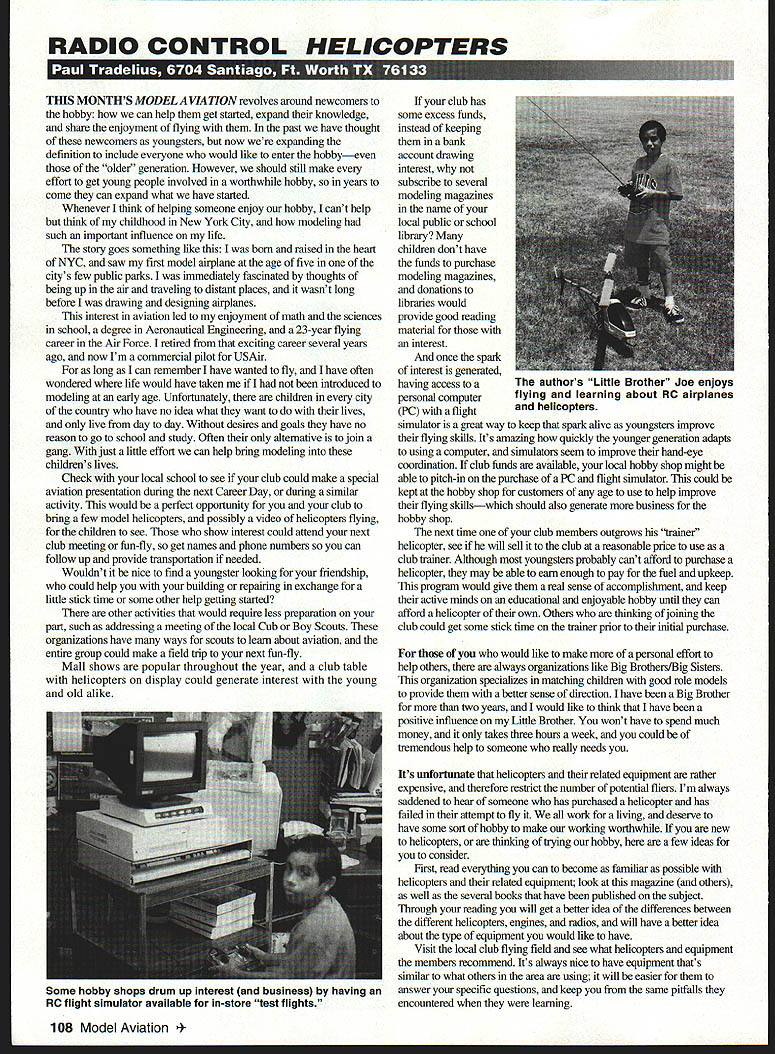
For those who would like to make a more personal effort, consider organizations such as Big Brothers/Big Sisters. This organization matches children with role models to provide them with a better sense of direction. I have been a Big Brother for more than two years, and I would like to think that I have been a positive influence on my Little Brother. You won't have to spend much money; it only takes about three hours a week, and you could be of tremendous help to someone who really needs you.
Helping newcomers to helicopters
It's unfortunate that helicopters and their related equipment are rather expensive, and therefore restrict the number of potential fliers. I'm always saddened to hear of someone who has purchased a helicopter and failed in their attempt to fly it. We all work for a living and deserve a hobby to make our working worthwhile. If you are new to helicopters, or are thinking of trying the hobby, here are a few ideas to consider:
- Read everything you can to become familiar with helicopters and their related equipment. Look at this magazine and others, as well as the several books that have been published on the subject. Through reading you will get a better idea of differences among helicopters, engines, and radios, and will better understand the type of equipment you would like to have.
- Visit the local club flying field to see what helicopters and equipment the members recommend. It's always nice to have equipment similar to what others in the area are using; it will be easier for them to answer your specific questions and keep you from the same pitfalls they encountered while learning.
- Match radios when possible. Having the same brand of radio as other fliers—especially one with a buddy-box feature—will pay big dividends when you start flying circuits and have an instructor ready to take over when needed. Hopefully there will be several modelers willing to give you personal instruction and recommendations.
- Talk with local hobby shops. Local fliers should be able to recommend a hobby shop where you can get a first-hand look at models and radios.
- Buy equipment that fits your budget, and buy the best helicopter you can comfortably afford. It will probably last longer and give you better service while you have it. Later, if you decide to sell your helicopter, there will probably be someone willing to purchase it at a reasonable price.
- Consider used helicopters. Don't overlook used helicopters from hobby shops or individuals. Helicopters that have been taken care of should provide many years of useful service. Many are available simply because the owner wants to try something new. However, if you're not familiar with the used helicopter you're considering—or the person selling it—get a second opinion from someone you trust so you don't buy someone else's problems.
- Ensure proper setup for novices. Whatever helicopter you purchase, it must be set up for a novice to fly. Before you even start the engine, get one of the local fliers or the local hobby shop to make sure the helicopter is set up correctly.
- Use training gear and practice hovering. Install a wide-set training gear, and get some basic hovering instruction. Keep the model close to the ground and practice. Remember: if you can hover at six inches you can hover at six feet—but it's much more difficult to hurt the helicopter at the six-inch level.
Final thoughts
I hope I've helped provide motivation for you to help others who haven't had the opportunity to enjoy our hobby. It may cost your club a little time and money to get things started, but wouldn't that be a great project for the entire club? Even if it costs you some time or money, big dividends can be gained by making this world a better place in which to live. I've spent a lot of time and money on all forms of modeling with my children and others, but I've never had to spend a dime on drug rehab. Let's all put our time, effort, and money where they can do the most good.
Transcribed from original scans by AI. Minor OCR errors may remain.

