

RADIO CONTROL HELICOPTERS
Paul Tradelius, 6704 Santiago, Ft. Worth, TX 76133
NATS UPDATE
The 1996 Helicopter Nationals is just around the corner, and I hope you are making plans to attend.
There is an important update: FAI-F3C will be flown and judged according to the 1997 FAI Sporting Code. Contact the AMA HQ — Competitions Dept. for additional information and/or a complete rules package. They can be reached at (317) 287-1256.
Flying the Tornado
In the May 1996 issue I described the assembly of the newest helicopter on the market: the Tornado by Precision Helicopters, Inc. Since then I have had a chance to complete the Tornado and put several flights on it, and I am very pleased with its performance.
It wasn't many years ago that radio-control helicopters were in their infancy, and reports of how they went together, the parts fit and instructions, as well as their flying performance and ease of maintenance, gave all of us an idea if that model was state of the art. However, in recent years the design and manufacturing of modern helicopters has become more of a science than an art, and we should feel very confident that a new helicopter will meet or exceed the standards we have come to enjoy. That is just the case with the Tornado.
High-quality materials, combined with a proven basic design, produced a helicopter that is capable in the hands of a novice or expert flier. My Tornado was one of the first kits available, and several upgrades have already been made to improve the kit. The new kits (available as you read this) will include:
- a new nylon main gear
- a fiberglass (instead of plastic) canopy
- carbon-fiber flybar doublers
- an improved paddle design for enhanced aerobatic performance
- carbon-fiber tailboom supports
- an improved tail rotor pushrod
- a flexible landing gear system
And coming soon, the metal side frames will give way to carbon fiber for an even stronger and lighter helicopter. Although my Tornado does not have any of the above upgrades, I am very impressed with its performance just as it is.
The Tornado can be set up for a novice by reducing the collective pitch range and reducing the control sensitivity by decreasing the amount of cyclic and tail-rotor control. In this tamed-down setup, the Tornado can be used to learn to hover as well as the basics of forward flight. When you're ready, readjust the collective pitch range, increase the control movements, and lean out the engine slightly for optimum power — you are ready for unlimited aerobatics.
I have always been impressed with belt-driven tail rotors because of their simplicity, ease of maintenance, light weight, and performance equal to a shaft-driven tail rotor — this one is no different. The Tornado has excellent tail rotor authority and smoothness of operation, which is essential for modern 3-D aerobatics.
It also seems that whenever I read about a helicopter in a magazine, the writer always mentions the strong points of the helicopter but rarely has anything bad to say about it. Well, I have given that some thought, and although there are some things I would have done differently, I don't have a lot of bad things to say about the helicopter — especially since improvements and upgrades are continuing to be made.
However, there is one thing I wish they would change in the future: the way the canopy is mounted. Three 3 mm bolts (one on each side and one on the bottom of the nose) are used to firmly attach the canopy, and although the bolts do a super job, they are hard to align when installing the canopy.
I have always favored the snap-on canopy, secured with a rubber band, as a simple and easy way to attach any canopy. That method would be a little hard to do on the Tornado because of the metal servo tray, but maybe they could somehow get rid of the bolts in the future. That's not really much of a criticism, but it is worth mentioning.
I would expect the combination of an excellent design and quality parts to keep the Tornado in the air and at the flying fields for a long time to come. So if you are looking for a different helicopter for your next project, I can certainly recommend this one.
And just before I sent in this article, I was informed that the manufacturers of the Tornado have found a better supplier of their needed bearings, which not only reduces the cost significantly but also improves the quality of the bearings. The current retail price of the Tornado is $599, and kits and parts can be obtained from Sunbelt HobbyTech at (205) 539-3191.
Futaba Radio and Piezo Gyro
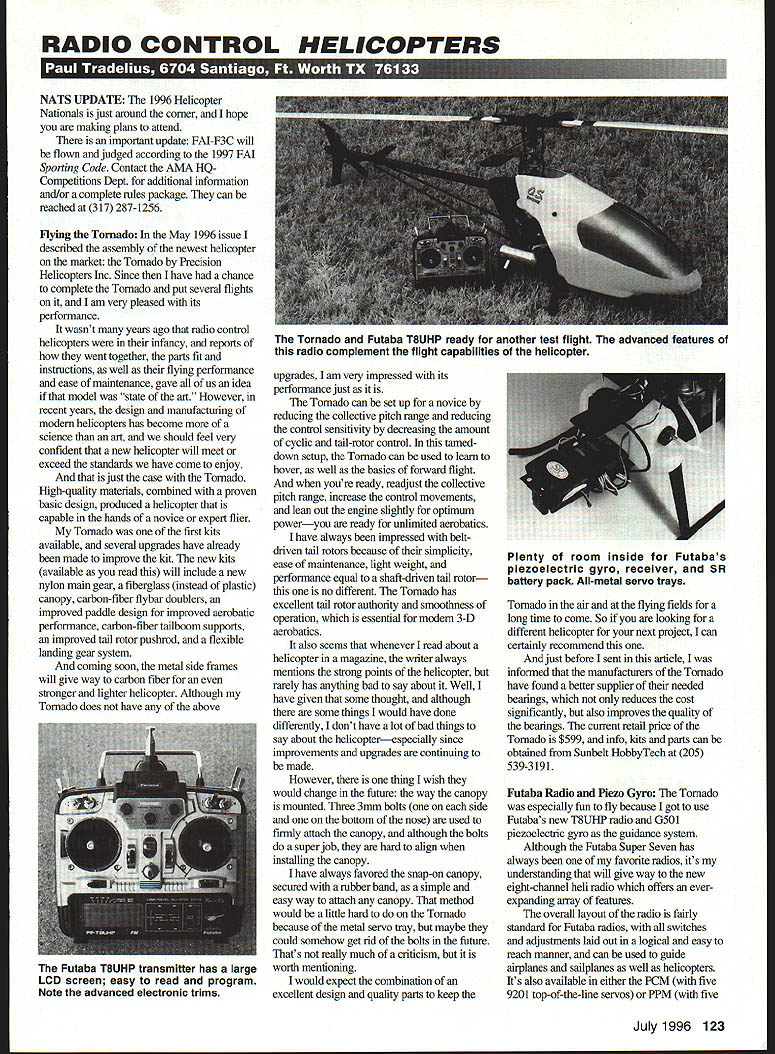
The Tornado was especially fun to fly because I got to use Futaba's new T8UHP radio and G501 piezoelectric gyro as the guidance system.
Although the Futaba Super Seven has always been one of my favorite radios, it's my understanding that the new eight-channel heli radio offers an ever-expanding array of features.
The overall layout of the radio is fairly standard for Futaba radios, with all switches and adjustments laid out in a logical and easy-to-reach manner, and it can be used to guide airplanes and sailplanes as well as helicopters. It's also available in either the PCM (with five 9201 top-of-the-line servos) or PPM (with five 301 standard ball-bearing servos) versions. To list and describe all of the radio's features would take a small book, so I'll just cover the basic functions here and go into more detail on what I believe are the more significant features.
Just a few years ago, having reversing switches was a big thing, but now we take for granted the features of almost every high-quality radio. These features include:
- memory for several helicopters
- adjustable stick length
- servo reversing
- adjustable servo throw
- dual rates
- exponential
- sub-trim
- fail-safe on PCM radios
Certainly the T8UHP has all these features, and more.
The "8" in the name of this radio means that it can store data for eight separate helicopters. You can also purchase a CAMPac module that will store an additional eight models.
This feature is fairly significant — not only because it allows you to store more models, but because you can use this module to transfer data from one transmitter to another. If you like the parameters on one of your friends' helicopters and you have a CAMPac, simply copy his parameters to the CAMPac and then plug the module into your transmitter. I can see this being a neat feature if two novices (or experts) are flying together and don't want to reinvent the wheel each time one makes a programming improvement.
This radio will also work with your other Futaba receivers, whether PCM or PPM (however, the PCM receiver must be of the 1024 type) and is programmed using a large LCD display panel, which is easy to see and use.
However, as with any more advanced radio with a lot of features, make sure you don't misplace the instruction manual. I keep mine in the transmitter case so it's always with me even when I go flying. That's not to say the radio is hard to program, but until you get familiar with all its features, it's much easier to use the manual as a quick reference. The manual is very well written in plain English to take you step-by-step through every feature of this radio.
One of the nicest features is the electronic trims, which replace the standard movable trim levers we have been using for years. To apply a little aileron trim, just "blip" the trim slightly for the smallest change. If a large amount of trim change is needed, hold the trim button and the amount of trim change actually accelerates as you hold it. The sensitivity of the trim can be programmed to match your desires, and the current trim position is always displayed on the LCD panel for quick reference.
The LCD screen is located on the lower left of the transmitter. The displays are large and easy to read, and the large buttons to the right of the screen allow for easy data entry. To improve programming efficiency, all transmitter functions have been separated into Basic and Advanced Menu items. But keep the instruction manual handy for a while.
Futaba has also entered the piezoelectric gyro field with the introduction of their G501 rate gyro. It is available with or without an S9203 high-speed/coreless servo, which was designed specifically for this gyro.
Some of the features of the G501 include:
- high-frequency response, which minimizes a helicopter's heading variations caused by the wind
- transmitter stick position that accurately controls the yaw rate of the helicopter
- a self-calibration phase of about five seconds when power is applied to cancel any drift or deviation from the desired heading
Although these features are an improvement over standard mechanical gyros, one of the nicest advantages of the G501 is that it should have a much greater service life because there are no moving parts, making it more resistant to mishaps.
Servos and Single-Stick Transmitters
I received a letter recently from Bob Jonasson of Carmel, CA, who wanted to make two points:
The first was on my March '96 column concerning the early disappearance of linear servos (now all our servos have a rotary output). He would like to see some input to the radio manufacturers by us (the users) and the AMA to convince them to at least offer a dual-output linear back servo in the future.
These type servos were probably dropped many years ago because rotary servos could be made in a smaller case, but now our electronics have reduced in size so much that we could stand a slightly larger servo in almost any airplane or helicopter that would have push-pull output and eliminate the control problems of a rotary servo.
Bob's other comment has to do with single-stick radios, and is something I have never considered before. He believes ACE R/C is the only radio manufacturer still making single-stick radios, but these radios are needed desperately by those fliers (of helicopters, airplanes, etc.) who have lost the use of one hand.
We have one such flier in the Ft. Worth Thunderbirds who uses a special tray to support a single-stick radio, and you could not tell any loss of performance in his flying or his enjoyment of the hobby. I would hope there is something we can do to revive the interest in single-stick radios, especially for this very important group of fliers.
Transcribed from original scans by AI. Minor OCR errors may remain.

