
RADIO CONTROL HELICOPTERS
Paul Tradelius, 6704 Santiago, Ft. Worth, TX 76133
A CLUB ANSWERING MACHINE
Some time ago I came up with the idea of using an answering machine to improve communication among club members. I believe the idea is a valid one, and I would like to explain it in the hopes that your club might be able to use (and expand on) this idea.
With every club there is always the problem of getting every member to the meetings so they can voice their opinion and vote on club issues. Members may have valid reasons why they can't attend (illness, vacation, work, etc.), but it would be nice to have their vote, or at least their opinion on important matters. This problem can be easily solved with the use of a club answering machine, used in a way similar to the following.
After the club meeting a short version of the minutes (including votes on various issues) could be placed on the outgoing message of the answering machine. Those members who could not attend the meeting could call and listen to the message, then leave a message of their opinion, or their vote, as needed. A tentative vote could be taken at the meeting, and the members who could not attend could be given, say, a week to get in their vote via the answering machine. This would certainly allow for more member input on important issues.
Newer answering machines, especially those that are built into computers, have up to 999 mailboxes that can be used by the club in any number of ways. Examples include:
- One mailbox for items for sale—do you know who wants to sell what in your club right now?
- One mailbox for fliers who need help—those who are in need of parts, advice, etc.
- One mailbox for coordinating who will be at the flying site over the weekend at what time; this way novice fliers could team up with more-experienced fliers.
These are just a few ideas on how a club answering machine would come in handy; with a little thought and an analysis of your club's needs, you can come up with even more useful ideas to help the whole club.
There will always be someone who will read this and say, "That won't work because of X problem." I am not saying this idea is foolproof, but I do believe that any associated problem can be discussed and solved. It may take a dedicated phone line, someone who has a computer with a built-in answering machine to manage it, and some brainstorming by a lot of club members. If given a chance, it will improve your club's communication and everyone's overall enjoyment of the hobby.
I would also like some feedback from those of you who try this idea—those who give it a try and succeed and those who do not. I will correlate all the inputs and report what different clubs are doing—how they are solving their problems, and what benefits they see when using the answering machine. Soon I will start including my E-mail and home-page address at the end of every column to make communication with me even easier.
Two Different Phone Calls
Now that the summer flying season is in full swing, as a helicopter flier you should fall into one of two categories:
- The novice looking for a place to fly.
- The more-experienced flier helping newcomers with their first helicopter.
I recently received two phone calls dealing with these positions, and in each case I thought the caller had the wrong idea.
The first call came from a novice who did not want to come out to the club flying field until he was a better pilot. He was at the very beginning of the learning curve, and was flying a new helicopter with the biggest set of training gear he could find. The model suffered from a little vibration (the cause of which had yet to be found), and an engine that wasn't running quite right.
He thought he would do better flying by himself for a while until he was good enough to take off the training gear and "fit in" better with the rest of the guys at the field. I told him very quickly (and in no uncertain terms) that our club was there to help new fliers (just like him) so they wouldn't have to make all the learning mistakes we did when we had no one to help us.
Although flying a model helicopter is not hard (once you learn how), there are certain techniques that will speed the learning process, and things you can look out for to prevent future mishaps. As we discussed the topic a little further, I asked what had given him the impression that he should wait before flying with us, and he mentioned the following reasons.
He felt that he did not fit in with the rest of the fliers because he was still using training gear. He didn't say it, but I'm sure he really meant that he was embarrassed by his lack of flying ability. When he read helicopter columns (such as this one), most of the photos were of expert fliers, rather than beginners with training gear.
If there is someone like this in your area, I hope you and your club will welcome the new flier so he or she can learn from those who are more experienced. Every one of us had to learn basic hovering (as well as basic walking, etc.) and it will only take a few words of help and encouragement to make the "new guy" enjoy this hobby even more.
The second phone call was especially displeasing, because the caller had gone out to the local helicopter club field to get help, but was very rudely turned away because he did not have the helicopter/radio/engine combination that was preferred by most of the fliers. Rather than help him with the equipment that he already purchased (which worked fine), he was told to buy different brands of equipment (his helicopter and radio, for example) and then come back for help.
As you can imagine, he was very upset that he had made the purchase to begin with, and didn't want anything more to do with the hobby after he was so rudely treated.
Most of us who have been flying for a while have been at the field when a new flier has arrived with something we would not necessarily have recommended. The fact remains that the flier has already paid for his equipment, and that it will work at least satisfactorily. Rather than hurt his feelings, the best course of action is to help him get into the air with his current helicopter so he can enjoy this hobby as much as we do.
New Products
Horizon Hobby Distributors (4105 Fieldstone Rd., Champaign, IL 61821) has been distributing the JR Super Servo to hobby shops for some time now (in both the standard and low-profile configurations), and I have been using them in my helicopters with great success.
I talked to Curtis Youngblood about these servos, and his opinion was that if you were going to use one of these servos in a 3-D machine (and do a lot of backward flying), the rudder would be the best place for it because of the need for a very steady tail. However, since most of my flying is nose-first, I think the best use for it would be the collective function. The collective needs a strong servo to accurately position the collective pitch of the blades—and to keep them there. Of course, you can use these servos throughout your helicopter (as Curtis does); just make sure you have a large-enough battery pack to handle the extra current they require.
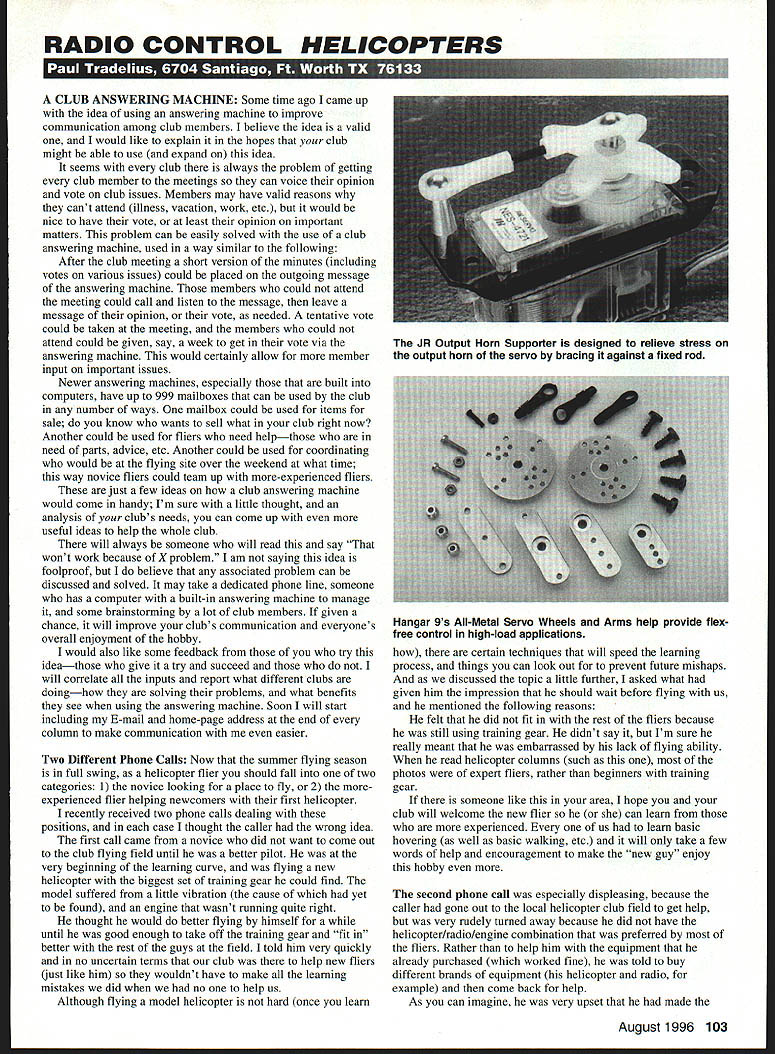
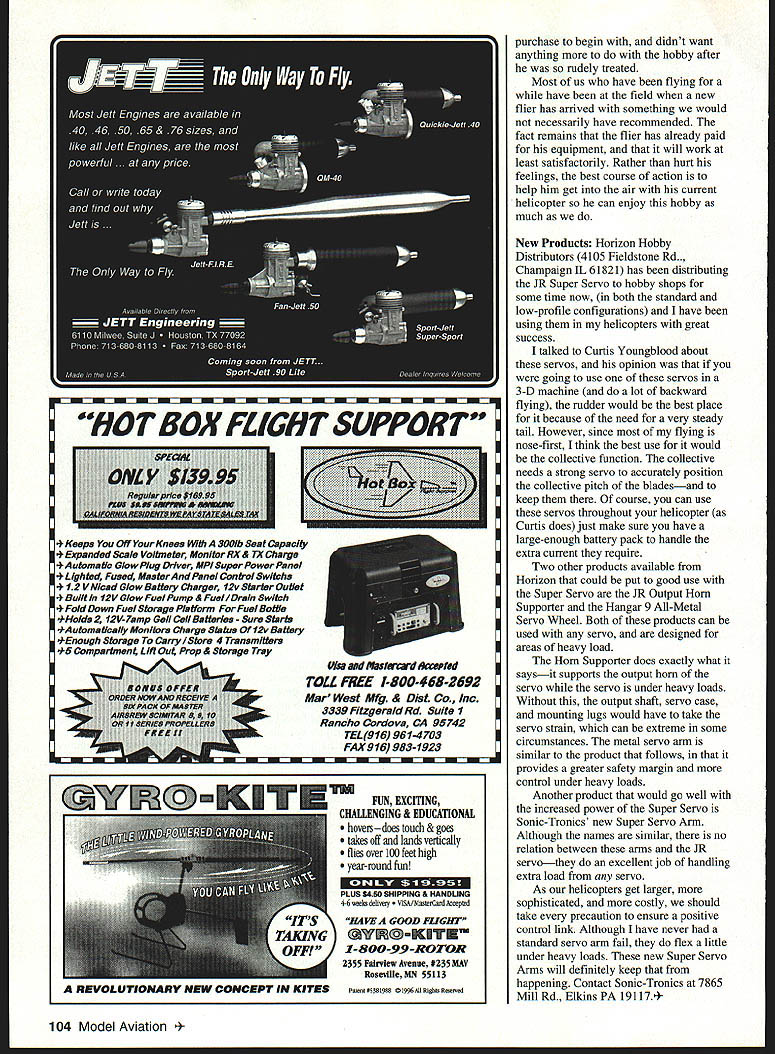
Two other products available from Horizon that could be put to good use with the Super Servo are the JR Output Horn Supporter and the Hangar 9 All-Metal Servo Wheel. Both of these products can be used with any servo, and are designed for areas of heavy load.
The Horn Supporter does exactly what it says—it supports the output horn of the servo while the servo is under heavy loads. Without this, the output shaft, servo case, and mounting lugs would have to take the servo strain, which can be extreme in some circumstances. The metal servo arm is similar to the product that follows, in that it provides a greater safety margin and more control under heavy loads.
Another product that would go well with the increased power of the Super Servo is Sonic-Tronics' new Super Servo Arm. Although the names are similar, there is no relation between these arms and the JR servo—they do an excellent job of handling extra load from any servo.
As our helicopters get larger, more sophisticated, and more costly, we should take every precaution to ensure a positive control link. Although I have never had a standard servo arm fail, they do flex a little under heavy loads. These new Super Servo Arms will definitely keep that from happening. Contact Sonic-Tronics at 7865 Mill Rd., Elkins, PA 19117.
Transcribed from original scans by AI. Minor OCR errors may remain.

