

RADIO CONTROL HELICOPTERS
Paul Tradelius 6704 Santiago, Ft. Worth TX 76133
THE KNEE OF THE CURVE
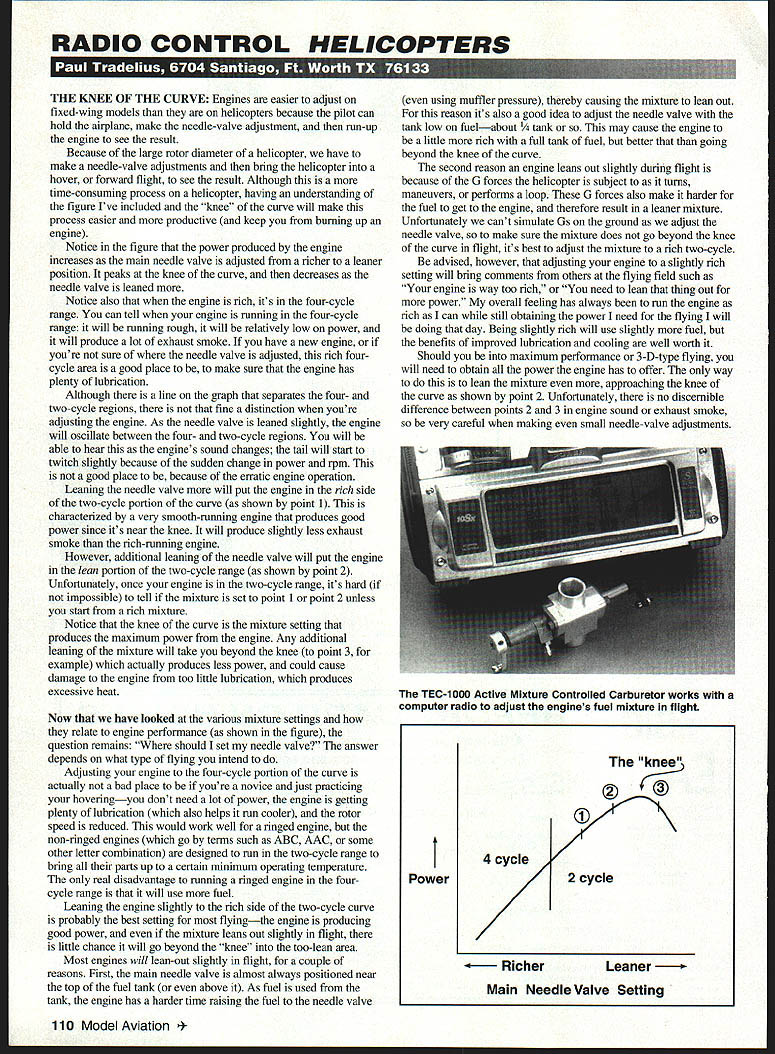
Engines are easier to adjust on fixed-wing models than on helicopters because the pilot can hold the airplane, make the needle-valve adjustment, and immediately see the result. With a helicopter, because of the large rotor diameter, you must adjust the needle valve and then bring the helicopter into a hover or forward flight to evaluate the change. Although this is more time-consuming, understanding the figure I’ve referenced and the "knee" of the curve will make the process easier and help prevent engine damage.
Notice that as the main needle valve is adjusted from a richer to a leaner position, engine power increases, peaks at the knee of the curve, and then decreases as you lean further. When the engine is rich it is in the four-cycle range: it will run rough, produce relatively low power, and create a lot of exhaust smoke. If you have a new engine or aren’t sure of your needle-valve setting, the rich four-cycle area is a safe place to start because the engine receives plenty of lubrication.
Although the graph shows a line separating the four- and two-cycle regions, in practice the transition is not sharp. As you lean the needle slightly the engine may oscillate between four- and two-cycle behavior; you will hear changes in sound and may see the tail twitch as power and rpm change. This erratic operation is not a good place to be.
Leaning the needle valve further will put the engine on the rich side of the two-cycle portion of the curve (point 1). This is characterized by a very smooth-running engine that produces good power and slightly less smoke than the rich four-cycle condition. Additional leaning moves the engine into the lean portion of the two-cycle range (point 2). Once the engine is in the two-cycle range, it can be hard—if not impossible—to tell whether the mixture is at point 1 or point 2 unless you start from a rich mixture and work back.
The knee of the curve is the mixture setting that produces maximum power. Any additional leaning beyond the knee (for example, point 3) reduces power and risks damage from insufficient lubrication and excessive heat.
Where should you set the needle valve? It depends on the flying you intend to do:
- For novices practicing hovering: Setting the engine in the four-cycle portion is not a bad place to be. You don’t need a lot of power; lubrication and cooler running are beneficial, and rotor speed is reduced. This works well for ringed engines. Non-ringed engines (ABC, AAC, etc.) are designed to run in the two-cycle range to reach a minimum operating temperature. The main disadvantage of running ringed engines in the four-cycle range is increased fuel consumption.
- For general flying: Leaning slightly to the rich side of the two-cycle curve is probably the best compromise. The engine produces good power, and if the mixture leans out slightly in flight there’s little chance of going beyond the knee into the too-lean area.
Most engines will lean out slightly in flight for two main reasons:
- Fuel-tank height: The main needle valve is usually near the top of the fuel tank (or above it). As the tank empties, it becomes harder for the engine to raise fuel to the needle valve (even with muffler pressure), causing the mixture to lean. For this reason, adjust the needle valve with the tank low on fuel—about 3/4 full. A full tank may make the engine a bit rich; better to err slightly rich than go beyond the knee.
- G forces: Turning, maneuvering, or performing loops subjects the helicopter to G forces that make it harder for fuel to reach the engine, producing a leaner mixture. We can’t simulate Gs on the ground, so set the mixture slightly rich of the two-cycle knee to avoid going too lean in flight.
Expect comments at the flying field telling you your engine is “way too rich” or to “lean that out for more power.” My preference is to run the engine as rich as possible while still obtaining the needed power. Being slightly rich uses a bit more fuel but improves lubrication and cooling.
- For maximum performance / 3-D flying: If you need every bit of power, you must lean the mixture toward the knee of the curve (approaching point 2). This area is dangerous for engine longevity; there is no obvious difference in sound or smoke between a safe peak and a too-lean, damaging setting (points 2 and 3), so make very small adjustments and accept the increased risk.
One more caution: Don’t rely on exhaust smoke alone to determine needle-valve setting. Smoke varies with oil type and amount, muffler or tuned pipe design, atmospheric conditions, and the mixture setting. I’ve seen pilots running lean beyond the knee who swore they couldn’t be lean because they saw smoke—only to have short-lived engines and ruined glow plugs prove otherwise.
NEW PRODUCTS
Horizon Hobby Distributors (4105 Fieldstone Rd., Champaign IL 61821) has released the TEC-1000 Active Mixture Controlled Carburetor. I haven’t had a chance to use it on my helicopter yet, but it’s worth discussing here because this column has focused on needle-valve adjustments.
The TEC-1000 is an all-metal deluxe carburetor designed to control engine mixture from the radio while the helicopter is in flight. It’s made for .60–.90-size engines and includes several adapters for popular engines. One item not provided is an arm to control the throttle-barrel opening; this is not a big issue since almost any plastic or metal servo arm will bolt to the carburetor with a 3mm screw. The instructions recommend an arm length of 20 mm from the center to the ball link.
What makes the TEC-1000 unique is that it allows infinite mixture adjustment for a given throttle position, and that mixture can be changed for each flight mode or condition. For example, you could set a fairly rich mixture for hovering at 3/4 throttle, and a leaner mixture for forward flight at the same throttle opening, using an advanced computer radio that supports mixing across flight modes. No more ground adjustments you have to live with for the entire flight—small changes to the radio mixing program can keep you from going beyond the knee of the curve.
I expect the TEC-1000 will improve engine performance and extend the life of engines and glow plugs.
LOOKING AHEAD
I am building the new JR Ergo .30–.46-size helicopter and will report on it and the new Webra .33 engine next month.
Transcribed from original scans by AI. Minor OCR errors may remain.

