
RADIO CONTROL HELICOPTERS
Paul Tradelius, 6704 Santiago, Ft. Worth TX 76133
THE JR ERGO .30/.46 helicopter was presented in my last column, and since then I have had the opportunity to complete the setup and put several flights on this new helicopter.
My overall impression of the Ergo continues to be nothing less than what we have come to expect from JR products: high-quality components combined with expert engineering to provide a product that will appeal to the novice and expert flier alike.
The Ergo is slightly larger than other .30-size helicopters, providing plenty of room for a standard-size radio and a rear-mounted gyro. Initial setup was also made easy (which the novice will appreciate) because many of the critical linkages were either preformed or factory assembled to the correct length.
Although swashplate deflection and collective pitch range can be reduced for learning, I was happy to see that a full 20° of collective pitch range is available for unlimited aerobatics.
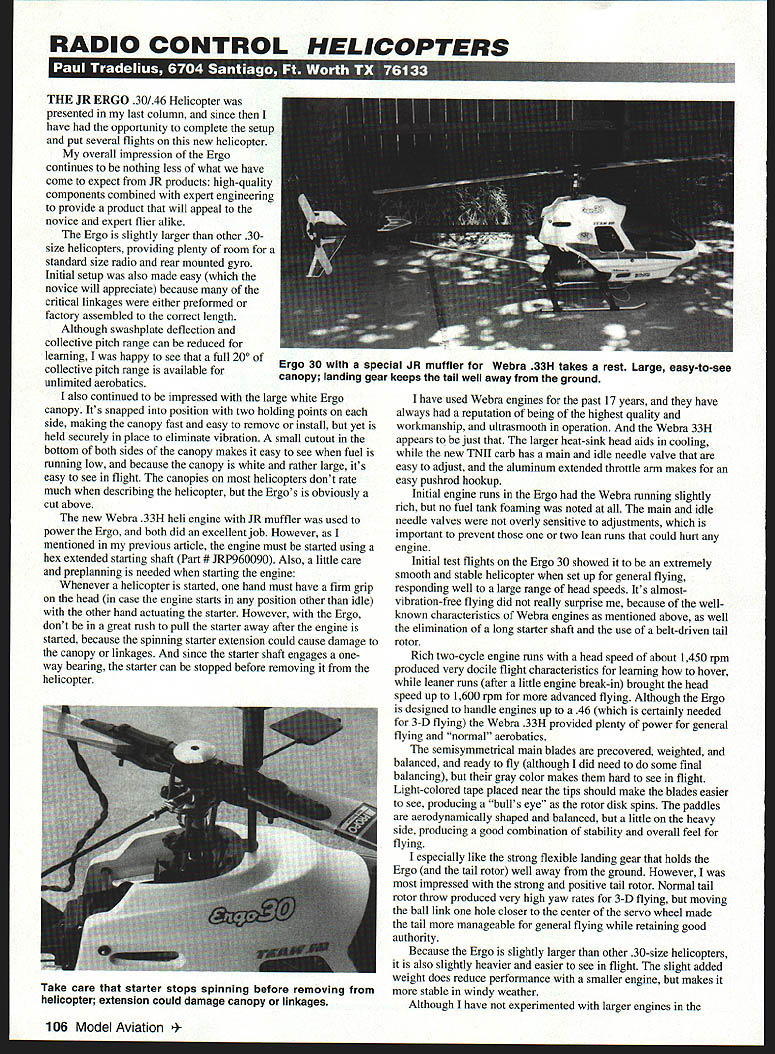
I also continued to be impressed with the large white Ergo canopy. It's snapped into position with two holding points on each side, making the canopy fast and easy to remove or install, yet held securely in place to eliminate vibration. A small cutout on the bottom of both sides of the canopy makes it easy to see when fuel is running low, and because the canopy is white and rather large, it's easy to see in flight. The canopies on most helicopters don't rate much when describing the helicopter, but the Ergo's is obviously a cut above.
The new Webra .33H heli engine with JR muffler was used to power the Ergo, and both did an excellent job. However, as I mentioned in my previous article, the engine must be started using a hex extended starting shaft (Part # JRP960090). Also, a little care and preplanning is needed when starting the engine.
Whenever a helicopter is started, one hand must have a firm grip on the head (in case the engine starts in any position other than idle), with the other hand actuating the starter. However, with the Ergo, don't be in a great rush to pull the starter away after the engine is started, because the spinning starter extension could cause damage to the canopy or linkages. And since the starter shaft engages a one-way bearing, the starter can be stopped before removing it from the helicopter.
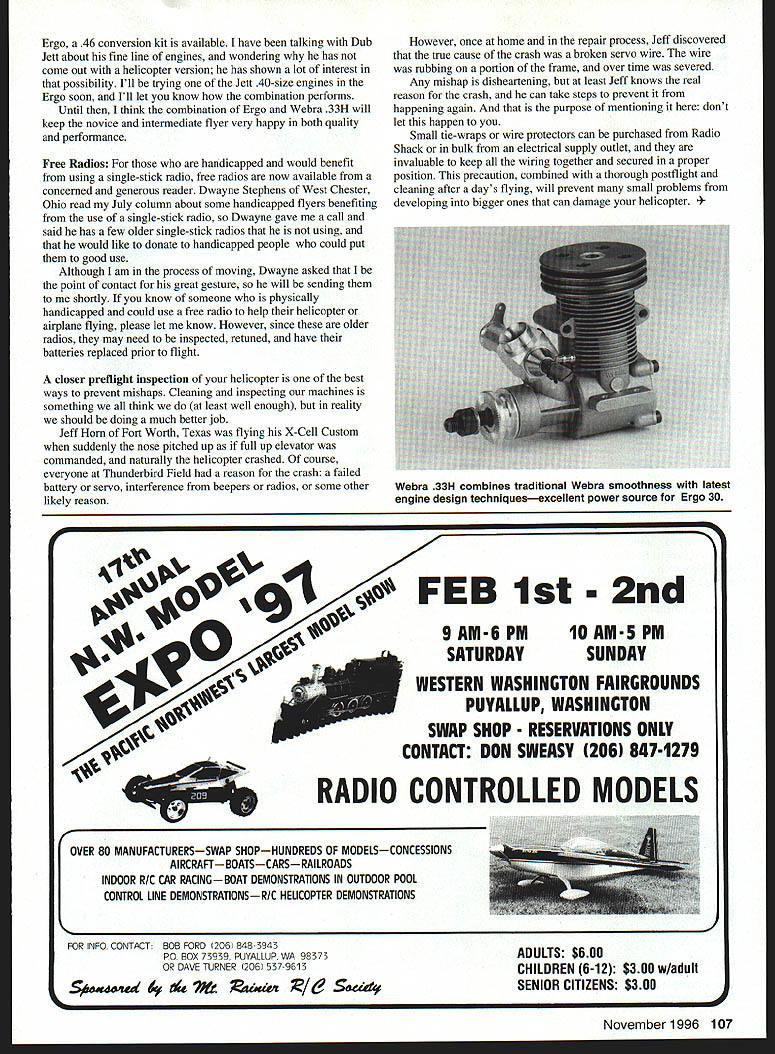
I have used Webra engines for the past 17 years, and they have always had a reputation of being of the highest quality and workmanship, and ultra-smooth in operation. The Webra 33H appears to be just that. The larger heat-sink head aids in cooling, while the new TNII carb has a main and idle needle valve that are easy to adjust, and the aluminum extended throttle arm makes for an easy pushrod hookup.
Initial engine runs in the Ergo had the Webra running slightly rich, but no fuel tank foaming was noted at all. The main and idle needle valves were not overly sensitive to adjustments, which is important to prevent those once-or-twice lean runs that could hurt any engine.
Initial test flights on the Ergo .30 showed it to be an extremely smooth and stable helicopter when set up for general flying, responding well to a large range of head speeds. Its almost vibration-free flying did not really surprise me, because of the well-known characteristics of Webra engines as mentioned above, as well as the elimination of a long starter shaft and the use of a belt-driven tail rotor.
Rich two-cycle engine runs with a head speed of about 1,450 rpm produced very docile flight characteristics for learning how to hover, while leaner runs (after a little engine break-in) brought the head speed up to 1,600 rpm for more advanced flying. Although the Ergo is designed to handle engines up to a .46 (which is certainly needed for 3-D flying), the Webra .33H provided plenty of power for general flying and "normal" aerobatics.
The semisymmetrical main blades are pre-covered, weighted, and balanced, and ready to fly (although I did need to do some final balancing), but their gray color makes them hard to see in flight. Light-colored tape placed near the tips should make the blades easier to see, producing a "bull's eye" as the rotor disk spins. The paddles are aerodynamically shaped and balanced, but a little on the heavy side, producing a good combination of stability and overall feel for flying.
I especially like the strong, flexible landing gear that holds the Ergo (and the tail rotor) well away from the ground. However, I was most impressed with the strong and positive tail rotor. Normal tail rotor throw produced very high yaw rates for 3-D flying, but moving the ball link one hole closer to the center of the servo wheel made the tail more manageable for general flying while retaining good authority.
Because the Ergo is slightly larger than other .30-size helicopters, it is also slightly heavier and easier to see in flight. The slight added weight does reduce performance with a smaller engine, but makes it more stable in windy weather.
Although I have not experimented with larger engines in the Ergo, a .46 conversion kit is available. I have been talking with Dub Jett about his fine line of engines and wondering why he has not come out with a helicopter version; he has shown a lot of interest in that possibility. I'll be trying one of the Jett .40-size engines in the Ergo soon, and I'll let you know how the combination performs.
Until then, I think the combination of Ergo and Webra .33H will keep the novice and intermediate flier very happy in both quality and performance.
Free Radios
For those who are handicapped and would benefit from using a single-stick radio, free radios are now available from a concerned and generous reader. Dwayne Stephens of West Chester, Ohio read my July column about some handicapped flyers benefiting from the use of a single-stick radio, so Dwayne gave me a call and said he has a few older single-stick radios that he is not using and that he would like to donate to handicapped people who could put them to good use.
Although I am in the process of moving, Dwayne asked that I be the point of contact for his great gesture, and he will be sending them to me shortly. If you know of someone who is physically handicapped and could use a free radio to help their helicopter or airplane flying, please let me know. However, since these are older radios, they may need to be inspected, returned, and have their batteries replaced prior to flight.
A closer preflight inspection of your helicopter is one of the best ways to prevent mishaps. Cleaning and inspecting our machines is something we all think we do (at least well enough), but in reality we should be doing a much better job.
Jeff Horn of Fort Worth, Texas was flying his X-Cell Custom when suddenly the nose picked up as if full up elevator was commanded, and naturally the helicopter crashed. Of course, everyone at Thunderbird Field had a reason for the crash: a failed battery or servo, interference from beepers or radios, or some other likely cause.
However, once at home and in the repair process, Jeff discovered that the true cause of the crash was a broken servo wire. The wire was rubbing on a portion of the frame and, over time, was severed. Any mishap is disheartening, but at least Jeff knows the real reason for the crash and he can take steps to prevent it from happening again. That is the purpose of mentioning it here: don't let this happen to you.
Small tie-wraps or wire protectors can be purchased from Radio Shack or in bulk from an electrical supply outlet, and they are invaluable to keep all the wiring together and secured in a proper position. This precaution, combined with a thorough postflight cleaning after a day's flying, will prevent many small problems from developing into bigger ones that can damage your helicopter.
Transcribed from original scans by AI. Minor OCR errors may remain.

