
Radio Control: Helicopters
Paul Tradelius 4302 39th St. West, Apt. #5, Bradenton, FL 34205
Buying a New or Used Helicopter
The winter is the time when most of us perform major maintenance on our helicopters and give thought to our next helicopter projects. For those who are considering entering the helicopter hobby, this time is often used to ask questions before that first flying season.
Two of the questions I am most frequently asked are: "Should I buy a new or used helicopter?" and "What are the advantages and disadvantages of each?" Because there are no clear-cut answers that will fit everyone's desires (or budget), let's start by looking at what a new helicopter entails.
New Helicopters — Advantages
- Many feel they have the best chance of success when using new equipment, because new equipment is often the latest design.
- A new helicopter has not been subject to previous wear or crash damage. You're not buying someone else's problems.
- Manufacturer support: warranties on engines and radio equipment are often available. Although most manufacturers do not have specific warranties on entire helicopter kits, they typically honor requests for missing parts.
- The fun of assembling the helicopter and watching it grow from individual parts into a flying machine.
- Building the helicopter teaches a lot about its construction, which helps later when performing maintenance or repairs after a mishap.
- The joy of opening boxes and seeing new parts—many new pilots like to make their helicopter one of the best-looking and best-performing models at the field.
New Helicopters — Disadvantages
- Building from a kit must be done carefully and correctly for all parts to work together. I have seen helicopters that looked fine externally but whose builders hadn't used any form of Loctite on internal screws and adjustments. These models had to be disassembled and reassembled correctly before they could be flown. (Use a non-permanent version of Loctite so parts can be disassembled later if needed.)
- Many parts must be balanced or aligned to ensure a smooth, vibration-free helicopter. For example, mounting the engine and starter shaft may require alignment to within .002 inches. Some newer helicopters use self-aligning shafts or eliminate long starter shafts to avoid this problem.
- All gears must have the proper mesh, and at minimum the main rotor and tail rotor blades must be balanced to reduce running vibration. Balancing requires some equipment and technique. These tasks are not difficult once you have experience, but they can seem overwhelming when you're starting out.
- Individual items must be chosen to support the helicopter. The helicopter, engine, radio, etc., must complement each other to suit the helicopter's performance and flying characteristics. It doesn't help to purchase a high-performance engine when you are just trying to hover, or to buy a basic radio for an advanced helicopter. You must be familiar with the components needed, or place your trust in the store with which you do business.
- Getting the new helicopter set up properly is often the hardest part of getting it off the ground. Many calls I receive begin, "All my helicopter will do is make circles as I add power," because the tail rotor and gyro have not been adjusted properly. These adjustments are not difficult once you have some experience.
Used Helicopters — Advantages
The used helicopter has distinct advantages for the new pilot because usually the helicopter and support equipment are purchased as a complete, ready-to-fly package. Benefits include:
- Price: you can often realize substantial savings compared with buying a new helicopter and all the required support equipment.
- Assuming the original owner was experienced, the helicopter will probably be constructed properly: Loctite used where needed; gears lubricated and meshed correctly; shafts aligned; rotors balanced. Once these items have been addressed, they typically don't need attention until a mishap occurs.
- It's easy to inspect the radio and gyro to see if they support the helicopter's mechanics. An entry-level radio (with limited functions and basic servos) should not be used to fly an X-Cell or similarly capable model. You want the radio to have the capability to handle the helicopter's performance. If the helicopter is capable of autorotation and 3-D flying, the radio should enable those maneuvers as your skills progress. Usually (and I emphasize usually) a helicopter package has been matched by the original owner with the correct engine, radio, rotor blades, etc.
- A used package may include additional items at no extra charge, such as training gear, a spare set of rotor blades, other parts, an electric starter, or field equipment. Depending on what's included, you could save a lot of money on necessary items.
- One of the best reasons to buy a used package is that it's generally ready to fly. The seller can demonstrate how the radio works, how easy the engine is to start, and how vibration-free the model is in flight. You can see if the gyro is adjusted properly, if the blades are balanced and in track, and whether the model will suit your training needs.
I'm not arguing for or against new or used helicopters—I want to provide information so you can make a choice that fits your budget and desires. No matter what you purchase, I recommend finding an experienced pilot in your area to help. There's no sense in reinventing the wheel when someone can point you in the right direction.
New Products
Horizon Hobby Distributors (4105 Fieldstone Rd., Champaign, IL 61821) continues to introduce and distribute new and interesting products for helicopter enthusiasts and the broader RC flying community.
Dynamite Compression Gauge
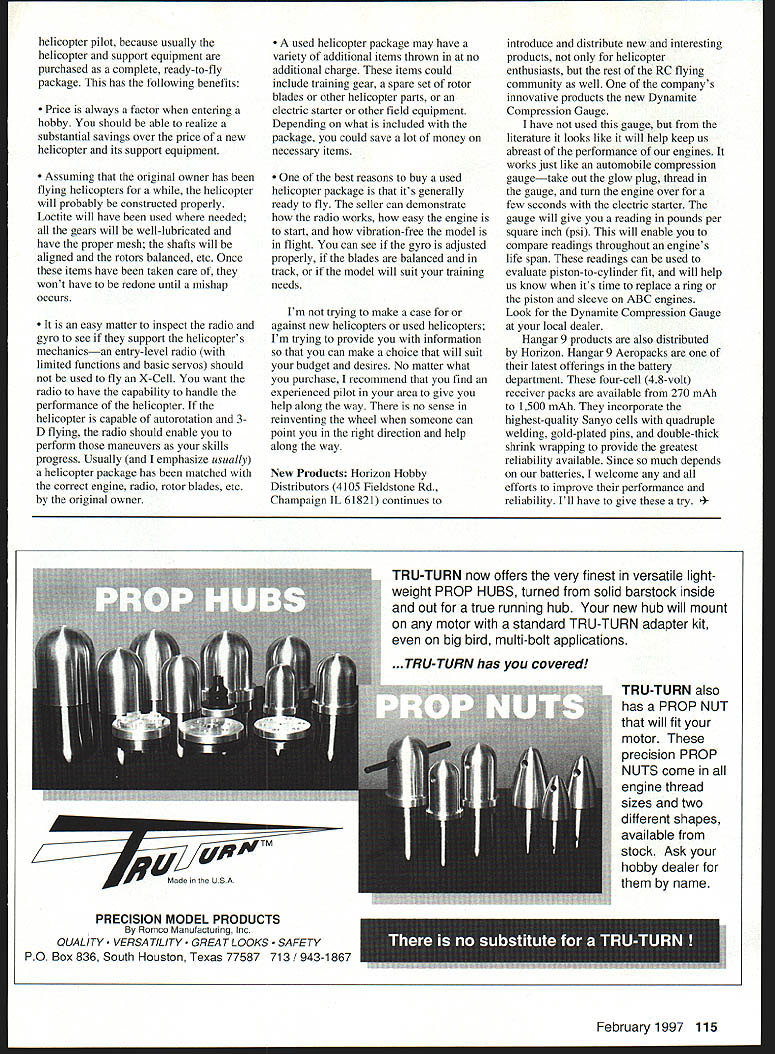
I have not used this gauge personally, but from the literature it appears useful for monitoring engine performance. It works like an automobile compression gauge: remove the glow plug, thread in the gauge, and turn the engine over for a few seconds with the electric starter. The gauge gives a reading in pounds per square inch (psi), enabling comparisons throughout an engine's lifespan. These readings can help evaluate piston-to-cylinder fit and indicate when it's time to replace a ring or the piston and sleeve on ABC engines. Look for the Dynamite Compression Gauge at your local dealer.
Hangar 9 Aeropacks
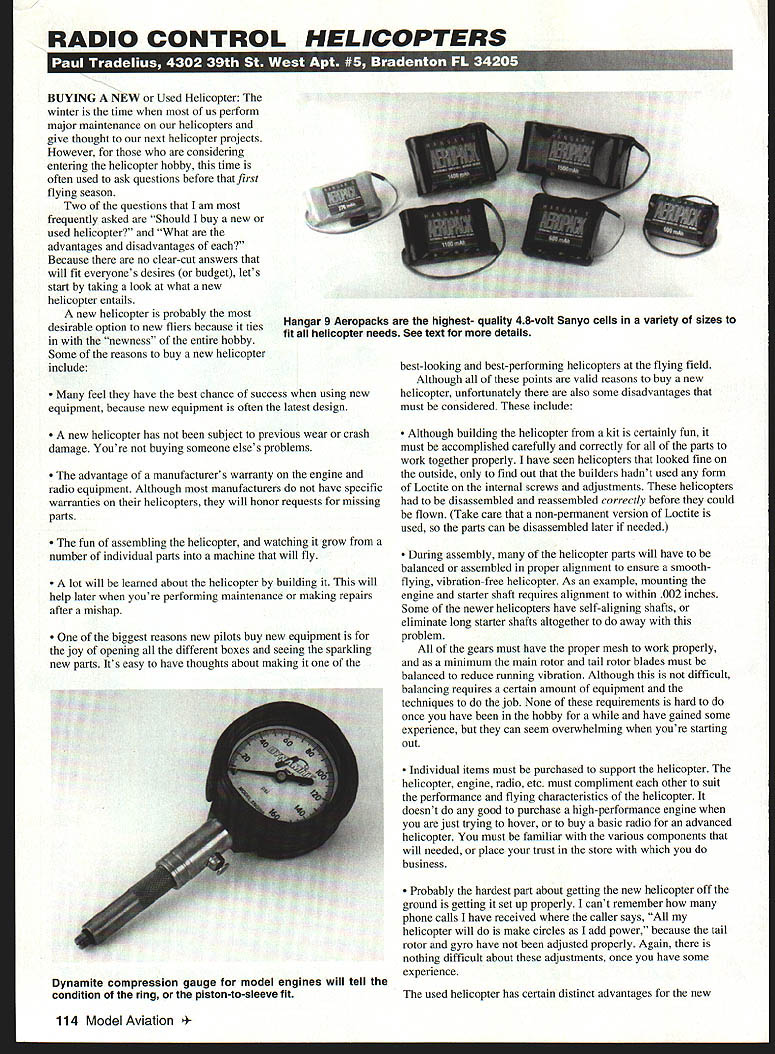
Hangar 9 products are also distributed by Horizon. Hangar 9 Aeropacks are a recent offering in the battery department. These four-cell (4.8-volt) receiver packs are available from 270 mAh to 1,500 mAh. They incorporate high-quality Sanyo cells with quadruple welding, gold-plated pins, and double-thick shrink wrapping for improved reliability. Since so much depends on our batteries, I welcome efforts to improve their performance and reliability. I'll have to give these a try.
Transcribed from original scans by AI. Minor OCR errors may remain.

