
RADIO CONTROL HELICOPTERS
Paul Tradelius, 4620 Barracuda Dr., Bradenton FL 34208
BLADE BALANCING TECHNIQUES
Now that the middle of summer is here, you should be out flying and enjoying your helicopter. One of the best ways to improve a helicopter's performance is to reduce vibration by making sure that everything is in balance. Of the many sources of vibration, one of the biggest is the main rotor system — specifically, the main rotor blades. If you can find a better way to balance them, not only will it reduce the helicopter's vibration, but it will help the model to fly better. This is a good time to discuss the basic principles of balance (and my techniques) since I haven't done so recently.
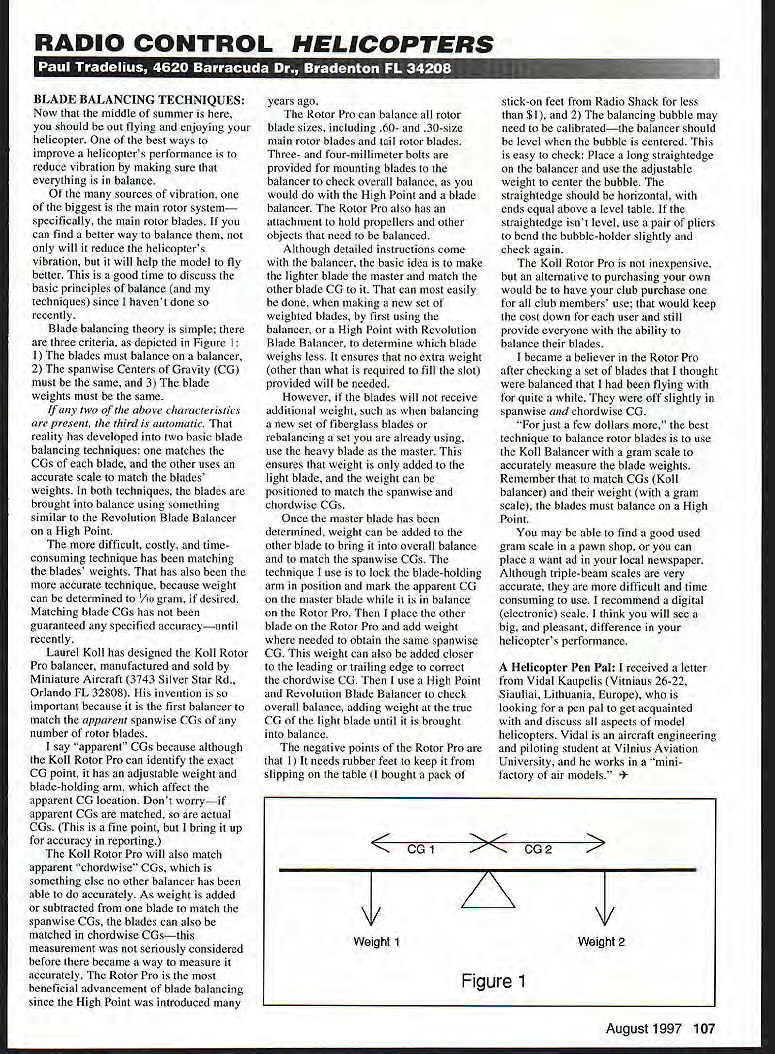
Blade balancing theory is simple; there are three criteria, as depicted in Figure 1:
- The blades must balance on a balancer.
- The spanwise centers of gravity (CG) must be the same.
- The blade weights must be the same.
If any two of the above characteristics are present, the third is automatic. That reality has developed into two basic blade balancing techniques: one matches the CGs of each blade, and the other uses an accurate scale to match the blades' weights. In both techniques, the blades are brought into balance using something similar to the Revolution Blade Balancer or a High Point.
The more difficult, costly, and time-consuming technique has been matching the blades' weights. That also has been the more accurate technique, because weights can be determined to 0.1 gram, if desired. Matching blade CGs has not been guaranteed any specified accuracy — until recently.
Koll Rotor Pro balancer
Laurel Koll has designed the Koll Rotor Pro balancer, manufactured and sold by Miniature Aircraft (3743 Silver Star Rd., Orlando FL 32808). His invention is important because it is the first balancer to match the apparent spanwise CGs of any number of rotor blades.
I say "apparent" CGs because although the Koll Rotor Pro can identify the exact CG point, it has an adjustable weight and a blade-holding arm, which affect the apparent CG location. Don't worry — if apparent CGs are matched, so are actual CGs. (This is a fine point, but I bring it up for accuracy in reporting.)
The Koll Rotor Pro will also match apparent chordwise CGs, which is something else no other balancer has been able to do accurately. As weight is added or subtracted from one blade to match the spanwise CGs, the blades can also be matched in chordwise CGs — this measurement was not seriously considered before there became a way to measure it accurately. The Rotor Pro is the most beneficial advancement of blade balancing since the High Point was introduced many years ago.
The Rotor Pro can balance all rotor blade sizes, including .60- and .30-size main rotor blades and tail rotor blades. Three- and four-millimeter bolts are provided for mounting blades to the balancer to check overall balance, as you would do with the High Point and a blade balancer. The Rotor Pro also has an attachment to hold propellers and other objects that need to be balanced.
Balancing procedure
Although detailed instructions come with the balancer, the basic idea is to make the lighter blade the master and match the other blade CGs to it. That can most easily be done, when making a new set of weighted blades, by first using the balancer, or a High Point with a Revolution Blade Balancer, to determine which blade weighs less. It ensures that no extra weight (other than what is required to fill the slot) will be needed.
If, however, the blades will not receive additional weight, such as when balancing a new set of fiberglass blades or rebalancing a set you are already using, use the heavy blade as the master. This ensures that weight is only added to the light blade, and the weight can be positioned to match the spanwise and chordwise CGs.
Once the master blade has been determined, weight can be added to the other blade to bring it into overall balance and to match the spanwise CGs. The technique I use is:
- Lock the blade-holding arm in position and mark the apparent CG on the master blade while it is in balance on the Rotor Pro.
- Place the other blade on the Rotor Pro and add weight where needed to obtain the same spanwise CG.
- Add weight closer to the leading or trailing edge to correct the chordwise CGs.
- Use a High Point and Revolution Blade Balancer to check overall balance, adding weight at the true CG of the light blade until it is brought into balance.
Negatives and setup tips
The negative points of the Rotor Pro are:
- It needs rubber feet to keep it from slipping on the table (a pack of stick-on feet from Radio Shack costs less than $1).
- The balancing bubble may need to be calibrated — the balancer should level when the bubble is centered.
Calibrating the bubble is easy: place a long straightedge on the balancer and use the adjustable weight to center the bubble. The straightedge should be horizontal, with both ends equal above a level table. If the straightedge isn't level, use a pair of pliers to bend the bubble-holder slightly and check again.
Recommendations
The Koll Rotor Pro is not inexpensive, but an alternative to purchasing your own would be to have your club buy one for all club members; that would keep the cost down for each user and still provide everyone with the ability to balance their blades. I became a believer in the Rotor Pro after checking a set of blades that I had been flying with for quite a while — they were off slightly in spanwise and chordwise CG.
For just a few dollars more, the best technique to balance rotor blades is to use the Koll Balancer with a gram scale to accurately measure the blade weights. Remember that to match CGs (Koll Balancer) and their weight (with a gram scale), the blades must balance on a High Point.
You may be able to find a good used gram scale in a pawn shop, or you can place a want ad in your local newspaper. Although triple-beam scales are very accurate, they are more difficult and time consuming to use. I recommend a digital (electronic) scale. I think you will see a big, and pleasant, difference in your helicopter's performance.
Transcribed from original scans by AI. Minor OCR errors may remain.

