
RADIO CONTROL HELICOPTERS
Paul Tradelius, 4620 Barracuda Dr., Bradenton FL 34208
THE NATS
The Nats: just saying it paints a picture of an event large enough to allow all modelers in the US (and other countries) to participate in all forms of flying competition. It wasn't too long ago the Nats was held in different cities each year, allowing modelers to gather for a week or more to compete, renew old friendships, and share ideas about their favorite hobby. That has changed recently (for the better) by having the Nats at the same site each year: AMA's International Aeromodeling Center in Muncie, Indiana.
Located about an hour north and east of Indianapolis, Muncie is a good site for all types of flying, with moderate weather, flat land, and minimal big-city radio interference. I hope you will be able to pay a visit to the site in the near future.
Helicopter events were held over a four-day span from Tuesday to Friday, with a couple of practice days beforehand and a planned freestyle event on Saturday that had to be canceled. Unfortunately, this schedule required competitors to take a full week off work, which likely contributed to only about 50 participants across all helicopter flying categories. That isn't a bad turnout considering travel distance and the cost of a week away from home. Everyone I talked to said it was well worth it and had a great time.
Since official results are posted elsewhere in this issue, I won't relist winners here—congratulations to all who participated.
FRIENDS AND VOLUNTEERS
One of the nicest things about the Nats is renewing old friendships (and building new ones). Naomi and Don Griffin are a husband-and-wife team who have been coming to the Nats for more years than most of us can remember—not to fly, but to manage the transmitter-impound area from dawn to dusk to ensure clean frequencies for practice and competition. Although many give freely of their time and talents, Naomi and Don are two of the best.
EQUIPMENT AND ENGINES
I was at the Nats for two days and spoke with many fliers about their helicopters, equipment, and thoughts on the competition.
One immediate impression was the uniformly high quality of helicopters and radios across all levels. A few years ago you could spot Class I pilots by .30-size helicopters flown by those with a year or so of experience. Now all flightlines look similar in equipment, and flying proficiency is high.
Most Class I, II, and III fliers now use the expensive .60-size machines with 30% fuel, fiberglass blades, and top-tier radios. While high-dollar gear isn't necessary to enjoy flying or compete locally or nationally, it's clear many choose to use it.
Notable engines and airframes:
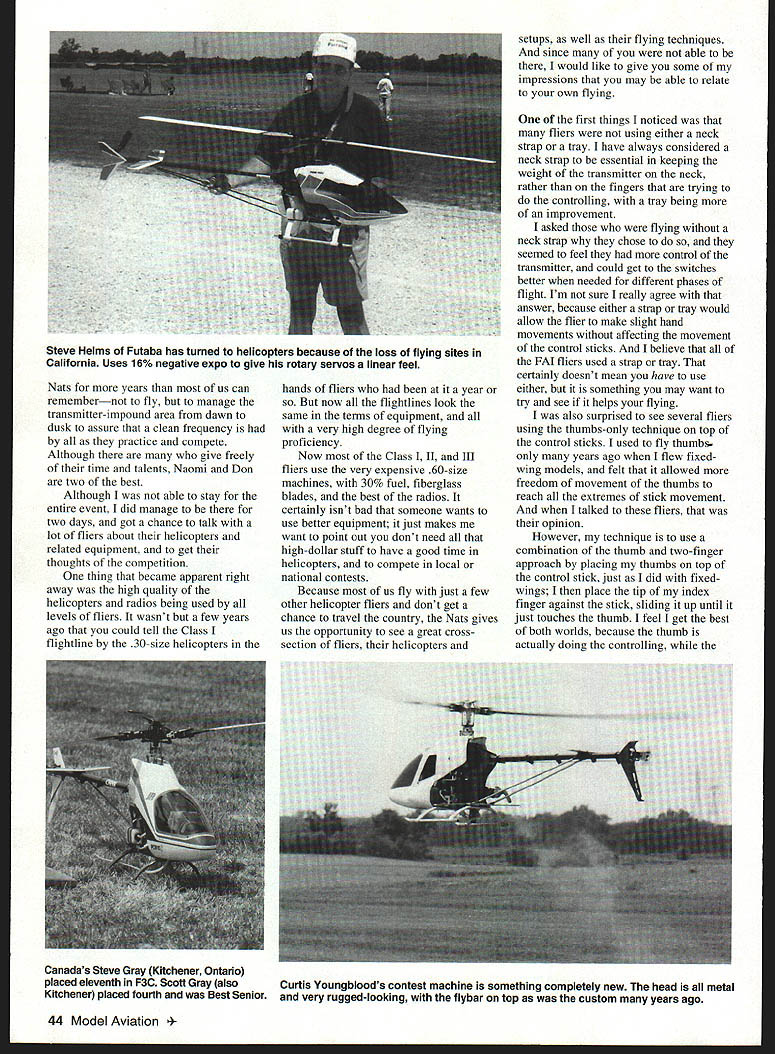
- Ted Schoonard (Miniature Aircraft) flew an X-Cell Pro VS-91 four-stroke—plenty of power and a great sound.
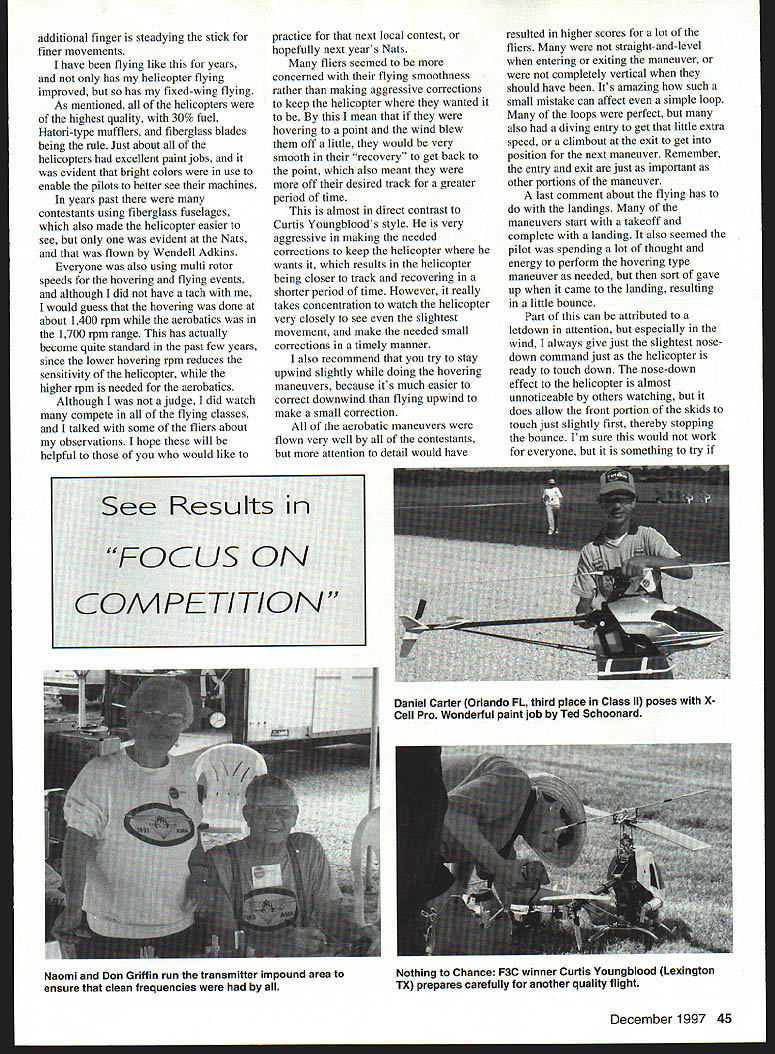
- George Grant (Wadsworth, OH) used an X-Cell Pro and gave his machine a wild paint scheme.
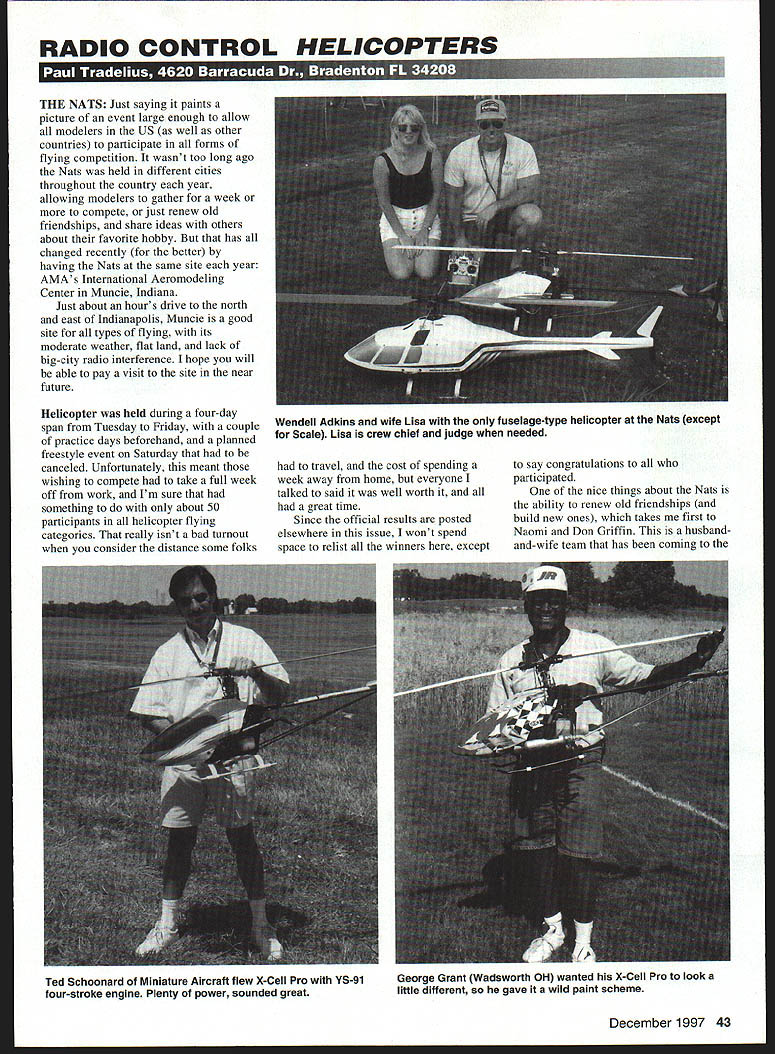
- Fiberglass fuselages were rare this year; Wendell Adkins flew the only one I noted.
Everyone was also using multiple rotor speeds for hovering and aerobatic flight. Though I didn't have a tach, hovering appeared to be around 1,400 rpm and aerobatics around 1,700 rpm. This has become standard: lower rpm for reduced sensitivity during hover, higher rpm for aerobatics.
TRANSMITTER HANDLING AND STICK TECHNIQUE
I noticed many fliers not using a neck strap or tray. I consider a neck strap essential for keeping transmitter weight off the fingers; a tray is an improvement over a strap. Those flying without a strap said it gave them better access to switches and a feeling of more control. I disagree—either a strap or tray allows slight hand movements without moving the control sticks. All the FAI fliers I saw used a strap or tray. Try both and see if it helps your flying.
Stick grip: several fliers used a thumbs-only technique on top of the sticks. I used thumbs-only years ago with fixed-wing models, and proponents say it allows freedom of thumb movement. My preferred technique uses thumb plus two-finger support: thumbs on top of the stick and the tip of the index finger against the stick, sliding it up until it just touches the thumb. The thumb does most of the controlling, and the index finger provides added leverage for fast or extreme movements.
FLYING STYLE AND TECHNIQUE
Many fliers emphasized smoothness over aggressive corrections. For example, when hovering to a point and the wind nudged them off, they made very smooth recoveries, which often left them off the desired track for a longer time.
In contrast, Curtis Youngblood flies aggressively, making immediate corrections to keep the helicopter where he wants it. This style keeps the helicopter closer to track and shortens recovery time, but it requires intense concentration to spot slightest movements and respond quickly.
Practical tips:
- Try to stay slightly upwind while performing hovering maneuvers; it's easier to correct downwind than to fly upwind to make a small correction.
- Pay attention to entry and exit of aerobatic maneuvers. Many missed points by not being straight-and-level on entry/exit or not fully vertical when required. Entries and exits influence the whole maneuver—small mistakes can ruin even a perfect loop.
- Landings deserve the same attention as maneuvers. Often pilots execute the hover well but relax on landing, resulting in a bounce. In wind, I give a slight nose-down command just as the helicopter touches down. This makes the front skids touch slightly first and helps stop the bounce. It may not work for everyone, but try it if your landings are bouncy.
GYROS AND RULES
One issue at the Nats was the new CSM gyro, made in England with electronics designed by Colin Mill (designer of the NHP simulator). It's a two-position gyro with a standard rate function and a heading-hold function that virtually acts as an autopilot.
Because the heading-hold function does not comply with current gyro rules, it was not allowed at the Nats. Some fliers like the CSM gyro but chose to switch to another gyro for competition.
Opinions varied on whether this type of gyro should be allowed. Curtis Youngblood offered a useful perspective: allow advancements in technology, but adjust the maneuvers to take advantage of improvements. We can't (and don't want to) stop progress; we must learn to live with it.
FREESTYLE EVENT
I most wanted to see the freestyle flying scheduled for Saturday, but it was canceled because competitors had to return home after the formal events concluded on Friday. Maybe next year some flying can be scheduled during a weekend so the freestyle event can occur with the others.
POST-NATS IMPRESSIONS AND THANKS
After I returned home I contacted several people for impressions and to fill in information from times I wasn't there.
- Paul Soha (Stow, OH) was impressed with the high quality of helicopters and radios, noting not a single crash during the week. He appreciated the openness among contestants—sponsored fliers still helped where needed. As an excellent freestyle flier, he regretted the canceled freestyle event and looks forward to next year.
- David Harkey (Birmingham, AL), assistant CD for the helicopter portion, felt it was the most competitive Nats ever. In Class III, after seven rounds, the normalized difference between first and second was only 1.7 points. In Class II the difference was 0.03 point, and Class I went to the last of nine rounds to determine the winner. That is very competitive flying.
All contestants would like to thank those who helped make the event possible, especially Craig Bradley, who was responsible for the overall Helicopter Nationals. It was an extremely big job with lots of responsibility and little public thanks for the work involved. Craig has consented to run the operation again next year, with David Harkey as his second in command. We wish them continued success—thanks for a job well done, and I look forward to being with you all next year at the Nats.
Transcribed from original scans by AI. Minor OCR errors may remain.

