
RADIO CONTROL HELICOPTERS
Paul Tradelius — 4620 Barracuda Dr., Bradenton, FL 34208
By the time you read this, it will be close to Christmas and too cold to fly helicopters in some parts of the country. But it's still the middle of the summer in Florida, and a disturbing thing happened at my "other" flying field in Waynesburg, PA.
I say "disturbing" because it concerns a new flier who did not want to come to the flying field to be with the rest of us on a nice Sunday afternoon. Rather, he practiced on training gear near his home, where others wouldn't see him bouncing around and make fun of him.
Although I have written about this many times, it seems that it is all too common in clubs throughout the world, and is something that club members should try to correct when they can.
The idea of flying with a group is to share company and have more-experienced fliers help when needed. Learning to fly helicopters isn't difficult, but it is time-consuming. It requires a certain amount of mechanical setup to make sure that the model will fly correctly, and it takes good flying technique to get the most enjoyment from each flight without damaging the helicopter by being too aggressive in the learning process. Where better to accomplish all of these things than at the local flying field with others who have been through the learning process; they can add knowledge and encouragement.
This new flier in Pennsylvania felt that others would make fun of him and his helicopter (with its traditional wide and not-so-pretty training gear) as he practiced hovering at the edge of the field, away from the rest of the fliers. I didn't know this individual, but I was happy to hear that someone talked him into joining the rest of us for a very nice afternoon, and he learned that everyone was willing to help where they could.
That is the message I would like to bring: no matter how good or how new you are to the hobby, local fliers should be willing to help you progress in your flying and help you enjoy the hobby if you give them a chance.
Christmas Wish List
This time of year it's nice to look forward to a visit from Santa to see what he'll bring for the hobby, and to give us something to work on until spring arrives (unless you live here in Florida, where we can fly year 'round). Lately I have come across the following items that I think will be of interest to you and might make nice surprises under the tree:
- JR Heli Division — Ergo Sport .60-size helicopter
- Jett Engineering — .65 engine (and .40 engine testing)
- BC6 Flight Monitor
- Hobbytech Voltage Proof
- Futaba S9204 servo
- Aristo/Polk's "Seeker" self-seeking FM receiver / flight pack
- Koll Rotor Pro balancer and AccuLab 600 digital gram scale
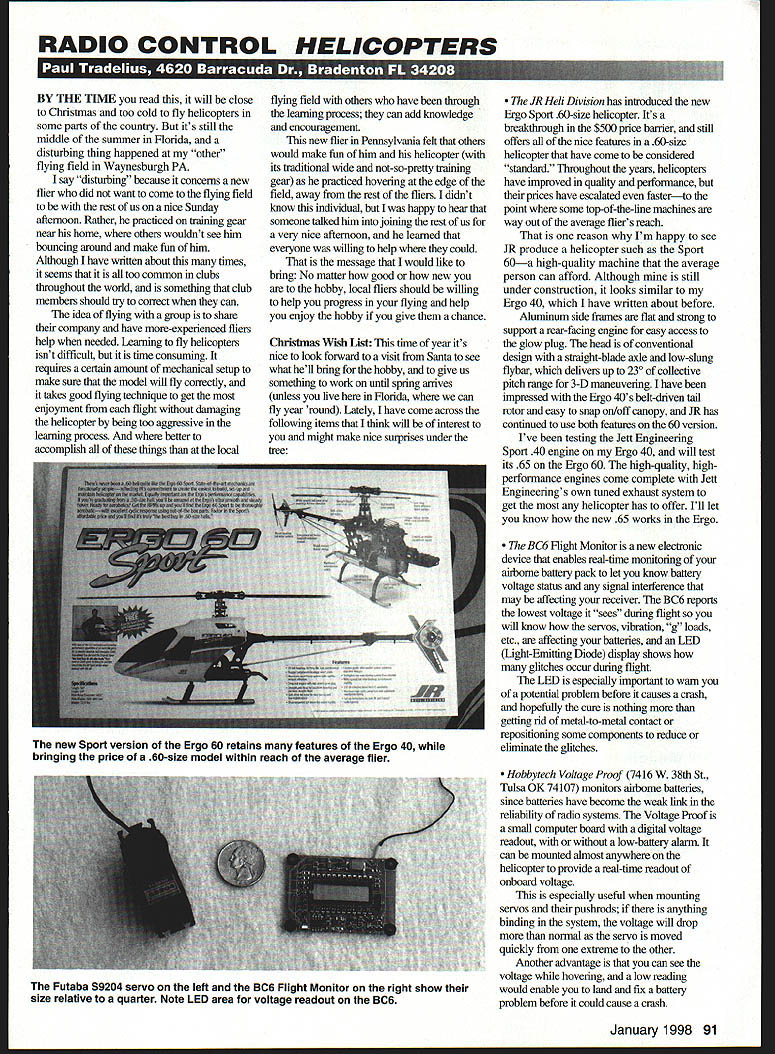
JR Ergo Sport .60-size helicopter
The JR Heli Division has introduced the new Ergo Sport .60-size helicopter. It's a breakthrough in the $500 price barrier and still offers all of the nice features in a .60-size helicopter that have come to be considered "standard." Throughout the years, helicopters have improved in quality and performance, but their prices have escalated even faster—to the point where some top-of-the-line machines are way out of the average flier's reach.
This is one reason I'm happy to see JR produce a helicopter such as the Sport 60—a high-quality machine that the average person can afford. Although mine is still under construction, it looks similar to my Ergo 40, which I have written about before. Aluminum side frames are flat and strong to support a rear-facing engine for easy access to the glow plug. The head is of conventional design with a straight-blade axle and low-slung flybar, which delivers up to 23° of collective pitch range for 3-D maneuvering. I have been impressed with the Ergo 40's belt-driven tail rotor and easy snap on/off canopy, and JR has continued to use both features on the 60 version.
Jett Engineering engines
I've been testing the Jett Engineering .40 engine on my Ergo 40, and will test its .65 on the Ergo 60. The high-quality, high-performance engines come complete with Jett Engineering's own tuned exhaust system to get the most any helicopter has to offer. I'll let you know how the new .65 works in the Ergo.
BC6 Flight Monitor
The BC6 Flight Monitor is a new electronic device that enables real-time monitoring of your airborne battery pack to let you know battery voltage status and any signal interference that might be affecting your receiver. The BC6 reports the lowest voltage it "sees" during flight so you will know how the servos, vibration, "g" loads, etc., are affecting your batteries, and an LED (Light-Emitting Diode) display shows how many glitches occur during flight.
The LED is especially important to warn you of a potential problem before it causes a crash, and hopefully the cure is nothing more than eliminating metal-to-metal contact or repositioning some components to reduce or eliminate the glitches.
Hobbytech Voltage Proof
Hobbytech Voltage Proof (7416 W. 38th St., Tulsa, OK 74107) monitors airborne batteries, since batteries have become the weak link in the reliability of radio systems. The Voltage Proof is a small computer board with a digital voltage readout, with or without a low-battery alarm. It can be mounted almost anywhere on the helicopter to provide a real-time readout of onboard voltage.
This is especially useful when mounting servos and their pushrods; if there is anything binding in the system, the voltage will drop more than normal as the servo is moved quickly from one extreme to the other. Another advantage is that you can see the voltage while hovering, and a low reading would enable you to land and fix a battery problem before it could cause a crash.
Futaba S9204 servo
Futaba Corporation of America has introduced another servo of interest to helicopter fliers. Their new S9204 sports a coreless motor for greater torque and speed, metal gears for increased strength, and a dust- and water-resistant case — all in the same standard size. The specs on this servo are impressive: 0.19 seconds for 60° of travel using 4.8 volts, with a torque of 132 oz./in.
Because of its high torque, Futaba recommends checking the freedom of pushrod movement to make sure that a high current drain is not being used as the servo operates. This is what I mentioned above, and how the Voltage Proof can be of help in servo setup.
Aristo/Polk's "Seeker" FM receiver / flight pack
The "Seeker" FM receiver by Aristo/Polk's Model Craft Hobbies (346 Bergen Ave., Jersey City, NJ 07304) has just come out with a flight pack that includes a self-seeking FM receiver. You'd never have to buy a set of receiver crystals again; just turn on your transmitter, and the receiver automatically adjusts to the proper frequency. I have tried it on several transmitters using different frequencies, and it works.
I'll use this receiver on the tests of the Ergo Sport .60 mentioned above, and let you know how it works in flight. I have been dealing with Polk's for more than 40 years, and I know it's good if they put their name on it.
Miniature Aircraft (3743 Silver Star Rd., Orlando, FL 32808) distributes the Koll Rotor Pro balancer, something I have written about many times. The reason I mention this fine product again is that I believe it's the best thing to happen to blade balancing since the High Point. When used with the AccuLab 600 digital gram scale by Champion Model Products (880 Carmen Court, La Verne, CA 91750), the combination provides the best blade-balancing results possible at this time.
The digital gram scale measures the weight of the blades to within 0.1 gram, and the Rotor Pro balancer measures the centers of gravity. This produces a set of blade-balanced blades that can be used on any helicopter — they don't have to be matched to a particular helicopter or rotor head.
I assume that any of these items will be welcome under your tree, and will provide years of better helicopter flying. Merry Christmas to all.
Transcribed from original scans by AI. Minor OCR errors may remain.

