

RADIO CONTROL HELICOPTERS
Paul Tradelius, 4620 Barracuda Dr., Bradenton, FL 34208
The Ergo 60 Sport is the latest release from the JR Heli Division, offering a high-quality helicopter with state-of-the-art design features at a price we can afford.
Those of you who have been in helicopters for several years will appreciate the great advances manufacturers have made in overall quality and flying performance. Unfortunately, those advances have been accompanied by ever-increasing prices to the point where helicopters are out of reach for many would-be fliers.
The Ergo 60 Sport solves this monetary problem with a street price of less than $500, while maintaining the modern features we have come to demand. If for no other reason, the price of the Sport 60 will ensure its position on the flightlines of many clubs around the world.
The instructions for the Sport 60 are as good as I have seen. Sketches and diagrams give just enough information without having to read a book. Hundreds of small plastic bags are used to separate parts until they are needed in sequence. This may not seem like a major point in describing a new kit, but when you are at the workbench late at night and need that one small critical part, it’s nice to know it’s right there in its little bag waiting for you, rather than in some dish you just accidentally spilled all over the floor.
The instructions also provide complete setup data for the latest models of JR radios.
Because the assembly sequence is so well laid out, I’ll point out some of the more interesting features of the Sport 60 rather than go through the building process step-by-step.
One unique aspect is the hex starter system. The long starter extension easily fits into the hex adapter, with a one-way bearing on top of the start shaft. This starting system requires no downward pressure while starting, does not have to be perfectly aligned straight up and down, and the one-way bearing allows the starter to come to a stop once the engine is running.
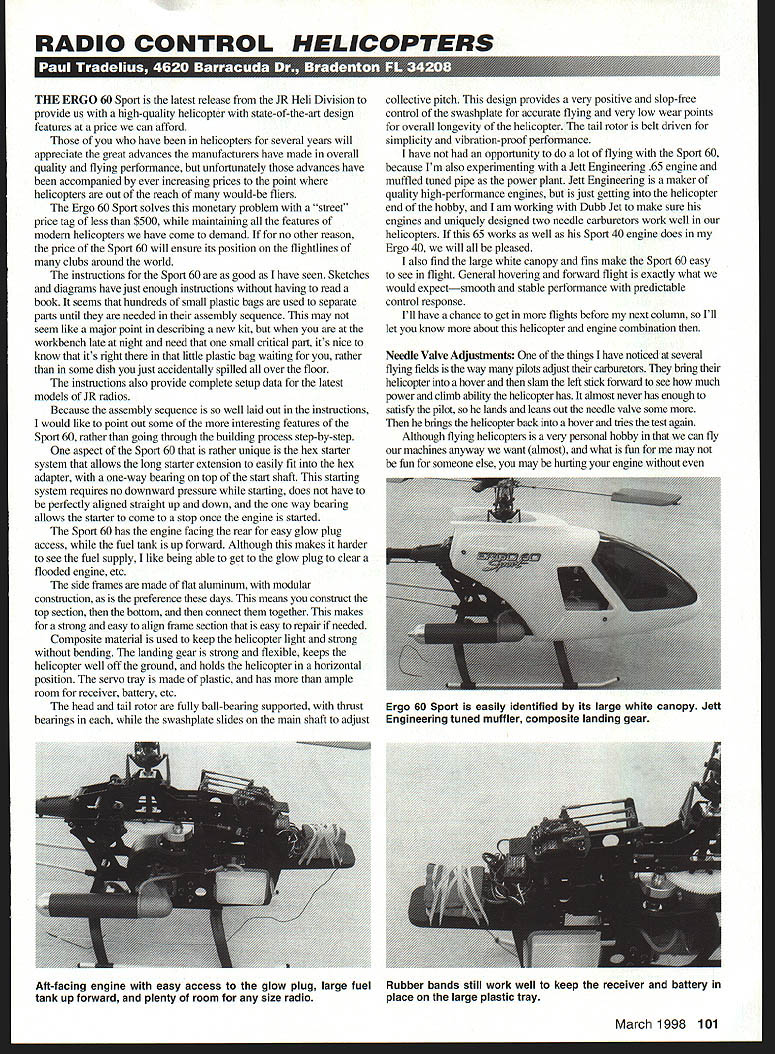
The Sport 60 has the engine facing the rear for easy glow-plug access, while the fuel tank is forward. Although this makes it harder to see the fuel supply, I like being able to access the glow plug to clear a flooded engine.
The side frames are made of flat aluminum with modular construction, as is the preference these days. You construct the top section, then the bottom, and then connect them together. This makes for a strong, easy-to-align frame that is also easy to repair if needed.
Composite materials are used to keep the helicopter light and strong without bending. The landing gear is strong and flexible, keeps the helicopter well off the ground, and holds it in a horizontal position. The servo tray is plastic and has more than ample room for receiver, battery, etc.
The head and tail rotors are fully ball-bearing supported, with thrust bearings in each, while the swashplate slides on the main shaft to adjust collective pitch. This design provides very positive, slop-free control of the swashplate for accurate flying and low wear for overall longevity. The tail rotor is belt-driven for simplicity and vibration-resistant performance.
I have not had an opportunity to do a lot of flying with the Sport 60 because I am experimenting with a Jett Engineering .65 engine and a muffled tuned pipe as the power plant. Jett Engineering is a maker of quality high-performance engines and is just getting into the helicopter end of the hobby. I am working with Dubb Jet to make sure his engines and uniquely designed two-needle carburetors work well in our helicopters. If this .65 performs as well as his Sport 40 engine does in my Ergo 40, we will all be pleased.
I also find the large white canopy and fins make the Sport 60 easy to see in flight. General hovering and forward flight are exactly what we would expect—smooth, stable performance with predictable control response.
I’ll have a chance to get in more flights before my next column, so I’ll report more about this helicopter and engine combination then.
Needle Valve Adjustments
One thing I’ve noticed at several flying fields is the way many pilots adjust their carburetors. They bring their helicopter into a hover and then slam the left stick forward to see how much power and climb ability the helicopter has. It almost never has enough to satisfy the pilot, so he lands and leans out the needle valve some, brings the helicopter back to hover, and tries again. Although flying helicopters is a very personal hobby and we can fly our machines almost any way we want, you may be hurting your engine without even knowing it.
A lot of time is wasted adjusting the needle valve to obtain the maximum available power when that maximum isn’t really needed.
As you lean out the needle valve, the engine produces more power, but at the price of reduced lubrication and cooling. It seems these are always the fliers having power or reliability problems. This is understandable, since leaning the mixture causes the engine to run hot, scoring the piston and cylinder in the process. Once this happens, it takes more time and effort to get the engine to run decently again, and it will never produce the power it once had.
What is the answer? There isn’t one that will work for everyone, but I adjust my needle valve so the engine will produce enough power for the type of flying I intend to do.
If I am just going to practice hovering maneuvers, I don’t need a lot of power, so I run the engine a little richer. This provides more fuel for additional lubrication and cooling.
If I later want to fly around and perform limited aerobatics, I then lean the engine out slightly (and I mean slightly) to increase power. The engine is still on the rich side of a two-stroke.
If I want to fly 3D or max-perform the helicopter, I can lean it out further. However, then I’m at the edge of being too lean, because there is a very fine line between max power and too lean. In fact, the engine may act fine in a hover or in normal flight, making us think the needle valve is set correctly. But once the helicopter starts to maneuver aggressively, the added load on the engine (combined with additional G-loading, which makes it harder for fuel to get from the tank to the engine) leans the engine out even further. This is the problem you may not be aware of that can cost you an engine.
My recommendation: lean out the engine only enough to get the power you need for that particular flight. Running the engine slightly rich most of the time will preserve it for when you really want—or need—all the power it has. But remember, any time you max-perform anything for an extended period, that part is more likely to fail.
Transcribed from original scans by AI. Minor OCR errors may remain.

