
RADIO CONTROL HELICOPTERS
Paul Tradelius 4620 Barracuda Dr., Bradenton FL 34208 E-mail: flytrade@earthlink.net
FOR THE PAST FEW months I have been working on a Concept VR 46 helicopter and hoped to have it well into the air by this time, but my work and other projects have distracted me.
Although I like flying full-scale airplanes for a living, one big disadvantage is that I'm normally not home at night, but rather off in some hotel somewhere in the country. That leaves little time to spend in my workshop when I'm home; I use the garage, which is very hot in the Florida summer.
I'm devoting this article to safety issues brought out in the following excerpt of a letter by a reader — a fellow flier who has made some safety mistakes from which others can learn.
Reader letter (excerpt)
"I really got one great concept from your book. That is, that hovering is mostly for landing nearby. I have had way too much flying in confined spaces (my yard) and tend to see the machine as a hovering device only. I tend to want to move the machine to some place and hold it there, then move back. Usually too far from myself where I have difficulty seeing and responding to the orientation.
"I have had way too many crashes. A high overhead hover put the machine into my body before I knew it, and led to a hospital trip and stitches. I was alone at the time (another mistake) and lost a lot of blood (thank God for Super Glue™). I also had way too much carbon fiber on the machine that was left black and hard to see. I also did too much flying at dusk when visibility was poor.
"I have since joined a club, read your book, and been doing more flying at a field. I think I'm making progress now. Thanks."
A note of thanks
I would like to thank this reader for sharing his experiences; it's not easy to stand up and say we have made a mistake, and even have stitches to prove it. The lessons learned will benefit many new (and older) fliers for a long time to come.
Major mistakes and lessons learned
- Flying in confined spaces
- The pilot's first mistake was flying in a confined space. Although helicopters don't need much room to fly, the pilot and spectators must have a plan to get out of harm's way should a mishap occur.
- It has nothing to do with how good a pilot you are, or how good your helicopter is: a battery pack can short out, a linkage can come loose, or a tail rotor blade can come off in flight.
- PCM radios can mask problems by going into a hold mode rather than showing radio glitches. In one case my helicopter backed up and my immediate reaction was a nose-down correction; after a couple of attempts I finally realized I was not in control and quickly got out of the way until the hold condition cleared.
- Getting the helicopter too far away
- The second mistake was getting the helicopter far enough away that the pilot had difficulty seeing and responding to its orientation. The obvious remedy is not to fly too far away.
- A useful, not-so-obvious aid is to know the last command you gave the helicopter. When disoriented, knowing whether your last input was right cyclic, left cyclic, etc., gives you a place to start — try the opposite command if appropriate.
- Make the helicopter more visible: use a colorful paint scheme (I find yellow the most visible against sky and clouds), add white tape to rotor blades near the tip and farther down to create a bulls-eye effect, or attach a brightly colored dowel laterally to the landing skids. Simple, visible modifications make a big difference.
- Flying high and directly overhead
- Flying high and directly overhead was the pilot's third problem. It's hard to judge altitude and rate of descent without reference points, and many pilots overestimate their ability to recover.
- Helicopters behave differently when descending: the rotor downwash creates a column of air that can accelerate the descent and reduce control as the machine gets caught in its own downwash. This likely contributed to the accident described.
- Flying at dusk compounds the problem by reducing visibility and depth perception.
Cell phones and flying alone
One advantage of modern electronics is portable communications. Almost every day there are ads for cellular phones — inexpensive and easy to get. You should consider carrying a cell phone. You should not fly alone whenever possible, but if you have to, a phone lets you summon help quickly. In the reader's case he used Super Glue™ to stop the bleeding and then drove himself to the hospital; having a phone would have allowed him to call for help and attend fully to his wounds while help was coming.
Other relatively easy safety practices
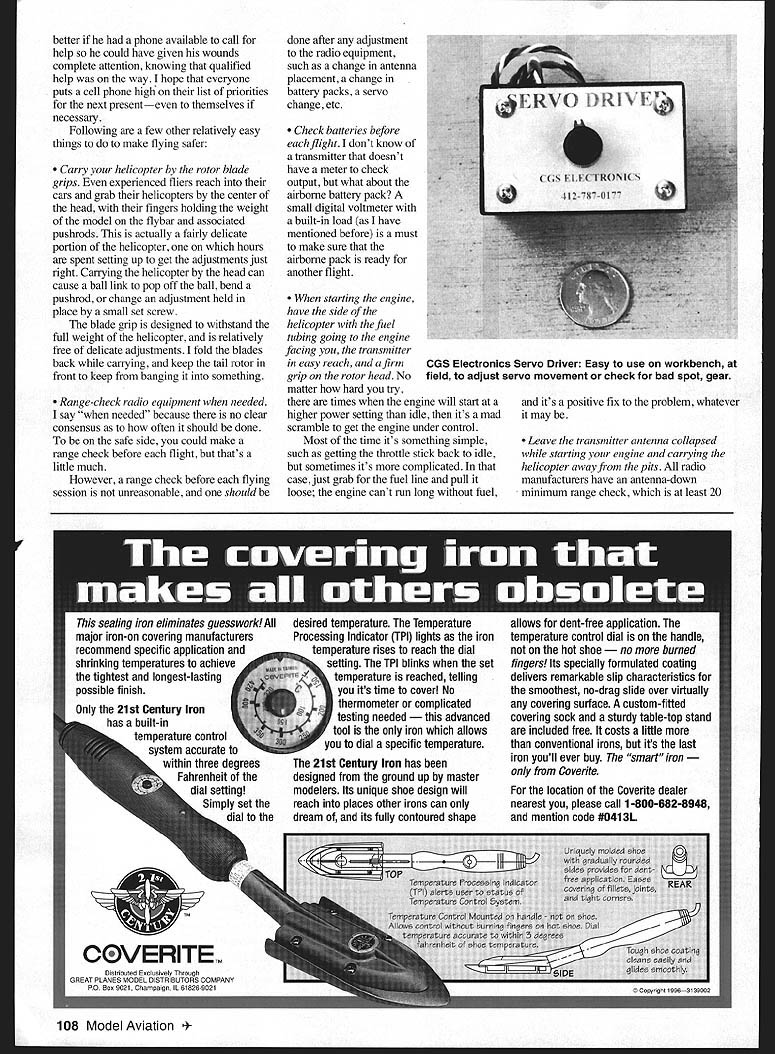
- Carry your helicopter by the blade grips. Many fliers reach into a car and grab the helicopter by the center of the head, but that area contains delicate adjustments and pushrods. The blade grip is designed to hold the full weight of the helicopter. Fold the blades back while carrying and keep the tail rotor in front to avoid banging it.
- Range-check radio equipment when needed. There is no exact consensus on frequency, but a range check before each flying session is reasonable, and always after any change to radio equipment (antenna placement, battery packs, servo changes, etc.).
- Check batteries before each flight. Verify transmitter output and check the airborne battery pack with a small digital voltmeter that has a built-in load to ensure the pack can handle a flight.
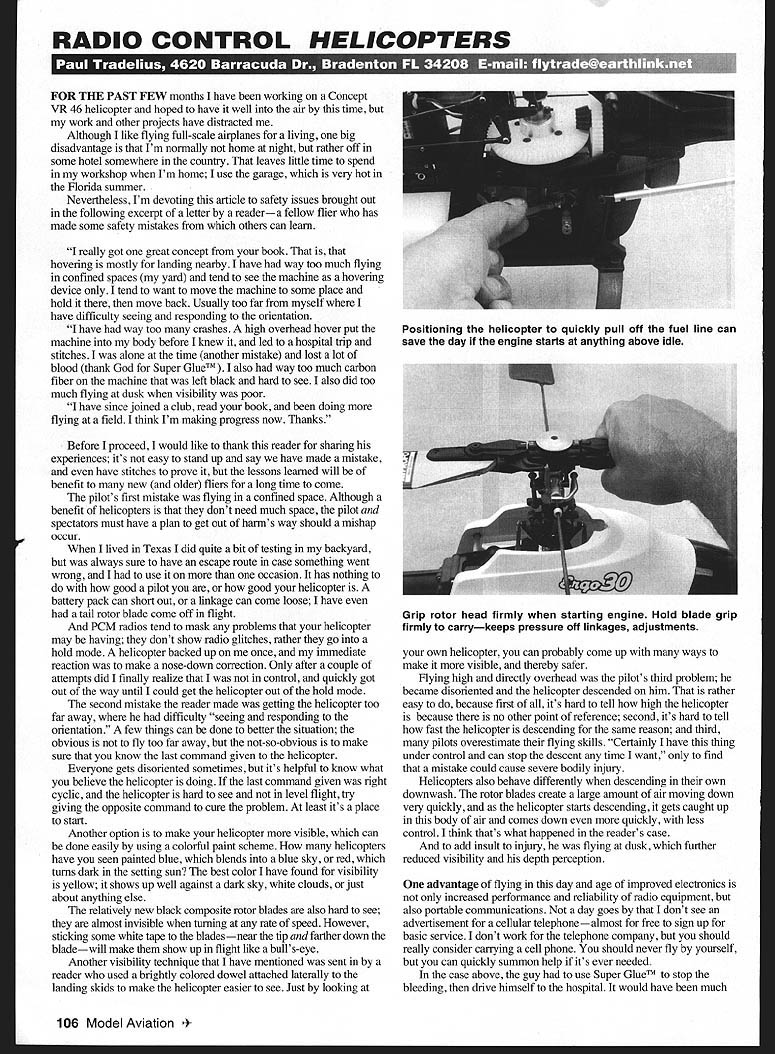
- When starting the engine, position the helicopter so the side with the fuel tubing faces you, keep the transmitter within easy reach, and maintain a firm grip on the rotor head. Engines sometimes start at higher than idle power; if you can't get the throttle back to idle, pulling the fuel line is a positive way to stop the engine.
- Leave the transmitter antenna collapsed while starting your engine and carrying the helicopter away from the pits. Manufacturers specify an antenna-down minimum range (at least 20 feet). Carry the helicopter away from the pit area, then extend the transmitter antenna when clear. This also helps avoid bending or breaking the antenna.
- Make all adjustments with the rotor blades stopped. Never check tracking or other settings with the blades turning. Accidents can be severe even with small or foam blades.
- When hovering, stand well away from the helicopter. Many fliers hover within five feet; I recommend 15–20 feet and about 30° to the side. That distance allows time to get away if something goes wrong.
Few people are as safe as they could be; we all accept some risk. Safety is rarely considered until an incident occurs. I hope this example of what not to do will encourage you to evaluate your own flying and safety habits. If you come up with good ideas that others can use, please let me know.
Thanks.
Transcribed from original scans by AI. Minor OCR errors may remain.

