

RADIO CONTROL HELICOPTERS
Paul Tradelius, 4620 Barracuda Dr., Bradenton FL 34208
E-mail: flytrade@earthlink.net
Carburetor adjustments and the pinch test
In my last column I discussed basic carburetor adjustments to the O.S. .46 FX-H engine, and my "pinch test" to check the idle mixture on most of the engines used in helicopters.
I had an interesting experience at the flying field recently when we got into a discussion about engines and their setup. One of the fliers said he was having trouble getting his engine and helicopter to fly the way he wanted, and asked if I would watch as he hovered and flew around.
After he landed, I said he was running too rich at idle, that the top end could be on the lean side, and that he was carrying too much pitch at hover. After making some changes, he was happy with the improved performance. Then he wanted to know why I thought his idle mixture was rich, and how he could judge engine mixture for himself during flight.
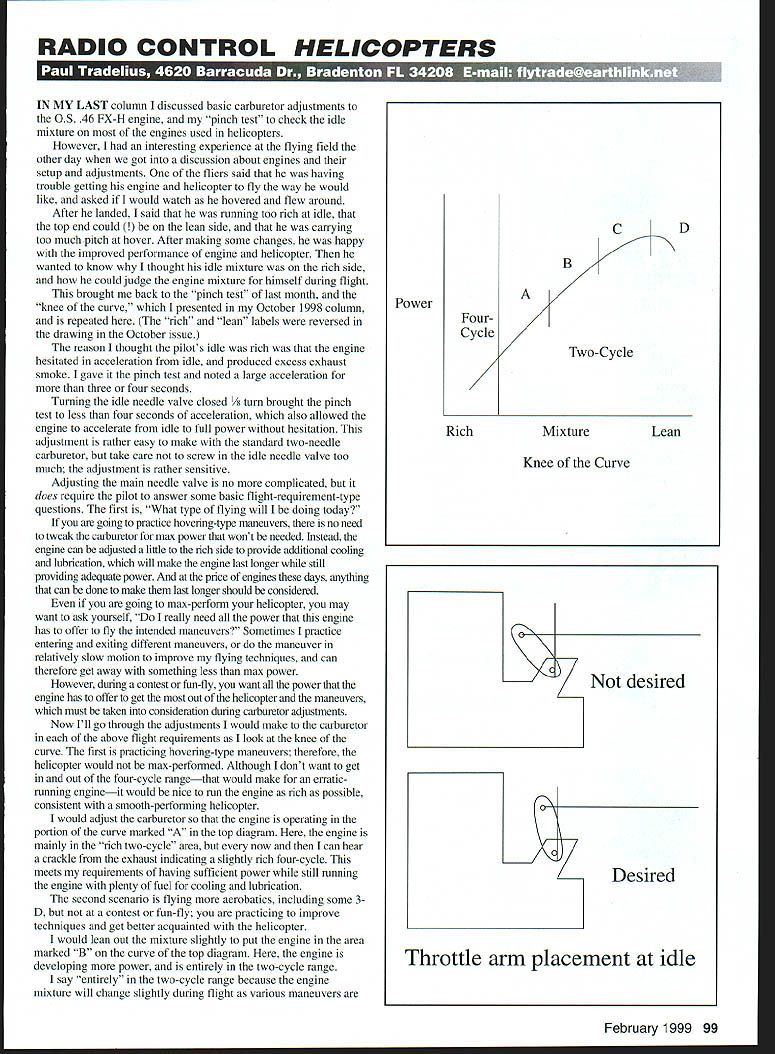
This brought me back to the "pinch test" and the "knee of the curve," which I presented in my October 1998 column (the "rich" and "lean" labels were reversed in the drawing in the October issue).
I thought the pilot's idle was rich because the engine hesitated when accelerating from idle and produced excess exhaust smoke. I gave it the pinch test and noted a large acceleration for more than three or four seconds. Turning the idle needle valve closed 1/8 turn brought the pinch test to less than four seconds of acceleration and allowed the engine to accelerate from idle to full power without hesitation. This adjustment is fairly easy to make with the standard two-needle carburetor, but take care not to screw the idle needle valve in too far; the adjustment is sensitive.
Adjusting the main needle valve is no more complicated, but it does require answering basic flight-requirement questions. The first is: what type of flying will I be doing today?
Choosing mixture for the type of flying
- Hovering-type maneuvers
- If you will mainly practice hovering, you don't need to tune the carburetor for maximum power. Instead, adjust a little toward rich to provide additional cooling and lubrication, which helps engine longevity. Avoid getting into the four-cycle range (it causes erratic running). Aim to operate in the portion of the curve marked "A": mainly in the rich two-cycle area with occasional slight four-cycle crackle. This gives sufficient power while running the engine with extra fuel for cooling.
- Aerobatics and 3-D practice (not contest)
- Lean the mixture slightly into the area marked "B" on the curve. The engine develops more power and remains entirely in the two-cycle range. You should feel and hear a stronger, higher-pitch sound. If you don't need full power often, you can lean further into area "C" for best performance, but be cautious not to cross the knee into area "D," which is dangerous.
- Contest or fun-fly (max performance)
- During contests you generally want all available power, so the mixture should be set accordingly. Remember that weather or bumping the needle valve can shift the mixture and move you closer to the knee of the curve than intended.
How to determine mixture at the start of the day
There is one reliable way I know to check the mixture: richen the needle valve to get the engine into a known rich condition. Once you hear the slight rich crackle in hover (indicating you are near the four-cycle range), you know where the change is relative to the graph. From that known rich point, lean the engine to the desired setting for the day's flying.
Those who don't begin the day by returning the engine to a known rich condition are guessing where they are on the curve. You cannot reliably determine the knee of the curve by watching or listening to the engine in flight alone. Looking at the amount of smoke is not reliable either, because different fuels and muffler systems produce varying smoke levels for similar mixture settings.
First richen slightly until you see increased exhaust smoke and hear the crackle, then lean to the desired setting. Too often pilots assume the engine is set because it idles well on landing—but many engines will idle and accelerate from idle to full power yet still not perform properly under hover or load.
If you check and set your mixture to a known condition at the start of the day, your flights will be more consistent and you will extend the life of your engine.
Throttle-to-collective relationship
The other change I made to the helicopter mentioned above was to adjust the relationship of pitch to throttle. The problem: the minimum collective pitch was only about -1°, while the throttle arm was way past center toward the idle position. The result was that collective pitch increased too fast while the throttle was slow to bring the engine up to speed and power.
The solution was a minor adjustment: bring the minimum collective pitch to -3° and reposition the throttle arm on the carburetor. This allowed the engine to develop power and come up to speed while the collective pitch was still close to 0°, keeping rotor drag minimal.
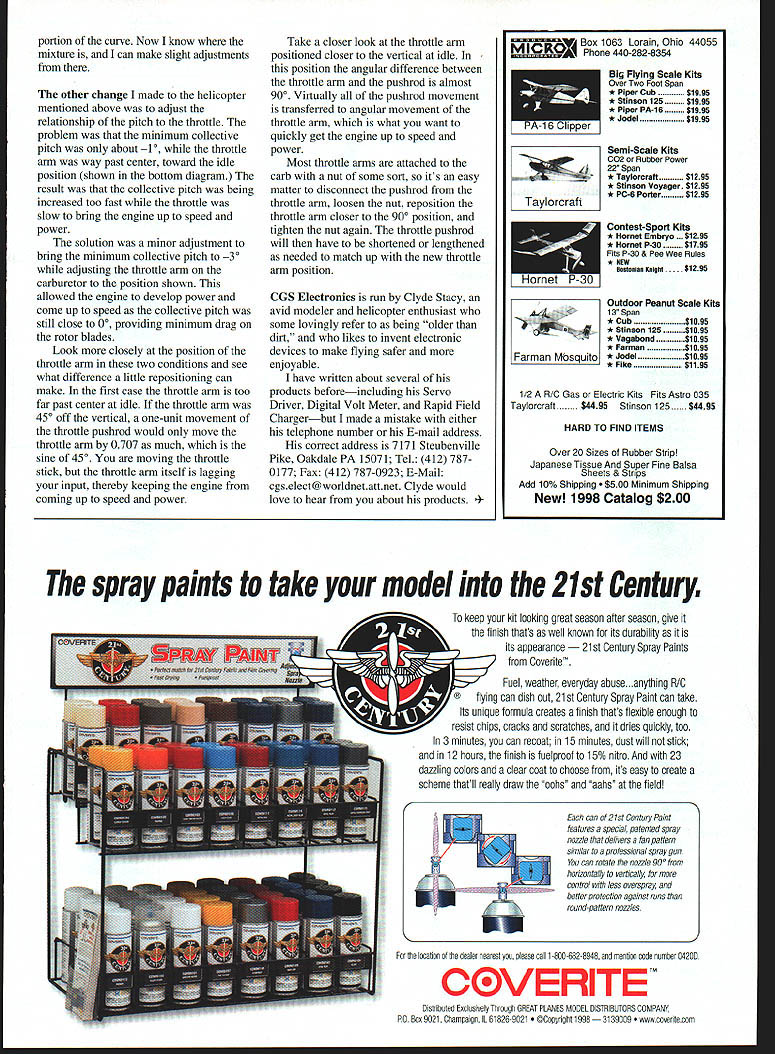
Look at the throttle arm position in two conditions and note the difference a little repositioning can make. In the first case, the throttle arm is too far off center at idle. If the throttle arm is 45° off the vertical, a one-unit movement of the throttle pushrod moves the throttle arm by only 0.707 units (the sine of 45°). You move the throttle stick, but the throttle arm lags your input, keeping the engine from coming up to speed quickly.
When the throttle arm is positioned closer to vertical at idle, the angular difference between the throttle arm and the pushrod is nearly 90°. Virtually all the pushrod movement transfers to angular movement of the throttle arm, which quickly gets the engine up to speed and power.
Most throttle arms are attached to the carb with a nut or some sort of fastener, so you can disconnect the pushrod from the throttle arm, loosen the nut, reposition the throttle arm closer to the 90° position, and retighten the nut. The throttle pushrod will then need to be shortened or lengthened as required to match the new throttle arm position.
CGS Electronics — contact information
CGS Electronics is run by Clyde Stacy, an avid modeler and helicopter enthusiast whom some lovingly refer to as "older than dirt." He invents electronic devices to make flying safer and more enjoyable.
I have written about several of his products before — including his Servo Driver, Digital Volt Meter, and Rapid Field Charger — but I made a mistake with either his telephone number or his e-mail address. His correct contact information is:
- CGS Electronics
1711 Steubenville Pike, Oakdale PA 15071 Tel: (412) 787-0177 Fax: (412) 787-0923 E-mail: cgs.elect@worldnet.att.net
Clyde would love to hear from you about his products.
Transcribed from original scans by AI. Minor OCR errors may remain.

