

RADIO CONTROL HELICOPTERS
Paul Tradelius 4620 Barracuda Dr., Bradenton FL 34208 E-mail: flytrade@earthlink.net
Using E-mail
Using E-mail to communicate with other helicopter fliers is starting to work out great. I can download information from the Web, get your messages, and answer them in a matter of minutes. I always intended this to be your column — to get the info you want and to share ideas so we don't have to reinvent the wheel — and having E-mail is making it better and easier, as the following messages show.
Throttle safety
Scott Kordes of Amarillo, Texas, added an idea to a previous column about ways to make helicopter flying safer. One such way is to make sure the throttle stick on the transmitter stays at idle after the engine is started and the helicopter is being carried away from the pit area. Many of us have had the bad experience of wind blowing a shirt or transmitter neck strap onto the throttle stick, causing the engine to advance above idle.
One method is to hold the transmitter in your left hand with your thumb holding the stick at full idle. Scott suggested another approach: use the throttle-hold switch as a safety device to ensure the throttle stays at idle. I like the idea. You need control of the throttle during engine start to make minor adjustments, but once the engine is warmed up and has a reliable idle, engaging the throttle-hold switch is a good safety step.
Ceiling storage for helicopters
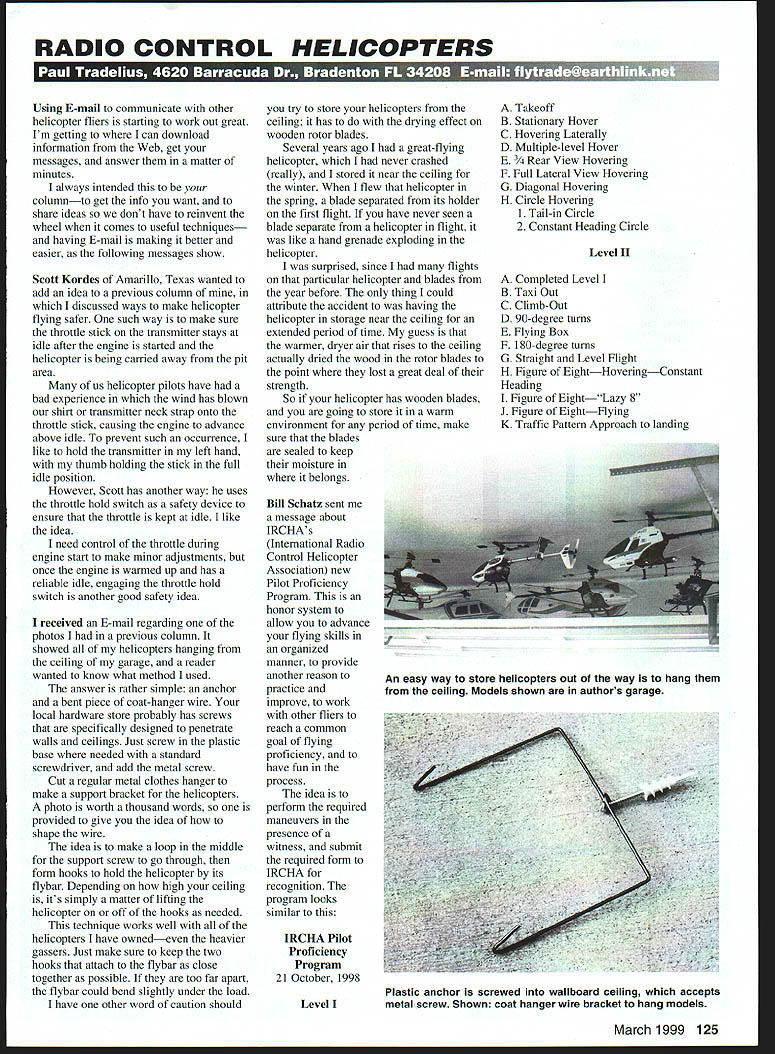
I received E-mail about a previous column photo that showed my helicopters hanging from the garage ceiling. The method is simple: an anchor and a bent piece of coat-hanger wire.
- Use plastic anchors and screws designed for walls/ceilings. Screw the plastic base in place with a standard screwdriver, then add the metal screw.
- Cut and bend a regular metal clothes hanger to make a support bracket. Make a loop in the middle for the support screw and form hooks to hold the helicopter by its flybar.
- Depending on ceiling height, lift the helicopter on or off the hooks as needed. This works well even for heavier gassers.
- Keep the two hooks that attach to the flybar as close together as possible. If they are too far apart, the flybar could bend under the load.
One word of caution with ceiling storage: wooden rotor blades can dry out if stored in a warm location near the ceiling for an extended period. I once stored a helicopter near the ceiling for the winter and, on the first flight in spring, a blade separated from its holder in flight. My guess is that the warmer, drier air rising to the ceiling dried the wood and weakened the blades. If your helicopter has wooden blades and you plan to store it in a warm environment, seal the blades to retain their moisture.
IRCHA Pilot Proficiency Program
21 October 1998
Bill Schatz sent a message about IRCHA's (International Radio Control Helicopter Association) new Pilot Proficiency Program. It's an honor system that allows you to advance flying skills in an organized manner. The idea is to perform the required maneuvers in the presence of a witness and submit the required form to IRCHA for recognition. The program looks like this:
- Level I
- A. Takeoff
- B. Stationary Hover
- C. Hovering Laterally
- D. Multiple-level Hover
- E. 3/4 Rear-View Hovering
- F. Full Lateral-View Hovering
- G. Diagonal Hovering
- H. Circle Hovering
- I. Tail-in Circle
- J. Constant-Heading Circle
- Level II
- A. Completed Level I
- B. Taxi Out
- C. Climb-Out
- D. 90-degree Turns
- E. Flying Box
- F. 180-degree Turns
- G. Straight Level Flight
- H. Figure of Eight — Hovering — Constant Heading
- I. Figure of Eight — "Lazy 8"
- J. Figure of Eight — Flying
- K. Traffic Pattern Approach to Landing
- Level III
- A. Completed previous Levels
- B. Nose-In Hover
- C. Nose-In Circle
- D. Takeoff Nose-In
- E. Land Nose-In Hover
- F. Basic Aerobatics / Unusual Attitudes Training
- 540 Stall Turn
- Horizontal Roll
- Immelmann Turn
- 1/2 Cuban Eight
- Loop with a Pirouette at the Top
- Flying Circle
- Figure of Eight — Nose-In and Tail-In
- Autorotation Landing
- 4-Point Pirouette / Hesitation Pirouette
- Level IV
- A. Completed all previous Levels
- B. Sustained Inverted Flight
- C. Inverted Figure of Eight — Flying
- D. Sustained Inverted Hover
- E. Inverted Pirouettes
- F. Stationary Rolls
- G. Autorotation 180 Degrees
- H. Advanced Aerobatics
- Level V
- A. Completed all previous Levels
- B. Backward Flight — Straight
- C. Backward Figure of Eight — Flying
- D. Backward Flying Loops
- E. Backward Rolls
- F. Backward Inverted Flight
- G. Backward Inverted Figure of Eight — Flying
- H. Autorotation with Inverted Segment
- I. Advanced Aerobatics
- Knife-edge Pirouette
- Death Spiral
- Tumbles
- Level VI
- A. Completed all previous Levels
- B. Sideways Loop
- C. Sideways Roll
- D. Sideways Outside Loop
- E. Pirouetting Figure 8
- F. Inverted Pirouetting Figure 8
- Level VII
- A. Completed all previous Levels
- B. Pirouetting Loop
- C. Pirouetting Roll
- D. Pirouetting Tumble
For more information, contact Bill Schatz at IRCHA, c/o AMA, Box 3028, Muncie IN 47302-3028; or visit www.ircha.org.
Club conflicts and AMA response
I received E-mail from a flier who belongs to an AMA-chartered club and is fighting to keep the right to fly helicopters at the club field. The field is on college property and the club has permission to fly there because it is AMA chartered. However, the club president doesn't like helicopters and is trying to influence members to ban them.
I contacted AMA to see if it could provide assistance. AMA responded:
- AMA has no procedure to "pressure" clubs into behaving in a certain way. Individual clubs operate autonomously.
- It would create problems if AMA tried to police all club activities.
- In almost every instance where conflict arises between helicopter and fixed-wing pilots, the problem can usually be traced to a personality clash.
- There are clubs that successfully incorporate helicopters, fixed-wing, control line, free flight, cars, boats, rockets, and kites at their fields without problems.
- AMA encourages multiple activities at club fields and has assisted clubs with new field layouts to make room for helicopter operations, but it cannot enforce club policy.
I spent 12 years in Fort Worth, Texas flying helicopters and fixed-wings at Thunderbird Field, and I continue to fly at Valkyrie Field in Palmetto, Florida. Flying helicopters and fixed-wings at the same site can have problems, but many clubs find workable solutions.
Send your experiences
It would be beneficial to share experiences and specific club procedures that allow both fixed-wing and helicopter models to fly together. How were problems solved? How did you handle personality clashes? Could you make recommendations to other clubs to improve flying harmony?
Write or E-mail me at the address above, and I'll present the information here in a later column.
Transcribed from original scans by AI. Minor OCR errors may remain.

