
RADIO CONTROL HELICOPTERS
Paul Tradelius 4620 Barracuda Dr., Bradenton FL 34208 E-mail: flytrade@earthlink.net
Hopefully by this time the worst of winter is behind us and we're planning a new year of flying. That may include the new helicopter you've been thinking about, but will almost certainly include the trusty machine that served you well last year.
Before you dust off last year's pride-and-joy for a few flights, there are things you should check to make sure all is well for another season of fun flying. Use the following at your workbench as a spring checklist. The checks don't take much time and can easily be done on a rainy afternoon when you have nothing better to do.
Helicopter
To make sure nothing is missed during the examination, I recommend starting from the nose. This list isn't complete; modify it as needed for your particular helicopter and the degree to which you do the inspection.
- Canopy: Remove and check for any cracks or splits—especially at the seams if it's the type that has been glued together. The mounting rubber grommets, latches, etc., should be in good condition and not worn from vibration. A good lubricant for rubber and plastic parts is Vaseline petroleum jelly. Many years ago a friend who repaired automatic transmissions told me that they contained many rubber parts, and the petroleum jelly lubricated well without causing swelling, as other lubricants might.
- Servo Tray: Check for stress cracks or broken glue joints in wooden trays. Twist and push/pull gently to check for a solid tray, and ensure that it is well-mounted to the frame.
- Pushrods: Check ball-links for wear and an overall snug fit. Replace as needed. Ball links can wear very easily if they get dirty or have fuel on them from being near the engine/exhaust. Disconnect pushrods from the servos and push/pull with your hand to check for slop or binding. Ensure that all pushrods are straight.
- Bearings: Although you should have given all bearings a coat of oil when the helicopter was put up for the winter, oil them or pack with bearing grease as needed.
- Landing Gear/Skids: Check that they are secure and straight. If made of metal, they may need to be bent back into proper position so the helicopter sits straight and level on the ground.
- Frame: Check to see that all nuts and bolts are secure. Inspect for vibration or stress cracks around the engine and skid mounts. Replace parts as required.
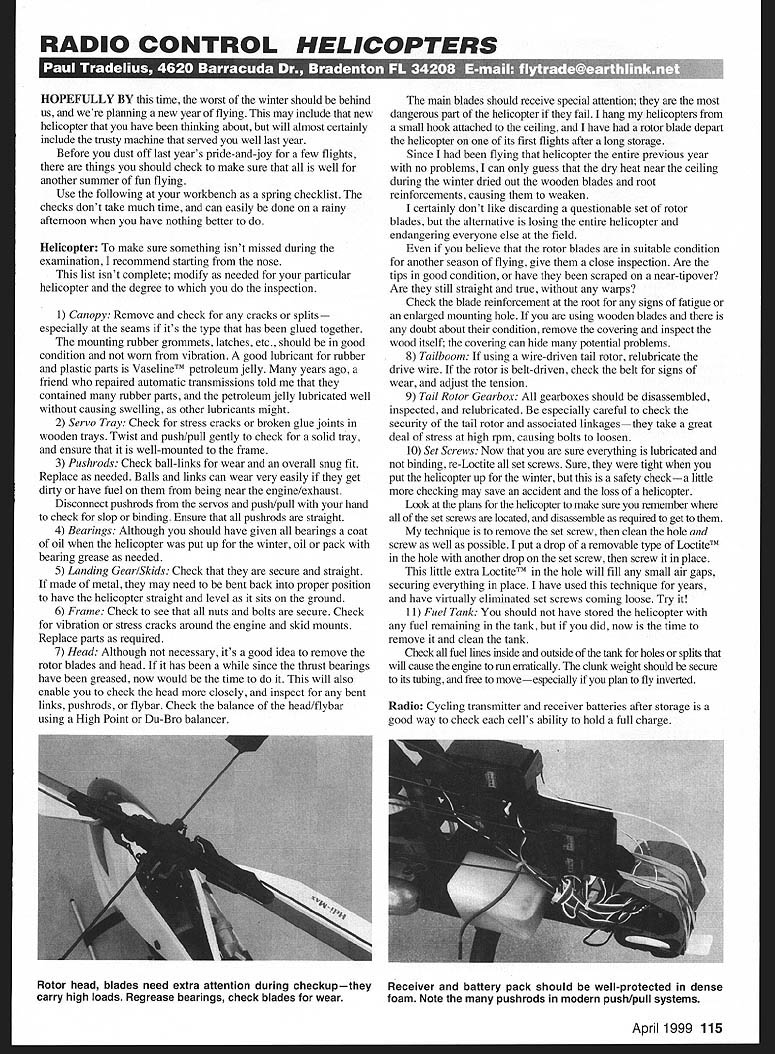
- Head and Main Blades: Although not always necessary, it's a good idea to remove the rotor blades and the head. If it has been a while since the thrust bearings have been greased, now is the time to do it. This will also enable you to check the head more closely and inspect for any bent links, pushrods, or a warped flybar. Check the balance of the head/flybar using a High Point or Du-Bro balancer.
The main blades should receive special attention; they are the most dangerous part of the helicopter if they fail. I hang my helicopters from a small hook attached to the ceiling, and I have had a rotor blade depart the helicopter on one of its first flights after long storage. Since I had been flying that helicopter the entire previous year with no problems, I can only guess that the dry heat near the ceiling during the winter dried out the wooden blades and root reinforcements, causing them to weaken.
I certainly don't like discarding a questionable set of rotor blades, but the alternative is losing the entire helicopter and endangering everyone else at the field. Even if you believe the rotor blades are in suitable condition for another season, give them a close inspection. Are the tips in good condition, or have they been scraped in a near-tipover? Are they still straight and true, without warp? Check the blade reinforcements at the root for any signs of fatigue or an enlarged mounting hole. If you are using wooden blades and there is any doubt about their condition, remove the covering and inspect the wood itself; the covering can hide many potential problems.
- Tailboom: If using a wire-driven tail rotor, relubricate the drive wire. If the rotor is belt-driven, check the belt for signs of wear and adjust the tension.
- Tail Rotor Gearbox: All gearboxes should be disassembled, inspected, and relubricated. Be especially careful to check the security of the tail rotor and associated linkages—they take a great deal of stress at high rpm, which can cause bolts to loosen.
- Set Screws: Now that you are sure everything is lubricated and not binding, re-apply Loctite to all set screws. They may have been tight when you stored the helicopter, but this is a safety check—a little extra attention may save an accident and the loss of a helicopter.
My technique is to remove the set screw, then clean the hole and screw as well as possible. Put a drop of removable type Loctite in the hole with another drop on the set screw, then screw it in place. This extra Loctite in the hole will fill any small air gaps and secure everything in place. I have used this technique for years and have virtually eliminated set screws coming loose.
- Fuel Tank: You should not have stored the helicopter with fuel remaining in the tank, but if you did, now is the time to remove it and clean the tank. Check all fuel lines inside and outside the tank for holes or splits that will cause the engine to run erratically. The clunk weight should be secure to its tubing and free to move—especially if you plan to fly inverted.
Radio
Cycle transmitter and receiver batteries after storage to check each cell's ability to hold a full charge. Check connectors and wires closely for any breaks, frays, etc. Look particularly where the wires go into the connectors; if the wires have been pulled on, they can become dislodged. No matter how securely your wires are routed, check each one to ensure it has not been rubbing on anything.
Check all servo mounting screws; they should be snug but not so tight that they remove their vibration protection. Check the foam rubber that protects the receiver, battery, etc., and replace as needed. You may want to consider getting the Strongbox from LDM Industries, which offers excellent crash protection for the receiver and airborne batteries.
Servo arms take quite a stress load, so ensure they aren't cracked or have enlarged holes. Replace as needed. I also like to disconnect the servo arms from the servos and inspect the shaft output splines.
Check that the antenna is free of cracks or nicks. Any minor problems with the wire covering can be corrected by placing a small piece of heat-shrink tubing over the bad spot. Accidentally tugging on the antenna could also have weakened the wire or solder connection to the receiver circuit board; you may want to open the receiver case and check the circuit board.
When everything looks as good as it can, give the entire system a range check as you are going to fly it. Do not route the receiver antenna differently, or remove the canopy or other pieces, because you may not be getting an accurate range check. Compare this range check to the distance you were getting last season and make sure it's more than the minimum recommended by the manufacturer. If your radio does not pass this check, do not start the engine; have a qualified technician check it out.
Gyro
Check the wiring and connectors. Also check for proper servo movement with the radio turned on, as if flying. As the helicopter nose is moved gently right and left, the gyro should be giving smooth commands to the tail rotor servo.
If you have a mechanical gyro (versus a solid state piezo-type gyro) that is operating erratically, take the gyro case apart and check that the springs are in their proper positions, the weighted wheels spin freely, and the electronic pickup is clean. A small drop of lightweight oil on the bearings may also be helpful.
Engine and Muffler
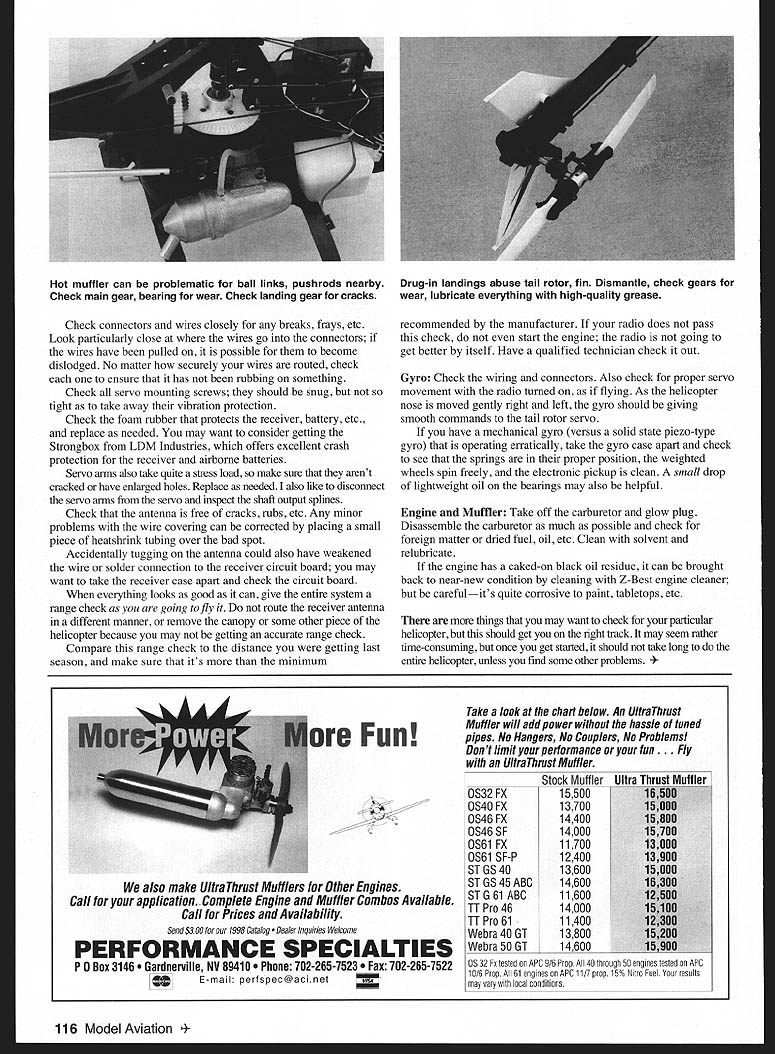
Take off the carburetor and glow plug. Disassemble the carburetor as much as possible and check for foreign matter or dried fuel/oil. Clean with solvent and relubricate.
If the engine has caked-on black oil residue, it can be brought back to near-new condition by cleaning with Z-Best engine cleaner; be careful, as it is corrosive to paint, tabletops, etc.
There are more things you may want to check for your particular helicopter, but this should get you on the right track. It may seem time-consuming, but once you get started it should not take long to do the entire helicopter—unless you find other problems that require attention.
Transcribed from original scans by AI. Minor OCR errors may remain.

