
Radio Control: Helicopters
Every once in a while I hear of an incident where a pilot made a mistake while flying, or his helicopter got away from him (or her) and almost caused a catastrophic accident. This does not mean that helicopters are more dangerous than airplanes or any other form of radio control (RC), but there are lessons to be learned that can improve safety in general.
Flying safety is no accident, and the more we can learn from others' mistakes, the better we will be able to handle mishaps if and when they happen to us.
Many issues ago I relayed the story of a person flying a helicopter in the backyard when it went out of control. It could have been an errant control input or some mechanical malfunction, but the cause really doesn't matter. Helicopters can go out of control for any number of reasons. No matter how good a flier we think we are, there will be the occasional "brain lock" and bad command on which we didn't plan.
Or it could be some malfunction in the helicopter: the battery could go bad, the switch could fail, a servo could fail, or there could be many other problems. Never trust your helicopter completely, and always have a plan for the unexpected.
Back to the story: once the helicopter went out of control, the pilot found himself pinned between his house and a line of trees, with nowhere to go. Although the helicopter did hit him, he sustained only minor injuries.
A basic point here is not to fly near your house or in any other confined space, but rather in an open field with room to run in case you need it. Although I basically agree with that, the real issue is having a plan to get away from an uncontrollable helicopter, no matter where you fly. I test many helicopters in my backyard, and I make sure there is an exit route.
However, there is more to safe flying than having a place to run; you need a constant awareness of what you are doing and to consider whether there is a safer way. Following are a few precautions:
Precautions
- If the on/off switch is exposed (i.e., not under or protected by the canopy), mount it so the "on" position is toward the rear of the helicopter. There have been cases of people flying over tall grass or having minor tip-overs where the switch was pushed to the off position after contact with grass, a twig, etc.
- After your helicopter batteries have been charged, give all of your equipment a once-over to make sure everything is secure and in good working order. Some parts may need to be lubricated or adjusted, and this is a good time to do it rather than at the field when you are more apt to be thinking of flying.
- Don't go flying by yourself. Although flying at a large field gives you more room to run if needed, it's still important to have someone else around to go for help should an accident occur. Now that cell phones are common and inexpensive, it is a good idea to carry one.
- If you have not used your radio for a while, if it has just been repaired, or if there is any doubt about its performance, give it a range check before flying. Many pilots perform a range check before the first flight of the day, which is a very safe practice.
- When starting the helicopter, assume that it's going to start at full throttle. The throttle stick might not be at idle, the idle-up switch could be on, a servo might be bad, or a linkage could have come loose. To protect myself, I position the helicopter so that the fuel line to the engine is right in front of me and keep one hand firmly on the rotor head. This way I can hold the head while bringing the throttle under control with the radio, and as a last-ditch backup I can pull the fuel line off.
- Carry the helicopter away from the pit area before running up the engine. This seems so basic it shouldn't have to be mentioned, but there are still those who would rather hover-taxi than carry the helicopter a safe distance away.
- If you are using a two-stick radio with the throttle on the left stick, carry the helicopter with your right hand and hold the radio with your left hand, with your left thumb holding the throttle stick at idle. I've had the throttle stick brush against my clothing or neck strap, causing the engine to go to full power while I was carrying the helicopter. That really gets your attention!
- When hovering, stand clear and to the side of the helicopter. If the helicopter malfunctions, your first thought might be to give a control input on the radio. If that does not help, you might try a larger correction, and only after two or three attempts realize you don't have control and need to take evasive action. If you are standing too close, the helicopter could be on you before you can get away.
Those are some of the safety techniques I use, and there are surely many more good ideas out there. Let me know if you have any so I can present them in a later column.
Emergency Action Checklist
I talked to Gary Guy, a longtime friend and fellow helicopter pilot, about flying safety issues, and he had a good idea: have an emergency action checklist for your helicopter that you can rely on during emergencies.
Gary and I are professional fixed-wing pilots, and over the years we have memorized emergency action checklists for all of the airplanes we have flown. If an airplane had an engine fire, the procedure might be something like: 1) Throttle — Idle; 2) Fuel lever — Shut; 3) Fire bottle — Discharge. These steps are committed to memory and performed without thinking to get the fire under control efficiently.
Gary's idea is to have similar emergency procedures for helicopters. We aren't so concerned with an engine fire for most RC helicopters, but we worry about a runaway throttle during start or engine failure during flight, and each pilot could come up with several scenarios and steps.
I'll talk more to Gary about his idea, see what other helicopter fliers can come up with, and present more on this idea in the next issue.
New Products
Larry Stephens Jr. of Horizon Hobby Distributors (4105 Fieldstone Rd., Champaign, IL 61821) sent information on a couple of new products of interest.
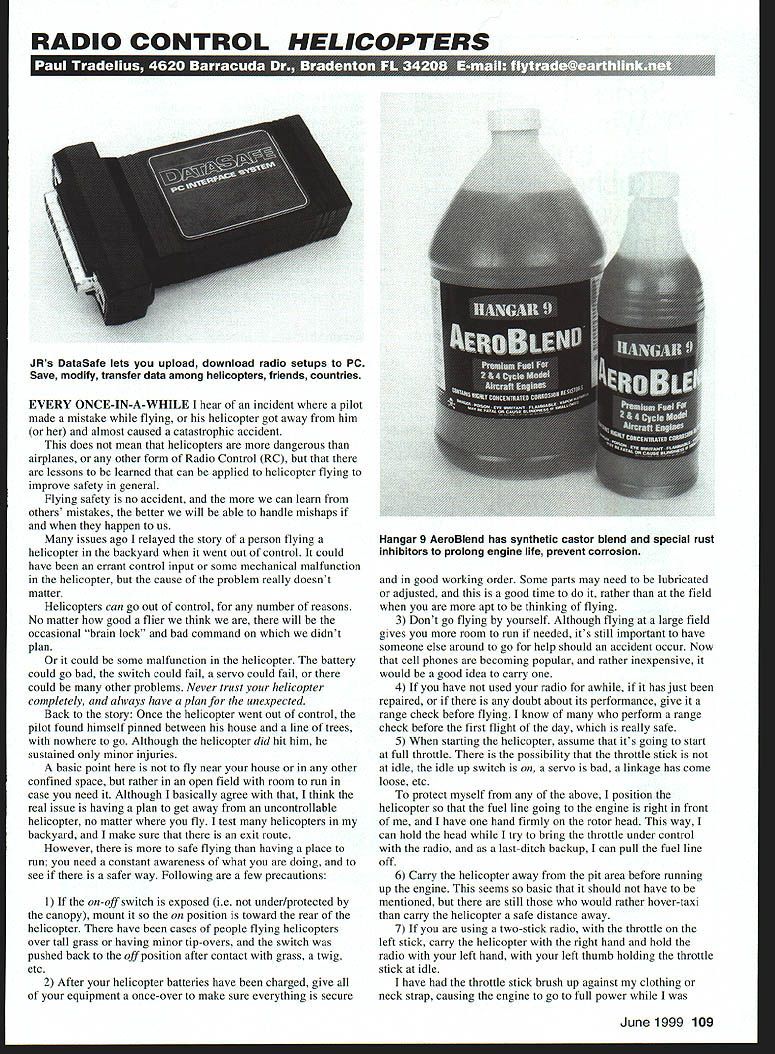
- JR DataSafe PC Interface Software
- Compatible with Windows 95, Windows 98, and NT.
- Allows you to upload and download model memory between the radio and a personal computer.
- You can transfer model setups to your PC to save or modify, or send to someone else via e-mail or disk.
Although I have not tried DataSafe, it seems to be another step in the right direction to improve our flying.
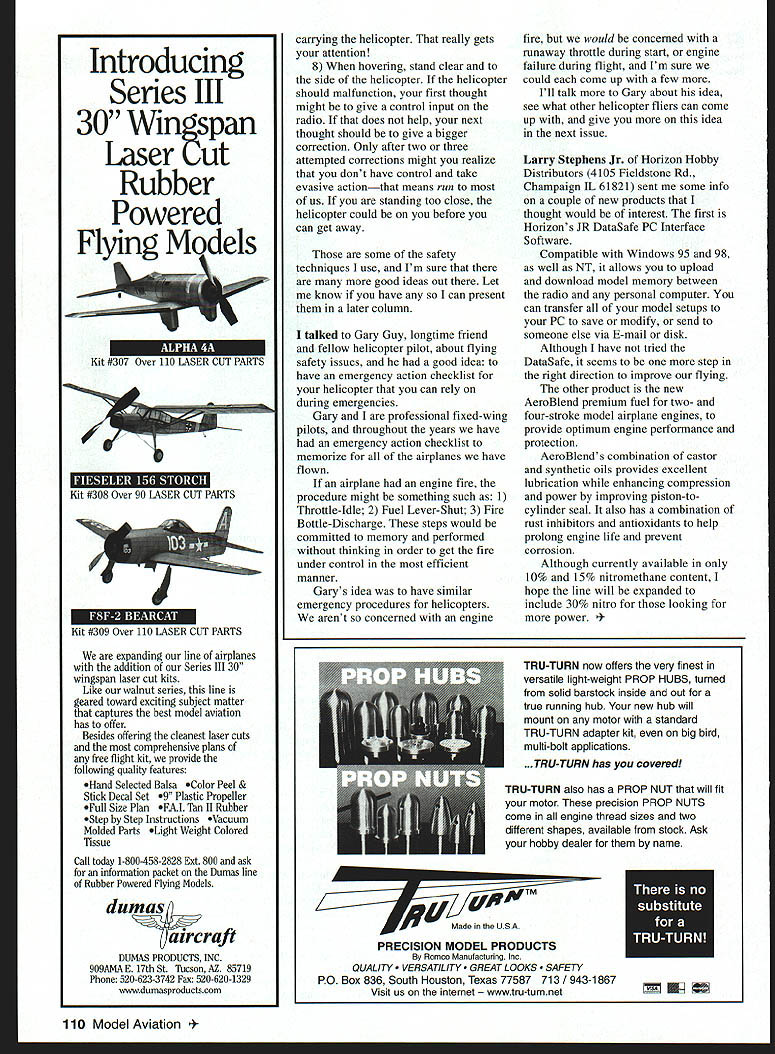
- AeroBlend premium fuel
- For two- and four-stroke model engines to provide optimum engine performance and protection.
- Combination of castor and synthetic oils provides excellent lubrication while enhancing compression and power by improving piston-to-cylinder seal.
- Contains rust inhibitors and antioxidants to help prolong engine life and prevent corrosion.
- Currently available in 10% and 15% nitromethane blends; I hope the line will be expanded to include 30% nitro for those seeking more power.
Transcribed from original scans by AI. Minor OCR errors may remain.

