
RADIO CONTROL HELICOPTERS
Paul Tradelius, 4620 Barracuda Dr., Bradenton FL 34208 E-mail: flytrade@earthlink.net
Last month I started to present Gary Guy's idea that pilots should have individual emergency checklists for their helicopters. (Gary is a good friend and fellow helicopter flier here in Bradenton.)
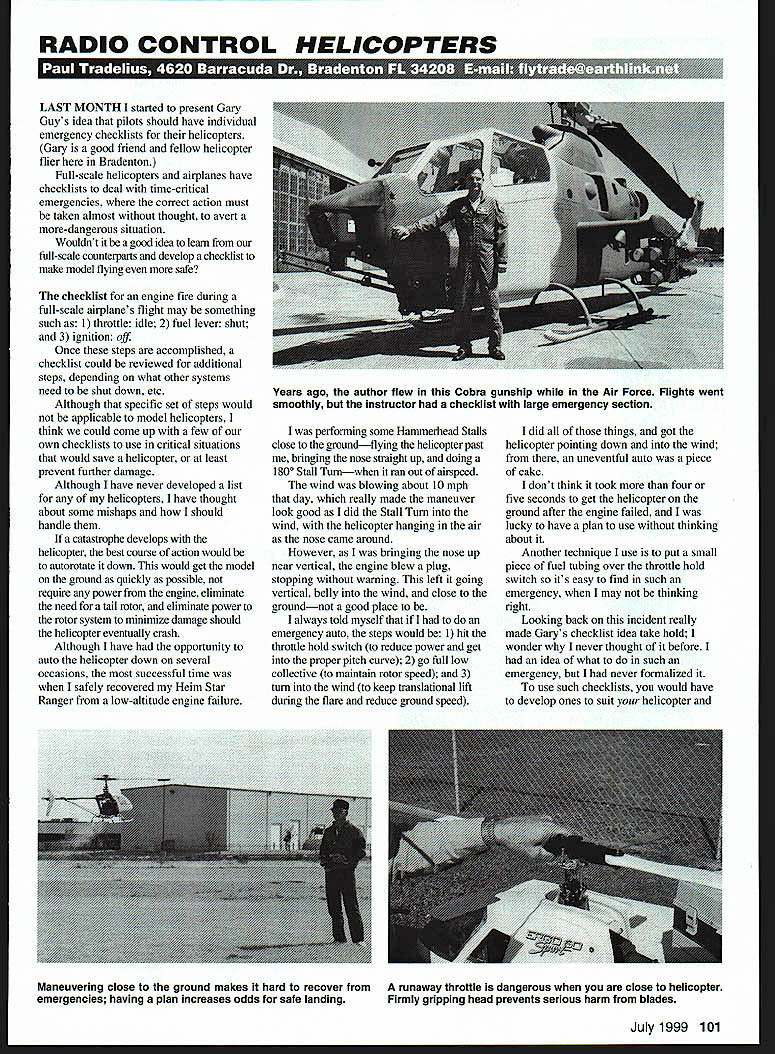
Full-scale helicopters and airplanes have checklists to deal with time-critical emergencies, where the correct action must be taken almost without thought to avert a more dangerous situation. Wouldn't it be a good idea to learn from our full-scale counterparts and develop checklists to make model flying even safer?
For example, the checklist for an engine fire during a full-scale airplane flight may be something like: 1) throttle: idle; 2) fuel lever: shut; 3) ignition: off. Once those steps are accomplished, a checklist could be reviewed for additional steps, depending on what other systems need to be shut down.
Although that specific set of steps would not apply directly to model helicopters, I think we could come up with a few of our own checklists to use in critical situations that could save a helicopter, or at least prevent further damage. I have thought about some mishaps and how I should handle them, even though I have not previously formalized a list for any of my helicopters.
If a catastrophe develops with the helicopter, the best course of action is usually to autorotate it down. This gets the model on the ground as quickly as possible, requires no power from the engine, eliminates the need for an operational tail rotor, and minimizes rotor-system power to reduce damage should the helicopter eventually crash.
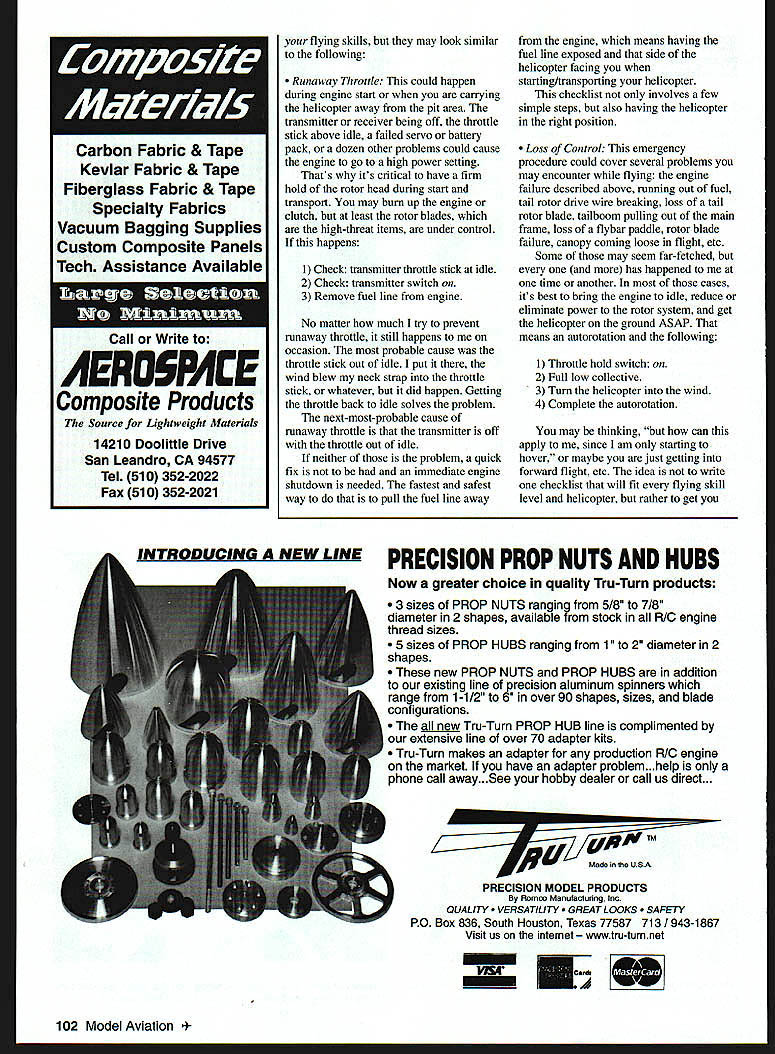
I have had the opportunity to autorotate on several occasions. The most successful time was when I safely recovered my Heim Star Ranger from a low-altitude engine failure. I was performing some Hammerhead stalls close to the ground—flying the helicopter past me, bringing the nose straight up, and doing a 180° stall turn—when it ran out of airspeed.
The wind was blowing about 10 mph that day, which made the maneuver look good as I did the stall turn into the wind, with the helicopter hanging in the air as the nose came around. However, as I was bringing the nose up near vertical, the engine blew a plug and stopped without warning. This left it going vertical, belly into the wind, and close to the ground—not a good place to be.
I always told myself that if I had to do an emergency autorotation, the steps would be:
- Hit the throttle-hold switch (to reduce power and get into the proper pitch curve).
- Go full low collective (to maintain rotor speed).
- Turn into the wind (to keep translational lift during the flare and reduce ground speed).
I did all of those things and got the helicopter pointing down and into the wind; from there, an uneventful autorotation was a piece of cake. I don't think it took more than four or five seconds to get the helicopter on the ground after the engine failed, and I was lucky to have a plan I could use without thinking about it.
Another technique I use is to put a small piece of fuel tubing over the throttle-hold switch so it's easy to find in an emergency when I may not be thinking clearly. Looking back on this incident really made Gary's checklist idea take hold; I wonder why I never thought of it before. I had an idea of what to do in such an emergency, but I had never formalized it.
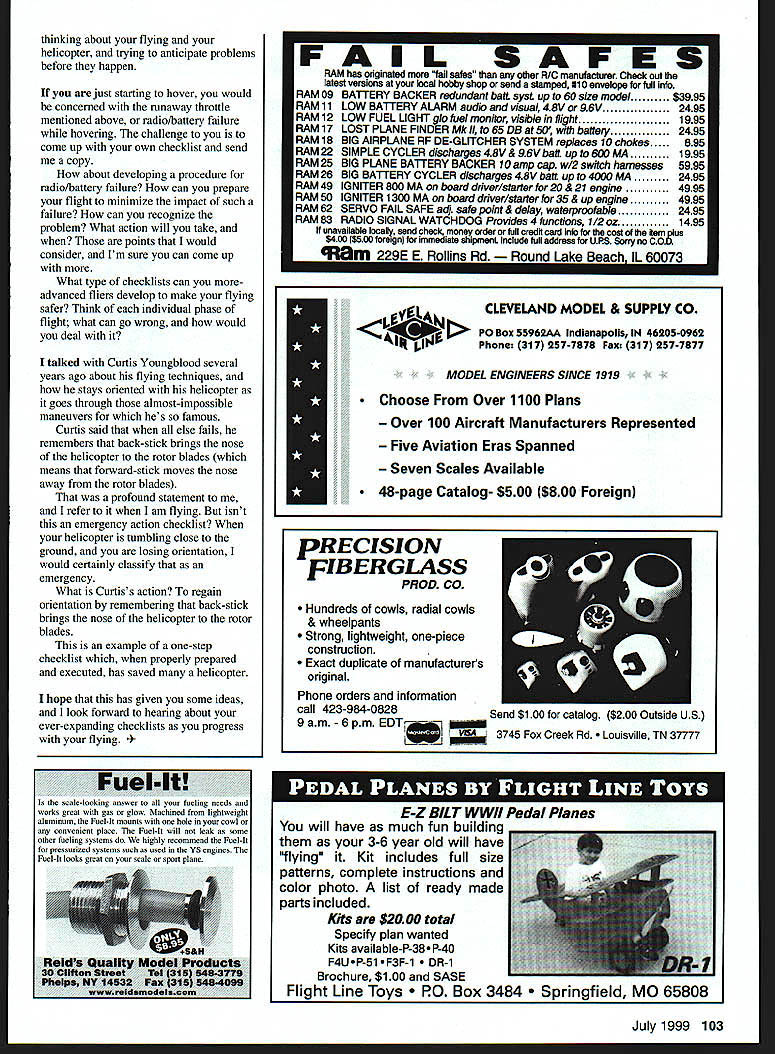
To use such checklists, you must develop ones to suit your helicopter and flying skills. Many emergencies may look similar. A runaway throttle could happen during engine start, while carrying the helicopter away from the pit area, or due to the transmitter/receiver being off, the throttle stick above idle, a failed servo, a low battery pack—there are many causes. That's why it's critical to have a firm hold on the rotor head during start and transport. The engine, clutch, or rotor blades can be destroyed if high power occurs while the helicopter is not secured.
Runaway Throttle
This could happen during engine start or when you are carrying the helicopter away from the pit area. Causes include the transmitter or receiver being off, the throttle stick above idle, a failed servo, a low battery pack, wind blowing a neck strap against the throttle stick, or other issues. If high power occurs with the helicopter not secured, you may damage the engine, clutch, or rotor blades.
If this happens:
- Check the transmitter throttle stick is at idle.
- Check the transmitter switch is on.
- Remove the fuel line from the engine.
Getting the throttle back to idle often solves the problem. If the transmitter is off or the throttle trim is out of idle, those are not quick fixes and immediate engine shutdown is needed. The fastest, safest way to shut the engine down is to pull the fuel line away from the engine, which means having the fuel line exposed on the side of the helicopter when starting or transporting it.
Loss of Control
This emergency procedure covers several problems you may encounter while flying: engine failure, running out of fuel, tail-rotor drive wire breaking, loss of a tail-rotor blade, tailboom pulling out of the main frame, loss of a flybar paddle, rotor blade failure, canopy coming loose in flight, etc. Some of those may seem far-fetched, but every one (and more) has happened to me at one time or another.
In most of those cases, it's best to bring the engine to idle, reduce or eliminate power to the rotor system, and get the helicopter on the ground as soon as possible. That means an autorotation and the following steps:
- Throttle-hold switch: on.
- Full low collective.
- Turn the helicopter into the wind.
- Complete the autorotation.
You may be thinking this doesn't apply to you if you are only starting to hover or just getting into forward flight. The idea is not to write one checklist that fits every flying-skill level and helicopter, but rather to get you thinking about your flying and your helicopter, and to anticipate problems before they happen.
If you are just starting to hover, you should be concerned with the runaway-throttle scenario or a radio/battery failure while hovering. The challenge to you is to come up with your own checklist and send me a copy.
How about developing a procedure for radio/battery failure? Consider:
- How can you prepare your flight to minimize the impact of such a failure?
- How can you recognize the problem?
- What action will you take, and when?
Those are points I would consider, and I'm sure you can come up with more.
What type of checklists can more-advanced fliers develop to make flying safer? Think of each individual phase of flight: what can go wrong, and how would you handle it?
I talked with Curtis Youngblood several years ago about his flying techniques and how he stays oriented with his helicopter as it goes through those almost-impossible maneuvers for which he's so famous. Curtis said that when all else fails, he remembers that back-stick brings the nose of the helicopter toward the rotor blades (which means forward-stick moves the nose away from the rotor blades).
That was a profound statement to me, and I refer to it when I fly. But isn't this an emergency action checklist? When your helicopter is tumbling close to the ground and you are losing orientation, I would certainly classify that as an emergency.
What is Curtis's action? To regain orientation by remembering that back-stick brings the nose to the rotor blades. This is an example of a one-step checklist which, when properly prepared and executed, has saved many helicopters.
I hope this has given you some ideas. I look forward to hearing about your ever-expanding checklists as you progress with your flying.
Transcribed from original scans by AI. Minor OCR errors may remain.

