
RADIO CONTROL HELICOPTERS
Paul Tradelius, 4620 Barracuda Dr., Bradenton, FL 34208 E-mail: flytrade@earthlink.net
Last month I discussed developing checklists to improve the safety of helicopter flying. Although it's too early to get a response, I received a letter from Ron Barat of Long Beach, CA, about a "safety platform" that he developed to improve the safety of his helicopter ground operations.
Ron's letter mentions using a preflight checklist, so his ideas are ahead of last month's column.
Safety platform — Ron Barat
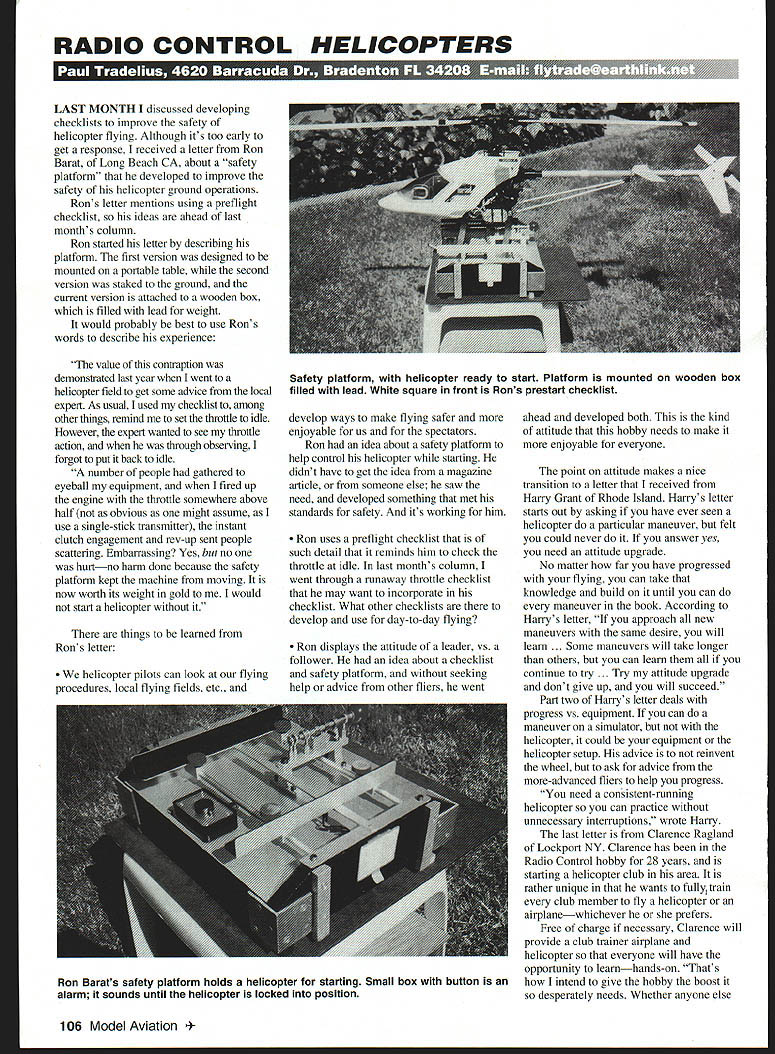
Ron started his letter by describing his platform. The first version was designed to be mounted on a portable table, while the second version was staked to the ground, and the current version is attached to a wooden box filled with lead for weight.
It is best to use Ron's words to describe his experience:
"The value of this contraption was demonstrated last year when I went to a helicopter field to get some advice from the local expert. As usual, I used my checklist to, among other things, remind me to set the throttle to idle. However, the expert wanted to see throttle action, and when he was through observing, I forgot to put it back to idle.
"A number of people had gathered to eyeball my equipment, and when I fired up the engine with the throttle somewhere above half (not as obvious as one might assume, as I use a single-stick transmitter), the instant clutch engagement and rev-up sent people scattering. Embarrassing? Yes, but no one was hurt—no harm done because the safety platform kept the machine from moving. It is now worth its weight in gold to me. I would not start a helicopter without it."
Lessons from Ron's letter
- We helicopter pilots can examine our flying procedures, local flying fields, and equipment, and develop ways to make flying safer and more enjoyable for us and for spectators.
- Ron had an idea for a safety platform to help control his helicopter while starting. He didn't have to get the idea from a magazine or from someone else; he saw the need and developed something that met his standards for safety. And it's working for him.
- Ron uses a preflight checklist detailed enough to remind him to check that the throttle is at idle. In last month's column I went through a runaway-throttle checklist that he may want to incorporate in his checklist. What other checklists are there to develop and use for day-to-day flying?
- Ron displays the attitude of a leader rather than a follower. He conceived a checklist and a safety platform, and without seeking help or advice from other fliers, he developed both. This is the kind of attitude the hobby needs to make it more enjoyable for everyone.
Attitude upgrade — Harry Grant
The point on attitude makes a nice transition to a letter I received from Harry Grant of Rhode Island. Harry's letter starts by asking if you have ever seen a helicopter do a particular maneuver but felt you could never do it. If you answered yes, you need an attitude upgrade.
No matter how far you have progressed with your flying, you can take that knowledge and build on it until you can do every maneuver in the book. According to Harry: "If you approach all new maneuvers with the same desire, you will learn ... Some maneuvers will take longer than others, but you can learn them all if you continue to try ... Try my attitude upgrade and don't give up, and you will succeed."
Part two of Harry's letter deals with progress versus equipment. If you can do a maneuver on a simulator but not with the helicopter, it could be your equipment or the helicopter setup. His advice is: do not reinvent the wheel; ask for advice from more-advanced fliers to help you progress.
"You need a consistent-running helicopter so you can practice without unnecessary interruptions," wrote Harry.
Club training — Clarence Ragland
The last letter is from Clarence Ragland of Lockport, NY. Clarence has been in the radio-control hobby for 28 years and is starting a helicopter club in his area. It is rather unique in that he wants to fully train every club member to fly a helicopter or an airplane—whichever he or she prefers.
Free of charge if necessary, Clarence will provide a club trainer airplane and helicopter so everyone will have the opportunity to learn hands-on. "That's how I intend to give the hobby the boost it so desperately needs." Clarence can be reached at 716-434-7965 or via E-mail fliers1@aol.com.
Visitors and accessories — Paul and Helen Binkley
One of the nice things about living in Florida is that the weather is suitable for flying year-round. Winter visitors from up north—snowbirds—bring their helicopters and join in the flying. A couple who have been visiting, Paul and Helen Binkley of Montrose, MI, showed some custom helicopter accessories Paul manufactures and has for sale.
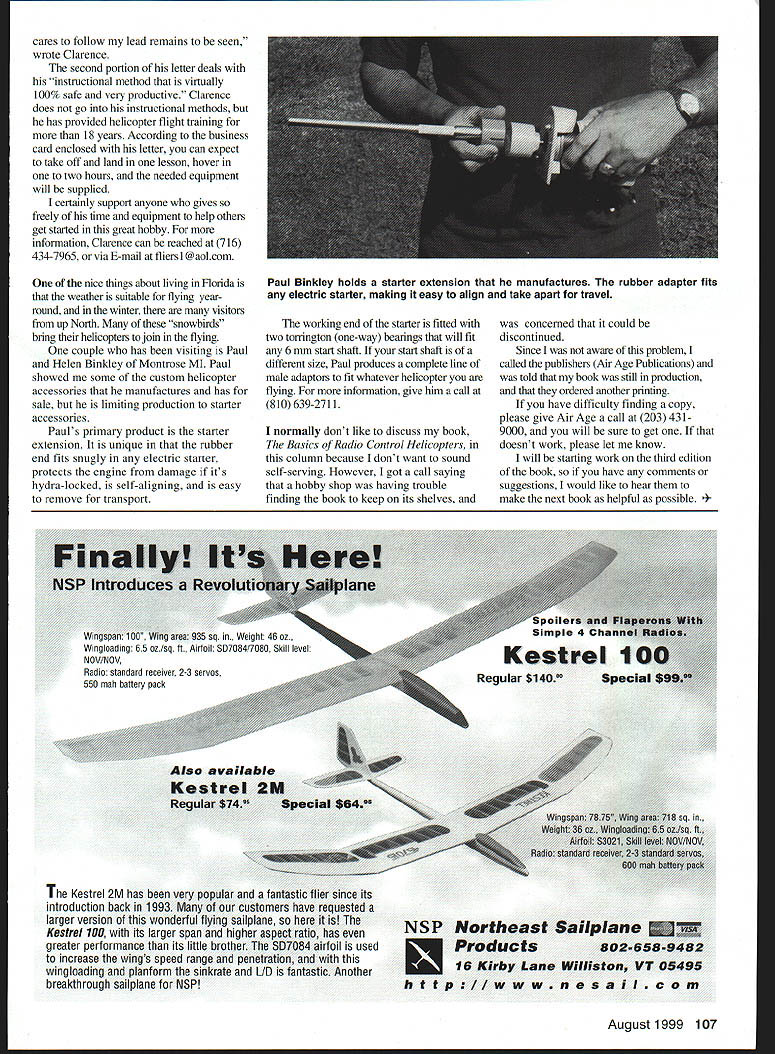
Paul's primary product is the starter extension. It is unique in that the rubber end fits snugly in any electric starter, protects the engine from damage if it's hydro-locked, is self-aligning, and is easy to remove for transport.
The working end of the starter is fitted with two Torrington (one-way) bearings that will fit any 6 mm starter shaft. If your starter shaft is a different size, Paul produces a complete line of male adapters to fit whatever helicopter you are flying. For more information, call him at (810) 639-2711.
Book availability and new edition
I normally don't like to discuss my book, The Basics of Radio Control Helicopters, in this column because I don't want to sound self-serving. However, I received a call saying that a hobby shop was having trouble finding the book to keep on its shelves and was concerned it might be discontinued.
Since I was not aware of this problem, I called the publisher (Air Age Publications) and was told that my book is still in production and that they ordered another printing.
If you have difficulty finding a copy, please give Air Age a call at (203) 431-9000, and you will be sure to get one. If that doesn't work, please let me know.
I will be starting work on the third edition of the book, so if you have any comments or suggestions I would like to hear them to make the next edition as helpful as possible.
Transcribed from original scans by AI. Minor OCR errors may remain.

