
Radio Control: Helicopters
Walt Schoonard
SOUTH CENTRAL Helicopter Championships, hosted by Mid-Arkansas Radio Control Society, Little Rock, Arkansas, will take place on July 23 and 24. The headquarters motel will be the Holiday Inn North, Little Rock, Arkansas—phone (501) 758-1440. Novice, Intermediate, Expert, Scale, and Beginners. Trophies and merchandise through third place. The contest directors are Doug Wilcox and Bill Runyan. This contest was pre-empted by the Helicopter Nats, and they have graciously set a new date for their contest.
This is going to be a great contest directed by two great guys so don't miss it! For further information, contact Doug Wilcox, 206 Sierra Madre North, Little Rock, Arkansas 72118—phone (501) 758-8626.
Jet Ranger Plastic Tail Cone: A very neat plastic tail cone (Part #3913) is available for the Jet Ranger. It saves a lot of work over carving out one from wood and has a built-in lens for a light. However, it has a very weak mounting lug and soon breaks. off from vibration. A simple cure for this problem is to zap in two 1/2 x 1/4 x 1/2 plywood blocks inside of the mounting tabs. When fit to the fuselage, they can be drilled and tapped for 4-40 or small sheet-metal screws. This makes a very secure mount and is simple to do.
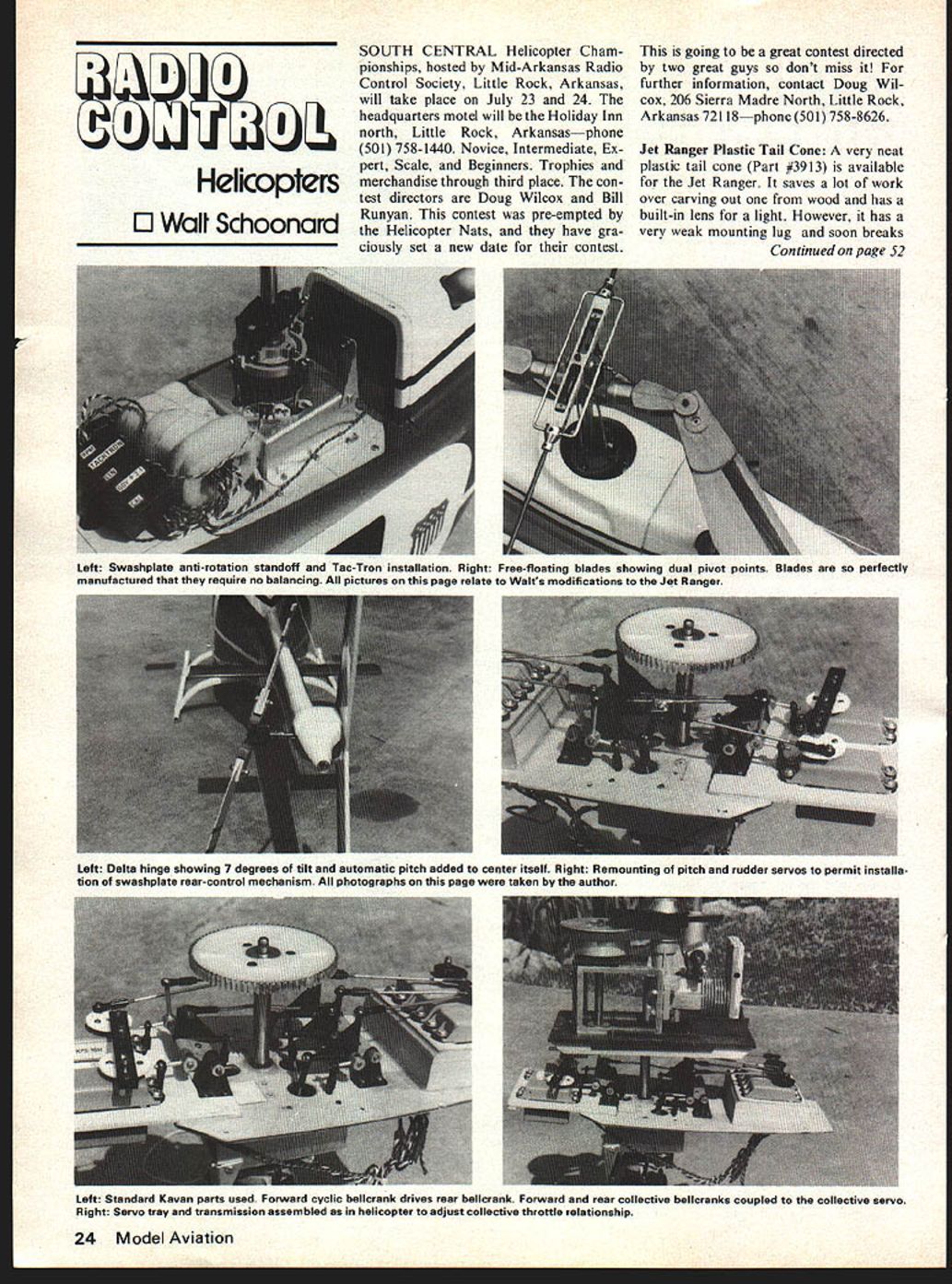
Free Floating Main Rotor Blades: One of the very hard and time-consuming things in setting up a Jet Ranger has been setting the rotor-blade lead lag. Not only does this take a great deal of time, but the process to accomplish perfect lead lag includes blade tongues that have a bad habit of splitting blades even on a slight upset. The answer to these problems is free-floating blades. Ernie Huber has done rolls and loops with free-floating blades. At Greenville last year, he had several crashes due to engine failure, and even though the helicopter sustained severe damage each time, no damage was done to the blades.
I have been experimenting with dual-pivot points on my main rotor blades. The theory was that in calm, hot weather we need more rotor disc area and in windy weather, less disc area. The pivot holes are drilled 3/4 of an inch apart so that the disc can be increased or decreased 1 1/2 inches by simply installing the blades in a different hole. It has worked really well, but I have found that each setting requires retracting the blades. However, this is a minor problem and takes only a couple of minutes to correct.
The blades that I have been using on the Jet Ranger were discovered by Bill Youmans of Lakeland, Florida. He is by far the smoothest flier I have ever seen, and he is constantly trying to make his helicopter fly even smoother. His theory being that our blades flex too much, so stiffer blades mean smoother flight! Well, he is right, and he was also the owner of the only set of these blades around. After several long distance phone calls, I located 14 sets—all that was in the U.S.A. These blades are completely assembled and finished and balanced. They are, by far, the finest blades that I have ever seen. I have since gotten 100 sets so if you need some, drop me a line.
Swashplate Mounting and Control: Every Jet Ranger that I have flown, or seen flown, would porpoise up and down in high-speed flight and when coming into the wind. I blamed this on too sensitive a setup, or pilot error, or servo centering. When I built my newest one, I made a special effort to keep everything up to the best possible standards. However, the porpoising was still apparent. Some of the local helicopter pilots, including Bill Youmans and Norm Holland and myself, have marked up a lot of napkins over long lunches trying to solve this problem. My contention all along has been that the problem was caused by the swashplate being mounted by three points, so that the rear of the swashplate could float around at will. The problem also was only apparent in the fore and aft control. When any helicopter does something on its own, it can only do so by the fact that we have lost control of the blades. All of the sketches that we drew out were very complicated and discouragement followed discouragement with the problem still unsolved. However, I finally worked out a sketch that looked like it would work.
I came home from work one night and made up my mind to make the mods and to stay up until I did. The photos in this column will show you that it did indeed require some hard work, but the end result is well worth the effort! Other than the board to remount the servos, all of the parts are standard Kavan parts that are readily available. It removed all the slop in the swashplate and also all of the porpoising in fast flight. The feel of the helicopter now is the same on the roll axis and the pitch axis. This mounting of the swashplate required a different anti-rotation device, and as the picture shows, a simple standoff was attached to the aluminum-bearing box with two ball clevices, one to the standoff and the other to the swashplate. The rear point of the swashplate has two brass balls with a longer screw holding them.
The anti-rotation device is horizontal when the swashplate is at lift-off position. The remounting of the collective and tail-rotor servos required that they be turned around end for end. This moved the mix-trim bar back 1 3/8 inches so this amount was cut off the tail-rotor control rod and required no retrimming. If enough interest is shown in this mod, I will make the parts and step-by-step procedure available in a package.
Carburetor-Collective Relationship: The carburetor opening can be preset outside of the helicopter by mounting the output shaft in a vise with the nylon gear facing up. Then mount the entire transmission assembly bottom side up on the nylon gear end of the output shaft, and hook up the carburetor linkage to the throttle servo. Now, by setting the collective control on the transmitter at lift off and the throttle trim at full, you can set the barrel opening while everything is outside the helicopter. On mine, with a Kraft engine, the barrel is half open at lift off and full open at full collective and engine shut off at full low throttle and full low trim. One person, who saw how easy this is, wondered why he hadn't thought of it. All it takes is to be basically lazy and trying to find an easier way.
Rotor-Head Mods: I have been telling you that I would write about Bill Youmans' head mods. However, he has not given me permission as yet; he is a very good friend; therefore, I shall have to honor his wishes. I will say this, however; the mod makes the Jet Ranger hover hands off even in strong winds! It puts the fly-bar to work so that it has a great deal to do with hover stability. It breaks down to 35% Hiller and 65% Bell control and a fly-bar to blade relationship of one to one. I have this system on my Jet Ranger and, as the picture shows, perfectly steady hovering in a very strong wind on the very first flight. Hopefully, I'll be able to give you the setup later.
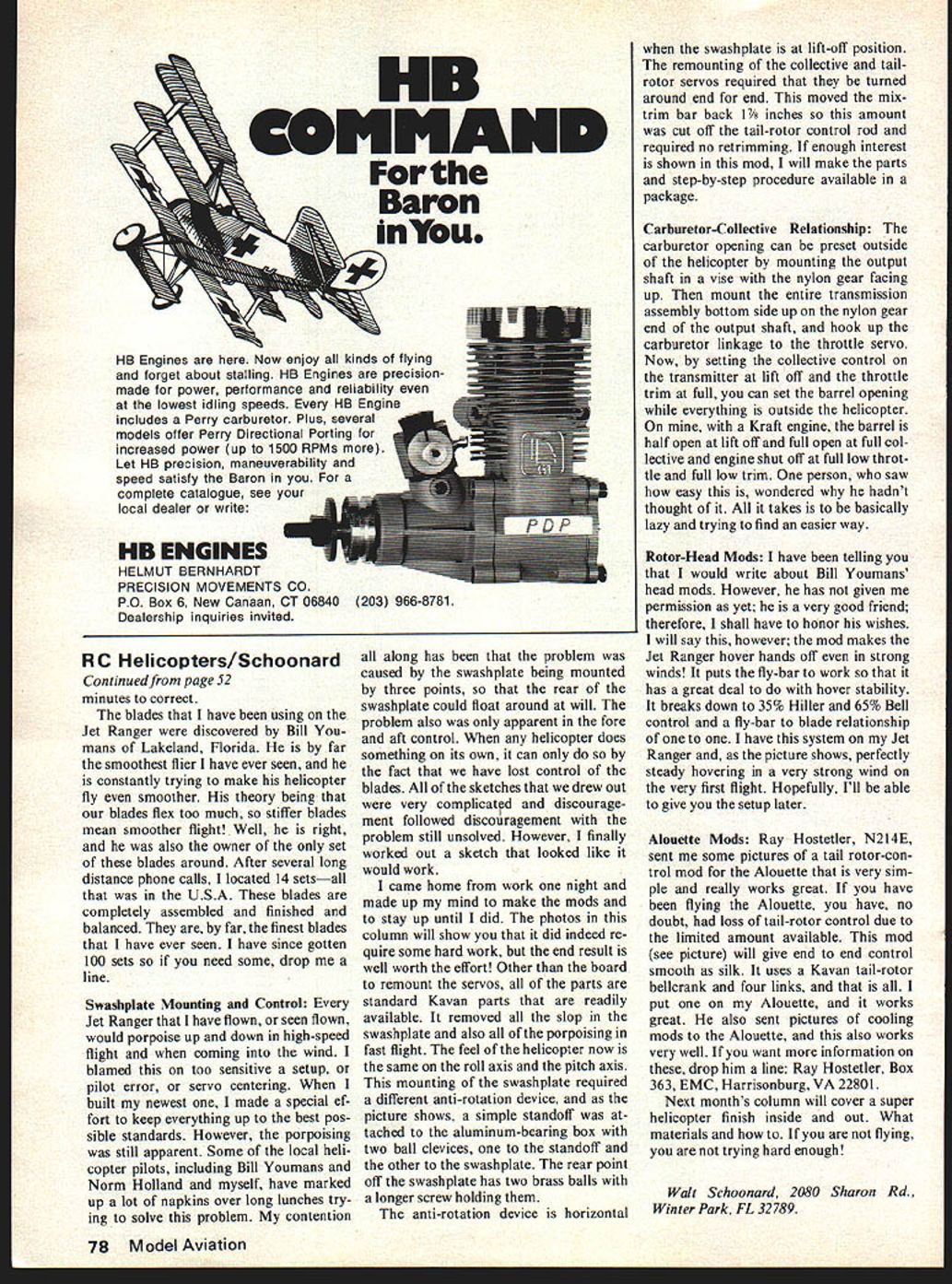
Alouette Mods: Ray Hostetler, N214E, sent me some pictures of a tail rotor-control mod for the Alouette that is very simple and really works great. If you have been flying the Alouette, you have, no doubt, had loss of tail-rotor control due to the limited amount available. This mod (see picture) will give end to end control smooth as silk. It uses a Kavan tail-rotor bellcrank and four links, and that is all. I put one on my Alouette, and it works great. He also sent pictures of cooling mods to the Alouette, and this also works very well. If you want more information on these, drop him a line: Ray Hostetler, Box 363, DCMC, Harrisonburg, VA 22801.
Next month's column will cover a super helicopter finish inside and out. What materials and how to. If you are not flying, you are not trying hard enough!
Walt Schoonard, 2080 Sharon Rd., Winter Park, FL 32789.
Transcribed from original scans by AI. Minor OCR errors may remain.

