
Radio Control: Helicopters
Walt Schoonard
COLLECTIVE PITCH and Constant Blade Speed: When most of us old-timers began flying helicopters, they were all fixed pitch. Just getting them to fly at all was a great accomplishment! Much of the flying skill was from a very skillful use of the motor speed or throttle control. The helicopters seemed so very complicated that, when collective pitch was mentioned, it threw a real chill into us just to think of the additional complexity. That, of course, is all history, and collective pitch is a well-established fact. With it came some new problems, such as ever-changing blade speed, and the need for tail-rotor mix.
With the changing blade speed, we have an ever-changing control response. At high blade speed, the control is quick and precise. The tail-rotor control sensitivity decreases with the decrease in tail-blade speed. So, as we get closer to the ground and need better control, we actually have less. When I first flew collective pitch, I was still learning to fly, so I did everything slowly and rather deliberately, but it soon became apparent that I needed tail-rotor mix or constant-blade speed, or both.
I looked at several real helicopters, talked to some pilots and helicopter engineers. I found that the real helicopters do indeed have tail-rotor mix—well, they do as long as there is a pilot at the controls. He is the ever-present tail-rotor mix, as he gives it whatever is necessary to keep the machine headed where he wants it to go. Yes, they do have constant-blade speed.
RC Helicopters/Schoonard
which the pilot can set, and it will maintain that speed no matter how much or how little collective is induced. These facts made sense to me, so I began to develop cams that would give me constant blade speed from one servo, and collective from one transmitter function.
With many long evenings of making and trying different cams on my machine and checking tail-rotor speed with a tachometer, I finally got what I wanted. This gave me a much better flying helicopter, because of better control. It was actually easier to fly. These cams have been used on Cobras, Heli-Babies, Bell 212s, you name it, with a great deal of success. After all this hard work was done, it was a simple matter to cut out a cam from 1/16 in. phenolic, and to lay out the pushrod position, install it on the collective servo as an output wheel, and go fly. I even got to where I could set it up on the bench, and when the machine first flew, it required no adjustments.
I got a great deal of personal satisfaction from this, but I soon found that no matter how I described it in these articles, very few people could make it work on their machines. About this time, Al Irwin sent me a Tach-Tron to try out. This required another servo and some elaborate wiring and adjustments, but it did work as he described. Frankly, I was not too impressed at the time, because it did practically what my 10-cent cam did, and I soon took it off and went back to the cam. However, later I decided that I had not given the Tach-Tron enough of a try and reinstated it in my Jet Ranger. I have since flown it in several other helicopters, and am now so sold on it that I would not fly a collective machine without a Tach-Tron governor.
You can set it to any blade speed that you wish. You can set it for a light machine, and light blades or heavy blades. It senses what you are doing and feeds the proper control to the motor servo to keep the blade speed constant. It is really great to be putting along and jam the collective to an already set blade speed, and watch the machine perform. If you are interested in realistic performance and smoother and easier flying, I recommend Al Irwin's Tach-Tron by Royal Electronics Corp., 6190 E. Evans Avenue, Box 22424, Denver, CO 80222 (phone 303 761-5960).
The unit can be purchased in kit form or completely assembled, ready to install. Royal can even install the servo feedback wire in your motor servo. They make two versions of this Tach-Tron, but the one that I recommend is the governor type. This one controls blade speed only, while the collective pitch one adds and subtracts collective. For the life of me, I cannot see how this type could be used to an advantage.
When you get your Tach-Tron, be sure to carefully read the instructions as to installation and adjustment. As the pictures show, I have mine installed under the swashplate, with the counter mounted on the aluminum box on former #9.
Several things I would like to caution you about are: Because of the constant blade speed, they do not want to come out of the air, so you must have a couple of degrees negative available. Also, when landing, while on the ground, do not take your eyes off the machine if you have left the blade speed on high, as a cyclic control or a gust of wind could upset your pride and joy! This took a little getting used to, and I nearly let it upset on a gusty day. This taught me a hard and quick lesson. I fly a single stick on helicopters, and have relocated the channel control lever so I can do collective and Tach-Tron functions with the same hand.
The Tach-Tron order blank is a vital part of ordering your unit. The blank asks some very pertinent questions that must be answered so that they can set up your unit properly. The blank can be obtained by writing to Royal at the address above.
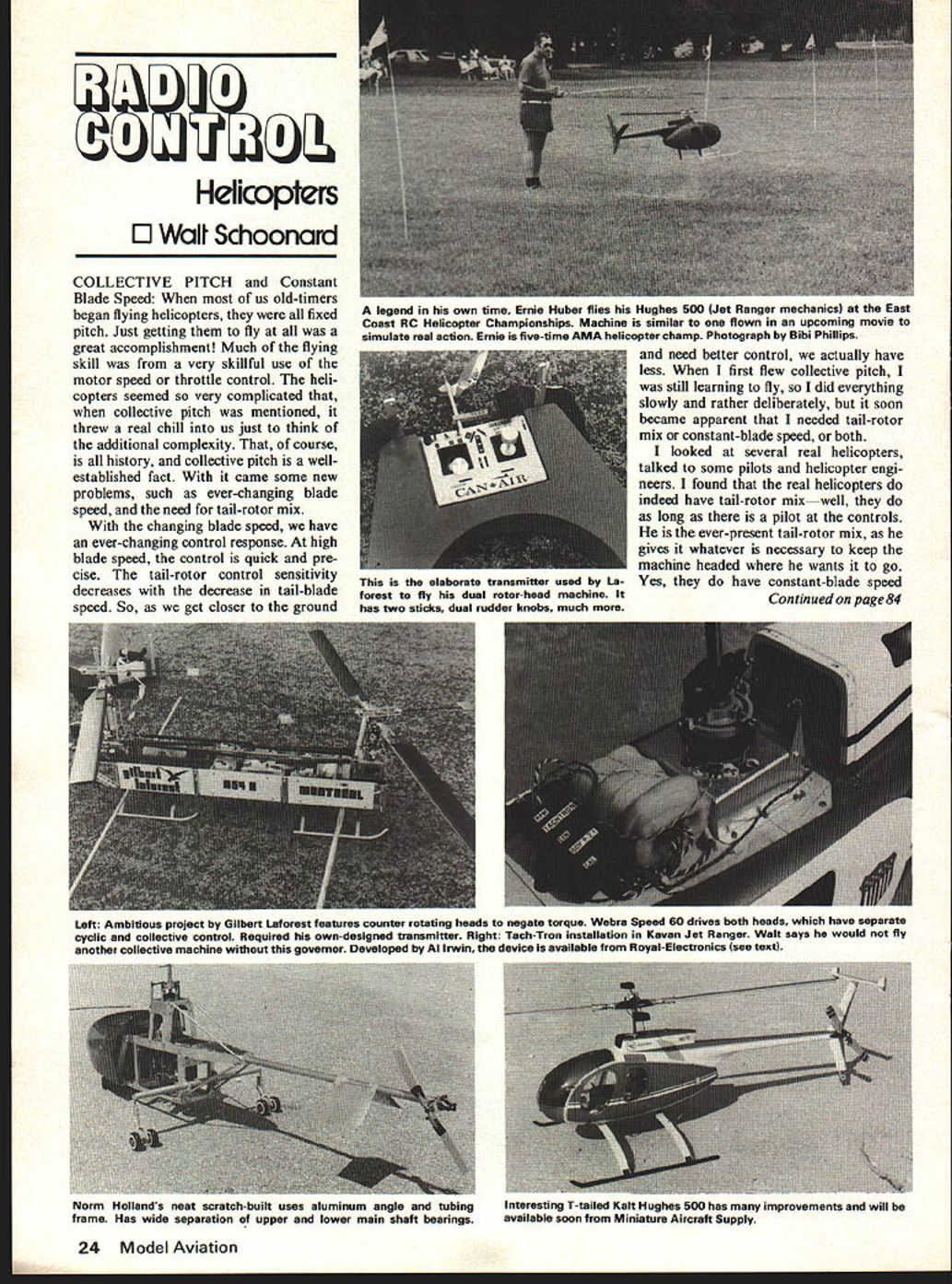
Second Annual East Coast Championships: Several contestants arrived on Saturday, August 13, the day before the contest to do some practice flying on our beautiful Thompson Park contest site (500 x 1500 feet of nicely groomed grass). Among the early birds was Ernie Huber (five-time AMA RC Helicopter National Champion). Ernie was flying his Hughes 500 (Jet Ranger mechanics), a machine similar to the ones he flew in an upcoming Hollywood movie. Ernie put on a show that had us spellbound. He did a couple of rolls and loops and, when he tried for another loop, it didn't come off just right, and the machine tumbled for a good 100 feet or so. How he ever regained control of the machine and pulled out with the engine groaning we will never know. But he did and made it look easy to boot.
Another well-known chopper pilot was there with his beautifully scratchbuilt machines. Faye Peoples put on a very nice show, including his specialty maneuver known as a stall turn with two 360's. That's 900 degrees in case you lost count. Spectacular! Faye has probably established some kind of a reliability record by now.
On the day of the contest we had little or no wind but then the rains came. The wonder of it all is that we managed to complete one full round of competition. It was encouraging to see an increase in participation to 25 (versus 19 last year) total entries. Moreover, there were no crashes. The flying skills observed this year were a dramatic improvement over last year.
There were 16 entries in Novice, 6 entries in Intermediate, and 3 entries in Expert. These numbers compare with 14, 1, and 4 in the Novice, Intermediate and Expert classes in last year's contest. Thus, it can be seen that some of the pilots are graduating to the next higher class.
A variety of machines were flown. There were 7 Jet Rangers, 5 Revolutions, 4 Heli-babies, 3 Alouettes, 2 Sharks, 1 Hughes 500 with Alouette mechanics, 1 Hughes 500 with Jet Ranger mechanics, and 2 scratchbuilts. The majority were powered by Schnuerle-type engines.
A special thanks is due the members of the Monmouth Model Airplane Club who were able and willing to help run this contest.
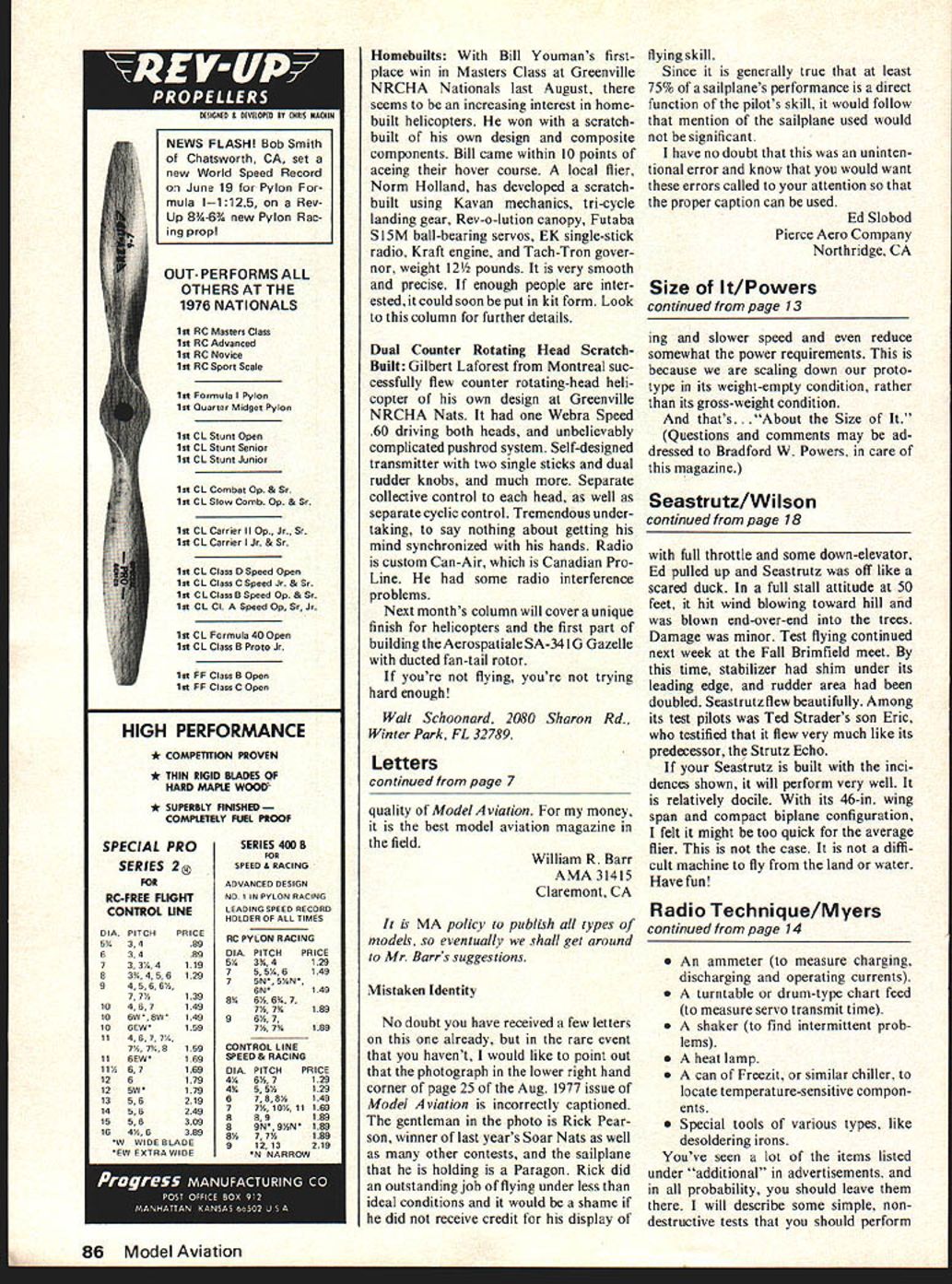
The winners: C. Sjobeck, Novice; T. Kneer, Intermediate; E. Huber, Expert. Homebuilts: With Bill Youman's first-place win in Masters Class at Greenville NRCHA Nationals last August, there seems to be an increasing interest in homebuilt helicopters. He won with a scratch-built of his own design and composite components. Bill came within 10 points of acing their hover course. A local flier, Norm Holland, has developed a scratch-built using Kavan mechanics, tri-cycle landing gear, Rev-O-Lution canopy, Futaba S15M ball-bearing servos, EK single-stick radio, Kraft engine, and Tach-Tron governor, weight 12½ pounds. It is very smooth and precise. If enough people are interested, it could soon be put in kit form. Look to this column for further details.
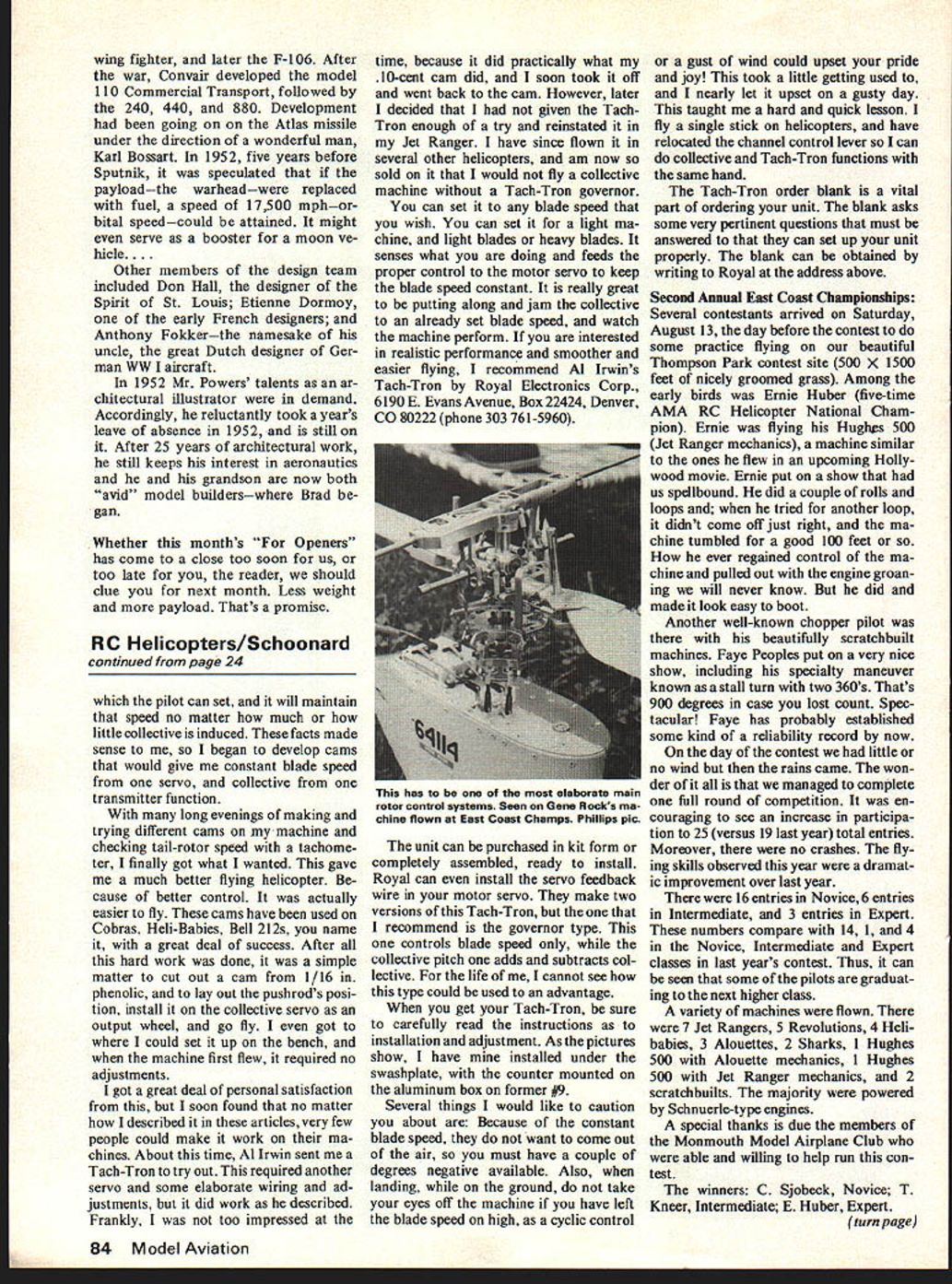
Dual Counter Rotating Head Scratch-Built: Gilbert Laforest from Montreal successfully flew a counter-rotating-head helicopter of his own design at Greenville NRCHA Nats. It had one Webra Speed .60 driving both heads, and an unbelievably complicated pushrod system. Self-designed transmitter with two single sticks and dual rudder knobs, and much more. Separate collective control to each head, as well as separate cyclic control. Tremendous undertaking, to say nothing about getting his mind synchronized with his hands. Radio is custom Can-Air, which is Canadian Pro-Line. He had some radio interference problems.
Next month's column will cover a unique finish for helicopters and the first part of building the Aerospatiale SA-341G Gazelle with ducted fan-tail rotor.
If you're not flying, you're not trying hard enough!
Walt Schoonard, 2080 Sharon Rd., Winter Park, FL 32789.
Transcribed from original scans by AI. Minor OCR errors may remain.

