

Radio Control: Helicopters
Walt Schoonard
FANTASTIC NEW HELICOPTER: On November 19-20 I had the pleasure of hosting Mr. Dieter Schluter and his charming wife, Heidi, here in Winter Park, Florida. He brought with him his new helicopter, called the Heli-Boy. I seldom use very exciting language in this column to describe a new product; however, seldom does such an exciting new product come along.
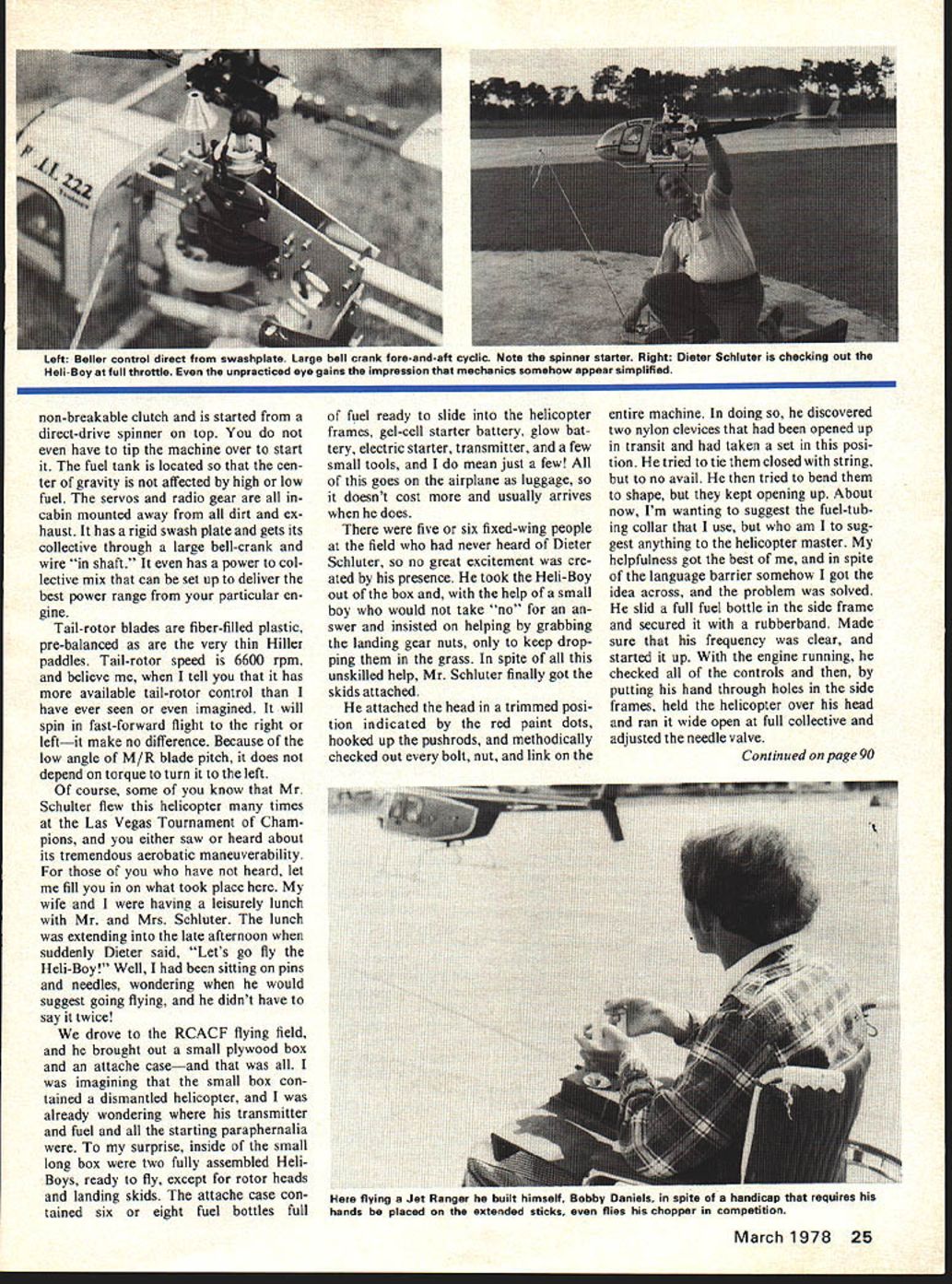
The Heli-Boy is the most fantastic helicopter that I have ever seen! If you could take all of the good points of all the helicopters presently on the market anywhere in the world, and put them altogether in one machine, you still would not come close to the simplicity, the low maintenance, the stability, and the maneuverability of the Heli-Boy! First of all, it is a bolt-together design, ala the Heli-Baby. It is .60 powered and weighs only 8 1/2 pounds; it has collective-control pitch with tail-rotor mix. It has positive gear-driven tail rotor, rigid head with Hiller and Bell control. Schluter prefers to call this "Beller" control. It uses symmetrical blades, and is flown on a maximum of 2 degrees positive pitch. Main rotor speed is 1550 rpm, and constant. The engine is geared so that, at full head speed, the engine is turning a little over 12,000 rpm. Consequently, massive power reserve is present with really good fuel economy.
The Heli-Boy has 23 ball-bearings and two needle bearings, and everything bolted rigidly to the metal frames. Vibration is totally eliminated, so the maintenance is extremely low. It can be flown on any .60 engine. However, the one that Mr. Schluter flew here, had a specially designed Profi .60 with a tuned pipe. It was so quiet that you could hardly hear it at all.
Schluter has become a part of the Profi Engine Co. and has done a great deal to help develop this engine line for helicopters. The tuned pipe offers many advantages in that it increases power, increases fuel economy, is light weight, and it is extremely quiet. I believe that we are going to see a much greater utilization of tuned pipes on helicopters in the near future. By the way, Mr. Schluter flew a fuel which consisted of 75 percent alcohol, 20 percent castor oil, and 5 percent unleaded gasoline. A fifteen-minute flight used less than 8 ounces of fuel. How's that for economy?
Heli-Boy is a convertible helicopter in many ways. It can be flown with the canopy only (as he flew it here), or you can quickly add the Bell 222 fuselage and fly with the skids or with tri-cycle wheels, and it even has retractable tri-cycle landing gear available! The fuselage is made from some non-brittle material which is water clear and bolts on in two parts. Tape up the windows and paint it any color, and you have a scale helicopter ready to go! Even though I did not see it fly with the body installed, Mr. Schluter states that weight is increased less than a pound, and flight performance is actually improved from better aero-dynamics. non-breakable clutch and is started from a direct-drive spinner on top. You do not even have to tip the machine over to start it. The fuel tank is located so that the center of gravity is not affected by high or low fuel. The servos and radio gear are all in-cabin mounted away from all dirt and exhaust. It has a rigid swash plate and gets its collective through a large bell-crank and wire "in shaft." It even has a power-to-collective mix that can be set up to deliver the best power range from your particular engine.
Tail-rotor blades are fiber-filled plastic, pre-balanced as are the very thin Hiller paddles. Tail-rotor speed is 6600 rpm, and believe me, when I tell you that it has more available tail-rotor control than I have ever seen or even imagined. It will spin in fast-forward flight to the right or left—it makes no difference. Because of the low angle of M/R blade pitch, it does not depend on torque to turn it to the left.
Of course, some of you know that Mr. Schluter flew this helicopter many times at the Las Vegas Tournament of Champions, and you either saw or heard about its tremendous aerobatic maneuverability. For those of you who have not heard, let me fill you in on what took place here. My wife and I were having a leisurely lunch with Mr. and Mrs. Schluter. The lunch was extending into the late afternoon when suddenly Dieter said, "Let's go fly the Heli-Boy!" Well, I had been sitting on pins and needles, wondering when he would suggest going flying, and he didn't have to say it twice!
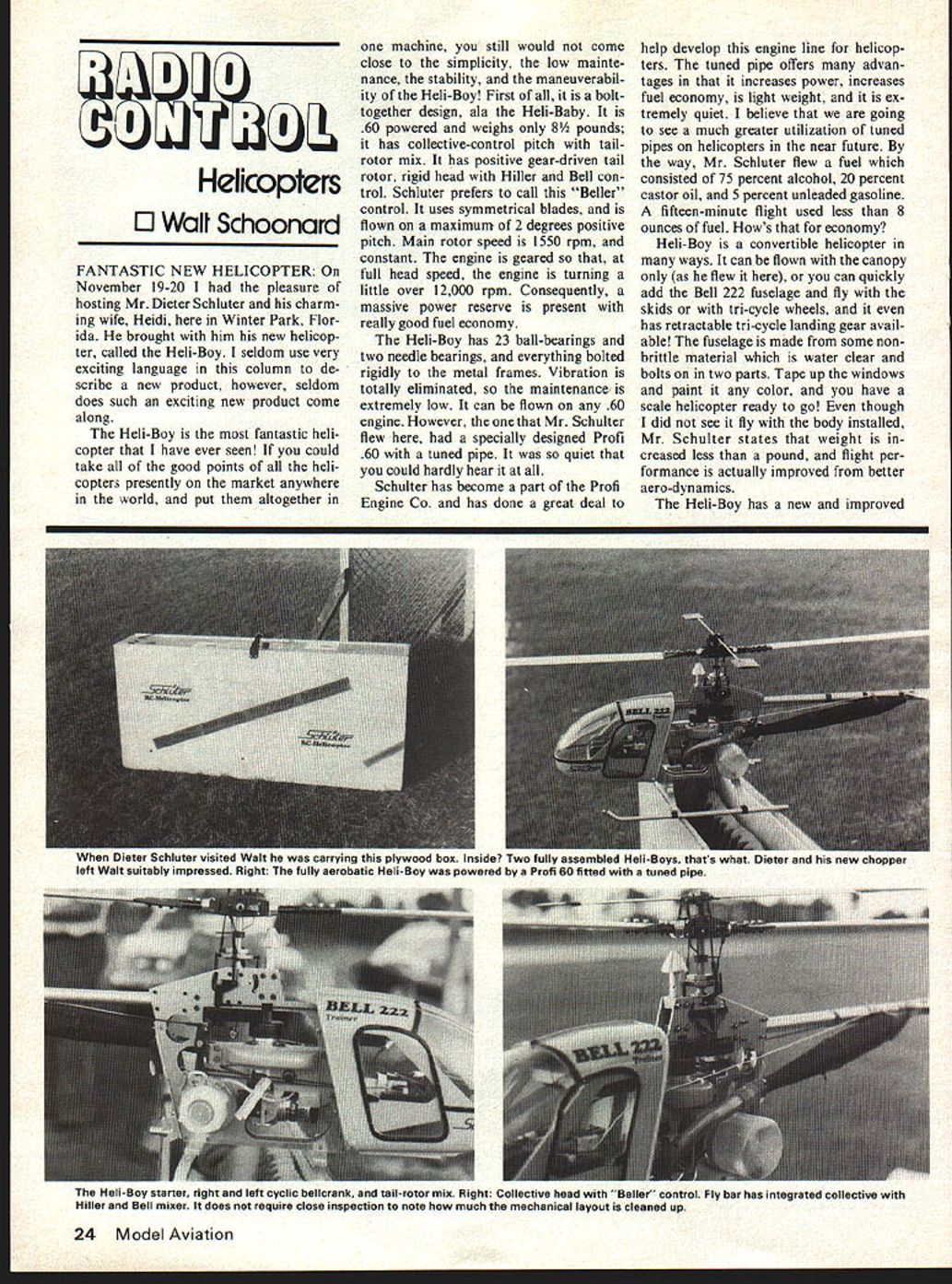
We drove to the RCACF flying field, and he brought out a small plywood box and an attache case—and that was all. I was imagining that the small box contained a dismantled helicopter, and I was already wondering where his transmitter and fuel and all the starting paraphernalia were. To my surprise, inside of the small long box were two fully assembled Heli-Boys, ready to fly, except for the rotor heads and landing skids. The attache case contained six or eight fuel bottles full of fuel ready to slide into the helicopter frames, gel-cell starter battery, glow battery, electric starter, transmitter, and a few small tools, and I do mean just a few! All of this goes on the airplane as luggage, so it doesn't cost more and usually arrives when he does.
There were five or six fixed-wing people at the field who had never heard of Dieter Schluter, so no great excitement was created by his presence. He took the Heli-Boy out of the box and, with the help of a small boy who would not take "no" for an answer and insisted on helping by grabbing the landing gear nuts, only to keep dropping them in the grass. In spite of all this unskilled help, Mr. Schluter finally got the skids attached.
He attached the head in a trimmed position indicated by the red paint dots, hooked up the pushrods, and methodically checked out every bolt, nut, and link on the entire machine. In doing so, he discovered two nylon clevises that had been opened up in transit and had taken a set in this position. He tried to tie them closed with string, but to no avail. He then tried to bend them to shape, but they kept opening up. About now, I'm wanting to suggest the fuel-tubing collar that I use, but who am I to suggest anything to the helicopter master. My helpfulness got the best of me, and in spite of the language barrier somehow I got the idea across, and the problem was solved. He slid a full fuel bottle in the side frame and secured it with a rubberband. Made sure that his frequency was clear, and started it up. With the engine running, he checked all of the controls and then, by putting his hand through holes in the side frames, held the helicopter over his head and ran it wide open at full collective and adjusted the needle valve. The pipe was so quiet that normal conversation was possible. He was now satisfied that everything was in order and carried the helicopter to the runway. Dieter flies Mode II and pulls for collective; he wears a transmitter tray strapped to his shoulders. Radio was Semiprop made in Germany. While all of this was taking place, it was getting darker by the minute, and I was worried about getting good pictures in this light. I was more worried that he would not be able to see to fly, and how often does such an event take place practically in my backyard?
He put the ship on the skids and reached for the throttle. With one quick motion the Heli-Boy jumped into the air; the tail rotor held fast; the main rotor produced such a lifting force that the helicopter easily climbed to treetop height and hovered with absolute stability. Forward flight was fast and predictable and the machine tracked straight as an arrow. The tail remained rock steady with no noticeable lag or hunting.
He demonstrated a number of aerobatic maneuvers that would have been difficult to believe had I not seen them. Inside loops, rolls, and rapid descending turns were accomplished with aplomb. He even held brief inverted flight. Autorotations were equally impressive; the Heli-Boy settled in with little forward speed and landed gently on the skids.
Weight, balance, and workmanship are all excellent. The use of metal frames and numerous bearings, together with rigid bolting, virtually eliminates vibration and makes maintenance extremely low. The convertible fuselage will accept a Bell 222 scale body, there is an optional retractable tricycle landing gear, and the canopy bolts on in two pieces. The optional body adds less than a pound and, according to Schluter, actually improves flight performance because of better aerodynamics.
Profi engines fitted with tuned pipes give a massive power reserve, good fuel economy and exceptionally quiet operation. Schluter has done a great deal of development work on his engines and tuned pipes, and I expect to see more helicopters equipped this way in the near future.
If you're in the market for a heli that combines simplicity, low maintenance, stability and maneuverability, the Heli-Boy is one of the most exciting new helicopters I have seen. He brought the rotor speed up and lifted the Heli-Boy straight off with no dancing or skidding around at all. He spent a couple of minutes in checkout hovering, and suddenly he gave it full collective, and the Heli-Boy literally shot into the sky about a hundred feet or so. He then made a very tight turn and, just as rapidly, dropped it down to a couple of feet and stopped it there. There was no engine loading at all and no tail waggle. He then shoved the stick forward, and the Heli-Boy came to life in high speed. He flew upwind and downwind at 20 or 30 feet altitude, doing perfectly round loops with no loss of heading or altitude and with no blade flapping. Rolls were axial with no loss of heading or altitude. In fact, he did loops and rolls with no flight set-up at all. He simply pulled back on the cyclic and looped. The same for the rolls.
He did stall turns with 3-360 degree rotation on the way down, and starting at 50 feet, and pulling out at 20 feet. He did right and left hand high speed turns in the helicopter's own length. From each set of maneuvers, the Heli-Boy was brought back into a hands-off hover. He did touch-and-go landings, skidding the helicopter for 50 feet on the runway, flat on its skids, and takeoffs like an airplane. He did bows and dances on the ground with absolutely perfect control. During all of this flying, he never flew over the spectator area, and he had not been to our field before.
The few fixed-wing pilots, whom I mentioned before, suddenly realized that they had never seen anything like this before, and were full of questions. I cannot begin to tell you all that he did that day, or the next day, when we had a large portion of the Florida R/C Helicopter Club present, as well as some 300 spectators who continually applauded Mr. Schluter as he flew.
On top of all this, I had the pleasure of entertaining Mr. and Mrs. Schluter that evening in my home. We had long discussions on the background of RC helicopters and their future. It was most interesting to hear firsthand about his development of RC helicopters, and how he has been copied the world over with little or no recognition for his efforts.
When can you get one? One of the things that Mr. Schluter impressed upon me was that this helicopter is the easiest helicopter to learn to fly on, and is the only one that will do all these maneuvers right out of the box with no mods at all. They have been selling like hot cakes in Europe for some seven months. By the time you read this, they will be available from several sources in this country.
Trying hard enough? Just a word about not trying hard enough. I have a friend in Lakeland, Florida, named Bobby Daniels, who is paralyzed from the waist down. He has no use of any of his fingers, gets around in a wheelchair. He builds and flies RC helicopters, and runs a hobby store. And I don't know what else! He also is a fine friend. He tries hard enough and flies — so when you feel like you cannot get it all together — think about Bobby!
Walt Schoonard, 2080 Sharon Road, Winter Park, FL 32789.
Transcribed from original scans by AI. Minor OCR errors may remain.

