
Radio Control: Helicopters
Walt Schoonard
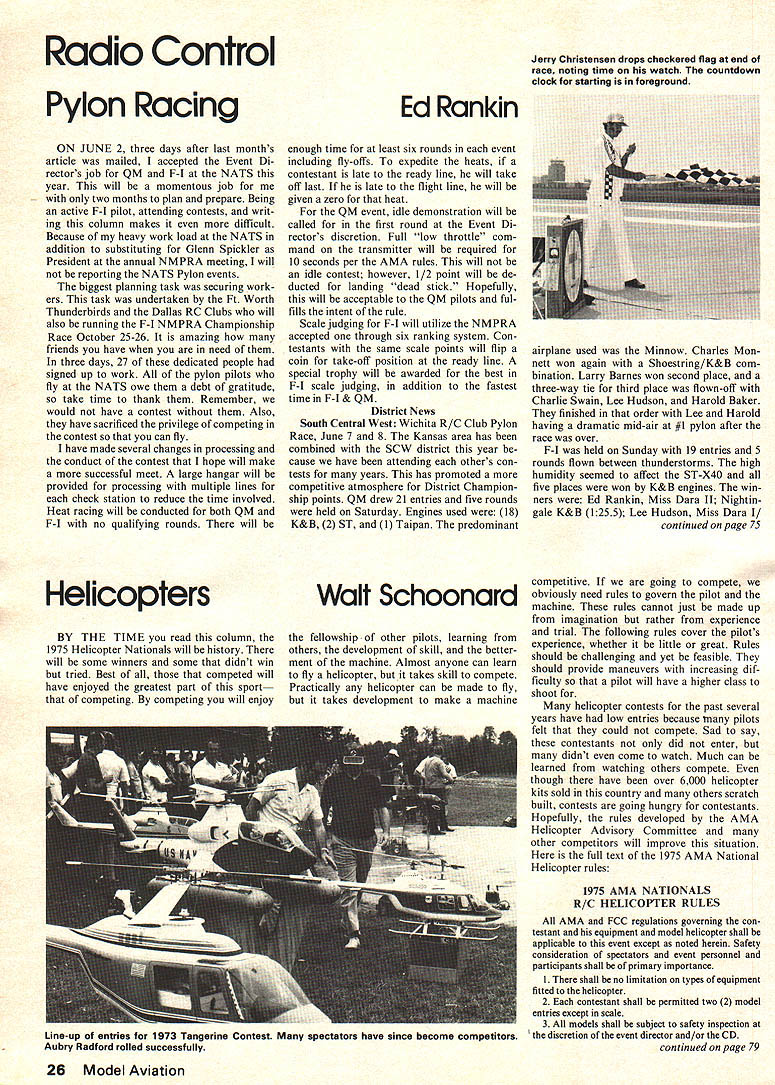
BY THE TIME you read this column, the 1975 Helicopter Nationals will be history. There will be some winners and some that didn't win but tried. Best of all, those that competed will have enjoyed the greatest part of this sport — that of competing. By competing you will enjoy enough time for at least six rounds in each event including fly‑offs. To expedite the heats, if a contestant is late to the ready line, he will take off last. If he is late to the flight line, he will be given a zero for that heat.
For the QM event, idle demonstration will be called for in the first round at the Event Director's discretion. Full "low throttle" command on the transmitter will be required for 10 seconds per the AMA rules. This will not be an idle contest; however, 1/2 point will be deducted for landing "dead stick." Hopefully, this will be acceptable to the QM pilots and fulfills the intent of the rule.
Scale judging for F‑I will utilize the NMPRA accepted one through six ranking system. Contestants with the same scale points will flip a coin for take‑off position at the ready line. A special trophy will be awarded for the best in F‑I scale judging, in addition to the fastest time in F‑I & QM.
There is the fellowship of other pilots, learning from others, the development of skill, and the betterment of the machine. Almost anyone can learn to fly a helicopter, but it takes skill to compete. Practically any helicopter can be made to fly, but it takes development to make a machine competitive. If we are going to compete, we obviously need rules to govern the pilot and the machine. These rules cannot just be made up from imagination but rather from experience and trial. The following rules cover the pilot's experience, whether it be little or great. Rules should be challenging and yet be feasible. They should provide maneuvers with increasing difficulty so that a pilot will have a higher class to shoot for.
Many helicopter contests for the past several years have had low entries because many pilots felt that they could not compete. Sad to say, these contestants not only did not enter, but many didn't come to watch. Much can be learned from watching others compete. Even though there have been over 6,000 helicopter kits sold in this country and many others scratch built, contests are going hungry for contestants. Hopefully, the rules developed by the AMA Helicopter Advisory Committee and many other competitors will improve this situation. Here is the full text of the 1975 AMA National Helicopter rules:
1975 AMA NATIONALS R/C HELICOPTER RULES
All AMA and FCC regulations governing the contestant and his equipment and model helicopter shall be applicable to this event except as noted herein. Safety consideration of spectators and event personnel and participants shall be of primary importance.
- There shall be no limitation on types of equipment fitted to the helicopter.
- Each contestant shall be permitted two (2) model entries except in scale.
- All models shall be subject to safety inspection at the discretion of the event director and/or the CD.
Radio Control: Helicopters
- Model designated #1 may be flown until disabled. If model #1 is not repairable by flight time, model #2 may then be entered. In no case will model #1 be reentered.
- The contestant must notify the event director or CD if and when model #2 is entered.
- Model judged unflyable due to crash must be re‑inspected prior to reuse.
- Dangerous flying or poor sportsmanship will be grounds for disqualification.
- All maneuvers will commence and end at the helipad.
- All maneuvers will be flown in proper sequence and away from the spectators. A minimum of three‑foot altitude will be maintained for all maneuvers.
a. Maneuvers seven through twelve (7–12) will be flown as a combined unit but will be scored segmentally. b. All freestyle maneuvers selected will be flown as a unit including landing but scored segmentally. Landing is a separate maneuver even when following auto‑rotation.
- All contestants will have three minutes to start their helicopters. This time may be used for adjusting and trimming as long as engine is started in the allotted time.
- All models will be carried from starting point to the helipad. No models will be flown from helipad to pit area.
- Should a flight be aborted, it will be considered an official attempt upon the completion of two maneuvers.
- All contestants will be permitted to fly as many equal rounds as time permits.
- Winning scores will be the sum of the two best scores.
- Novice contestants will fly maneuvers one (1) through six (6) — five minutes flight time. See maneuver schedule.
- Intermediate contestants will fly maneuvers one (1) through thirteen (13) — seven minutes flight time. See maneuver schedule.
- Expert contestants will fly maneuvers one (1) through thirteen (13) plus as many self‑selected freestyle maneuvers as can be completed in three (3) minutes. Time will include landing. Total expert flight time — ten minutes. See maneuvers schedule.
- Additional landing score will not be added to auto‑rotation landing. Should this score be desired the contestant must lift his model off to ten (10) foot altitude and execute landing maneuver.
- Scale contestants will fly the following maneuvers in this order:
- Fifteen (15) second stationary hover and landing.
- Constant heading figure of eight starting left and right.
- 360° fly‑around starting left and land. Five minutes flight time.
- Scale contestants will fly same equipment as static judged. Should part of aircraft be damaged so as to be replaced, that portion of aircraft will be re‑judged.
- Scale contestants will present the following materials with helicopter for static judging:
a. Published three‑view drawings. b. Pictures published or otherwise pertaining to color, markings, and details. The better the presentation, the better it can be judged.
- Scale entries will be judged on the following (maximum of 25 points each):
a. Fuselage b. Cockpit c. Landing gear d. Rotor systems e. Craftsmanship f. Finish and markings
- Scale winning points will be the sum of the best two flights plus static judging points.
- All maneuvers flown will be judged 0–10. Freestyle maneuvers will have an additional K factor multiplier as indicated.
- All models will have contestant's AMA number affixed at contestant's discretion.
- Protests: Protests will be in writing and hand delivered to event director or CD immediately after flying is completed. Protests must state specific infraction — by whom, made, when and signed and dated by protestant. All protests will be settled using these rules.
MANEUVERS
Group One — Novice:
- Lift off — 15 second hover — land.
- Lift off — hover forward 15 feet — land.
- Lift off — hover backward 15 feet — land.
- Lift off — hover to right 15 feet — land.
- Lift off — hover to left 15 feet — land.
- Lift off — hover constant heading, figure‑eight starting left — land.
Group Two — Intermediate:
- Lift off — climb at 45° to 25 feet.
- One‑hundred foot straight flight.
- Ninety‑degree left turn followed by 270° right turn.
- Return flight same path as #8.
- Figure‑eight away from spectators.
- Landing.
- Lift off — starting left, fly 360° fly‑around and land.
Group Three — Expert Freestyle: K‑Factor maneuvers (K factor indicated for each maneuver):
- 360° hover — tail in.
- 360° hover — nose in.
- 360° hover — roll 45° low in.
- Stationary hover — pilot circles 360° around helicopter.
- Hover 50 feet — turn 180° — hover back.
- Top hat — fly 20 feet forward, climb 20 feet, descend 20 feet, fly forward 20 feet.
- Chandelle — climbing 180° direction change.
- Constant heading inside loop — 20 foot diameter.
- Constant heading outside loop — 20 foot diameter.
- Vertical eight — ascending inside constant‑heading loop followed by descending constant‑heading outside loop. Twenty‑foot segments.
- Loop.
- Roll.
- Stall turn.
- Stall turn with 360° turn descending.
- Auto‑rotation to landing.
- Landing. This maneuver must start from at least ten‑foot altitude and is separate from auto‑rotation landing and must be part of freestyle selection.
These rules were formulated by the AMA Helicopter Advisory Committee and the present RC helicopter competitors. They represent a safe and challenging event that is in tune with the present state of the art.
Obviously, improvements and additions will need to be made to these rules, but they are a good start and have been used in three major contests already. If you are planning a contest, it is hoped that you will use these rules. I solicit your comments on them.
In the July issue I discussed the forming of the Florida RC Helicopter Association. Next month's column will deal with the further state‑by‑state and AMA district helicopter association development. Then we will cover state competition, then district competition, and finally national competition. I already have a major RC helicopter manufacturer interested in promoting such competition.
I am sure that someone will say, "Why all this hullabaloo about competition?" The next time you hear of a contest near where you live, at least go and be a spectator; but if possible enter your helicopter and do the best you can! You will get to talk to the other pilots and look over their machines and see someone who is maybe a little more skilled than yourself. From them you will learn and from learning will come confidence. From confidence will come a greater degree of enjoyment, and after all, that is what it is all about.
Let me hear from you and send in some pictures. If they are published, you will even get paid for them. Direct all correspondence to RC Helicopters, c/o Walt Schoonard, 2080 Sharon Rd., Winter Park, Fla. 32789.
Transcribed from original scans by AI. Minor OCR errors may remain.

