
Radio Control-- Helicopters-- Dave Chesney
THE NRCHA has lost its sponsorship by Radio Control Modeler magazine.
In the early 1970's RCM, and others, realized the potential of the helicopter as another challenging aspect of the radio control sport. It was realized that some form of organization was needed to provide communications and incentives to aspiring helicopter enthusiasts. NRCHA was formed as that organization. A pilot proficiency system was developed to provide the incentive for self-development of piloting skills. Membership dues for the NRCHA were held to $4.00 per year; RCM made up the balance of money needed for operating expenses. Things looked good until RCM recently notified the membership that the cost of supporting the organization had grown to such proportions that such support had to be withdrawn.
R/C Modeler magazine should be thanked for their years of involvement in our growth.
Looking back to the early 1970's a group of active helicopter fliers were nominated by the AMA Contest Board to the RC Helicopter Advisory Committee. The RC HAC was to develop a set of rules and competition classes to be used on a national scale within the framework of the Academy of Model Aeronautics. The RC HAC did develop a maneuver schedule for three classes of competition, plus contest rules and regulations, and submitted these as a committee proposal in 1976; they are now a part of the AMA 1978-79 rule book on a provisional basis.
Both NRCHA and AMA had recognized the need to organize our interest group, but there appeared to be little coordination of efforts. At the recent Toledo trade show, in light of the loss of NRCHA sponsorship, a meeting was called of the RC helicopter enthusiasts to determine the future course of the helicopter special interest group. The consensus of that group was that a new AMA RC Helicopter Advisory Committee should be formed, with committee members being suggested on the basis of their active interest and upon their geographical locations. Horace Hagen was suggested as the RC HAC chairman, and subsequently his appointment, and the appointment of five other committee members, was confirmed by Bill Northrop, chairman of the RC Contest Board. (See the "Competition News" section of this issue for names and addresses of the full committee.)
The new AMA RC HAC intends to act as a clearing house for ideas and suggestions that individuals may have. Every RC helicopter enthusiast is encouraged to call or write his nearest representatives with suggestions or comments concerning helicopter activities.
There was also talk at Toledo of reforming NRCHA or a similar organization. Several individuals and groups are interested, but again we are lacking coordination of efforts. I would suggest that contact regarding a national helicopter association be initiated through an RC HAC member. The RC HAC may then direct you to the appropriate interest group.
There will be considerable work and expense involved in reforming the NRCHA; perhaps you can be the catalyst. One way to lessen the burden of operating a national group is by creating smaller units of interest groups. Your local RC helicopter group could become part of a state or regional helicopter club. Coordination and communications could then be handled between these units rather than 2,000 individuals.
If your state does not have an active RC helicopter club, bring one together. First, find a suitable flying site and obtain permission to use it. The North Carolina Helicopter Association's first get-together was held on the auxiliary parking lot of a shopping center; but your local model airplane field, a high school athletic field, or a large vacant lot may be used—but insure that the site is safe and that permission to use it is verified. If an AMA Contest Director is available, enlist his help. I would suggest your first meet be an informal one.
After the preliminaries, get the word out. Mail a letter to every AMA chartered club in the state. The letter should include: the date and time of the meet, the location of your site with a map, a list of local motels and phone numbers, and your name, address and phone number. Also include a brief statement about the meet, your intentions, and a final request that everyone pass the word. While you are waiting for the date to come around, prepare a quantity of questionnaires to be handed out at the meet. Each person attending can be requested to fill in his name, address, phone number, AMA number and types of helicopters flown.
When the date comes, whether your first meet yields a club or not, I assure you that it will be rewarding. Don't forget to collect some ideas to pass on to Horace. His address is Horace Hagen, 15 Parkway Place, Red Bank, NJ 07701.
It is not necessary that you be an expert helicopter flier in order to stimulate local interest. In fact, a big benefit of a state helicopter group will be your ability to communicate the problems and successes of helicopter flying with others sharing your interest. That alone can speed your progress.
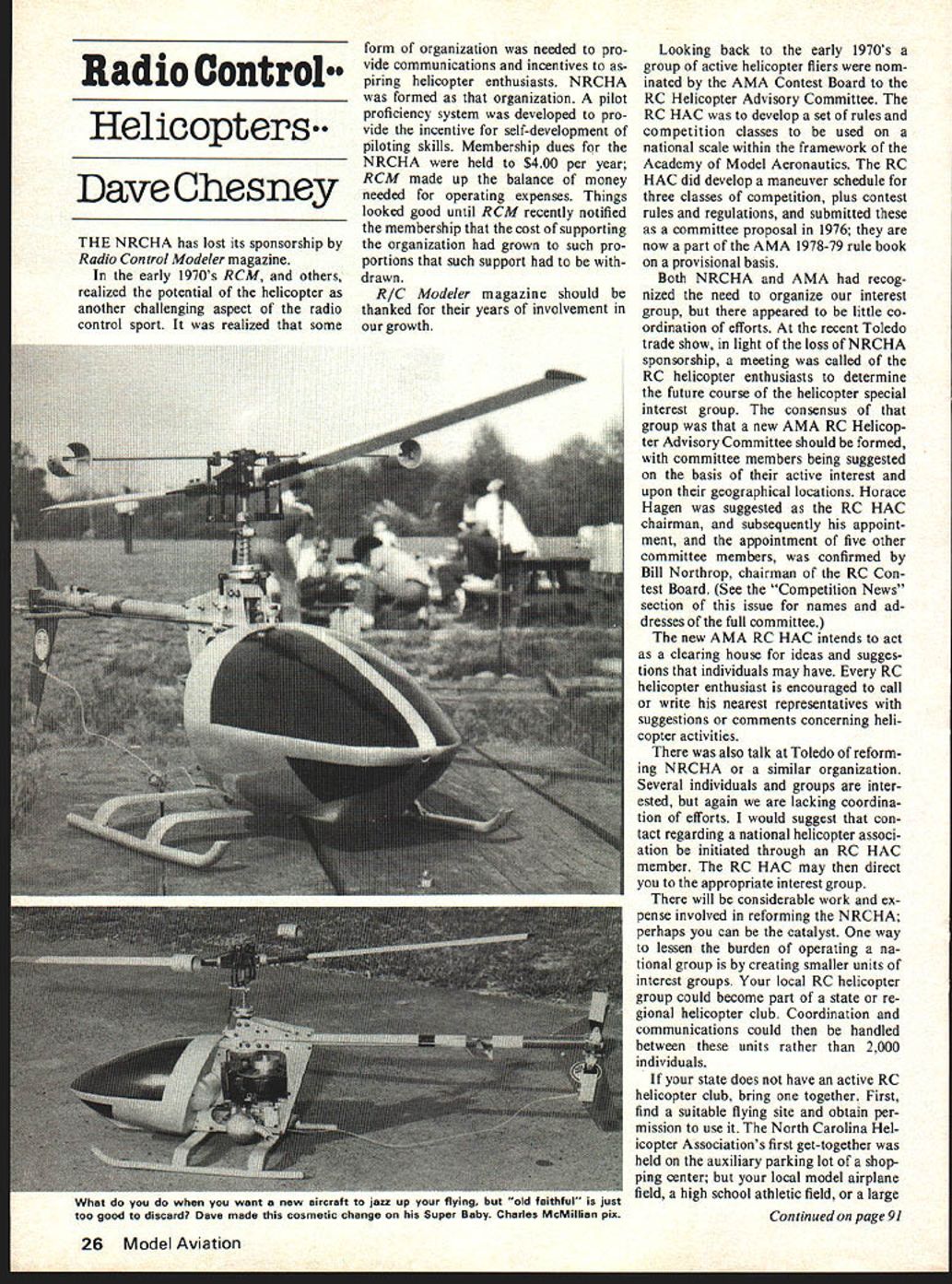
I was about to retire my three-year-old Heli-baby but decided to experiment instead; the photos are the result of the experiment. Since this helicopter was difficult to wear out, I got a little tired of seeing the same old scarred bubble and elected to make a fiberglass canopy.
Most helicopters will last a long time despite the hard knocks of learning to fly; so you may elect to try this type of cosmetic modification before retiring your bird. In most cases, a canopy similar to the one shown in the photos may be produced in just a few hours. I'll explain next month so sketch a few ideas for your "new" helicopter.
Dave Chesney, Rt. 9, Box 621A, Greensboro, NC 27407.
Transcribed from original scans by AI. Minor OCR errors may remain.

