
Radio Control: Helicopters
Dave Chesney
Don't overlook the obvious
A few months ago I wrote some hints regarding the assembly and pre-flight of RC helicopters. The general theme was to persevere. Well, recently I was plagued with what appeared to be a radio problem in my Kavan Jet Ranger.
I had spent several months carefully assembling the machine, but from the second day of pre-flight testing the swash plate would begin to dance whenever the throttle was advanced to a high idle. I had heard that the brand of radio that I was using is particularly sensitive to electrical noise and assumed that my problem was indeed metal-to-metal noise. So, back to the ship. I installed grounding wires from the engine frame to the main rotor shaft bearing and to the tail rotor gearbox. The grounding wires electrically connected all metal from the tip of the fly-bar to the tip of the tail rotor shaft. I thought I had the problem licked, but again the swash plate would dance when the throttle was advanced to high idle.
To make a long, frustrating story short, I sold the Jet Ranger. Within twelve hours the fellow who bought it called me and said that the Ranger flew great. He said that he, too, had experienced a radio problem initially, but also noticed a vibration in the machine. The vibration was coming from the cooling fan. Once the fan was balanced and re-installed, the radio problem ceased.
You will recall from the story above that the problem began on the second day of pre-flight testing. On the first day I broke the original cooling fan by letting the electric starter slip off the spinner and into the blades. Anxious to get on with it, I simply replaced the fan.
Add one more suggestion: whenever a repair is made, spend the same kind of attention to detail as you did on the original installation, and don't overlook the obvious.
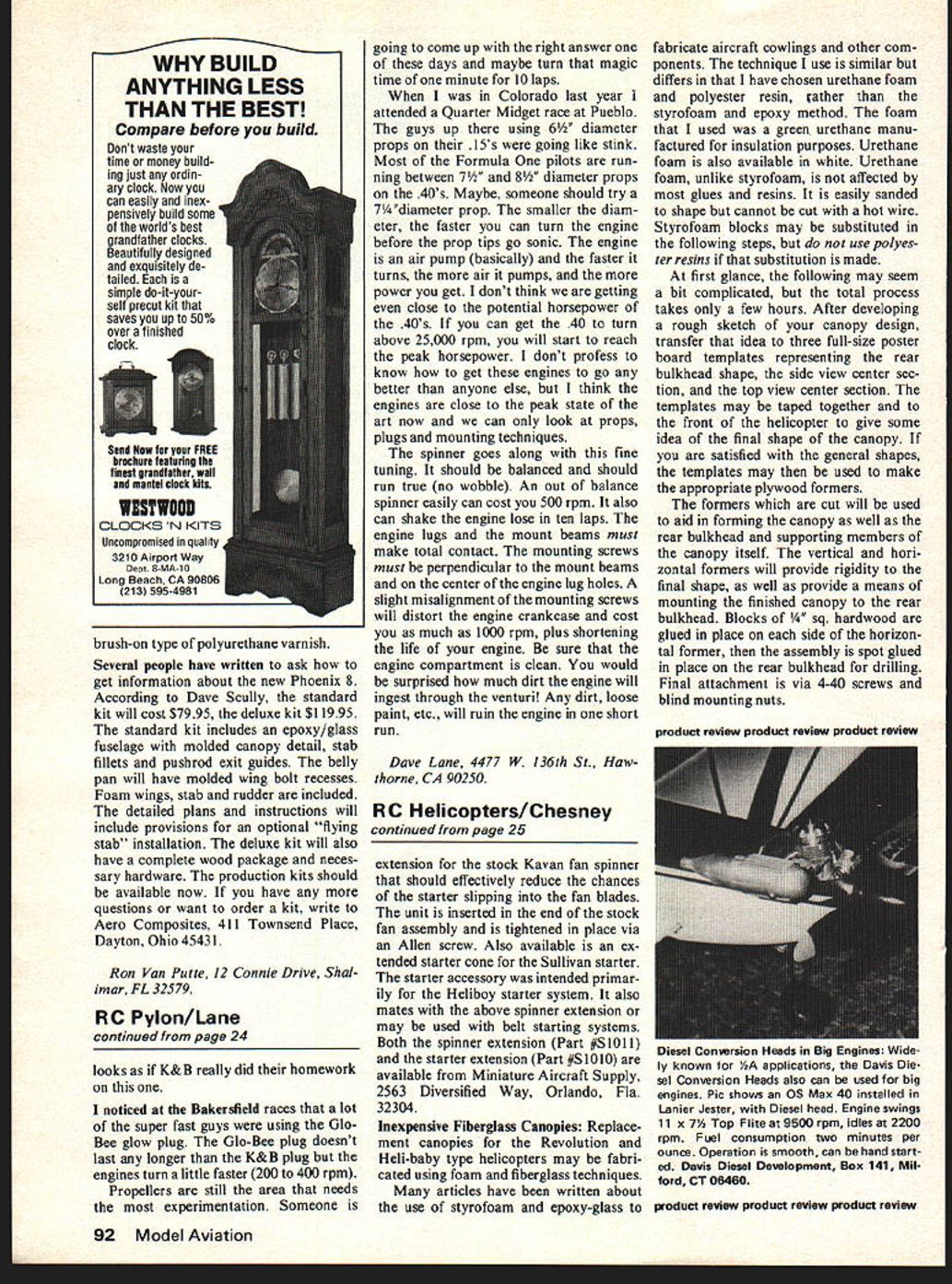
You may be experiencing similar radio problems with your machine. If you have followed my previous suggestions and tried to eliminate the helicopter to allow for a radio reliability check, then you may be as frustrated as I was trying to determine why the blankety-blank radio doesn't work. But if you didn't follow those pre-flight instructions, then you may be about to give up thinking that you cannot fly helicopters — you can. So, make sure that vibration or electrical noise is not controlling the machine for you.
Spinner and starter accessories
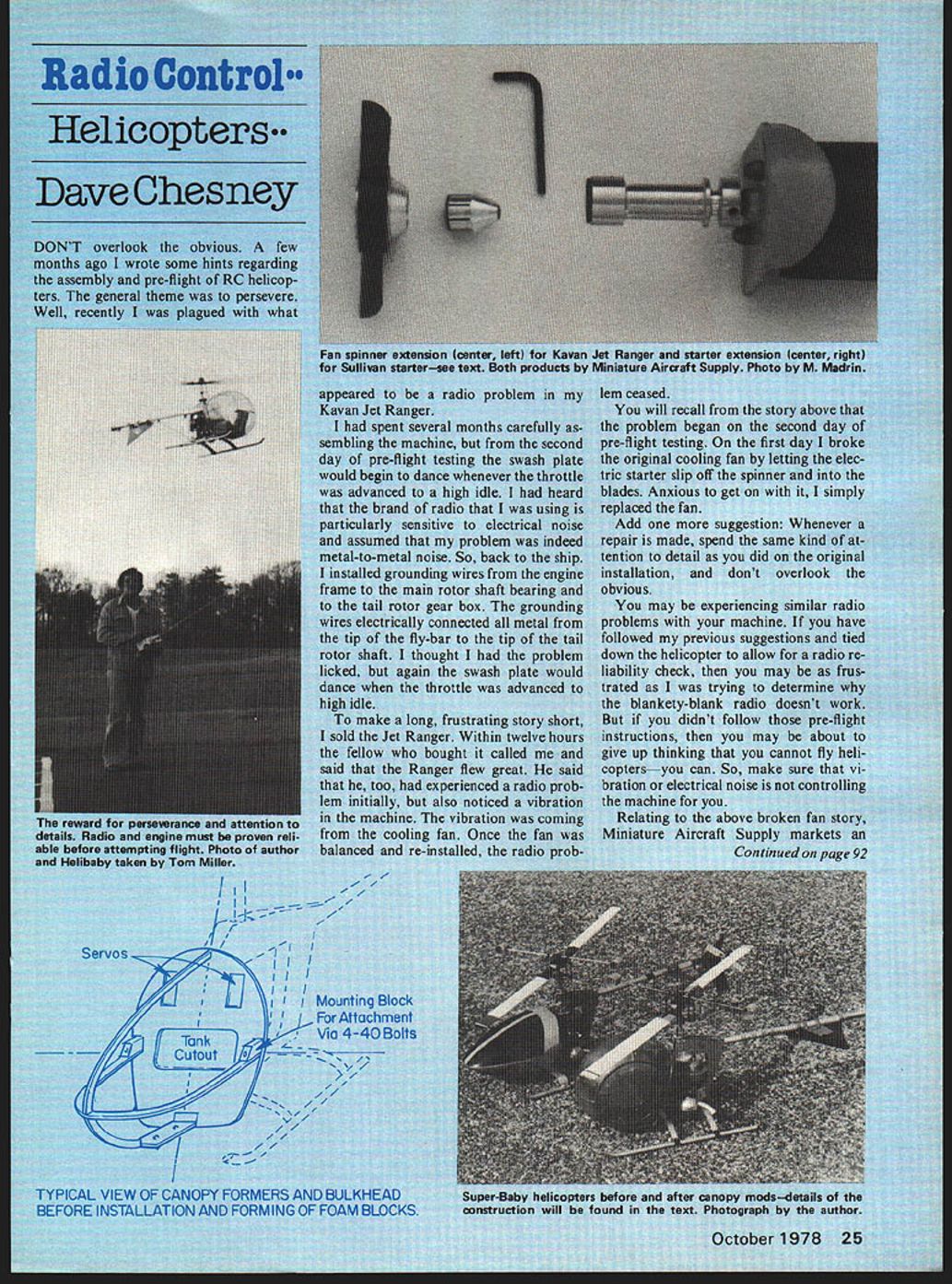
Relating to the above broken fan story, Miniature Aircraft Supply markets an extension for the stock Kavan fan spinner that should effectively reduce the chances of the starter slipping into the fan blades. The unit is inserted in the end of the stock fan assembly and is tightened in place via an Allen screw. Also available is an extended starter cone for the Sullivan starter. The starter accessory was intended primarily for the Heliboy starter system. It also mates with the above spinner extension or may be used with belt starting systems.
- Spinner extension: Part # S1011
- Starter extension: Part # S1010
- Available from: Miniature Aircraft Supply, 2563 Diversified Way, Orlando, Fla. 32304
Inexpensive Fiberglass Canopies
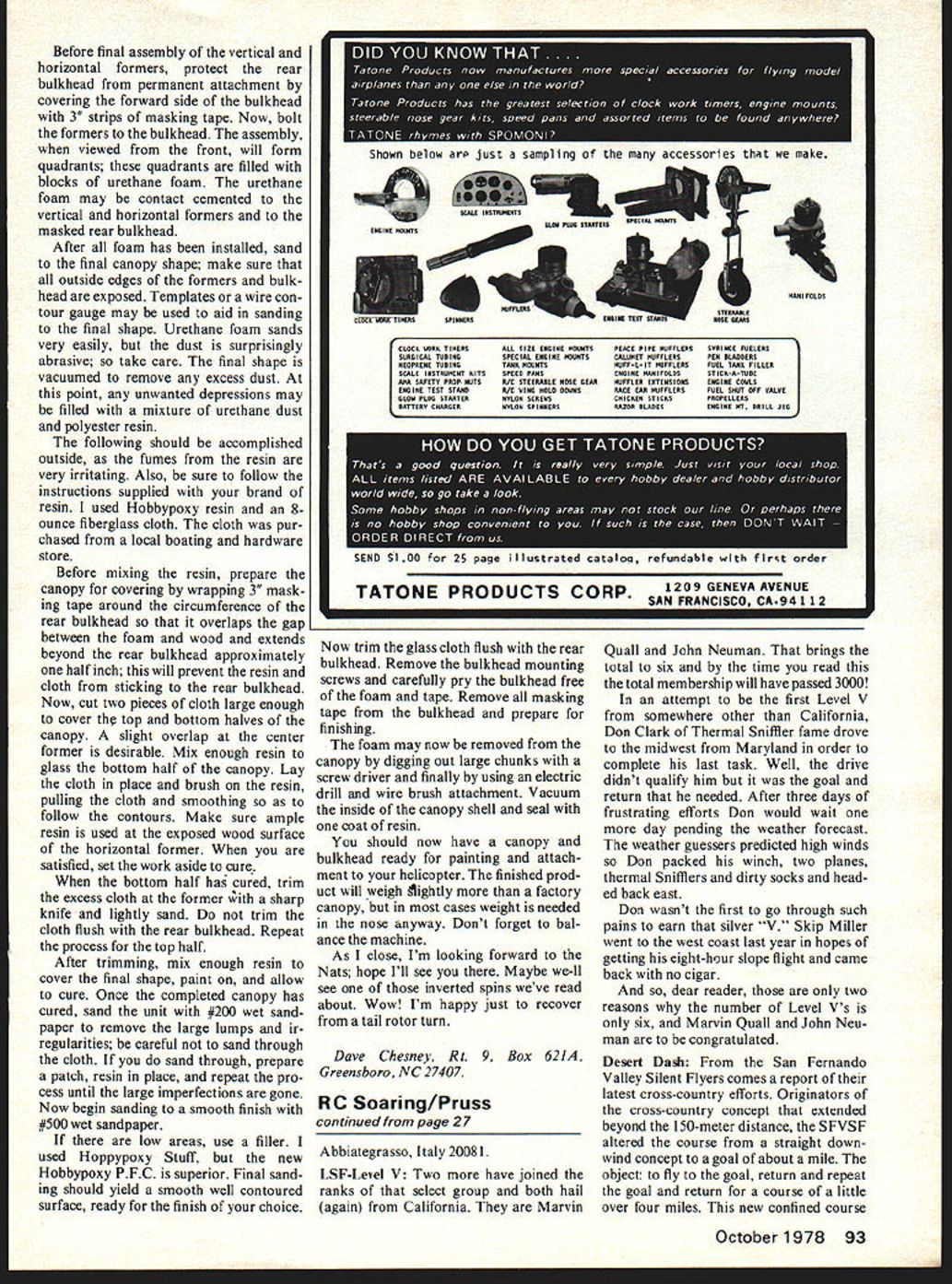
Replacement canopies for the Revolution and Heli-baby type helicopters may be fabricated using foam and fiberglass techniques.
Many articles have been written about the use of styrofoam and epoxy-glass to fabricate aircraft cowlings and other components. The technique I use is similar but differs in that I have chosen urethane foam and polyester resin, rather than the styrofoam and epoxy method. The foam that I used was a green urethane manufactured for insulation purposes. Urethane foam is also available in white. Urethane foam, unlike styrofoam, is not affected by most glues and resins. It is easily sanded to shape but cannot be cut with a hot wire. Styrofoam blocks may be substituted in the following steps, but do not use polyester resins if that substitution is made.
At first glance, the following may seem a bit complicated, but the total process takes only a few hours.
Templates and formers
- Develop a rough sketch of your canopy design and transfer that idea to three full-size poster board templates representing:
- the rear bulkhead shape,
- the side view center section, and
- the top view center section.
- Tape the templates together and to the front of the helicopter to get an idea of the final shape.
- If satisfied with the shapes, use the templates to make the appropriate plywood formers.
The formers which are cut will be used to aid in forming the canopy as well as the rear bulkhead and supporting members of the canopy itself. The vertical and horizontal formers will provide rigidity to the final shape and provide a means of mounting the finished canopy to the rear bulkhead. Blocks of 1/4" square hardwood are glued in place on each side of the horizontal former, then the assembly is spot-glued in place on the rear bulkhead for drilling. Final attachment is via 4-40 screws and blind mounting nuts.
Foam shaping and preparation
After all foam has been installed, sand to the final canopy shape; make sure that all outside edges of the formers and bulkhead are exposed. Templates or a wire contour gauge may be used to aid in sanding to the final shape. Urethane foam sands very easily, but the dust is surprisingly abrasive, so take care. Vacuum the final shape to remove any excess dust. At this point, any unwanted depressions may be filled with a mixture of urethane dust and polyester resin.
The following work should be accomplished outside, as the fumes from the resin are very irritating. Also, be sure to follow the instructions supplied with your brand of resin. I used Hobbypoxy resin and an 8-ounce fiberglass cloth. The cloth was purchased from a local boating and hardware store.
Before mixing the resin, prepare the canopy for covering by wrapping 3" masking tape around the circumference of the rear bulkhead so that it overlaps the gap between the foam and wood and extends beyond the rear bulkhead approximately one half inch; this will prevent the resin and cloth from sticking to the rear bulkhead.
Glassing and curing
- Cut two pieces of cloth large enough to cover the top and bottom halves of the canopy. A slight overlap at the center former is desirable.
- Mix enough resin to glass the bottom half of the canopy.
- Lay the cloth in place and brush on the resin, pulling the cloth and smoothing so as to follow the contours. Make sure ample resin is used at the exposed wood surface of the horizontal former.
- Set the work aside to cure.
- When the bottom half has cured, trim the excess cloth at the former with a sharp knife and lightly sand. Do not trim the cloth flush with the rear bulkhead.
- Repeat the process for the top half.
After trimming, mix enough resin to cover the final shape, paint on, and allow to cure. Once the completed canopy has cured, sand the unit with #200 wet sandpaper to remove the large lumps and irregularities; be careful not to sand through the cloth. If you do sand through, prepare a patch, resin in place, and repeat the process until the large imperfections are gone. Now begin sanding to a smooth finish with #500 wet sandpaper.
If there are low areas, use a filler. I used Hobbypoxy Stuff, but the new Hobbypoxy P.F.C. is superior. Final sanding should yield a smooth, well-contoured surface, ready for the finish of your choice.
Finishing and removal of foam
Now trim the glass cloth flush with the rear bulkhead. Remove the bulkhead mounting screws and carefully pry the bulkhead free of the foam and tape. Remove all masking tape from the bulkhead and prepare for finishing.
The foam may now be removed from the canopy by digging out large chunks with a screwdriver and finally by using an electric drill and wire brush attachment. Vacuum the inside of the canopy shell and seal with one coat of resin.
You should now have a canopy and bulkhead ready for painting and attachment to your helicopter. The finished product will weigh slightly more than a factory canopy, but in most cases weight is needed in the nose anyway. Don't forget to balance the machine.
Closing
As I close, I'm looking forward to the Nats; hope I'll see you there. Maybe we'll see one of those inverted spins we've read about. Wow! I'm happy just to recover from a tail rotor turn.
Dave Chesney Rt. 9, Box 621A, Greensboro, NC 27407.
Transcribed from original scans by AI. Minor OCR errors may remain.

