
Radio Control: Helicopters
Dave Chesney
LAST MONTH I said that aerobatic helicopters dominated all classes at the 1978 AMA NATS. As an ex-pattern flier, I was very excited about the capabilities of those aerobatic machines; but frankly, until the Nats, I was convinced that any machine capable of aerobatic maneuvers had to be a beast to hover.
The opportunity to hover Walt Schoonard's HeliBoy and to loop and roll John Gorham's HeliBoy was enough to convince me that, although control response is quick, there is a degree of stability as well. The control input to response time is immediate and because of that response time, my initial effort to hover Walt's machine almost led to a damaged tail rotor and related parts. The second attempt was much better and I went away with more confidence than I began with.
As I had noted above, I was quite apprehensive about flying any aerobatic helicopter; this was particularly true of rigid-rotor flybarless machines such as the Revolution II RR. The story behind that apprehension is primarily that my only claim to being an "ace" helicopter pilot was that during my attempts at learning to hover my first RC helicopter, I managed to hit five automobiles.
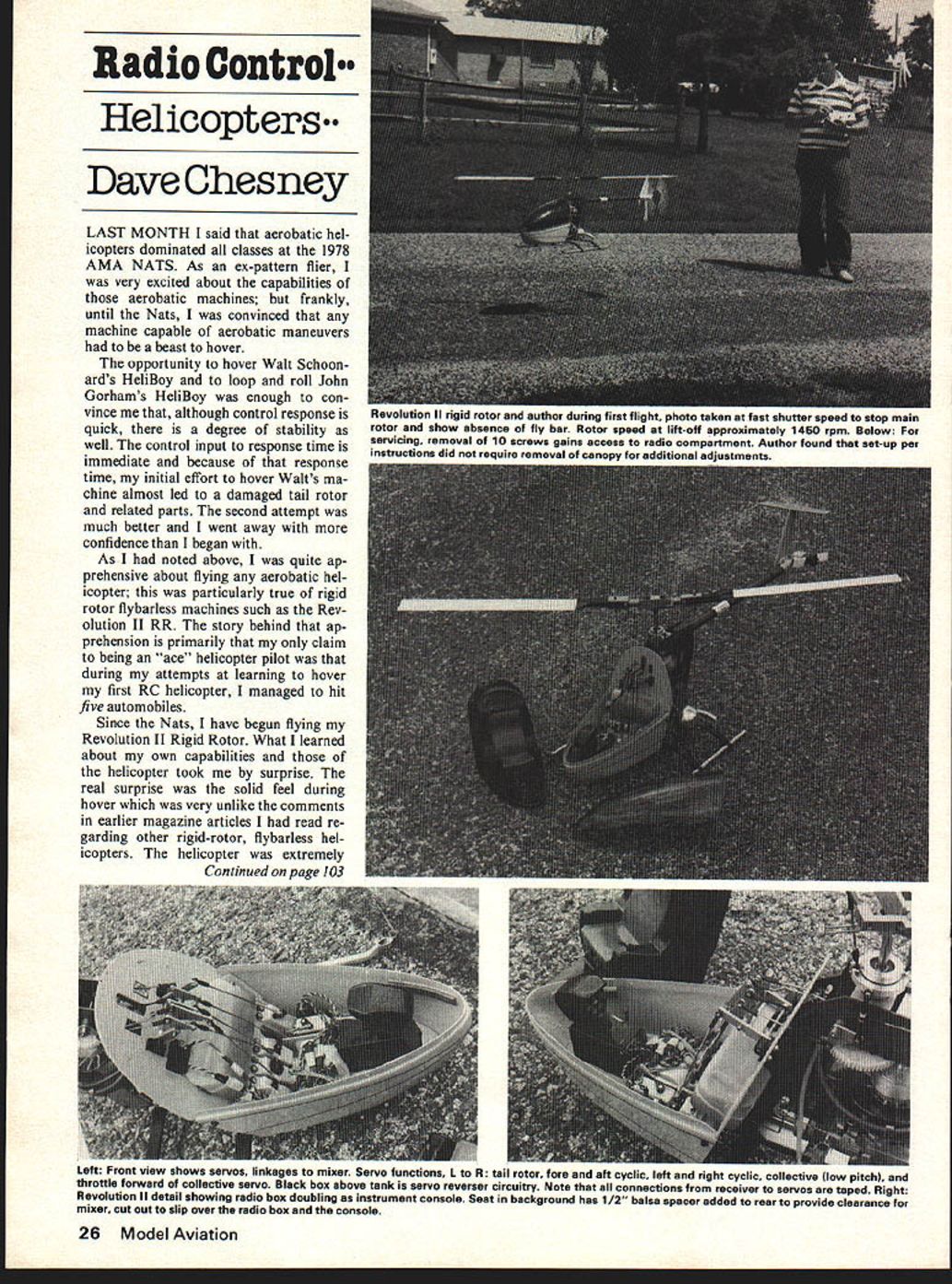
Since the Nats, I have begun flying my Revolution II Rigid Rotor. What I learned about my own capabilities and those of the helicopter took me by surprise. The real surprise was the solid feel during hover which was very unlike the comments in earlier magazine articles I had read regarding other rigid-rotor, flybarless helicopters. The helicopter was extremely quick to respond to control inputs, unlike the Hiller systems I am most familiar with. As it turned out, that quickness and absolute control was a welcome change from the "hurry up and wait" Hiller system.
Flybarless (Rigid Rotor) vs. Hiller Flybar Systems
The difference in control response between the rigid-rotor flybarless helicopter and Hiller-type systems is primarily because of direct inputs from the swash plate to each rotor blade. Hiller systems must rely on the stabilizing flybar as a servo to the main rotors; in other words, the swash plate acts upon the flybar which in turn drives the main rotor pitch change mechanism. The absence of the flybar and servo paddles (or cans) is also a disadvantage because all servo power must come directly from the radio system's servos.
In addition to the force-multiplying effect of the flybar and paddles, the flybar is also responsible for much of the rotor system's stability by acting as a gyroscope. In the flybarless helicopter, the blades are weighted so the spinning rotor system itself acts as a gyroscope and stabilizes the machine. It is possible to put so much weight in each blade that control inputs to the rotors will not have any effect on the helicopter's altitude. Too little weight in the blades will result in very little gyroscopic effect and the machine could become almost impossible to control. The folks at American R/C Helicopter have found the best compromise in the Revolution II Rigid Rotor and caution against changing the amount and location of the rotor tip weights.
Combination ("Beller") System
Another type of rotor system in use is a combination system allowing direct input to the rotor blades as well as input through the flybar to the rotor. I believe it is referred to as the "Beller" system. It is the "Beller" system which is used in the Kavan Jet Ranger, HeliBoy, and Revolution Commander. With a light helicopter such as the HeliBoy and Revolution Commander, the "Beller" system offers aerobatic performance plus the additional stability and damping provided by the flybar.
The Revolution II Rigid Rotor Conversion
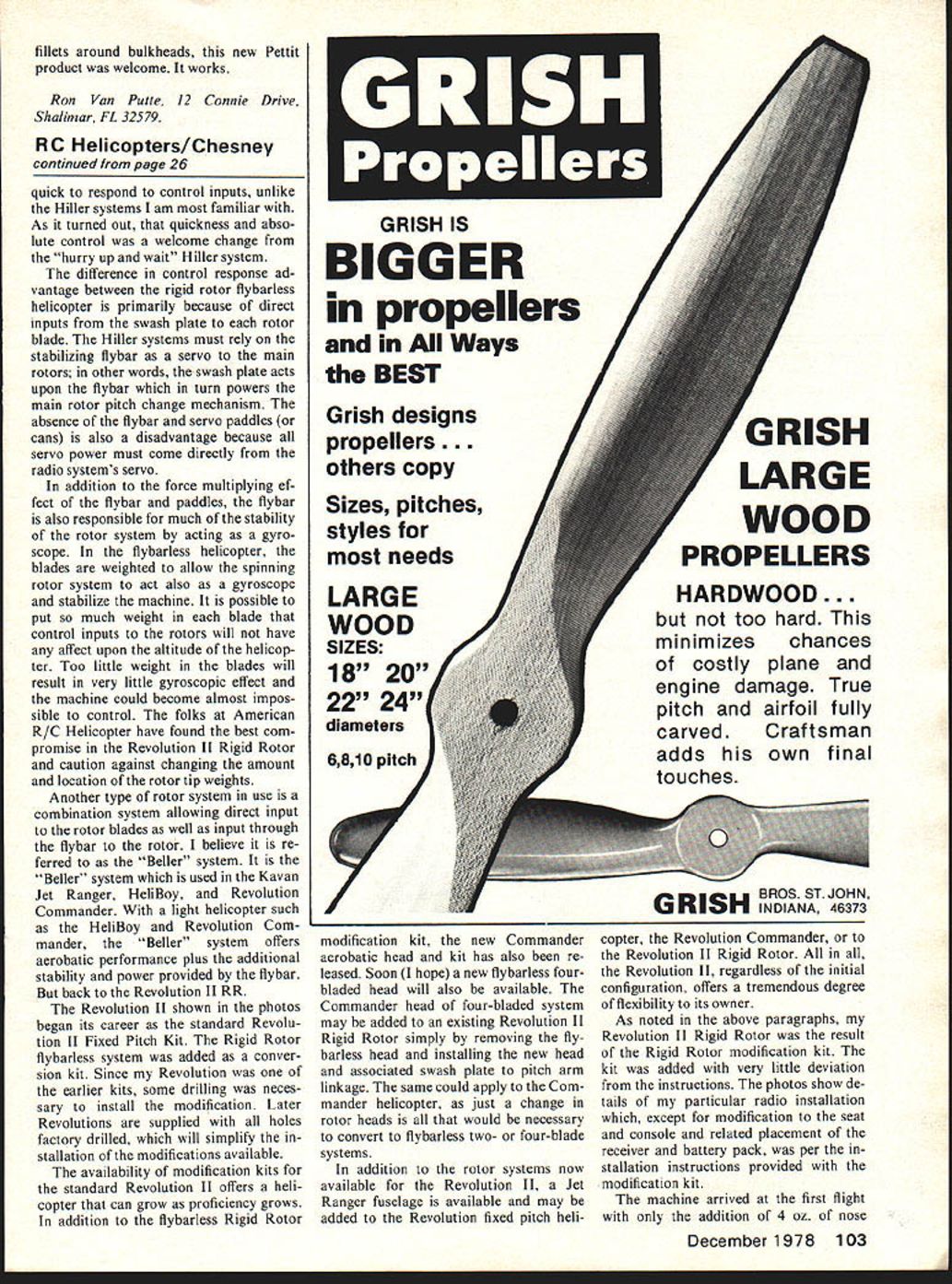
The Revolution II shown in the photos began its career as the standard Revolution II Fixed Pitch kit. The Rigid Rotor flybarless system was added as a conversion kit. Since my Revolution was one of the earlier kits, some drilling was necessary to install the modification. Later Revolutions are supplied with all holes factory-drilled, which will simplify the installation of available modifications.
The availability of modification kits for the standard Revolution II offers a helicopter that can grow as proficiency grows. Available and forthcoming options include:
- Rigid Rotor (flybarless) modification kit
- Commander acrobatic head and kit
- Flybarless four-bladed head (expected)
- Jet Ranger fuselage (can be added to Revolution fixed pitch, Revolution Commander, or Revolution II Rigid Rotor)
The Commander head or a four-bladed system may be added to an existing Revolution II Rigid Rotor simply by removing the flybarless head and installing the new head and associated swash plate-to-pitch arm linkage. The same change of rotor heads could convert a Commander helicopter to flybarless two- or four-blade systems.
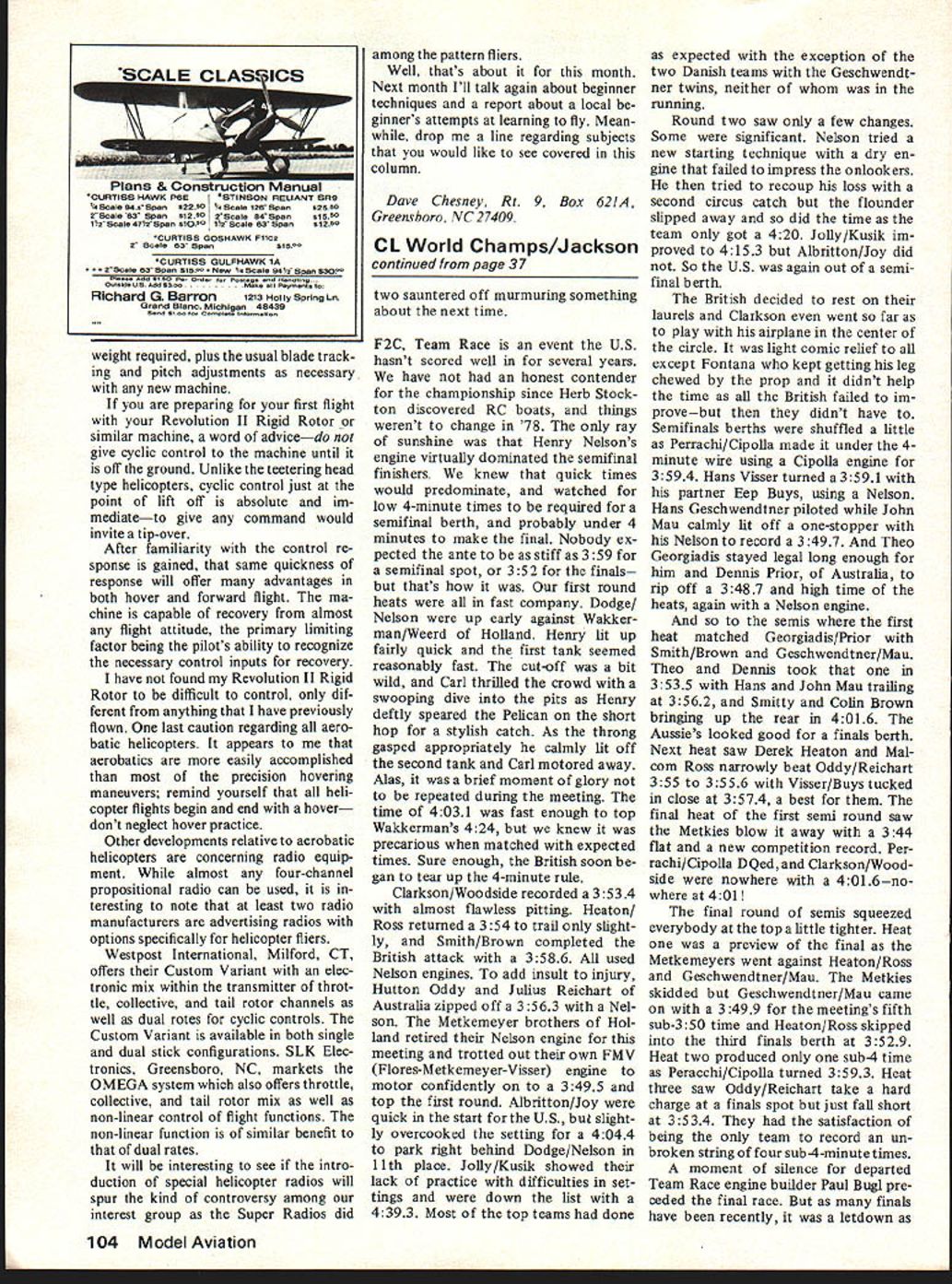
As noted above, my Revolution II Rigid Rotor was the result of the Rigid Rotor modification kit and was installed with very little deviation from the instructions. The photos show details of my particular radio installation which, except for modification to the seat and console and related placement of the receiver and battery pack, was per the installation instructions provided with the modification kit.
The machine arrived at the first flight with only the addition of 4 oz. of nose weight required, plus the usual blade tracking and pitch adjustments as necessary.
Flying Tips and Impressions
If you are preparing for your first flight with your Revolution II Rigid Rotor or a similar machine, a word of advice—do not give cyclic control to the machine until it is off the ground. Unlike teetering-head type helicopters, cyclic control at the point of liftoff is absolute and immediate—giving any command would invite a tip-over.
After familiarity with the control response is gained, that same quickness of response will offer many advantages in both hover and forward flight. The machine is capable of recovery from almost any flight attitude; the primary limiting factor is the pilot's ability to recognize the necessary control inputs for recovery.
I have not found my Revolution II Rigid Rotor to be difficult to control, only different from anything that I have previously flown. One last caution regarding all aerobatic helicopters: it appears to me that aerobatics are more easily accomplished than many of the precision hovering maneuvers; remind yourself that all helicopter flights begin and end with a hover—don't neglect hover practice.
Radio Equipment for Aerobatic Helicopters
While almost any four-channel proportional radio can be used, it is interesting to note that at least two radio manufacturers are advertising radios with options specifically for helicopter fliers.
- Westport International (Milford, CT) offers their Custom Variant with an electronic mix within the transmitter of throttle, collective, and tail rotor channels, as well as dual rates for cyclic controls. The Custom Variant is available in both single- and dual-stick configurations.
- SLK Electronics (Greensboro, NC) markets the OMEGA system which also offers throttle, collective, and tail rotor mixing as well as non-linear control of flight functions. The non-linear function is of similar benefit to that of dual rates.
It will be interesting to see if the introduction of special helicopter radios will spur the kind of controversy among our interest group as the Super Radios did among the pattern fliers.
Closing
Well, that's about it for this month. Next month I'll talk again about beginner techniques and report on a local beginner's attempts to learn to fly. Meanwhile, drop me a line regarding subjects that you would like to see covered in this column.
Dave Chesney Rt. 9, Box 621A Greensboro, NC 27409.
Transcribed from original scans by AI. Minor OCR errors may remain.

