
Radio Control: Helicopters
Dave Chesney
Last month I promised to get back to basics and to report on the progress of a local RC helicopter student. The intent here will be to answer some of the questions that he — and you — have regarding your new endeavor.
Unlike some of you, Gregg elected to buy a machine which was fully assembled but less radio. If you purchased a kit and have assembled it by the instructions, some of the points to follow will be familiar; but if, on the other hand, you bought a used helicopter as Gregg did, this review may be of great significance to you.
First, I'd like to point out that it is impossible to learn to fly an RC helicopter by reading about it. Reading may help, but practice and perseverance are the keys to learning your new skills. In order to achieve that practice and to receive benefit from it, you must become expert and meticulous at maintaining the machine. Note that I did not say expert at building the machine. Building only gets you to the flying field; maintenance keeps you in the air.
Buying and building a new kit does not guarantee success, so if a used helicopter is available to you at a savings, consider it — but consider carefully. Ideally, the used helicopter is being offered by a competent pilot who is willing to help you learn to fly. He may even demonstrate the machine before you buy it. On the other hand, the used machine may be available due to the previous owner's lack of success, in which case it is probably up to you to determine what is wrong (if anything) with the machine.
Questions to ask about a used machine
- Is the helicopter still available in kit form? If not, parts for repairs may not be readily available.
- Are building instructions available with the machine? If the instructions are not available at the time, you may elect to find a set before buying the machine so that you may easily critique the condition of the machine and to aid you with the set-up and maintenance of the machine when you buy it. Most instruction booklets may be bought for under $10.00 from current manufacturers.
- Is the helicopter obviously worn out? If so, check the instructions and the parts price list to determine the approximate cost of replacing critical subassemblies and components. It could be that a new machine is the least expensive route — or you may still have a good deal.
- If there is crash damage, what kind? Check for bent shafts, broken gears, etc. How much will replacements cost?
- Are all special tools included? Check the instructions and confirm.
- Is the helicopter really what you want? Some folks have to have new stuff. Are you one of them?
Assume now that you've bought your used helicopter. Use the instructions to perform not only your radio/engine installation, but also a critical examination of the builder's techniques. Look for and correct some of these common problems.
Common problems to inspect and correct
- Nuts and bolts not installed properly; locktite, lock nuts, and washers not used appropriately.
- Rotating parts not properly aligned or lubricated. Check particularly the engine fan/clutch assembly for alignment to the clutch housing. Also check for proper gear mesh. Are gears chipped?
- Wood parts not properly assembled. Do wooden parts rely on glue rather than fit for strength? Are exposed wood parts fuel-proof?
- Pushrods installed so as to allow excessive slop. All pushrods should be routed from the servos directly to the control with a minimum of bends.
- Excessive modifications. Check instructions and remove modifications unless absolutely necessary for safety. Rebuild to factory specs.
- Improper set-up of controls and/or rotor system. Recheck instructions and confirm all set-up points are followed.
- Bent main or tail rotor shaft (crash induced?).
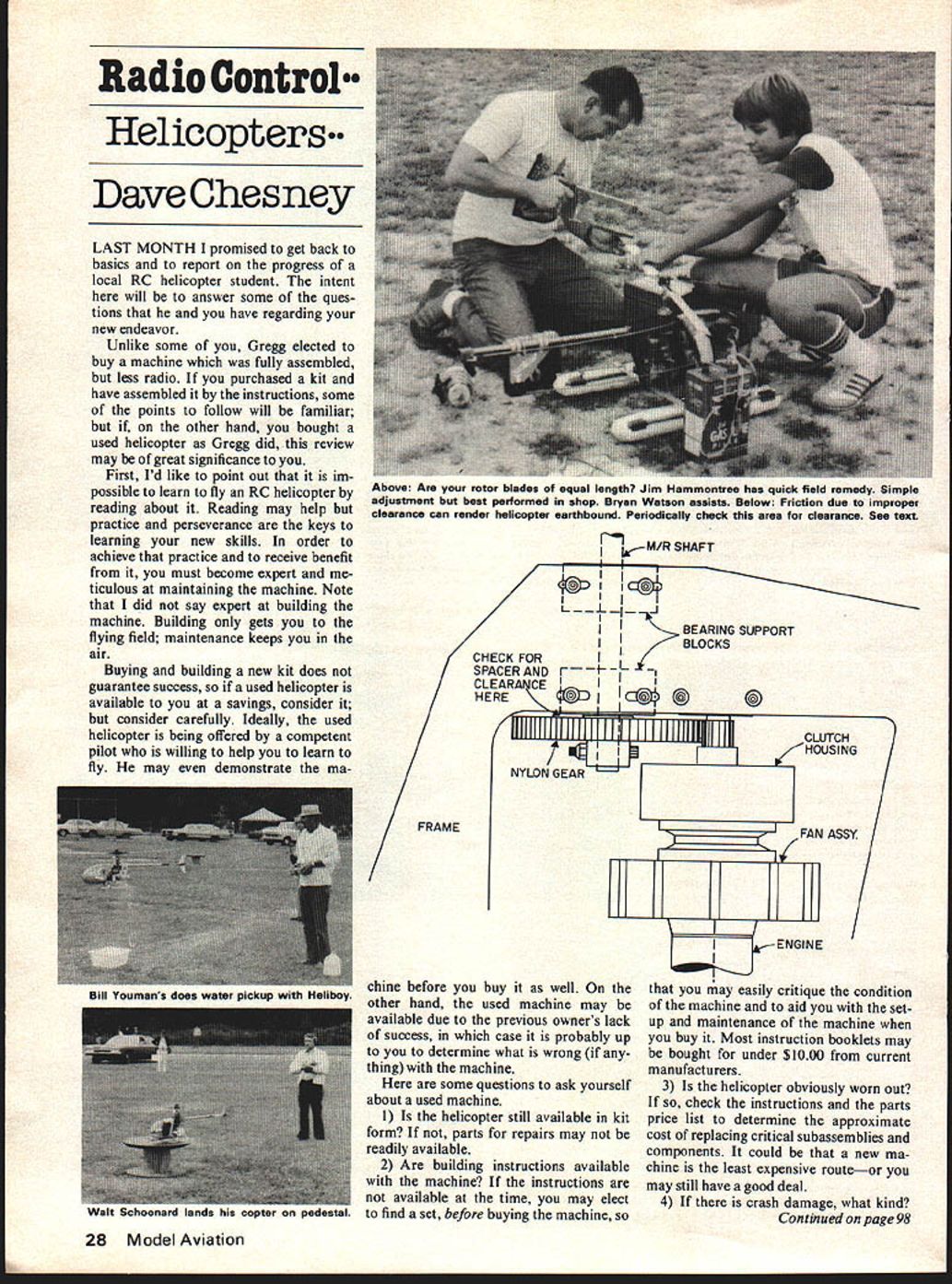
- Main and tail rotors not balanced or of unequal length (see photo).
While most of the above points were directed at a buyer of a used machine, you may also find a few points worthy of consideration, particularly after the first crash. After all, the machine is not new any more.
Gregg has found that proper maintenance is absolutely necessary for flight. One trick he has learned is that new parts are not always necessary. For instance, a recent mishap resulted in a bent main rotor shaft. Rather than buy a new one, Gregg had the shaft straightened at a local machine shop for $4.00.
Another tip is to check clearance of the nylon gear to the bearing support block and side frames, à la Helibaby and Revolution (see Fig. 1). Although a spacer washer was installed, he found that wear — and possibly heat generated by the bearing — had caused the spacer to be drawn partially into the nylon, thus reducing the clearances. As the RPM and lift approached liftoff, the main rotor shaft and gear were pulled up against the bearing block and side frames; the additional friction reduced RPM to a point that the helicopter would barely continue to hover. At the same time, torque increased so much that the tail rotor could not maintain heading. Sound familiar? To correct the problem, insert additional spacers to ensure clearance. Remember: friction/drag will decrease RPM and increase torque. In a helicopter, mechanical friction or aerodynamic drag due to excessive rotor pitch will probably show up first in tail rotor (anti-torque rotor) response.
Next month I'll go into more detail about helicopter set-up. Meanwhile, build some extra blades, recheck your alignments, and try again.
Rules
We have arrived at a time where the rules reward machine capability at the expense of pilot capability to perform precision maneuvers. So, some events are being run with modifications to take this into account. Witness the following letter from Norm Holland, Helicopter Event Director for the Tangerine International Meet.
Dear Dave:
We would appreciate receiving support in your column for the Tangerine Helicopter event. This year, we have pushed the Tangerine planning committee into two full days from one and a half days last year. We are working hard to make the helicopter event a permanent portion of this annual meet and to do this takes participation. As you know, the Tangerine is a big meet with two and a half days of pattern, one and a half days of Formula I and one day stand-off scale, and two days helicopter, for a total of four days. Helicopters will be flown off site in a country club setting.
AMA maneuvers will be flown as this is a AAA AMA meet; however, we are going to modify the expert free-style category. We want to upgrade the flying and to try to open it up to all types of helicopters, not just one or two fully-aerobatic models.
To do this, our plans are not final at this writing, but we plan to limit the selected maneuvers to any six, within four minutes. This will give them time to perform each maneuver, not just try to get quantity and fly like a drunk bumblebee. Also required to make this work is an adjustment of the "K" factors. A loop and roll are now almost commonplace; therefore the K factor on these once-exotic maneuvers will be lowered. This will allow the less acrobatic helos to be competitive with precision flying.
The other key point is that once a flight plan is chosen, the pilot must stick to it throughout the meet. We did this last year and the final scores were very close.
We would like to thank you in advance for your support of the '79 Tangerine.
— Norman A. Holland Helicopter Event Director
Looks like Norm's group is putting together a great meet. The dates are December 30 and 31. The headquarters motel is the Red Carpet Inn, Altamonte Springs, Fla. 1-305-862-5221. See the contest listings for further details.
See you next month.
Dave Chesney Rt. 9, Box 621A Greensboro, NC 27409
Transcribed from original scans by AI. Minor OCR errors may remain.

