
Helicopters
Walt Schoonard
BETWEEN THE DOWNPOURS of rain that had deluged Louisiana for over a week, we set up the flying course equipment for the RC Helicopter event. The very amiable Deputy Cooper of the sheriff's department had the grass mowed, and the general flying area was clean as a whistle. Through Nick Nixon's efforts, I had all the good help I could use. He lined up the judges, the timers, and the couriers and had them there on time. Two years in a row this Lark's sparkplug has come through one hundred percent. Thanks, Nick, I couldn't have done it without you. Speaking of super help, Steve and Eileen Mintz flew from New Orleans to Lake Charles and worked through the whole meet. Eileen kept all the records up to the minute while Steve judged. This is the second year this young couple has done this at their own expense. Believe me, you meet some great people in this sport!
Because of the sudden downpours, the judges' training session had to be held in a van. The humid, crowded van apparently didn't bother the judges because we didn't have a single complaint about the judging. These people were trained on the spot to judge an event by a set of rules they had never seen before. This speaks well for the people and the rules!
The AMA supply office provided tents, chairs, tables, rope, stakes, comfort stations, and a van to transport it all. By the time everyone was registered and the pilots had been briefed, we got the first flight under way (about 9 a.m.). Before the flight was over, it started to rain and lasted for about a half an hour, and then we were able to fly two full rounds before it rained again. A funny thing I have noticed at all meets where I have been contest director is the reluctance to be the first one to fly. I have never been able to see what made the difference. Just a human quirk, I guess.
The entry was very low, only 13. Considering how many helicopters there are around and the fact that there are so few contests to go to, I cannot see how come so few enter. Even those learning to fly lose a great deal by not watching those who compete. Regardless of the low entry, we had the top fliers from the country competing. We flew six full rounds, plus scale, and had time for demonstration flights by anyone who wished. Some that demonstrated were Ernie Huber, Faye Peoples, Aubrey Radford, and several others. Beautiful smooth flights consisting of every maneuver you can imagine, and
to think that all this just started about four years ago!
Of the pilots that flew at the Nats, some were rank novices and could hardly hover; but they did, and they improved noticeably. No one in Novice crashed from pilot error but rather from equipment failure. The Intermediate pilots flew the Novice hover maneuvers and the Intermediate transitional-flying maneuvers that consisted of the AMA procedure turn, followed by a figure-of-eight, and then a 360-degree-flying circle. This category was won by Bill Youmans with one year's flying experience. He flew a highly modified, very smooth Gazelle. The experts flew all the Novice and Intermediate maneuvers, and then all
Radio Control: Helicopters
the free-style of their choice that they could fly in three minutes, including the landing. This category was won by Ernie Huber, who is four times Nationals champion. He flew a Kavan Jet Ranger. It was a real pleasure to watch him fly. So precise, so smooth, and so in command. His vast helicopter knowledge is available to anyone that will ask.
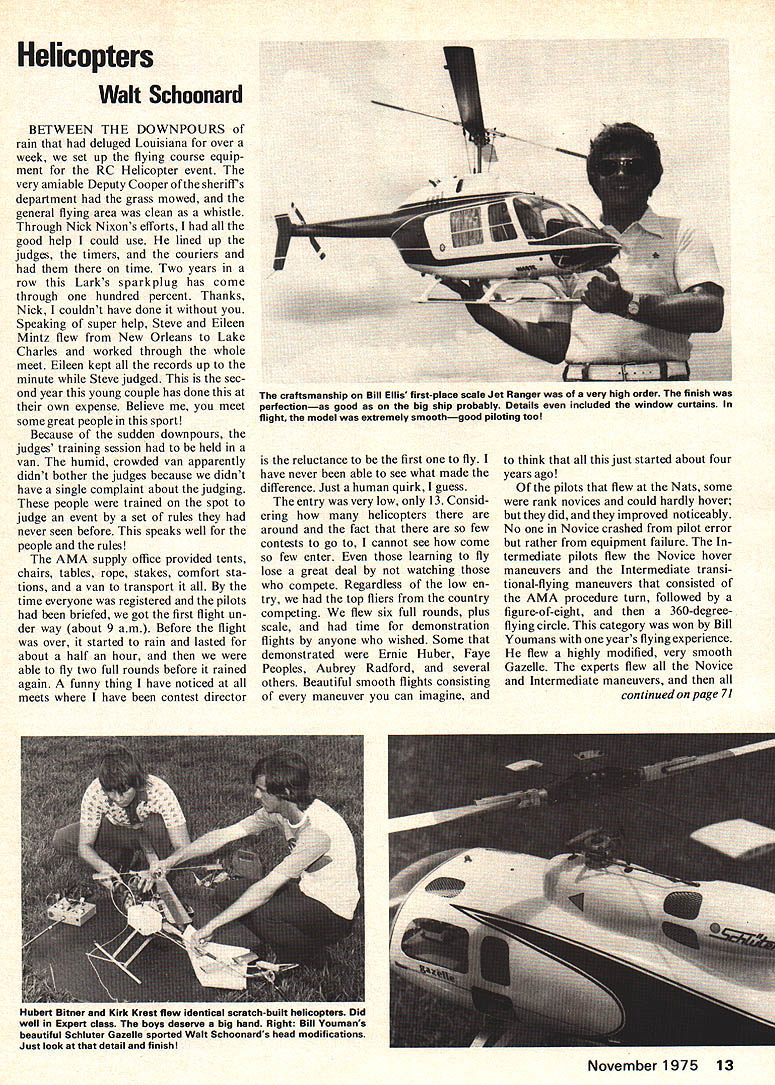
The second day dawned bright and clear, and the pilots were getting serious now, and each posted score was applying pressure on the next person to fly. Now, down to the last round each pilot was doing his very best to impress the judges and get a higher score. Scale was now running away by Bill Ellis with his highly detailed Bell Jet Ranger. This helicopter looked like it had taken shrink tablets. The scale helicopters had to fly as they were judged and none encountered any problems. Plaques were awarded to the winners in all categories, plus the most outstanding helicopter in the event. Also a plaque for the highest point average was given. The types of helicopters flown were: seven Jet Rangers, three home-built, and two Gazelles. Most used Kraft radios and Webra engines. The sponsors were: Kavan Model Products, EK-Logitrol, Top Flite Models, Carl Goldberg Models, Sig Model Products, and Miniature Aircraft Supply.
I want to thank the following people for their help and dedication: Judges: Bill Burnett, Elwood Robichaux, Clarence Hardy, George Gregori, Steven Mintz, Dennis Hinch, Jr., Dick Morris, and Dave McGee. Tabulations: Eileen Mintz. These people came early each day and helped set up, then worked all day and helped secure everything for the next day. I cannot say enough about these fine people. They made my job very easy.
I would like to say a little about La. and its weather. A lot of people indicated that they wouldn't go to La. because of the weather. I have been to contests from one end of this country to the other and whether it is weather, nothing can be done about it. Anyway, the weather in La. is no different from anywhere else. Furthermore, the people of this area are the friendliest I have ever met, and they will do anything to make you feel at home. I feel that a great disservice has been done to these kind people by negative comments and articles, such as the Bayou Blues. If and when I need someone to come to my rescue, I hope it will be from La.!
This is the fourth year that helicopters have been flown in conjunction with the Nats but not as a part of the Nats. Steps are being taken to have this event a sanctioned part of the Nats so if you have an opportunity to speak to your contest board representative, urge him to vote to accept this event soon so that we will receive our just support from the AMA.
Contest Results appear in the Competition News section.
Transcribed from original scans by AI. Minor OCR errors may remain.

