
Radio Control: Helicopters
Dave Chesney
AS PROMISED last month, the following is the R/C Helicopter Judges Guide prepared by the chairman of the R/C Helicopter Advisory Committee. Since this guide and the rules on Page 50 of the AMA's Official Model Aircraft Regulations of 1978/79 are provisional, the Advisory Committee is asking for your inputs so that appropriate changes may be made through the AMA Contest Board.
Judges Guide Maneuver Descriptions
GROUP ONE — NOVICE
- 15-Second Hover
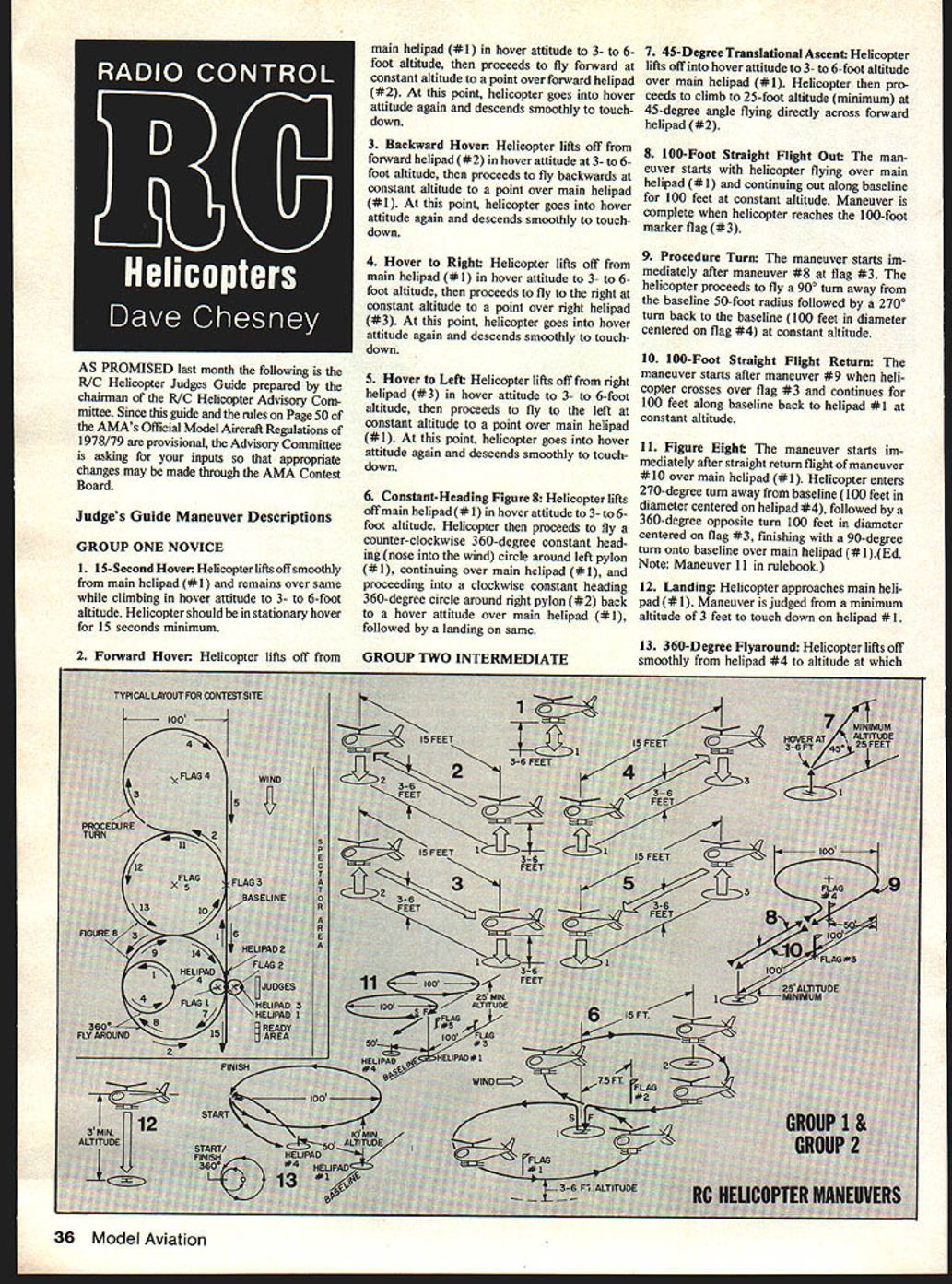
Helicopter lifts off smoothly from main helipad #1 and remains over the same spot while climbing in hover attitude to a 3- to 6-foot altitude. Helicopter should be in a stationary hover for 15 seconds minimum.
- Forward Hover
Helicopter lifts off from main helipad #1 in hover attitude at a 3- to 6-foot altitude, then proceeds to fly forward at constant altitude to a point over forward helipad #2. At that point the helicopter goes into hover attitude again and descends smoothly to touch down.
- Backward Hover
Helicopter lifts off from forward helipad #2 in hover attitude at a 3- to 6-foot altitude, proceeds to fly backwards at constant altitude to a point over main helipad #1. At that point the helicopter goes into hover attitude again and descends smoothly to touch down.
- Hover to Right
Helicopter lifts off from main helipad #1 in hover attitude at a 3- to 6-foot altitude, then proceeds to fly to the right at constant altitude to a point over right helipad #3. At that point the helicopter goes into hover attitude again and descends smoothly to touch down.
- Hover to Left
Helicopter lifts off from right helipad #3 in hover attitude at a 3- to 6-foot altitude, then proceeds to fly to the left at constant altitude to a point over main helipad #1. At that point the helicopter goes into hover attitude again and descends smoothly to touch down.
- Constant-Heading Figure 8
Helicopter lifts off from main helipad #1 in hover attitude at a 3- to 6-foot altitude. Helicopter then proceeds to fly a counter-clockwise 360-degree constant-heading (nose-in) circle around left pylon #1, continuing over main helipad #1, then proceeds into a clockwise constant-heading 360-degree circle around right pylon #2 back to a hover attitude over main helipad #1, followed by a landing on the same helipad.
GROUP TWO — INTERMEDIATE
- 45-Degree Translational Ascent
Helicopter lifts off into hover attitude at a 3- to 6-foot altitude over main helipad #1. Helicopter then proceeds to climb to a minimum 25-foot altitude on a 45-degree angle, flying directly across to forward helipad #2.
- 100-Foot Straight Flight Out
Maneuver starts with the helicopter flying over main helipad #1 and continuing out along the baseline for 100 feet at constant altitude. Maneuver is complete when helicopter reaches the 100-foot marker flag #3.
- Procedure Turn
Maneuver starts immediately after maneuver #8 at flag #3. The helicopter proceeds to fly a 90-degree turn away from the baseline on a 50-foot radius, followed by a 270-degree turn back to the baseline (100 feet in diameter centered on flag #4) at constant altitude.
- 100-Foot Straight Flight Return
Maneuver starts after maneuver #9 when the helicopter crosses over flag #3 and continues for 100 feet along the baseline back to helipad #1 at constant altitude.
- Figure Eight
Maneuver starts immediately after the straight return flight of maneuver #10 over main helipad #1. Helicopter enters a 270-degree turn away from the baseline (100 feet in diameter centered on helipad #4), followed by a 360-degree opposite turn (100 feet in diameter centered on flag #3), finishing with a 90-degree turn onto the baseline over main helipad #1. Ed. Note: Maneuver 11 is in the rulebook.
- Landing
Helicopter approaches main helipad #1. Maneuver is judged from a minimum altitude of 3 feet to touch down on helipad #1.
- 360-Degree Flyaround
Helicopter lifts off smoothly from helipad #4 to the altitude at which the flyaround takes place. Once altitude is a minimum of 10 feet, the helicopter proceeds to fly a left-hand 360-degree circle approximately 100 feet in diameter, ending over helipad #4.
GROUP THREE — EXPERT / FREESTYLE
- 360-Degree Hover — Tail
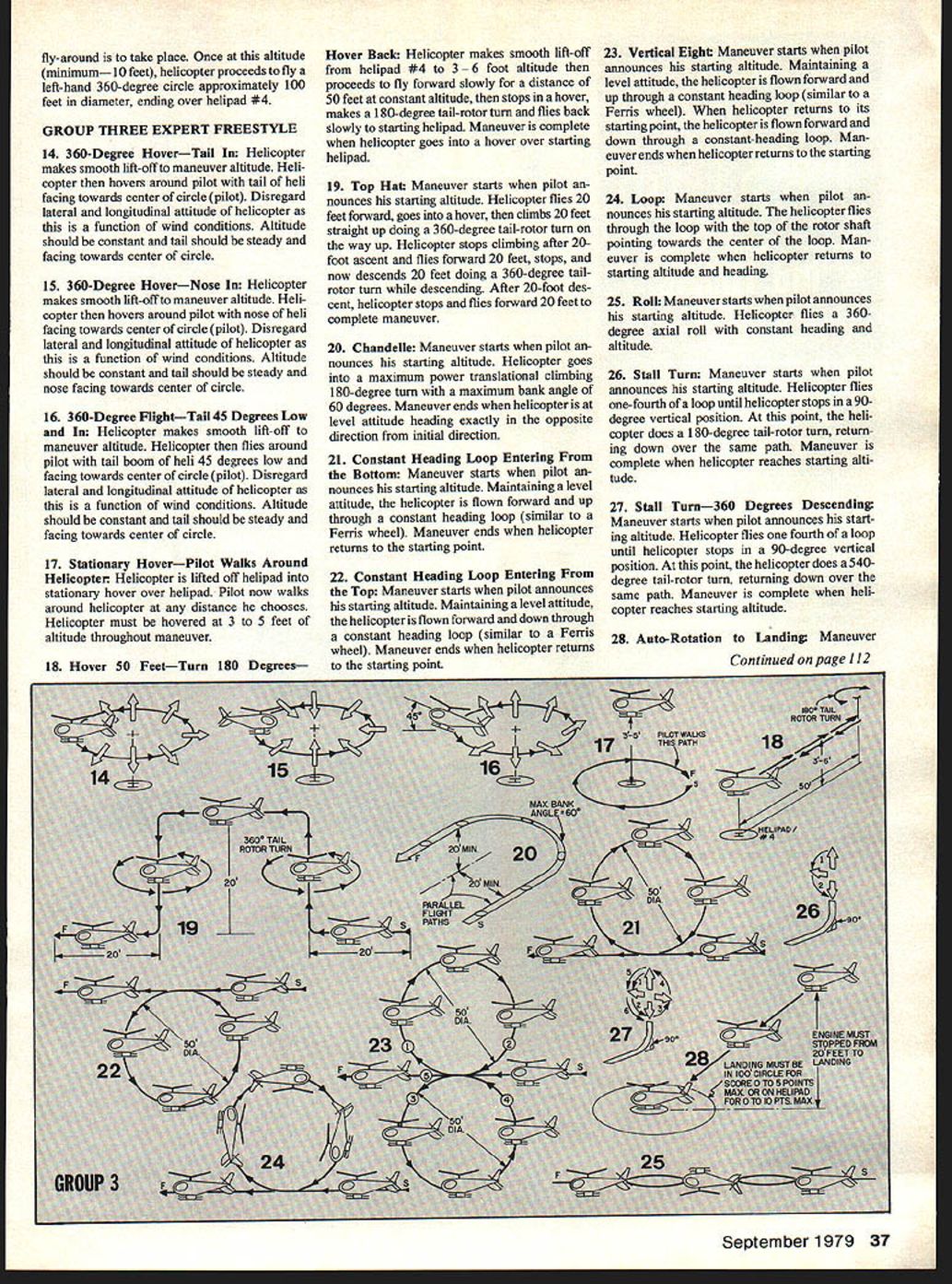
Helicopter makes a smooth lift-off to altitude and hovers around the pilot with the tail of the helicopter facing towards the center circle. Pilot should disregard lateral and longitudinal attitude changes due to helicopter function and wind conditions. Altitude should be constant; tail should be steady facing towards the center circle.
- 360-Degree Hover — Nose
Helicopter makes a smooth lift-off to altitude and hovers around the pilot with the nose of the helicopter facing towards the center circle. Pilot should disregard lateral and longitudinal attitude changes due to helicopter function and wind conditions. Altitude should be constant; nose should be steady facing towards the center circle.
- 360-Degree Flight — Tail 45 Degrees Low and In
Helicopter makes a smooth lift-off to maneuver altitude. Helicopter then flies around the pilot with the tail boom 45 degrees low and facing towards the center of the circle (pilot). Disregard lateral and longitudinal attitude of the helicopter as this is a function of wind conditions. Altitude should be constant and tail should be steady and facing towards the center of the circle.
- Stationary Hover — Pilot Walks Around Helicopter
Helicopter is lifted off helipad into a stationary hover over the helipad. Pilot now walks around the helicopter at any distance he chooses. Helicopter must be hovered at 3 to 5 feet of altitude throughout the maneuver.
- Hover 50 Feet — Turn 180 Degrees — Hover Back
Helicopter makes a smooth lift-off from helipad #4 to 3–6 foot altitude then proceeds to fly forward slowly for a distance of 50 feet at constant altitude, then stops in a hover, makes a 180-degree tail-rotor turn and flies back slowly to the starting helipad. Maneuver is complete when helicopter goes into a hover over the starting helipad.
- Top Hat
Maneuver starts when the pilot announces his starting altitude. Helicopter flies 20 feet forward, goes into a hover, then climbs 20 feet straight up doing a 360-degree tail-rotor turn on the way up. Helicopter stops climbing after the 20-foot ascent and flies forward 20 feet, stops, and then descends 20 feet doing a 360-degree tail-rotor turn while descending. After the 20-foot descent, the helicopter stops and flies forward 20 feet to complete the maneuver.
- Chandelle
Maneuver starts when the pilot announces his starting altitude. Helicopter performs a maximum-power translational climbing 180-degree turn with a maximum bank angle of 60 degrees. Maneuver ends when the helicopter is at level attitude heading exactly in the opposite direction from the initial direction.
- Constant-Heading Loop Entering From the Bottom
Maneuver starts when the pilot announces his starting altitude. Maintaining a level attitude, the helicopter is flown forward and up through a constant-heading loop (similar to a Ferris wheel). Maneuver ends when the helicopter returns to the starting point.
- Constant-Heading Loop Entering From the Top
Maneuver starts when the pilot announces his starting altitude. Maintaining a level attitude, the helicopter is flown forward and down through a constant-heading loop (similar to a Ferris wheel). Maneuver ends when the helicopter returns to the starting point.
- Vertical Eight
Maneuver starts when the pilot announces his starting altitude. Maintaining a level attitude, the helicopter is flown forward and up through a constant-heading loop. When the helicopter returns to its starting point, the helicopter is flown forward and down through a constant-heading loop. Maneuver ends when the helicopter returns to the starting point.
- Loop
Maneuver starts when the pilot announces his starting altitude. The helicopter flies through the loop with the top of the rotor shaft pointing towards the center of the loop. Maneuver is complete when the helicopter returns to starting altitude and heading.
- Roll
Maneuver starts when the pilot announces his starting altitude. Helicopter flies a 360-degree axial roll with constant heading and altitude.
- Stall Turn
Maneuver starts when the pilot announces his starting altitude. Helicopter flies one-fourth of a loop until it stops in a 90-degree vertical position. At this point, the helicopter performs a 180-degree tail-rotor turn, returning down over the same path. Maneuver is complete when the helicopter reaches the starting altitude.
- Stall Turn — 360 Degrees Descending
Maneuver starts when the pilot announces his starting altitude. Helicopter flies one-fourth of a loop until it stops in a 90-degree vertical position. At this point, the helicopter performs a 540-degree tail-rotor turn, returning down over the same path. Maneuver is complete when the helicopter reaches the starting altitude.
- Auto-Rotation to Landing
Auto-rotation to landing maneuver description (continued).
Continued on page 112.
Transcribed from original scans by AI. Minor OCR errors may remain.

