
Radio Control: Helicopters
Dave Chesney
Good news for RC helicopter fliers. John Tucker is back to writing the Choppers column for R/C Model Builder. If, like me, you grab at the latest issues of every model mag looking for helicopter articles, look again at R/C Model Builder. Welcome back, John.
Over the past few months some of the more proficient helicopter pilots have, no doubt, been thinking about helicopter autorotations. Some are now routinely shutting down their engines and autorotating down to soft landings. Quite a change from the early days of stop-and-go approaches to landings — remember? The engine stopped and the helicopter went all to pieces. Well, autorotations might not have been new when American R/C Helicopters introduced their Commander Helicopter with autorotation modification, but the excitement sure is. If you're excited about trying autorotations, Mike Mas has some suggestions. I have condensed his writing for this column.
Rules and recommendations
- Know how to land.
- The first rule for successfully autorotating an RC helicopter is to know how to land. If you can't land the helicopter with the engine running, you will not be able to successfully land from an autorotation approach.
- Practice normal landings some distance away since, when you begin practicing autorotations, chances are the landing will not be within your usual landing area.
- You may also practice the autorotation approach without shutting the engine off (highly recommended) since the descent rates are about the same.
- Follow manufacturer setup and maintain the machine.
- Mike's second rule is to follow the manufacturer's instructions regarding the setup of the helicopter.
- He recommends good maintenance of any helicopter, particularly with regard to reducing or eliminating serious vibrations.
- Pay close attention to the rotor blade finish. Mike has experienced some difference in performance between blades that are simply covered and those that are resined and smoothly finished.
Typical training flight (American R/C Commander with autorotation device)
- Positioning
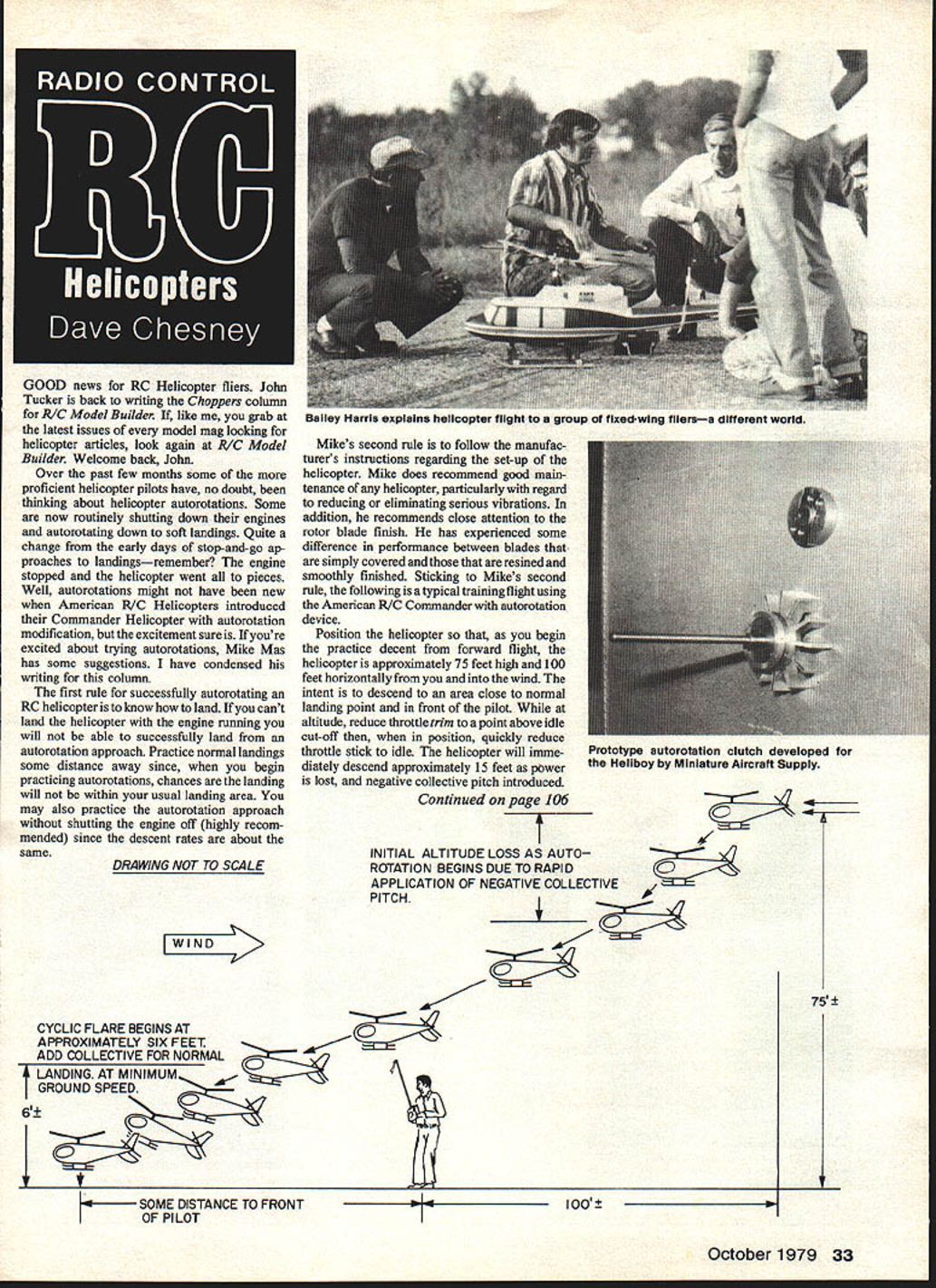
- Place the helicopter so that, as you begin the practice descent from forward flight, the helicopter is approximately 75 feet high and 100 feet horizontally from you and into the wind.
- The intent is to descend to an area close to the normal landing point and in front of the pilot.
- Initiating the descent
- While at altitude, reduce throttle trim to a point above idle cut-off.
- When in position, quickly reduce the throttle stick to idle. The helicopter will immediately descend approximately 15 feet as power is lost and negative collective pitch is introduced.
- Entering autorotation
- After the initial drop, the helicopter will enter autorotation and the air moving up through the blades will keep them at a somewhat constant speed.
- Keep the nose down with a slight amount of forward cyclic. Keep the helicopter moving forward, but do not over-control cyclic commands because each cyclic input will affect rotor speed.
- The goal is to maintain a constant rotor speed and a steady rate and angle of descent.
Landing flare and touchdown
- The landing flare begins at about 6 feet. The flare is simply a back stick command (no collective) and is used to reduce the rate of descent and forward speed of the helicopter. Ground speed should be reduced to near zero.
- As the flare begins, the rotor will momentarily overspeed due to exposing a greater disc area to the relative wind. Take advantage of the overspeeding to increase collective pitch for the final soft landing from an altitude of one to three feet.
- Timing is critical. If either the cyclic flare or the collective pitch is given too early, the stored energy of the rotor could be used up, making the landing less than soft.
Contacts and resources
- For a more complete rundown on autorotating the American R/C Commander: Mike Mas, c/o American R/C Helicopter, 23811 Via Fabricante, Suite 102, Mission Viejo, CA 92691.
- If you're flying the Heliboy, contact Gorham and Associates, S.C. Modeler, or Miniature Aircraft Supply for information on Heliboy autorotating modifications and flying tips.
- Helpful hints and additional instructions for the Schluter Heliboy are available from S.C. Modeler, 1999 West Larkin Avenue, Elgin, IL 60120. Copies are fifty cents to cover postage and printing.
I'm still surprised to find that many clubs in our area have never seen an RC helicopter fly. We have even found members of those clubs who own helicopters but have not tried to fly because help was seemingly not available. Some members of the North Carolina Helicopter Association have made a point of visiting clubs and demonstrating helicopter flight and helping prospective helicopter fliers get off the ground. Why not visit a few clubs in the coming months and let them know you're available for helping newcomers?
Dave Chesney Rt. 9, Box 621A, Greensboro, NC 27409.
Transcribed from original scans by AI. Minor OCR errors may remain.

