
Radio Control: Helicopters
Dave Chesney
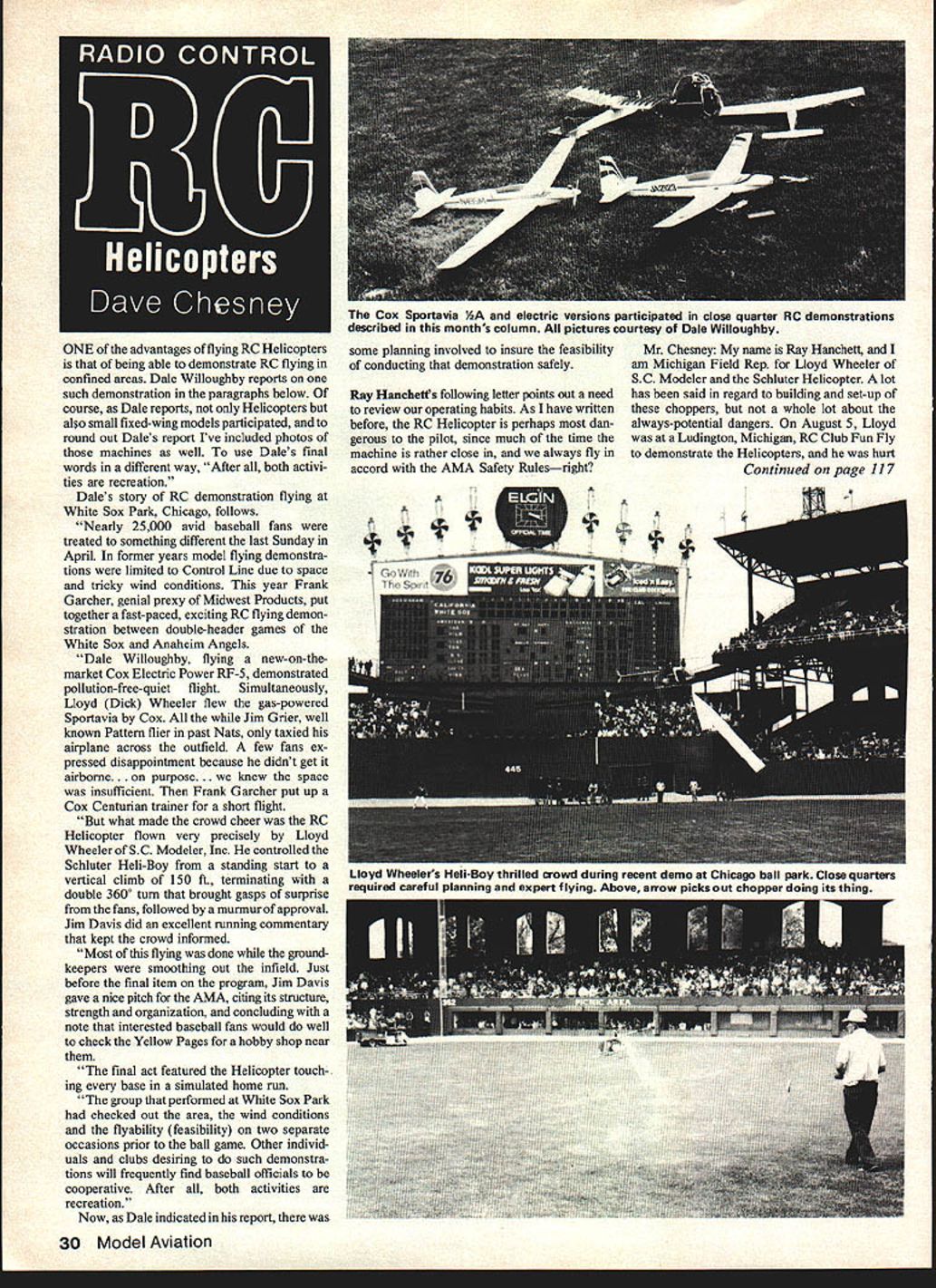
ONE of the advantages of flying RC helicopters is being able to demonstrate RC flying in confined areas. Dale Willoughby reports on one such demonstration below. Of course, as Dale reports, not only helicopters but also small fixed‑wing models participated, and to round out Dale's report I've included photos of those machines as well. To use Dale's final words in a different way, "After all, both activities are recreation."
White Sox Park demonstration (Dale Willoughby)
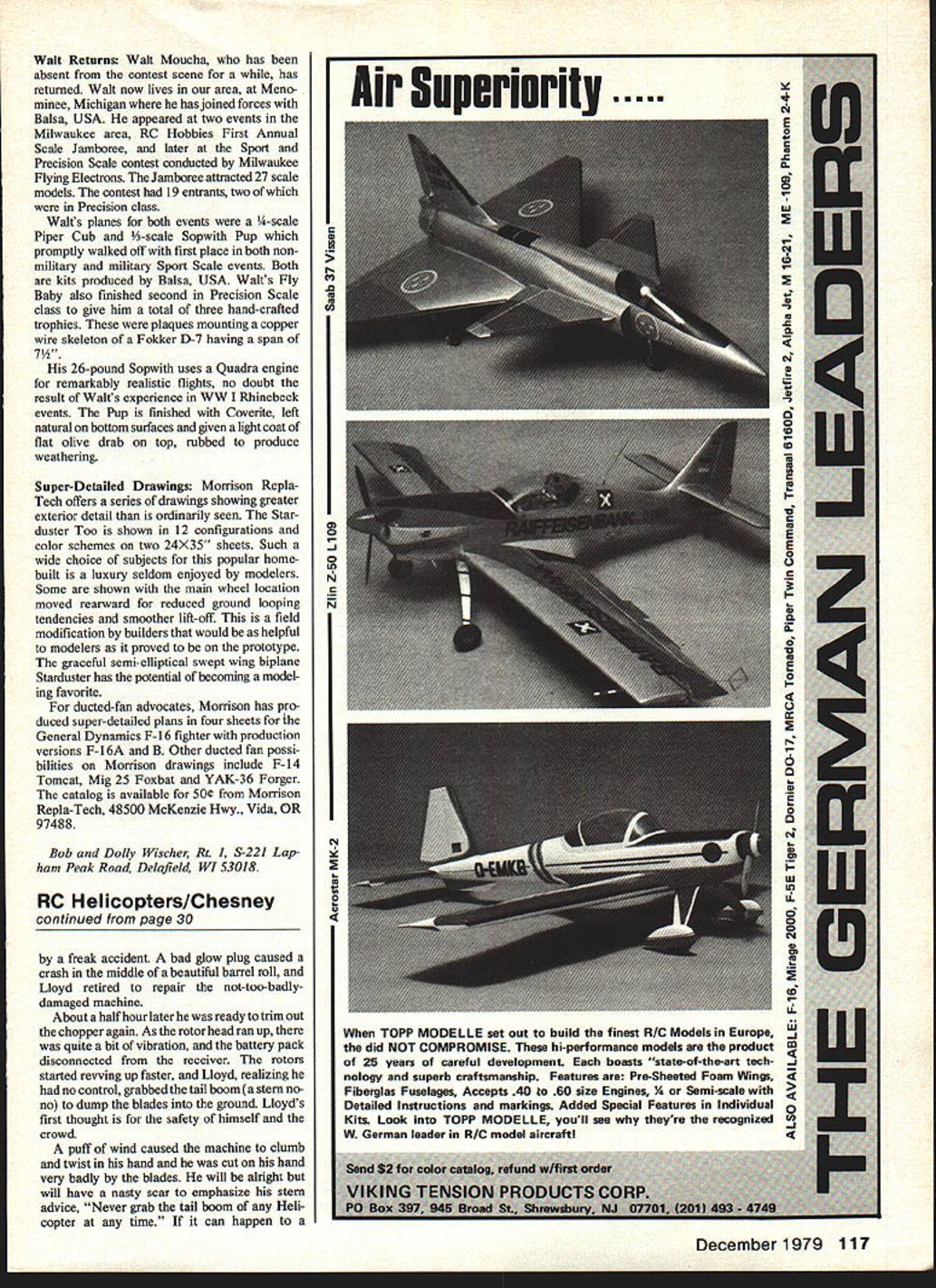
Nearly 25,000 avid baseball fans were treated to something different the last Sunday in April. In former years model flying demonstrations were limited to control line due to space and tricky wind conditions. This year Frank Garcher, genial president of Midwest Products, put together a fast‑paced, exciting RC flying demonstration between double‑header games of the White Sox and Anaheim Angels.
Dale Willoughby, flying a new‑on‑the‑market Cox Electric Power RF‑5, demonstrated pollution‑free, quiet flight. Simultaneously, Lloyd (Dick) Wheeler flew the gas‑powered Sportavia by Cox. All the while Jim Grier, well known pattern flier in past Nats, only taxied his airplane across the outfield. A few fans expressed disappointment because he didn't get it airborne … on purpose … we knew the space was insufficient. Then Frank Garcher put up a Cox Centurion trainer for a short flight.
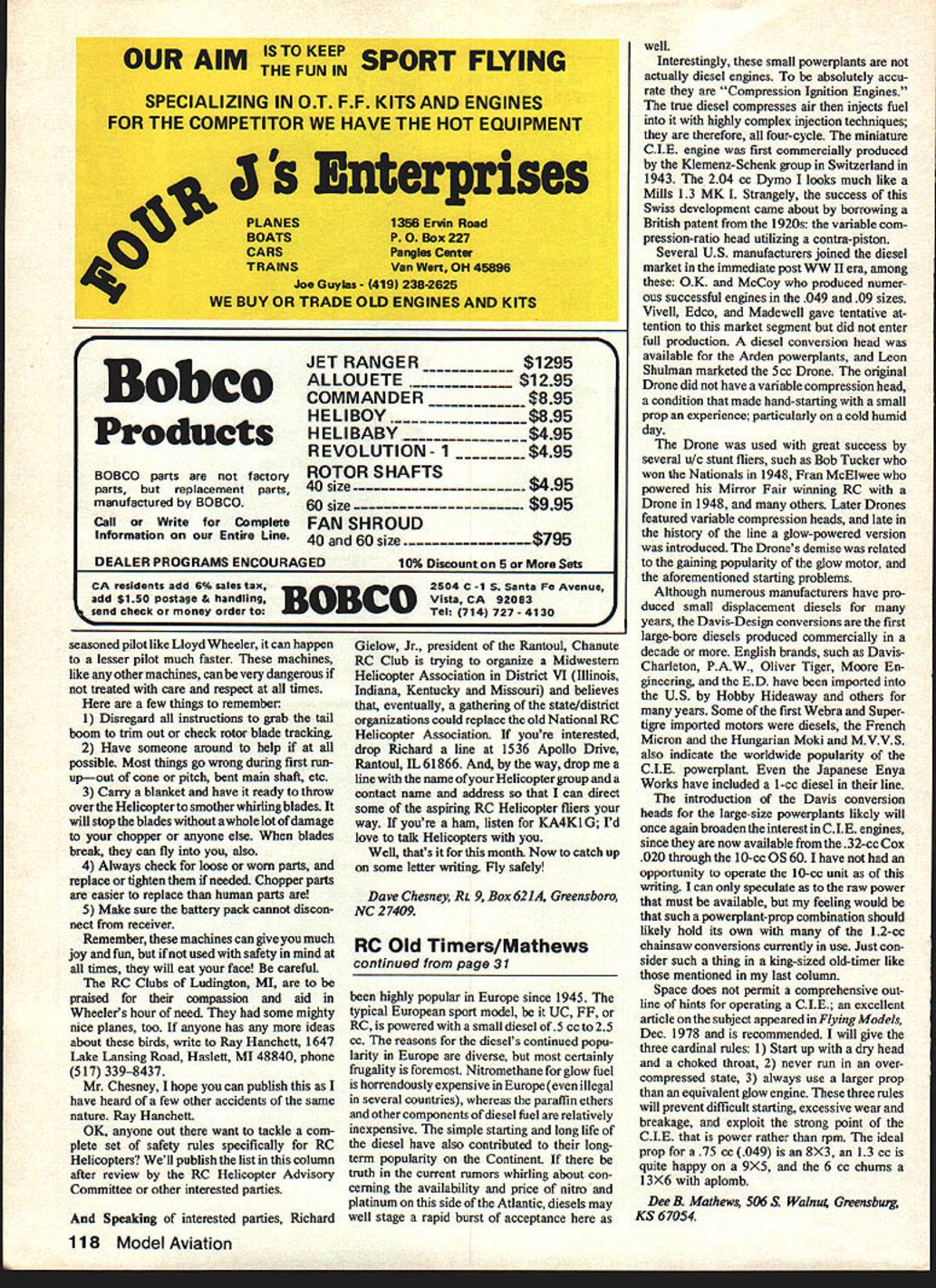
But what made the crowd cheer was the RC helicopter flown very precisely by Lloyd Wheeler of S.C. Modeler, Inc. He controlled the Schluter Heli‑Boy from a standing start to a vertical climb of 150 ft., terminating with a double 360° turn that brought gasps of surprise from the fans, followed by a murmur of approval. Jim Davis did an excellent running commentary that kept the crowd informed.
Most of this flying was done while the groundkeepers were smoothing out the infield. Just before the final item on the program, Jim Davis gave a nice pitch for the AMA, citing its structure, strength and organization, and concluding with a note that interested baseball fans would do well to check the Yellow Pages for a hobby shop near them.
The final act featured the helicopter touching every base in a simulated home run.
The group that performed at White Sox Park had checked out the area, the wind conditions and the flyability (feasibility) on two separate occasions prior to the ball game. Other individuals and clubs desiring to do such demonstrations will frequently find baseball officials to be cooperative. After all, both activities are recreation.
Now, as Dale indicated in his report, there was some planning involved to ensure the feasibility of conducting that demonstration safely.
Letter from Ray Hanchett
Mr. Chesney:
My name is Ray Hanchett, and I am Michigan field rep for Lloyd Wheeler of S.C. Modeler and the Schluter helicopter. A lot has been said in regard to building and set‑up of these choppers, but not a whole lot about the always‑potential dangers. On August 5, Lloyd was at a Ludington, Michigan, RC Club fun fly to demonstrate the helicopters, and he was hurt by a freak accident. A bad glow plug caused a crash in the middle of a beautiful barrel roll, and Lloyd retired to repair the not‑too‑badly‑damaged machine.
About a half hour later he was ready to trim out the chopper again. As the rotor head ran up, there was quite a bit of vibration, and the battery pack disconnected from the receiver. The rotors started revving up faster, and Lloyd, realizing he had no control, grabbed the tail boom (in an attempt not to dump the blades into the ground). Lloyd's first thought was for the safety of himself and the crowd.
A puff of wind caused the machine to climb and twist in his hand and he was cut on his hand very badly by the blades. He will be all right but will have a nasty scar to emphasize his stern advice: "Never grab the tail boom of any helicopter at any time." If it can happen to a seasoned pilot like Lloyd Wheeler, it can happen to a lesser pilot much faster. These machines, like any other machines, can be very dangerous if not treated with care and respect at all times.
Here are a few things to remember:
- Disregard any instructions that tell you to grab the tail boom to trim out or check rotor blade tracking.
- Have someone around to help if at all possible. Most things go wrong during first run‑up — out of cone or pitch, bent main shaft, etc.
- Carry a blanket and have it ready to throw over the helicopter to smother whirling blades. It will stop the blades without a whole lot of damage to your chopper or engine. Otherwise, when blades break they can fly into you.
- Always check for loose or worn parts, and replace or tighten them if needed. Chopper parts are easier to replace than human parts!
- Make sure the battery pack cannot disconnect from the receiver.
Remember, these machines can give you much joy and fun, but if not used with safety in mind at all times, they will "eat your face"! Be careful.
The RC clubs of Ludington, MI, are to be praised for their compassion and aid in Wheeler's hour of need. They had some nice planes, too. If anyone has any more ideas about these birds, write to Ray Hanchett, 1647 Lake Lansing Road, Haslett, MI 48840; phone (517) 339‑8437.
Mr. Chesney, I hope you can publish this as I have heard of a few other accidents of the same nature. Ray Hanchett
Call for helicopter safety rules
OK, anyone out there want to tackle a complete set of safety rules specifically for RC helicopters? We'll publish the list in this column after review by the RC Helicopter Advisory Committee or other interested parties.
Organization and contacts
Richard Giselow, Jr., president of the Rantoul‑Chanute RC Club, is trying to organize a Midwestern Helicopter Association in District VI (Illinois, Indiana, Kentucky and Missouri) and believes that, eventually, a gathering of the state/district organizations could replace the old National RC Helicopter Association. If you're interested, drop Richard a line at 1536 Apollo Drive, Rantoul, IL 61866.
And, by the way, drop me a line with the name of your helicopter group and contact name and address so that I can direct some of the aspiring RC helicopter fliers your way. If you're a ham, listen for KA4KIG; I'd love to talk helicopters with you.
Closing
Well, that's it for this month. Now to catch up on some letter writing. Fly safely!
Dave Chesney R1, Box 621A, Greensboro, NC 27409
Transcribed from original scans by AI. Minor OCR errors may remain.

