
Radio Control: Helicopters
By Dave Chesney Guest columnist: Horace Hagen
Editor's Note
Occasionally one of our columnists, prevented from meeting a deadline because of other workloads, will invite another expert in his field to fill in. Dave's guest this issue is Horace Hagen, who discusses the 4th Annual MMAC East Coast R/C Helicopter Championships.
4th Annual MMAC East Coast R/C Helicopter Championships — Report
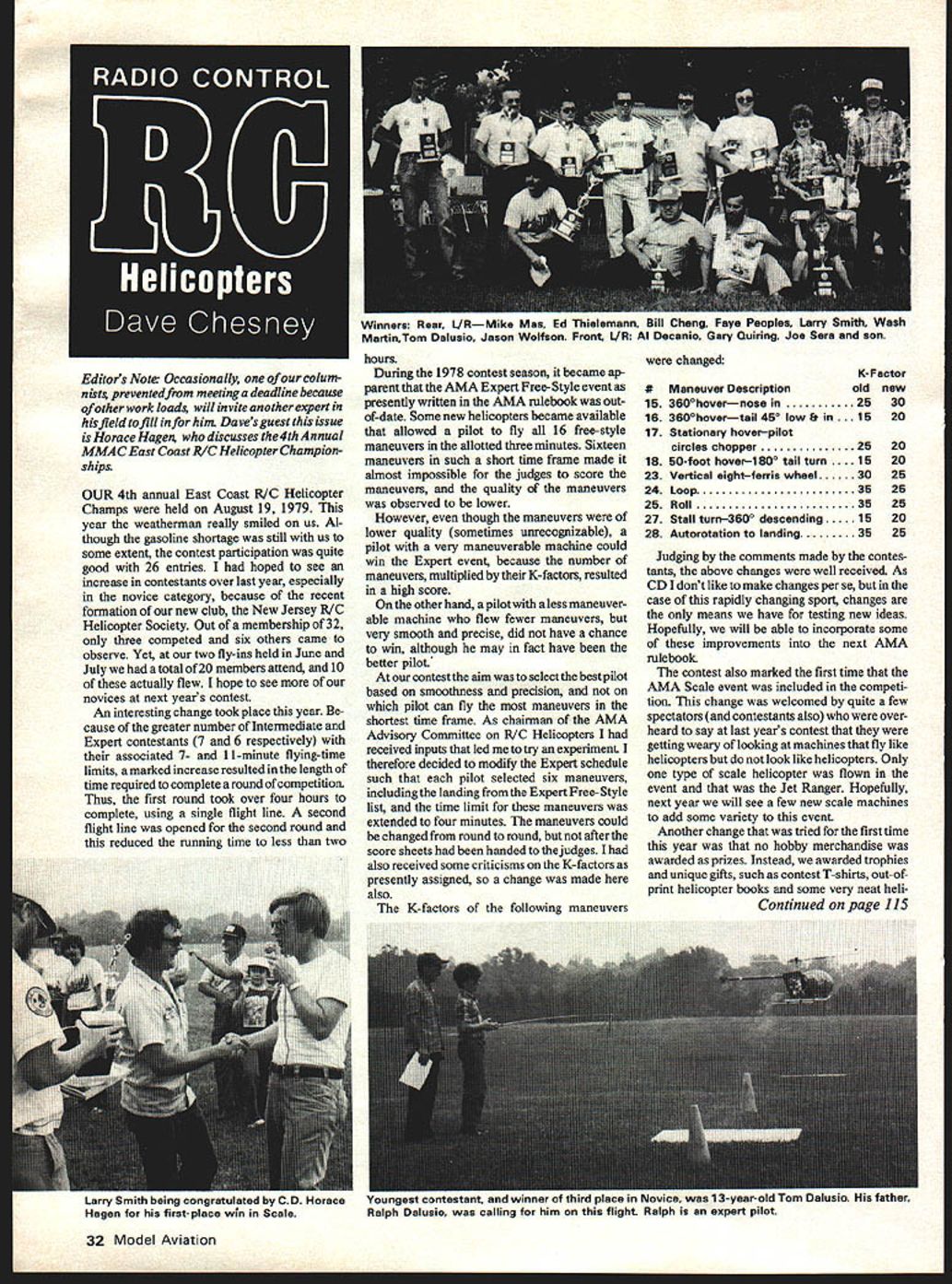
Our 4th annual East Coast R/C Helicopter Championships were held on August 19, 1979. This year the weatherman really smiled on us. Although the gasoline shortage still affected travel to some extent, contest participation was quite good — 26 entries.
We had hoped to see an increase in contestants over last year, especially in the novice category, because of the recent formation of the New Jersey R/C Helicopter Society. Out of a membership of 32, only three competed and six others came to observe. However, at two club fly-ins held in June and July, a total of 20 members attended and 10 of these actually flew. I hope to see more novices at next year's contest.
An interesting change this year was the greater number of Intermediate and Expert contestants (7 and 6 respectively). With associated 7- and 11-minute flying-time limits, the time required to complete a round increased markedly. The first round took over four hours to complete using a single flight line. Opening a second flight line for the second round reduced the running time to less than two hours.
During the 1978 contest season it became apparent that the AMA Expert Free-Style event as written in the AMA rulebook was out of date. Newer helicopters allowed pilots to attempt all 16 free-style maneuvers in the allotted three minutes. Sixteen maneuvers in such a short time made it almost impossible for judges to score properly, and the overall quality of maneuvers dropped. A pilot with a very maneuverable machine could score highly simply by attempting many maneuvers (the number multiplied by K-factors), while a pilot flying fewer, but much smoother and more precise maneuvers had little chance to win.
As chairman of the AMA Advisory Committee on R/C Helicopters, I received input that led me to try an experiment. For this contest the Expert schedule was modified so that each pilot selected six maneuvers (including the landing) from the Expert Free-Style list. The time limit for these maneuvers was extended to four minutes. Maneuvers could be changed from round to round, but not after the score sheets had been handed to the judges. I also made adjustments to several K-factors based on criticism of their previous assignments.
K-factor changes
- 15. 360° hover — nose in: old 25 → new 30
- 16. 360° hover — tail 45° low & in: old 15 → new 20
- 17. Stationary hover — pilot circles chopper: old 25 → new 20
- 18. 50-foot hover — 180° tail turn: old 15 → new 20
- 23. Vertical eight — ferris wheel: old 30 → new 25
- 24. Loop: old 35 → new 25
- 25. Roll: old 35 → new 25
- 27. Stall turn — 360° descending: old 35 → new 25
- 28. Autorotation to landing: old 35 → new 25
Judging by contestants' comments, these changes were well received. As Contest Director/Instructor I don't change rules lightly, but in a rapidly evolving sport testing new ideas is necessary. Hopefully some of these improvements can be incorporated into the next AMA rulebook.
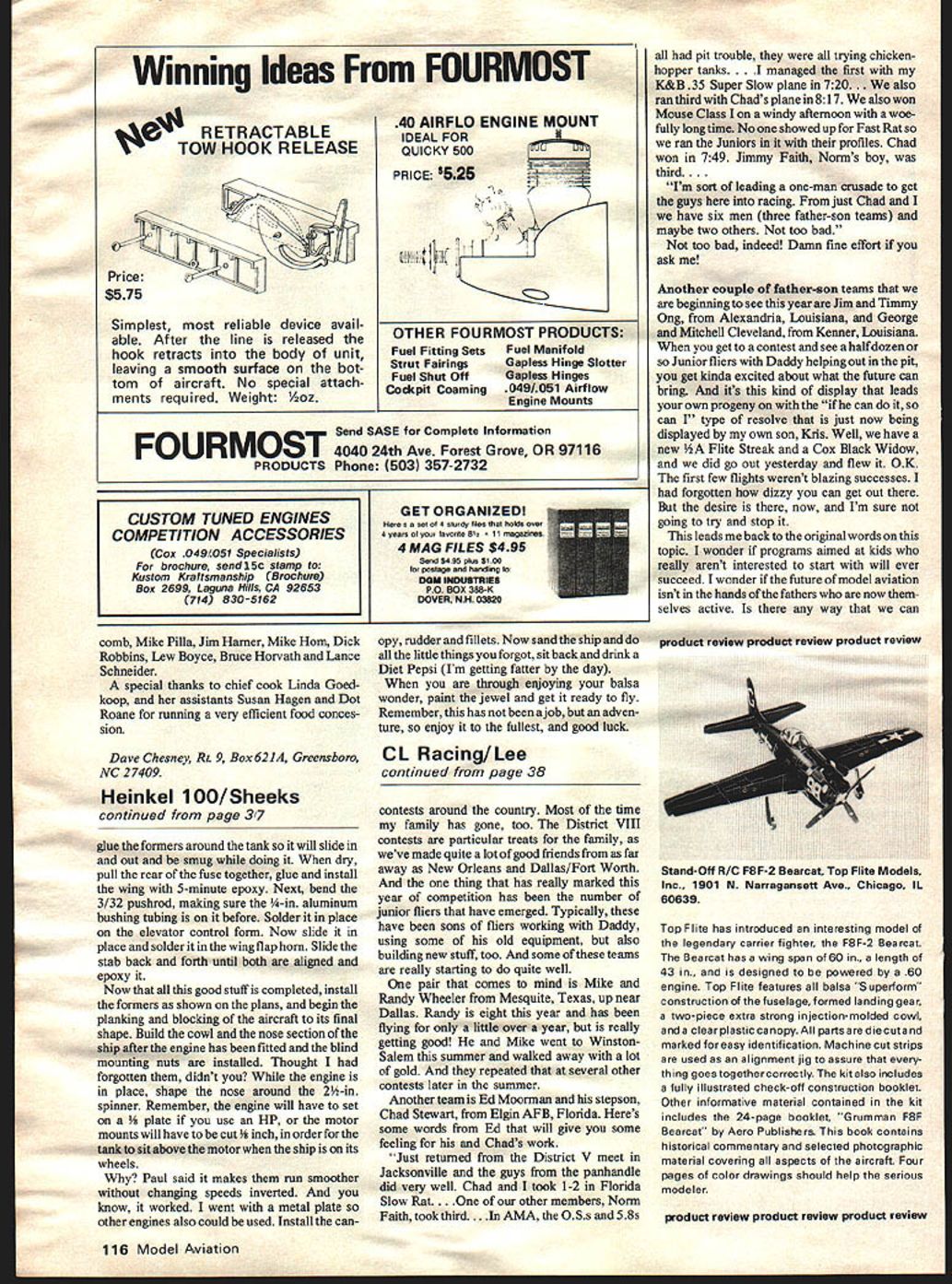
The contest also marked the first time an AMA Scale event was included. This addition was welcomed by many spectators and contestants who had grown weary of seeing models that flew like helicopters but did not look like helicopters. Only one type of scale helicopter was flown in the event this year — the Jet Ranger — but we hope to see more variety in future contests.
Another first this year: no hobby merchandise was awarded as prizes. Instead we presented trophies and unique gifts such as contest T-shirts, out-of-print helicopter books, and other helicopter-themed gifts. This reduces overly competitive behavior seen at some contests where substantial merchandise prizes are offered, helps the Contest Director remain on good terms with hobby industry suppliers, and reduces the chance that the sponsoring club empties its treasury for what may be a minority interest.
A special attraction at noon was the arrival of a full-scale Bell UH-1D (Iroquois) helicopter in U.S. Army colors. This visit was arranged by MMAC member Joe Vanacek. Joe's coworker Dave Haldane and two fellow reservists from the Army Reserve unit at Warminster NAS brought the chopper to the field. When the helicopter first made an inspection pass, one contestant at the food concession joked, "Wouldn't it be something if it landed here." It did — much to the delight of many present.
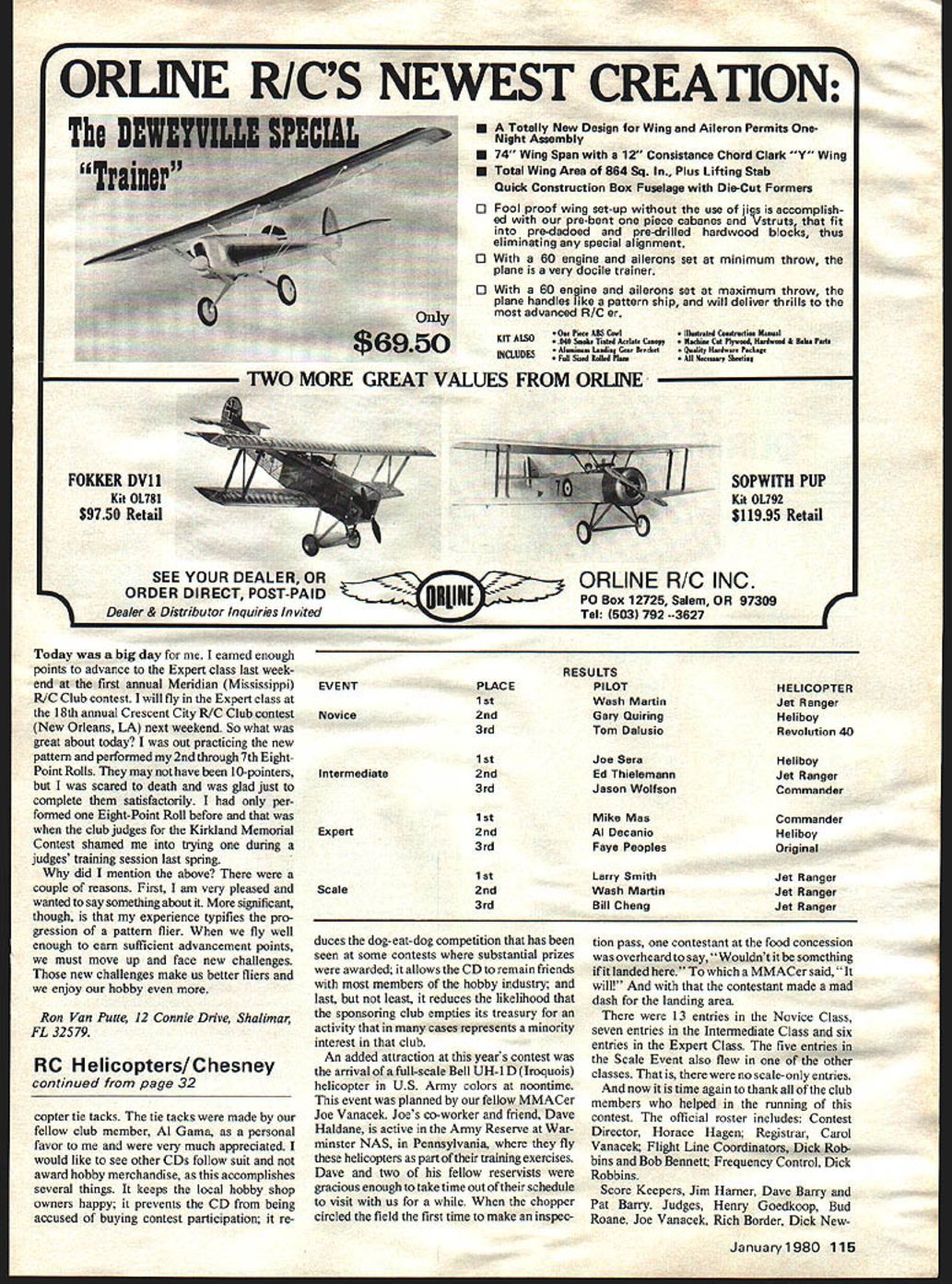
There were 13 entries in the Novice class, seven entries in the Intermediate class, and six entries in the Expert class. The five entries in the Scale event also flew in one of the other classes; there were no scale-only entries.
Results
- Novice
- 1st — Wash Martin — Jet Ranger
- 2nd — Gary Quiring — Heliboy
- 3rd — Tom Dalusio — Revolution 40
- Intermediate
- 1st — Joe Sera — Heliboy
- 2nd — Ed Thielemann — Jet Ranger
- 3rd — Jason Wolfson — Commander
- Expert
- 1st — Mike Mas — Commander
- 2nd — Al Decanio — Heliboy
- 3rd — Faye Peoples — Original
- Scale
- 1st — Larry Smith — Jet Ranger
- 2nd — Wash Martin — Jet Ranger
- 3rd — Bill Cheng — Jet Ranger
Acknowledgements
Thanks to all members who helped run the contest. Official roster included:
- Contest Director: Horace Hagen
- Registrar: Carol Vanacek
- Flight Line Coordinators: Dick Robbins and Bob Bennett
- Frequency Control: Dick Kopp
- Score Keepers: Jim Hamer, Dave Barry, and Pat Barry
- Judges: Henry Goedkoop, Bud Roane, Joe Vanacek, Rich Border, and Dick Newcomb
Special thanks to the food concession team: Linda Goedkoop (chief cook), Susan Hagen, and Dot Roane for running a very efficient concession.
Horace Hagen
Transcribed from original scans by AI. Minor OCR errors may remain.

