
Radio Control: Helicopters
Dave Chesney
I guess if things didn't go wrong occasionally, we'd all get bored stiff. Maybe that's the enjoyment of flying radio-control aircraft — not when things go wrong, but when we have taken the time to correct the errors and are rewarded with the improvement. Those setbacks are opportunities: the opportunity to continue practicing toward flight perfection, to learn more about the workings of our machinery, to experiment with new and improved equipment. The fun must be in searching for improvements, not in arriving at perfection. Anyway, that's the rationalism that has gotten me through some major rebuilding projects.
Of course, sometimes it seems the helicopter is the winner and I'm destined to be the loser. Take, for instance, a recent series of crashes (very hard landings) while practicing autorotations. The score was three and three to the helicopter's favor. The machine got new parts, but I got the experience. What fun! It really takes an optimist with a persevering soul to stick with RC helicopters.
Since the popularity of helicopters is relatively low compared to other RC activities, there is a definite lack of information available to newcomers. Certainly, the help that is usually available at most flying fields for beginning fixed-wing RC fliers is not often available to the beginning helicopter flier. How many RC clubs have even one helicopter flier available to the newcomer? Can it be that even as the popularity of RC helicopters grows, and even as reliable off-the-shelf equipment is available, we are still pioneers of this activity?
Perhaps the challenge to the optimist is not in mastering the difficulty of flying helicopters. Perhaps the real challenge is to share your experiences and pioneer the introduction of helicopters to your club and to surrounding clubs.
Tapes and seminars
A new product soon to be available from Miniature Aircraft Supply of Orlando, FL, will ease some of the problems of getting the word out to those beginners that are segregated from any helicopter flying activities. A cassette recording explaining the setup of Heliboy helicopters should be available about the time you read this column. The tape will be about an hour and a half long and all explanations will be given in layman's terms. Although the tape deals specifically with the Heliboy, many of the explanations would probably apply to all RC 'copters.
A second tape in the works deals with flight training and should be available shortly after the release of the setup tape. The cassettes will probably sell for around $7 to $10 each. Miniature Aircraft Supply may be charging for the tapes, but they also offer one service at no charge that should interest many clubs, whether active in RC helicopters or not. Walt is currently offering helicopter seminars to groups in the Southeast and expects to expand from that geography. Interested clubs should contact Walt Schoonard at Miniature Aircraft Supply, 2563 Diversified Way, Orlando, FL 32804.
Electronic tail-rotor mixers
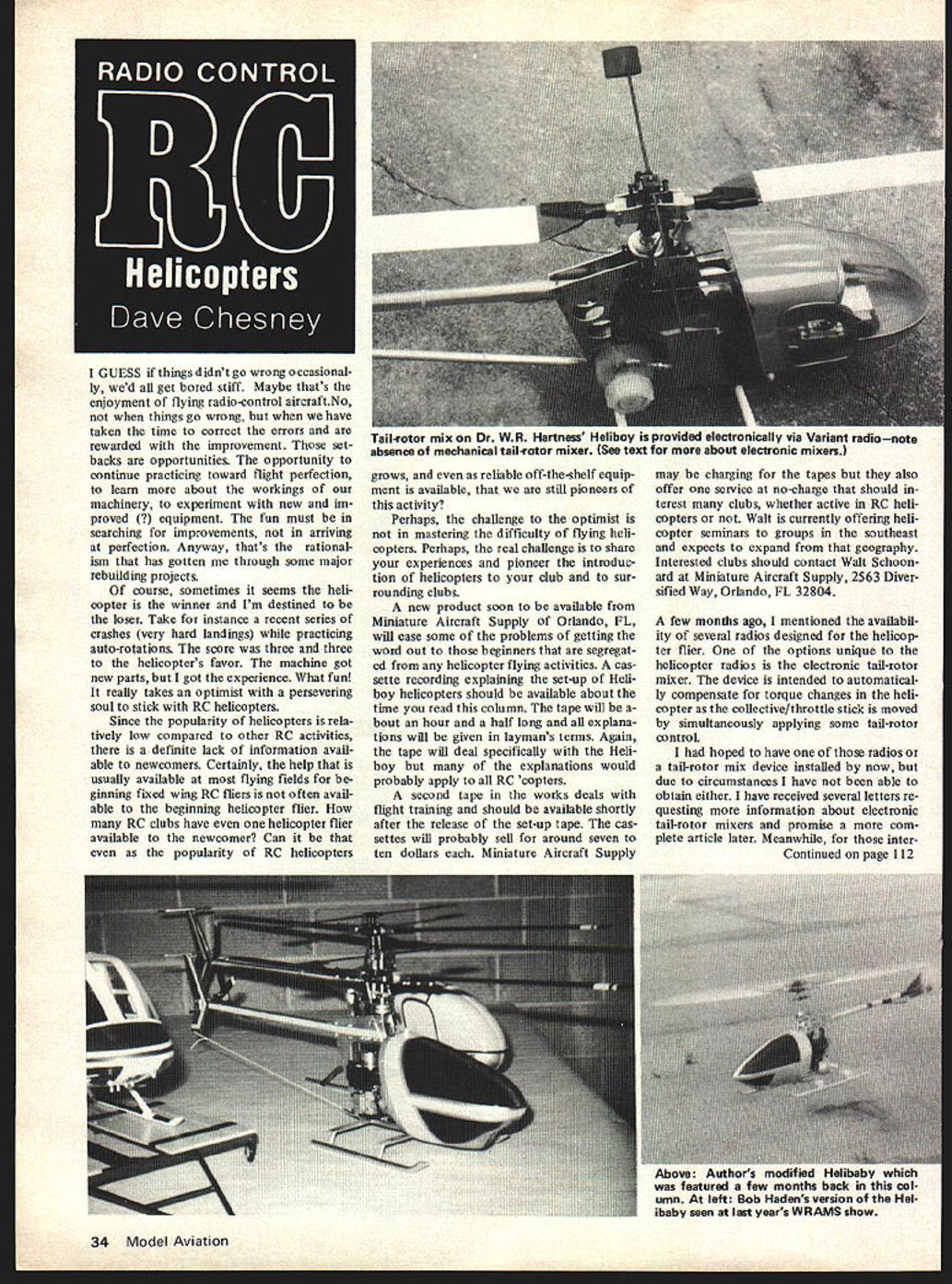
A few months ago I mentioned the availability of several radios designed for the helicopter flier. One of the options unique to helicopter radios is the electronic tail-rotor mixer. The device is intended to automatically compensate for torque changes in the helicopter as the collective/throttle stick is moved by simultaneously applying some tail-rotor control.
I had hoped to have one of those radios or a tail-rotor mix device installed by now, but due to circumstances I have not been able to obtain either. I have received several letters requesting more information about electronic tail-rotor mixers and promise a more complete article later. Meanwhile, for those interested, I'll explain some of the advantages.
Most of the collective-pitch helicopters and some fixed-pitch helicopters have included in their design a mechanical tail-rotor mix device. The mechanical devices can be adjusted to operate quite effectively. If the mix device is easily accessible, adjustments during the initial setup can be made quickly and changed as often as necessary. However, if the mixer is buried deep in the fuselage, trial-and-error adjustments can get frustrating. A detailed adjustment of the Kavan Jet Ranger mechanical mixer may be found in the May issue of R/C Modeler Magazine. The article, written by Ray Hostetler, may at first reading convince you to go the electronic route, since the mix device on the Jet Ranger is not quickly accessible. But keep in mind that once the mechanical mixer is set, we can usually compensate for slight errors with pilot technique.
Now, the electronic mixer is always accessible, and not only can it be adjusted for an amount (mix ratio), but it can also be adjusted to lead or lag collective/throttle changes and to give momentary overshoot. The overshoot allows a momentary increase or decrease of the selected mix ratio at times when rapid changes of collective/throttle may be necessary. The advantages of the electronic mix are:
- Freedom from excessive mechanical linkage and associated adjustment.
- The electronic mix ratio is adjustable while in flight.
- The electronic mix may be adjusted to lead or lag collective/throttle changes in flight.
- The electronic mix offers "overshoot" capability.
- The electronic mix can provide tail-rotor mix on helicopters where an existing mechanical mixer is not available.
Keep in mind, where a mechanical mixer is available, the mix function will occur without the need for a special transmitter or transmitter modification. And keep in mind that flying an RC helicopter is largely dependent upon an operator selecting up the machine and lots of practice with it. The convenience of electronic mixers will not guarantee success as you learn to fly.
Inverted flight milestone
Perhaps by now you will have heard that on November 22, 1979, at 9:00 a.m., Mike Mas successfully flew an RC helicopter in sustained inverted flight. Mike's accomplishment is not a minor achievement but marks a milestone in helicopter flight. Mike was the first in the world to fly an RC helicopter in sustained inverted flight — proof that model technology and pilot skill can surpass the full-scale world.
Mike, who had won every contest he attended in the 1979 season, used a standard Series 80 Heliboy helicopter with the free-swinging blades to attain his unique goal. The Heliboy was equipped with an HP Gold Cup .61 with Heliball muffler running K&B 50 fuel. The radio was a standard Futaba two-stick radio (no mixers) with standard graphite cyclic. The only deviation from standard practice was his setup of collective and throttle to yield both full throttle at +5 degrees pitch and full throttle at -5 degrees pitch.
The helicopter was also set up with a high coning angle so as to avoid tail-boom strikes while inverted. The negative pitch and available power provided enough force to actually flatten the landing gear and allow the main frame of the Heliboy to rest on the ground during run-up tests, so the high coning angle was certainly necessary.
On the radio end, the throttle/collective stick was set so that center stick position was idle, movement forward for positive pitch and movement aft of that position for negative. Mike flies with throttle and tail-rotor on the right stick and cyclic on the left stick (sort of a left-handed mode two, or as Walt Schoonard calls it, the "Commode").
Entry to inverted flight was by half roll at an approximate altitude of 100 feet. Once inverted, the helicopter was flown as low as 50 feet and even hovered inverted. And all is recorded on videotape.
Mike's achievement will have been demonstrated again at Rosemont Park, Orlando, FL, at the Tangerine and will be demonstrated at the WRAMS Show and at Toledo (weather permitting) this year, so plan to attend.
Well, that's it for this month. Congratulations, Mike Mas! What will you do to top this?
Dave Chesney Route 9, Box 621A Greensboro, NC 27409
Transcribed from original scans by AI. Minor OCR errors may remain.

