
Radio Control: Helicopters
Walt Schoonard
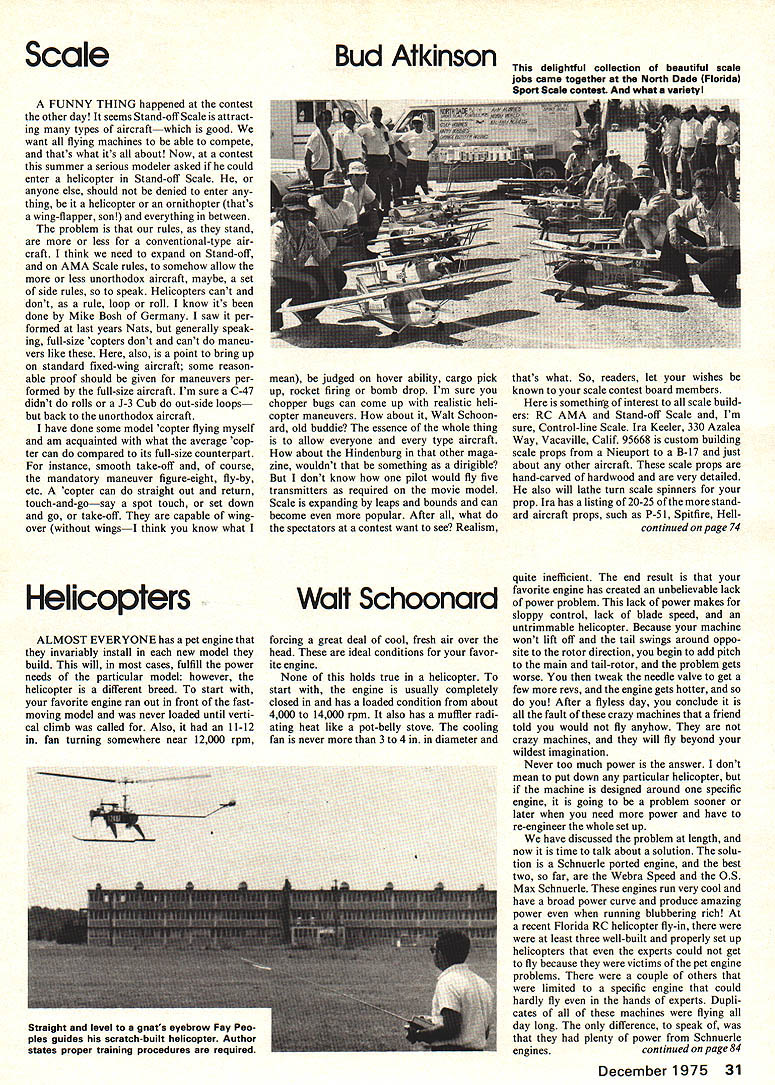
ALMOST EVERYONE has a pet engine that they invariably install in each new model they build. This will, in most cases, fulfill the power needs of the particular model; however, the helicopter is a different breed. To start with, your favorite engine ran out in front of the fast-moving model and was never loaded until vertical climb was called for. Also, it had an 11–12 in. fan turning somewhere near 12,000 rpm, forcing a great deal of cool, fresh air over the head. These are ideal conditions for your favorite engine.
None of this holds true in a helicopter. To start with, the engine is usually completely closed in and has a loaded condition from about 4,000 to 14,000 rpm. It also has a muffler radiating heat like a pot-belly stove. The cooling fan is never more than 3 to 4 in. in diameter and quite inefficient. The end result is that your favorite engine has created an unbelievable lack of power problem. This lack of power makes for sloppy control, lack of blade speed, and an untrimmable helicopter. Because the machine won't lift off and the tail swings around opposite to the rotor direction, you begin to add pitch to the main and tail-rotor, and the problem gets worse. You then tweak the needle valve to get a few more revs, and the engine gets hotter and so do you! After a flyless day, you conclude the fault is the crazy machine, and a friend told you it would fly anyhow. They are not crazy machines, and they will fly beyond your wildest imagination.
Never too much power is the answer. I don't mean to put down any particular helicopter, but if the machine is designed around one specific engine, it is going to be a problem sooner or later when you need more power and have to re-engineer the whole set-up.
We have discussed the problem at length, and now it is time to talk about a solution. The solution, so far, is the Schnuerle-ported engine, and the best two, so far, are the Webra Speed and the O.S. Max Schnuerle. These engines run very cool and have a broad power curve and produce amazing power even when running blubbering rich! At a recent Florida RC helicopter fly-in, there were at least three well-built helicopters that even the experts could not get to fly because they were victims of the pet engine problems. There were a couple of others that were limited to a specific engine that could hardly fly even in the hands of experts. Duplicates of machines were flying day long. The only difference, to speak of, was that they had plenty of power from Schnuerle engines.
RC Helicopters/Schoonard
Trimming Your Helicopter: A great deal has been printed in some publications about training devices from table marbles, bicycle wheels, old shock absorbers, furniture casters, and you name it. But when all the dust has cleared away, the helicopter has to be set free and allowed to fly if it is ever going to be trimmed out, and if you are going to learn to fly, you must have a trimmed helicopter! As you built your machine, let's hope you gave special attention to the alignment of shafts to bearings and alignment of engine and clutch to transmission. What I am trying to say is that it must be in line and free. Any misalignment will mean a loss of power and thereby a lack of control.
The rotors should be spin-free. What I mean by this is, when they are turned, they should spin freely such as a turntable on a good stereo system. All servos should be mounted as the factory indicates. With the rudder (tail-rotor control on transmitter) in neutral, the tail-rotor control arm should be in neutral, allowing equal travel to the right and left. Be sure that, on command, the control comes back to the same neutral after a right or left turn of the stick. If it does not, look for a bind in the linkage or in the control cable. Make sure you accomplish this before you go any further. Now, set the pitch of the tail-rotor as the designer indicated.
With the roll (or aileron servo) in neutral, with transmitter trim in neutral, the swashplate should be level to the output shaft. This is easy to check by using a small 90-degree square on the swashplate to the output shaft. Now make sure that the fore and aft servo (elevator) is in neutral. Adjust ball links to bring the swashplate perpendicular to the output shaft when the swashplate is level. The fly-bar control should now be neutral with equal travel both directions. With this accomplished, make sure the fly-bar paddles are parallel to each other and to the swashplate. Now, you should go through all the flight controls to make sure that the travel or tilt of the swashplate meets the designer's specifications.
If you have not properly balanced the blades, here is a simple and good method. Weigh each blade and determine the neutral center of gravity of the heaviest blade. Add enough weight to the lighter blade to make it weigh the same. Move the weight along the blade to get the center of gravity at the same place on the blade as on the heavier blade. Another method is to remove blade and assemble to head, and then use a balancing tool. Now, balance the entire head assembly and set the lead-lag as specified. Add colored foil to blade tips as a quick check in flight. Pitch is as specified.
You may notice that I haven't said anything about setting up the engine and carburetor.
Engine and Carburetor: This is the most critical part and most important. The carburetor should move freely, and the pushrod should have a nylon clevis fastened to the carburetor arm. This needs a safety made from fuel tubing or small copper wire; just so it cannot come out during flight. The pushrod should be of some rigidity and run as directly from the carburetor to the servo as possible. If your carburetor does not have a good linear response, and you cannot modify it so that it does, replace it with a Kavan, O.S., or other. I am not endorsing any particular brand, but the ones above really work well and are right out of the box. Set the carburetor so that it will shut off the engine by the transmitter trim control. You should be able to start the engine with the throttle control in full slow and the trim in half fast. Full trim should engage the clutch. Operate the throttle so the engine idles in the slow position and then increase throttle to the fast position to make sure that it works properly.
If you have done all of your homework properly up to this point, the best thing to do is get a friend or instructor to help you with the first flights. If you have no one locally, try contacting clubs or RC Modeler for assistance. Hook up the glow-plug wire. It is a good idea to check the glow-plug to see if it is operating properly. It should be an idle-bar type; plugs that have worked well for me are the type that maintain a good idle and heat quickly. Be sure to secure the rotor while starting. stand that I will describe in the next article.
The engine should start right up and should be set to idle with glow head disconnected. A good place to stand is to the left rear about ten feet from the helicopter. Have the helicopter facing into the wind, slowly advance motor trim to engage the clutch. Slowly rev up the engine to about lift-off speed. Check rotor blades for tracking. They should track perfectly for smooth operation. I recommend flying the nose and not the tail. By this I mean right rudder turns the nose right and left turns the nose left.
As you advance power, the helicopter may turn one way or the other. Trim the tail rotor until it does not change direction as you add power. If the helicopter slips to the right or left, trim the swash-plate until the helicopter does not move right or left. With added power the helicopter should rise straight up. Add only enough power to achieve desired altitude. Swashing of the helicopter can be corrected by swash-plate command.
To set the helicopter down, remove power slowly. You should practice lifting the helicopter up by slowly advancing the motor speed and gently setting it down by slowly retarding motor speed. These instructions have all been for a fixed-pitch machine. I will write later on their instruction for a collective helicopter. If you need further help, let me hear from you. Direct your correspondence to Walt Schoonard, 2080 Sharon Rd., Winter Park, Fla., 32789. Phone—305-647-1335—evenings.
Transcribed from original scans by AI. Minor OCR errors may remain.

