
Radio Control: Helicopters
Dave Chesney
A big "sorry about that" goes to Ulli Baudrexel of Germany regarding my report in the February issue of MA that Mike Mas was the first in the world to fly an RC helicopter in sustained inverted flight. Not long after that issue circulated, I was informed that the first recorded demonstration of sustained inverted flight took place in Europe mid‑summer of 1979, and that Ernie Huber had also succeeded in flying inverted as well. My congratulations go to the three (or more) who pioneered inverted flight.
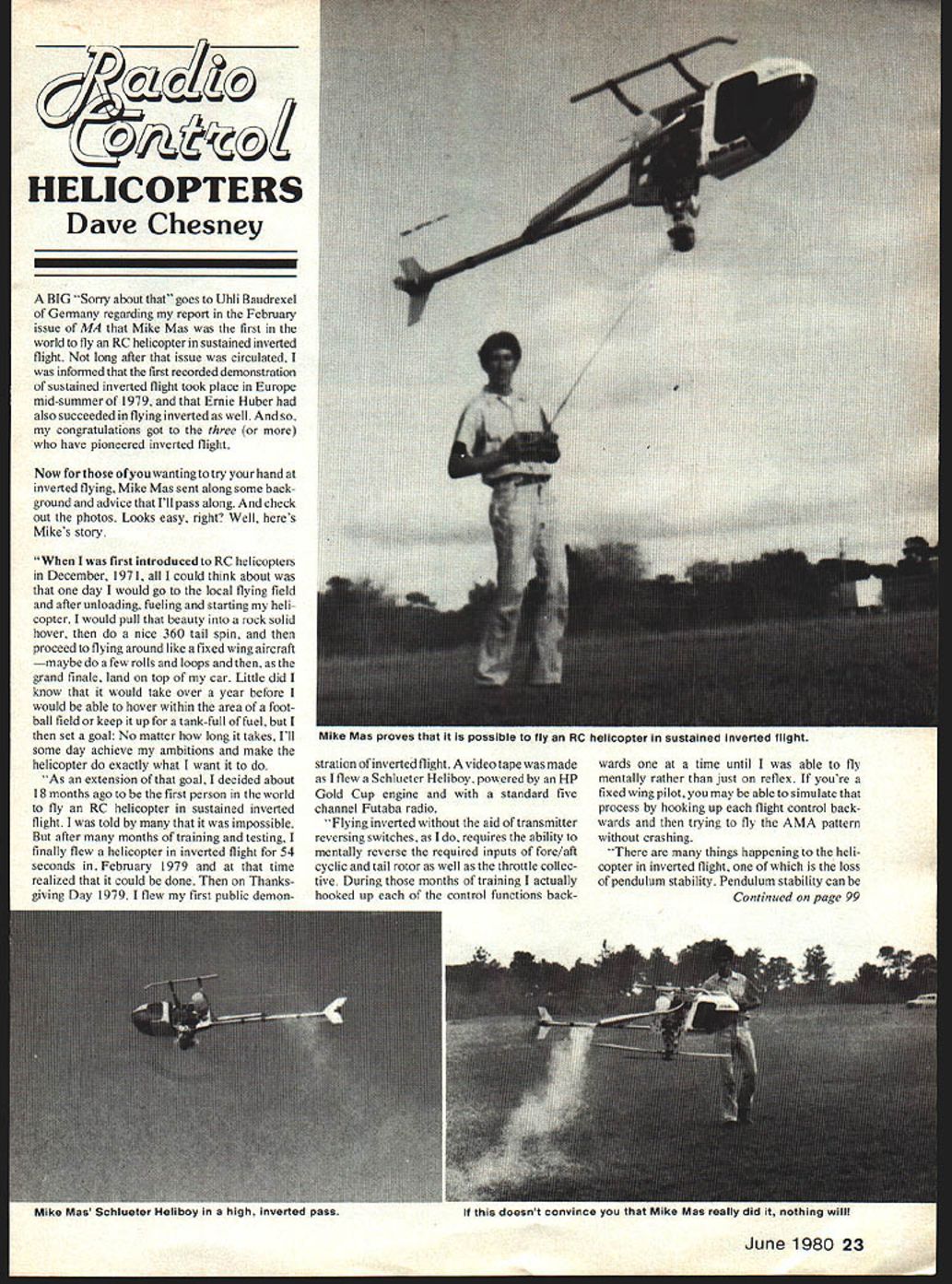
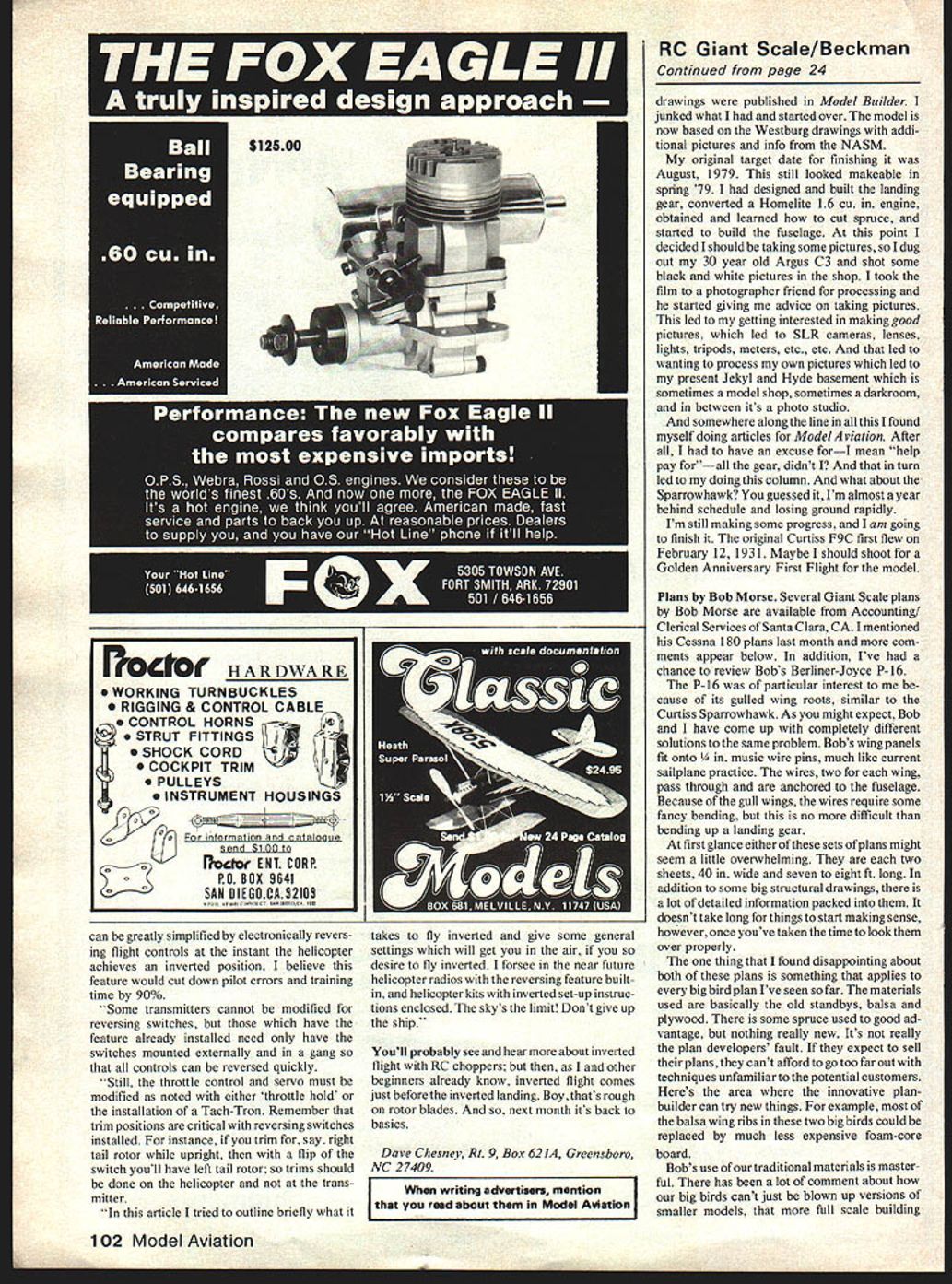
Now for those of you wanting to try your hand at inverted flying, Mike Mas sent along some background and advice that I’ll pass along. Check out the photos — looks easy, right? Well, here's Mike's story.
Mike Mas: My story
When I was first introduced to RC helicopters in December 1971, all I could think about was that one day I would go to the local flying field and after unloading, fueling and starting my helicopter, I would pull that beauty into a rock‑solid hover, do a nice 360 tail spin, and then proceed to fly around like a fixed‑wing aircraft — maybe do a few rolls and loops and then, as the grand finale, land on top of my car. Little did I know that it would take over a year before I could hover within the area of a football field or keep it up for a tank‑full of fuel, but I set a goal: no matter how long it takes, I'll someday achieve my ambitions and make the helicopter do exactly what I want it to do.
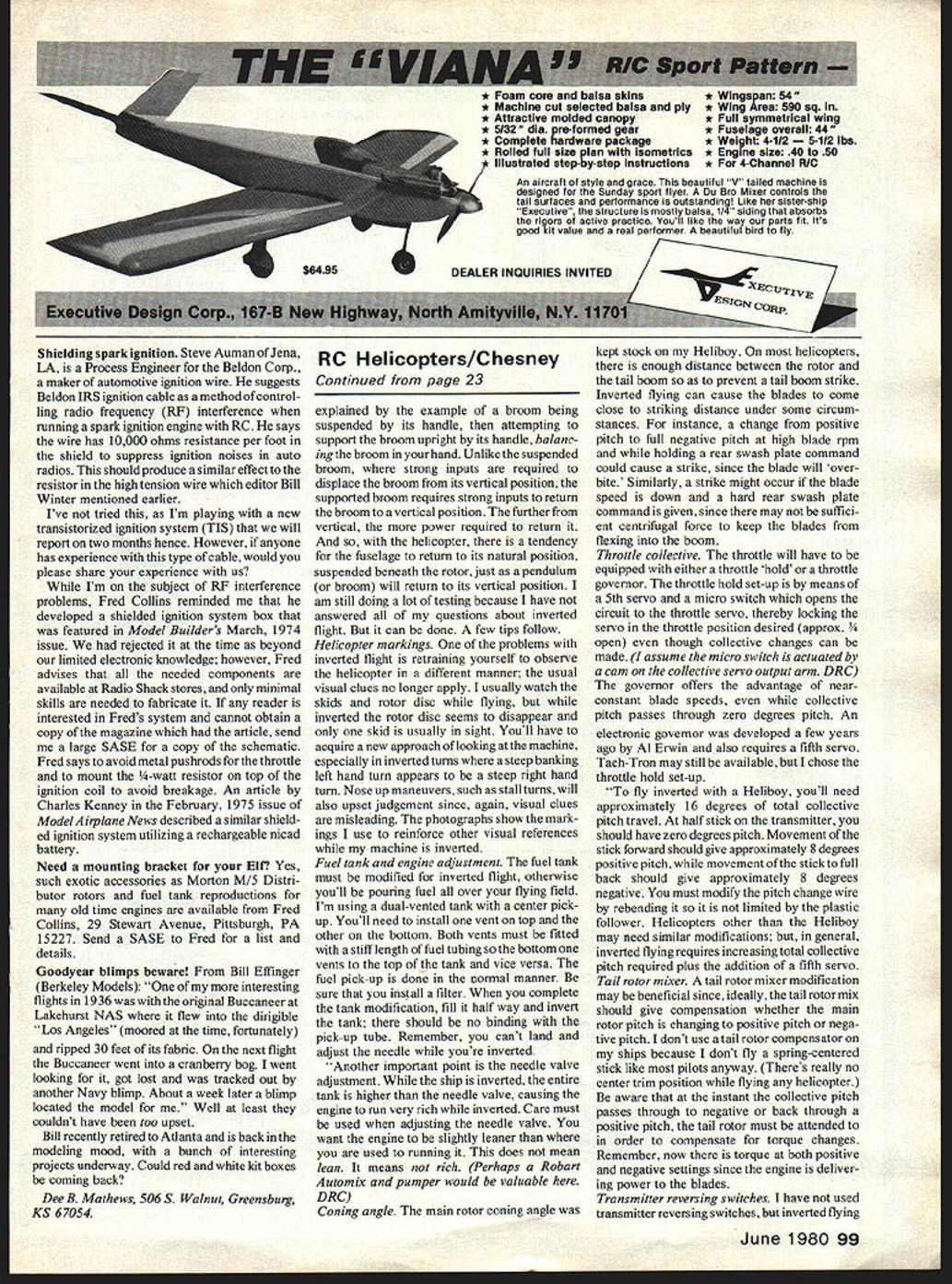
As an extension of that goal, about 18 months ago I decided to be the first person in the world to fly an RC helicopter in sustained inverted flight. I was told by many that it was impossible. After many months of training and testing, I finally flew a helicopter in inverted flight for 54 seconds in February 1979 and realized that it could be done. On Thanksgiving Day 1979, I flew my first public demonstration of inverted flight. A videotape was made as I flew a Schlueter Heliboy powered by an HP Gold Cup engine and with a standard five‑channel Futaba radio.
Flying inverted without the aid of transmitter reversing switches, as I do, requires the ability to mentally reverse the required inputs of fore/aft cyclic and tail rotor as well as the throttle collective. During those months of training I actually hooked up each of the control functions backwards one at a time until I was able to fly mentally rather than just by reflex. If you're a fixed‑wing pilot, you may be able to simulate that process by hooking up each flight control backwards and then trying to fly the AMA pattern without crashing.
There are many things happening to the helicopter in inverted flight, one of which is the loss of pendulum stability. Pendulum stability can be explained by the example of a broom suspended by its handle. When suspended, strong inputs are required to displace the broom from its vertical position; when you support the broom by the handle in your hand, strong inputs are required to return it to upright. With the helicopter, there is a tendency for the fuselage to return to its normal position suspended beneath the rotor, just as a pendulum (or broom) will return to its vertical position.
I am still doing a lot of testing because I have not answered all of my questions about inverted flight. But it can be done. A few tips follow.
Helicopter markings
One of the problems with inverted flight is retraining yourself to observe the helicopter in a different manner; the usual visual clues no longer apply. I usually watch the skids and rotor disc while flying, but while inverted the rotor disc seems to disappear and only one skid is usually in sight. You must acquire a new approach to looking at the machine, especially in inverted turns where a steep banking left‑hand turn appears to be a steep right‑hand turn. Nose‑up maneuvers, such as stall turns, will also upset judgment since visual clues are misleading. The photographs show the markings I use to reinforce other visual references while my machine is inverted.
Fuel tank and engine adjustments
The fuel tank must be modified for inverted flight, otherwise you'll be pouring fuel all over your flying field. Use a dual‑vented tank with a center pick‑up: install one vent on top and the other on the bottom. Both vents must be fitted with a stiff length of fuel tubing so the bottom one vents to the top of the tank and vice versa. The fuel pick‑up is done in the normal manner. Be sure to install a filter. When you complete the tank modification, fill it halfway and invert the tank; there should be no binding with the pick‑up tube. Remember, you can't land and adjust the needle while you're inverted.
Another important point is the needle‑valve adjustment. While the ship is inverted, the entire tank is higher than the needle valve, causing the engine to run very rich while inverted. Care must be used when adjusting the needle valve. You want the engine to be slightly leaner than where you are used to running it — not overly lean, just not rich. Perhaps a Robart Automix and pump would be valuable here.
Coning angle
The main rotor coning angle was kept stock on my Heliboy. On most helicopters there is enough distance between the rotor and the tail boom to prevent a tail‑boom strike. Inverted flying can cause the blades to come close to striking the boom under some circumstances. For instance, a change from positive pitch to full negative pitch at high blade rpm while holding a rear swash‑plate command could cause a strike, since the blade will "over‑bite." Similarly, a strike might occur if the blade speed is low and a hard rear swash‑plate command is given, since there may not be sufficient centrifugal force to keep the blades from flexing into the boom.
Throttle collective
The throttle must be equipped with either a throttle "hold" or a throttle governor. The throttle‑hold setup is accomplished with a fifth servo and a micro‑switch that opens the circuit to the throttle servo, thereby locking the servo in the desired throttle position (approximately 3/4 open) even though collective changes can be made. (I assume the micro‑switch is actuated by a cam on the collective‑servo output arm.)
A governor gives the advantage of near‑constant blade speeds, even while collective pitch passes through zero. An electronic governor was developed a few years ago by Al Erwin and also requires a fifth servo. Tach‑Tron units may still be available, but I chose the throttle‑hold setup.
To fly inverted with a Heliboy you'll need approximately 16 degrees of total collective pitch travel. At half stick on the transmitter you should have zero degrees pitch. Movement of the stick forward should give approximately 8 degrees positive pitch, while movement of the stick to full back should give approximately 8 degrees negative. You must modify the pitch‑change wire by rebending it so it is not limited by the plastic follower. Helicopters other than the Heliboy may need similar modifications; in general, inverted flying requires increasing total collective pitch travel and the addition of a fifth servo.
Tail rotor mixer
A tail‑rotor mixer modification may be beneficial since, ideally, the tail rotor should provide compensation whether the main rotor pitch is changing to positive or negative. I don't use a tail‑rotor compensator on my ships because I don't fly a spring‑centered stick like most pilots. Remember that at the instant the collective passes through zero to negative there will be a loss in nose‑up torque. More torque is required at both positive and negative settings since the engine is delivering power to the blades.
Transmitter reversing switches
I have not used transmitter reversing switches, but inverted flying requires the ability to reverse fore/aft cyclic and tail‑rotor inputs as well as the throttle collective — mentally or electronically. During training I hooked up each control function backwards one at a time until I could fly mentally rather than purely by reflex. Electronically reversing flight controls at the instant the helicopter achieves an inverted position can greatly simplify the process; I believe this feature would cut down pilot errors and training time by as much as 90%.
Some transmitters cannot be modified for reversing switches, but those that have the feature already installed need only have the switches mounted externally and in a gang so that all controls can be reversed quickly. Still, the throttle control and servo must be modified as noted with either a throttle hold or the installation of a governor. Remember that trim positions are critical with reversing switches installed. For instance, if you trim for right tail rotor while upright, then with a flip of the switch you'll have left tail rotor; trims should be done on the helicopter and not at the transmitter.
There are many other things that can go wrong during inverted flight, such as increased sensitivity to wind gusts, unexpected gyroscopic effects and rapid changes in control response. The reader should be aware that inverted flight requires practice, patience and careful modifications to the ship. It is not a stunt to be attempted without adequate preparation and a full understanding of the changes required in controls, fuel systems and power management.
In this article I tried to outline briefly what it takes to fly inverted and give some general settings that will get you in the air if you desire to fly inverted. I foresee in the near future helicopter radios with the reversing feature built in, and helicopter kits with inverted set‑up instructions enclosed. The sky's the limit! Don't give up the ship.
You'll probably see and hear more about inverted flight with RC choppers; but then, as I and other beginners already know, inverted flight comes just before the inverted landing. Boy, that's rough on rotor blades. Next month it's back to basics.
Dave Chesney Rt. 9, Box 621A, Greensboro, NC 27409.
Transcribed from original scans by AI. Minor OCR errors may remain.

