
Radio Control: Helicopters
Dave Chesney
Thanks to Ken Kiel and others who have helped bail me out for the past few months. My time flying model helicopters has been replaced by time flying via Delta Airlines and a rented Grumman AA5B. The company I work with has added a few new branches, so time at home has been at a premium.
I must apologize for not being responsive to most of the letters I've received over the past few months; here again, business travel will have to do as the excuse. I'm recovering slowly, so by the time you read this column, the letters will have been answered.
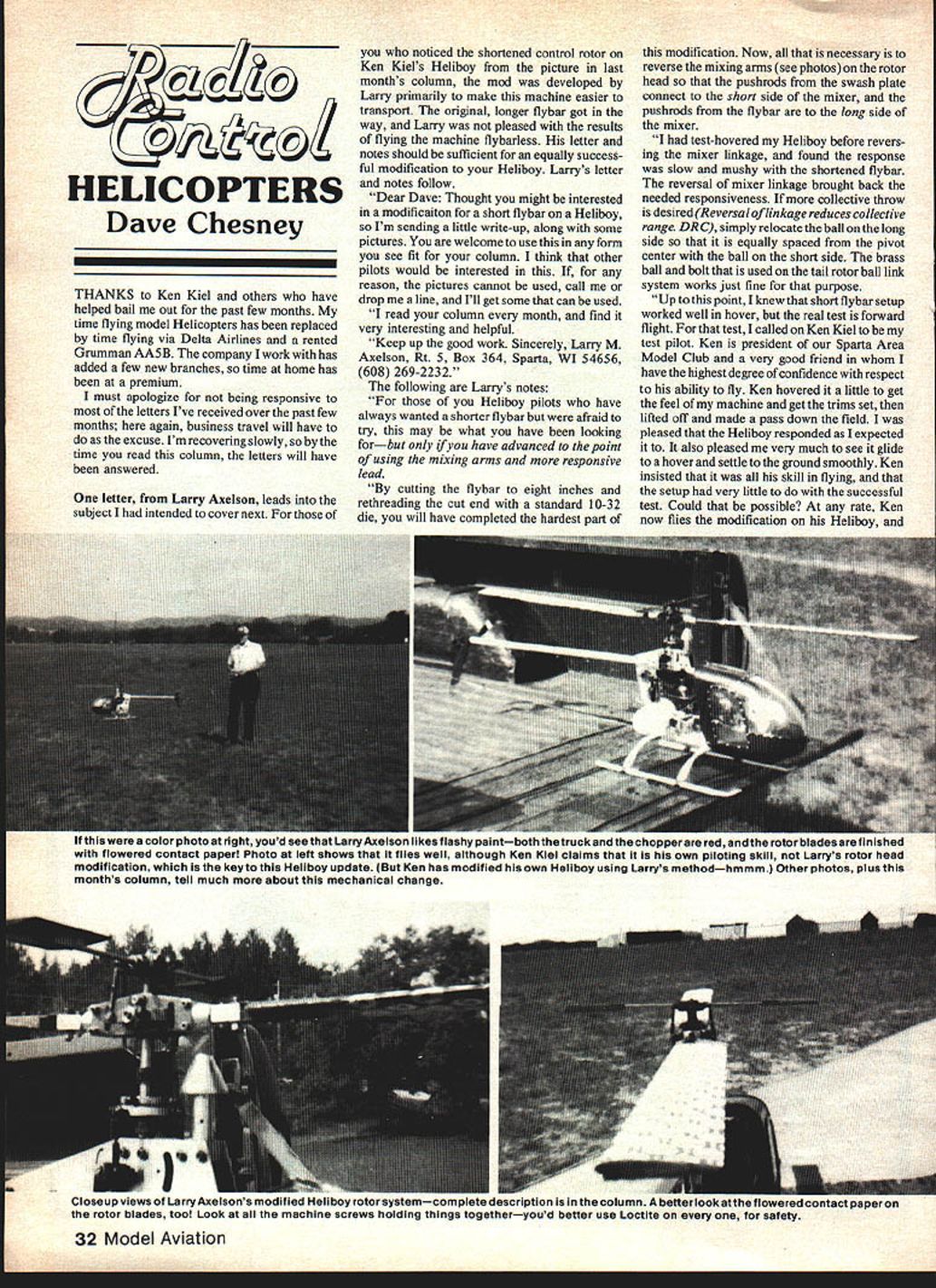
One letter, from Larry Axelson, leads into the subject I had intended to cover next. For those of you who noticed the shortened control rotor on Ken Kiel's Heliboy from the picture in last month's column, the mod was developed by Larry primarily to make this machine easier to transport. The original, longer flybar got in the way, and Larry was not pleased with the results of flying the machine flybarless. His letter and notes should be sufficient for an equally successful modification to your Heliboy. Larry's letter and notes follow.
Letter from Larry Axelson
Dear Dave:
Thought you might be interested in a modification for a short flybar on a Heliboy, so I'm sending a little write-up, along with some pictures. You are welcome to use this in any form you see fit for your column. I think that other pilots would be interested in this. If, for any reason, the pictures cannot be used, call me or drop me a line, and I'll get some that can be used.
I read your column every month, and find it very interesting and helpful.
Keep up the good work.
Sincerely, Larry M. Axelson Rt. 5, Box 364, Sparta, WI 54656 (608) 269-2232
Larry's notes on the short flybar modification
For those of you Heliboy pilots who have always wanted a shorter flybar but were afraid to try, this may be what you have been looking for—but only if you have advanced to the point of using the mixing arms and more responsive lead.
By cutting the flybar to eight inches and rethreading the cut end with a standard 10-32 die, you will have completed the hardest part of this modification. Now, all that is necessary is to reverse the mixing arms on the rotor head so that the pushrods from the swash plate connect to the short side of the mixer, and the pushrods from the flybar connect to the long side of the mixer.
I had test-hovered my Heliboy before reversing the mixer linkage, and found the response was slow and mushy with the shortened flybar. The reversal of mixer linkage brought back the needed responsiveness. If more collective throw is desired (reversal of linkage reduces collective range, D.R.C.), simply relocate the ball on the long side so that it is equally spaced from the pivot center with the ball on the short side. The brass ball and bolt that is used on the tail rotor ball link system works just fine for that purpose.
Up to this point, I knew that the short flybar setup worked well in hover, but the real test is forward flight. For that test, I called on Ken Kiel to be my test pilot. Ken is president of our Sparta Area Model Club and a very good friend in whom I have the highest degree of confidence with respect to his ability to fly. Ken hovered it a little to get the feel of my machine and get the trims set, then lifted off and made a pass down the field. I was pleased that the Heliboy responded as I expected it to. It also pleased me very much to see it glide to a hover and settle to the ground smoothly. Ken insisted that it was all his skill in flying, and that the setup had very little to do with the successful test. Could that be possible? At any rate, Ken now flies the modification on his Heliboy, and has modified his own Heliboy using my method — hmmm. Other photos, plus this month's column, tell much more about this mechanical change.
Bruce Buchanan from Winona, MN, the 1978 Nats Novice Champ and 1979 Nats Third Place Intermediate, also flies the short flybar modification.
Ken, Bruce and I have not noticed any adverse effects from the modification. My objective in the project was to use the very short flybar and yet maintain the original stability and responsiveness of the standard one. That objective, I believe, has been reached.
(s) Larry Axelson
Well, there you have it. Larry had cut the standard 19-inch flybar by 11 inches and yet still maintained a responsive rotor system.
Hiller rotor systems and following rate
I mentioned briefly in the October column that most popular RC helicopters do use the flybar (servo rotor) in their rotor systems. Some models use the Hiller setup, where the servo rotor alone is responsible for transmitting cyclic control to the main rotor blades. Examples include:
- Helibaby and Revolution 40
- Early Schlueter machines
- Du-Bro's Hughes 300 and Shark
- Other similar designs
The fixed-collective-pitch Hiller rotor system is beautifully simple, and offers the beginner a very stable rotor system. In fact, the system might well have been too stable. Some might remember the modifications to increase responsiveness of the rotor system: drilling holes in the paddles to lighten them was one method, and of course, there were the "cans." At any rate, once the beginner could hover comfortably, the next step was to get the helicopter to respond to those new flying skills.
The response time (or following rate) of the Hiller-type rotor is determined by the servo rotor. Most advanced fliers want a faster following rate (FR), while beginners may wish their helicopter's FR reduced. In general, most RC helicopters are designed with an FR well within the capabilities of the beginning pilot, but adjustments can be made. The weight of the paddles will influence the FR, as will paddle area and, as Larry found, the length of the flybar. Rotor speed will also affect the FR and, as mentioned several columns back, the more-or-less constant rotor rpm of the variable-collective rotor is advantageous, since fixed-collective rotors require increases and decreases of rotor speed to vary lift. As the speed of the rotor is reduced, so is the FR. Consequently, a comfortable FR during hover and forward flight might well be too slow during a descent or translation from forward flight with the fixed-collective helicopter.
Before moving on, I believe that most beginners to chopper flying, particularly those who have flown RC airplanes, will be most comfortable flying a helicopter with quick responses. As someone told me a few years back, you might get in trouble faster, but you can get out of trouble faster, too! Of course, each helicopter will respond differently, and each pilot's capabilities will vary; so the best rule may well be to fly it the way it comes out of the box.
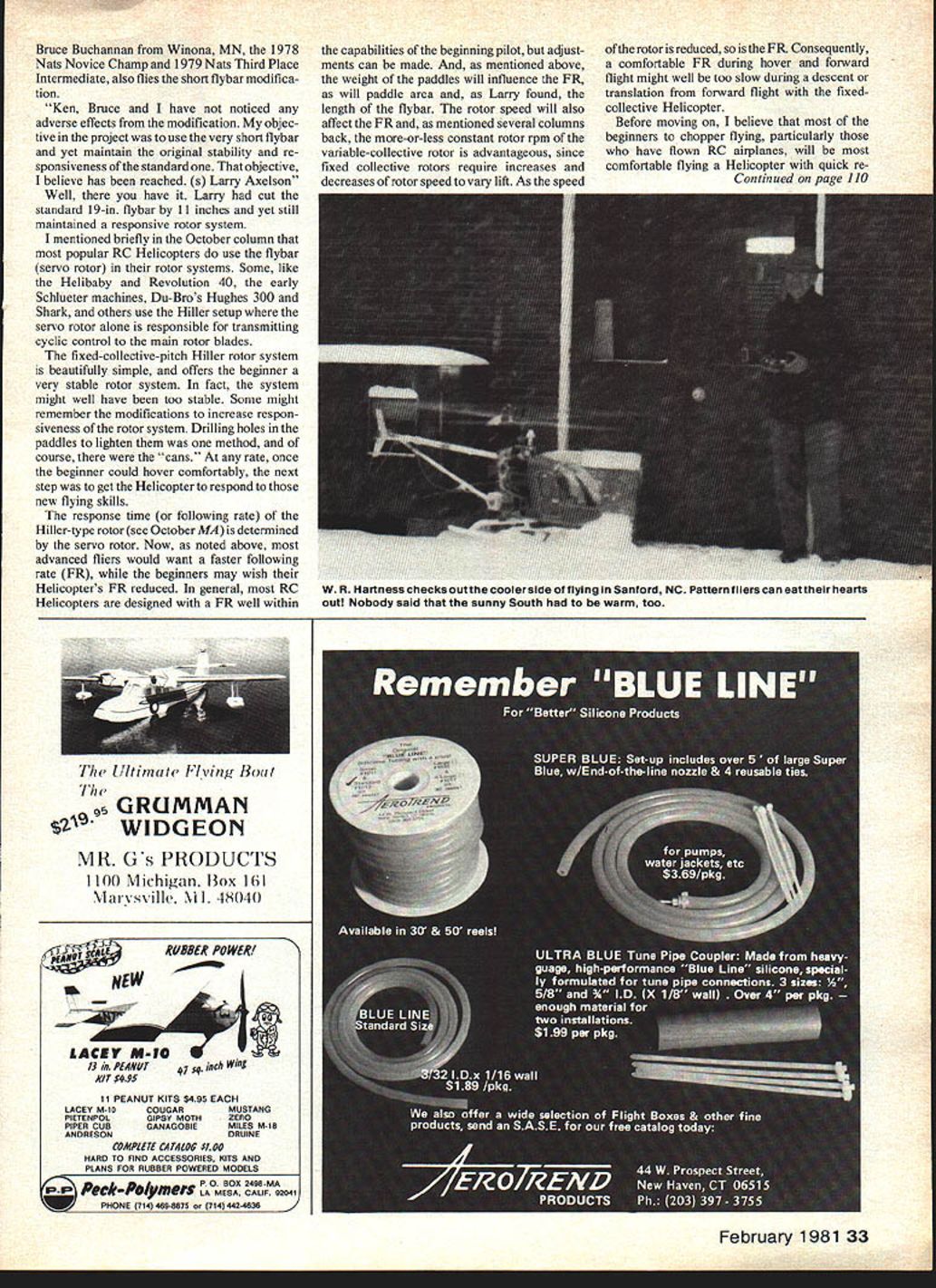
Thought you might enjoy knowing there are a few times when it snows down South. One of the photos shows that mere snow can't stop a dedicated chopper pilot like W. R. Harrness of Sanford, NC. Also, a special tip for winter fliers from Lloyd Wheeler — watch out for rotor blade icing.
See you next month.
Dave Chesney Rt. 9, Box 621A, Greensboro, NC 27409
Transcribed from original scans by AI. Minor OCR errors may remain.

